
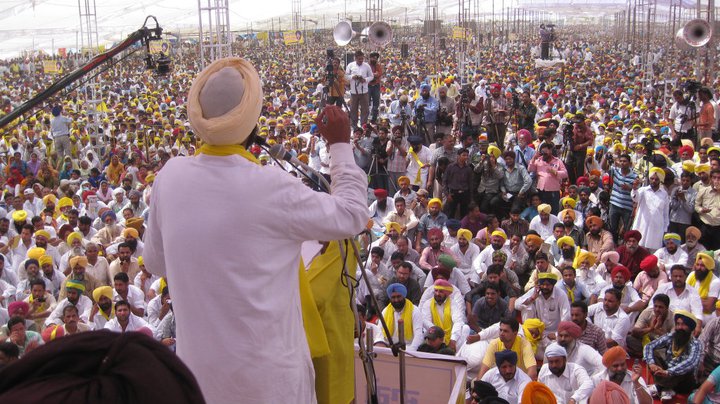
 As we follow news on pro-democracy uprisings across the globe, Panjab has joined this conversation in it’s own way. On Sunday March 27th 2011, Manpreet Badal announced a brand new political party in preparation for February 2012 elections in Punjab. Thousands gathered at Khatkar Kalan village, the village of Shaheed Bhagat Singh, to hear the former Finance Minister of Punjab launch the agenda for The People’s Party of Punjab (PPP), promising a “better, progressive Punjab”. He asked supporters for their backing for the next 11 months as the party’s agenda reaches fruition. The party will be founded on the ideology of the martyrs.
Aspects of the PPP’s agenda include: police reform, stopping the domination by an individual or clan, an assembly to evaluate ministers’ performance, government expenditure to be cut down drastically, only one security officer provided and extensive security to be paid for individually, only necessary foreign trips for leaders, free electricity provision will not be provided to wealthy farmers, revenue will be hiked by checking tax evasion, a desire to restore Punjab’s primacy in agriculture, investments in new industries, an increase in investments that create jobs, promotion of religious tolerance, scholarships provided for excellence in sports, speciality hospitals in each district and zero tolerance for crime and corruption. [via gpunjab news]
In an interview, Manpreet Badal spoke about the need for leaders to be role models and for the government to be transparent and accountable. In addition, he stated that 50% of seats will be reserved for women and youth. For those Panjabis living in Panjab or in the diaspora, who are acutely aware of the issues impacting Punjab’s growth and prosperity, the idea of a new party that is committed to change is a promising thought. What do you think? Will this be the change we have been looking for in Punjab?
For more information, see PPP’s Facebook page. After the jump you can view videos of Manpreet Badal’s announcement.
Guestblogged by Mewa Singh

This past week members of the College Sikhs Collaborative and the Jakara Movement – created the first Alternative Spring Break – explored the issue of immigration by visiting so-called ground zero – the Mexi/Cali border. While the surge of the Tea Party movement has helped bring nativist sentiments to the fore, the Sikh-American response on the issue has been largely muted. In 2006, we saw huge protests calling for a more open immigration policy, led largely by our Chicano/a and Latino/a brothers and sisters. As is too often the case, Sikhs, who are also directly affected by issues of immigration – both documented and undocumented – remain passive bystanders to the national debate. [For those that do not know about the increasing number of Punjabi undocumented workers – including over 1600 that were caught and detained in 2010 alone, see the LA Times article ] Even worse, is some Sikhs even support candidates that have borderline racist views on such issues. While groups such as Sikh Coalition and SALDEF have tacitly supported the cause of immigration cause, it is a shame that we have not been more vocal. Without standing with others (especially on those cases where we have a self-interest!), why should anyone stand with us on the issues we care about?
Day 1 – Orientation Our trip began with an orientation with our partner organization – Border Angels.
Guest blogged by resistsingh
March 23rd, 2011 marked the Anniversary of the Martyrdom of Shaheed Bhagat Singh.
Bhagat Singh is a legend in many circles, a man who gave his life to secure the freedom of India from Colonial Rule. Today, many celebrate his bravery and he has become somewhat of an icon. Unfortunately, like other popular revolutionaries, such as Che Guevera the content of his revolution is lost.
Like the many oppressive systems we face everyday, our identity is consistently a target – a means to keep our community impotent, by robbing us of our history, our motivation and association to revolution and social justice. With that in mind, we should always be aware of the ideologies, the motivations and the history behind those we celebrate. Bhagat Singh is no different.
So today, we share a quote with you all, from the Final Petition of Bhagat Singh before his death, one that eloquently describes his resistance to Imperialist and Capitalist ideology and one that we should hold to our hearts as we celebrate his life. As injustice continues to prevail, the greatest honour to the shaheedi of our ancestors is to understand their struggle, today.
“Let us declare that the state of war does exist and shall exist so long as the Indian toiling masses and the natural resources are being exploited by a handful of parasites. They may be purely British Capitalist or mixed British and Indian or even purely Indian. ” – Bhagat Singh
As a continuation of the conversation initiated by Navdeep’s post “Fatting it Up at the Langar Hall,” I want to share this the trailer for Soul Food Junkies, a film-in-progress directed by African American filmmaker and activist Byron Hurt.

The parallels to the challenges we face in the Punjabi community were striking to me as I watched the trailer. Obesity and diabetes are epidemics in the African American community, just as they are in our community, both in Punjab and the diaspora. And there is no doubt of the central role that diet plays for us all.
This post by our Mehmaan is none other than Harinder Singh. About Harinder Singh – he works with the Sikh Research Institute and the Panjab Digital Library to address all things Sikhi and Panjabi. http://twitter.com/1force
I have taken some time off to be Mr. Mom while my wife is on a work assignment in India. In preparing to make the move to Bangalore, I was excited about being in the land of MS Subbulakhsmi (renowned Carnatic vocalist) and Kalmane (locally grown 100% Arabica beans) coffee. Being here for about three weeks, this is what I have discovered: people are nicer than the North, infrastructure is horrible, and there is not much to see in the city. Even Frommers.com couldn’t come up a list of not-to-be-missed attractions in Bangalore, though people in India claim it to be a great city. I guess the new IT opulence has brought in pubs and gigs only (it is common for Indians to end almost every sentence with ‘only’).
Yesterday, I picked up my son Jodha Singh from the pre-school he is enrolled in here. His teacher said, he wouldn’t play Holi (“Festival of Colors”—though bastardized; some “celebrants” today throw sewerage on people as well!). Now, the legend of Holika is vanishing and so too the spirit of post harvesting thanksgiving prayer to the Almighty. Apparently, Jodha was upset when other children were throwing water and colors on him. I told Miss Priya that his aversion may have come because he has not partaken in this festival as the Sikhs of Panjab have a little reason to celebrate. She wasn’t sure how to respond; do most Panjabis and Sikhs know how to “play Holi?”
Conversations about hair are often emotional for Sikhs – and therefore they are conversations which we tend to avoid. For many Sikhs, it is a constant struggle to explain the historical significance of keeping our hair and/or wearing a turban while other Sikhs will argue that simply keeping your hair or wearing a turban by no means makes you a good Sikh. While that may be true, being able to have conversations about hair is an incredibly important and necessary dialogue for us to participate in. Many Sikhs in the diaspora have struggled to maintain their identity, while Sikhs in Panjab are struggling to be western. It’s such an interesting juxtaposition and anybody who has visited Panjab recently will see the dwindling number of Sikh boys choosing to wear turbans. In an effort to explore this issue, a fascinating documentary film – Roots of Love – by award winning filmmaker Harjant Gill is being released this Spring.
Told through the stories of six different men ranging in age from fourteen to eighty-six, Roots of Love documents the changing significance of hair and the turban among Sikhs in India. We see younger Sikh men abandoning their hair and turban to follow the current fashion trends, while the older generation struggles to retain the visible symbols of their religious identity. The choice of cutting one’s hair is one that not only concerns the individual and his family, but an entire community. [link]
I was given the opportunity to watch the entire documentary – I highly recommend the film and was drawn to its excellent cinematography. You can watch the trailer below and after the jump, read my interview with Director, Harjant Gill. Then, think about how hair plays a significant role in your life, if at all?

 The aftermath of last Friday’s earthquake and tsunami in Japan is nothing short of horrific. I’m sure most of you have seen footage of the devastation on the news and on YouTube. My mind is boggled, my heart is aching, and I am all in all extremely overwhelmed by what is happening.
While I haven’t heard about any specific Sikh responses or relief efforts yet, United Sikhs, which sent a team to Haiti after last year’s huge earthquake, has a Japan earthquake/tsunami page up on their website. If you know of any efforts happening, please post them in the comments section.
While we keep the people of Japan in our thoughts and prayers, there are many ways we can be taking action. Below are a few simple things you can do to provide support. This is not intended to be a comprehensive list, so please add your own suggestions.
 Immigration is a popular topic on The Langar Hall. Many of us being immigrants ourselves, if not the children of immigrants, the topic often hits home. Still anytime the topic of ‘illegal immigration’ takes place (at least here in the United States), many Sikhs believe that it is the problem of Mexicans. Despite the fact that many of us know, have family members, have ourselves come to this country without ‘legal’ documentation, still the problem is that of another.
A recent article in the Los Angeles Times helps explode this myth:
About 650 Indians were arrested in southern Texas in the last three months of 2010 alone. Indians are now the largest group of immigrants other than Latin Americans being caught at the Southwest border…Most of the immigrants say they are from the Punjab or Gujarat states.
I strongly suggest Langa(r)eaders to take a look at the article. Interestingly enough, despite the importance of the issue, few Sikhs really engage with the issue. Most Sikh advocacy organizations in the US (SALDEF, Sikh Coalition, etc.) are sympathetic to the issue, but hardly promote action or dialogue within the community. In fact, the institution that most deals with the issue are our local Gurdwaras.
I am pleased to announce the Sikh youth as taking a strong engagement with the issue. The College Sikh collaborative has teamed up with the Jakara Movement, to create the first all-SSA Alternative Spring Break (ASB). This pilot project will look at the issue of immigration through working with border human rights groups, working with families of day laborers, speaking to law enforcement officials, and visiting numerous sites to engage with the issue. If you are free on the dates – March 23-25, 2011, do register (hey, actually do something during your spring break!). THE DEADLINE FOR REGISTERING HAS BEEN EXTENDED until Sunday, March 20, 2011! I hope to provide a report of the initiative afterwards.
Guest blogged by santokh
A couple days ago I was reading some news articles on Hondh Chillar and Pataudi. Some of these articles include photographs from the two big events that took place at Hondh Chillar–clean up of the destroyed gurdwara building and Akhand Paath that took place thereafter in that building. I was talking to a couple friends about what all of this means for us as Sikhs, as youth with a vested interested in all things Punjab but separated from it by distance, and as a generation that, despite a fascination and infatuation with Punjab and Sikhi, seems disconnected to the memory of 1984 in many ways.
I was born a year after Operation Bluestar, no one from my family or relatives were directly affected by the genocide, my grandparents didn’t live close to New Delhi, Amritsar, or any of the other affected areas–Hondh Chillar and Pataudi, for example. As I was talking with my friends, I realized our awareness of Bluestar comes from websites, media, press releases by advocacy groups, a few books and essays, and the occasional speech at gurdwara or elsewhere almost as an annual ritual in June and November. It’s almost a kind of dynamic I can chart out–come the first week of June and November, emotions run high and my inbox is filled with invites to a number of vigils and memorials.
If I view the memory of Bluestar from the perspective of a generation before mine, everything changes. Many of my friends’ parents and grandparents were directly affected in 1984 as victims and/or witnesses. They have a direct connection to and memory of Bluestar. They know what media channels did and did not report, each of them is a walking memorial in a sense.
If you haven’t heard yet, March 14th, the First of the month of Chet in the Nanakshahi Calendar is being commemorated by Sikhs across six continents as ‘Sikh Vatavaran Diwas,’ or Sikh Environment Day.
Following an official statement from the Akal Takht, this week over 250 Gurdwaras, schools, and Sikh organizations around the world, along with Takht Sri Kesgarh Sahib and Takht Sri Hazur Sahib, will focus kirtan and katha on ‘kudrat’, host tree plantings, clean ups, nagar kirtans, children’s art displays, and Khalsa school lessons on the theme of the environment.
Here’s a video taken of the British Columbia sangat during an entire weekend of successful events organized by the Sikh Green Team, in conjunction with the Guru Nanak Sikh Gurdwara and Sukh Sagar Gurdwara Sahib. Sarya Nu Sri Guru Har Rai Sahib Ji de Gurgaddi Diwas Di Lakh Lakh Vadhaiyan Hove!

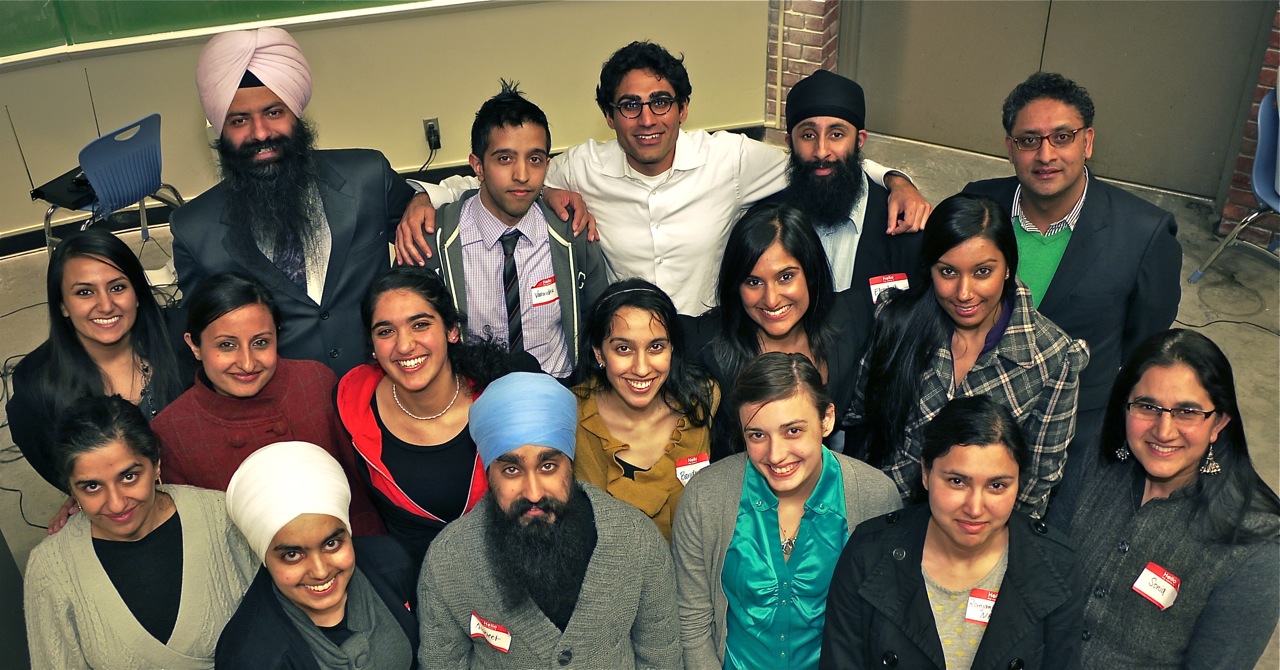
My apologies for a post that is far overdue. So Sikholars 2011 came and went. This year was an even greater success than last year with attendance of over 110+ and a growing number of presenters. This year’s Sikholars 2011 class – Kamal Arora, Amneet Singh Bali, Sonia Dhami, Amandeep Kaur Dhillon, Neelamjit Singh Dhillon, Sandeep Singh Dhillon, Roopan Kaur Gill, Gurbachan Singh Jandu, Tarnjit Kaur Johal, Varinder Singh Johal, Simran Kaur, Sujot Kaur, Tavleen Kaur, Semran Kaur Mann, Ranjanpreet Kaur Nagra, Neilinder Singh Ranu, Sharanjit Kaur Sandhra, and Elizabeth Weigler – was our best yet and we look forward to incoming Sikholars classes.
The event was made possible by the CSU East Bay Ethnic Studies Department, the Sabharwal Sikh and Punjabi Studies Chair, the CSU East Bay Sikh Students Association, the Jakara Movement, and the scores of volunteers.
Below the fold, as promised are uploaded copies of some of the papers (we did not receive permission from all the Sikholars to upload their papers due to ongoing research, publication in academic journals, etc.). These papers will be made available for one month as per our goal of greater democratization of research.
We look forward to Sikholars 2012
By now you’ve probably heard about Wisconsin governor Scott Walker’s attack on working class people and labor unions in Wisconsin. This week, Walker’s bill, which undermines public sector workers’ right to collectively bargain and slashes their benefits, among other things, passed through the state Senate, without a single Democratic Senator present for the vote, and the Assembly, in the face of three weeks of massive protests, the largest demonstrations in Wisconsin since the Vietnam War.
The Washington Post reports:
Wisconsin Gov. Scott Walker won his drive to strip the state’s government workers of nearly all of their collective-bargaining rights Thursday, after a three-week standoff that brought tens of thousands of protesters to the Capitol.
The new legislation represents a major setback for organized labor, but the political battle over public employees and their rights to bargain is likely to continue – not only in Madison.
The state Assembly passed Walker’s proposal a day after Republican senators outmaneuvered the 14 Democratic senators who had fled Wisconsin to deny a quorum needed for passing a budget measure. By stripping the bill of its spending language, they were able to pass it with only Republicans present.

 An exhibition showcasing British Bhangra music and Culture, titled ‘Soho Road to the Punjab’, will be crossing the pond from the UK to New York City on March 18th 2011 at 6pm. The USA version of the exhibition, Soho Road – Five Rivers to Five Boroughs, will be the world’s first visual arts exhibition inspired by Bhangra music and culture held outside of the UK. The event is being hosted by 92YTribeca and is free to the public.
Originally debuting in Birmingham, UK, Soho Road to the Punjab is an exhibition that includes photography, album sleeves, promotional art and rare prints from South Asian media. This contemporary archive uncovers the worldwide Bhangra phenomenon, showcasing individuals who have championed the UK and USA Bhangra scene.
“Soho Road – from the Five Rivers to the Five Boroughs” is a gift of a title. The Punjab is, of course, the Land of the Five Rivers, while New York iconically comprises Brooklyn, Queens, Manhattan, Staten Island and the Bronx. This is a symmetry just too much too leave alone – it’s a sign! Queens is the largest and the most diverse, and famous as the birthplace of bebop and jazz. Queens also has the largest Sikh population outside California and the highest concentration of Indians anywhere in America. Punjabi is in the top ten of the hundred-odd languages spoken locally, and almost half of all South Asians who live in New York live in Queens. The NY experience will shape the show for the USA. [link]
The event will be held at 92YTribeca, 200 Hudson Street, New York. For more information and to view the exhibition online, see the Facebook page.
Guest blogged by Preserve Architectural Heritage
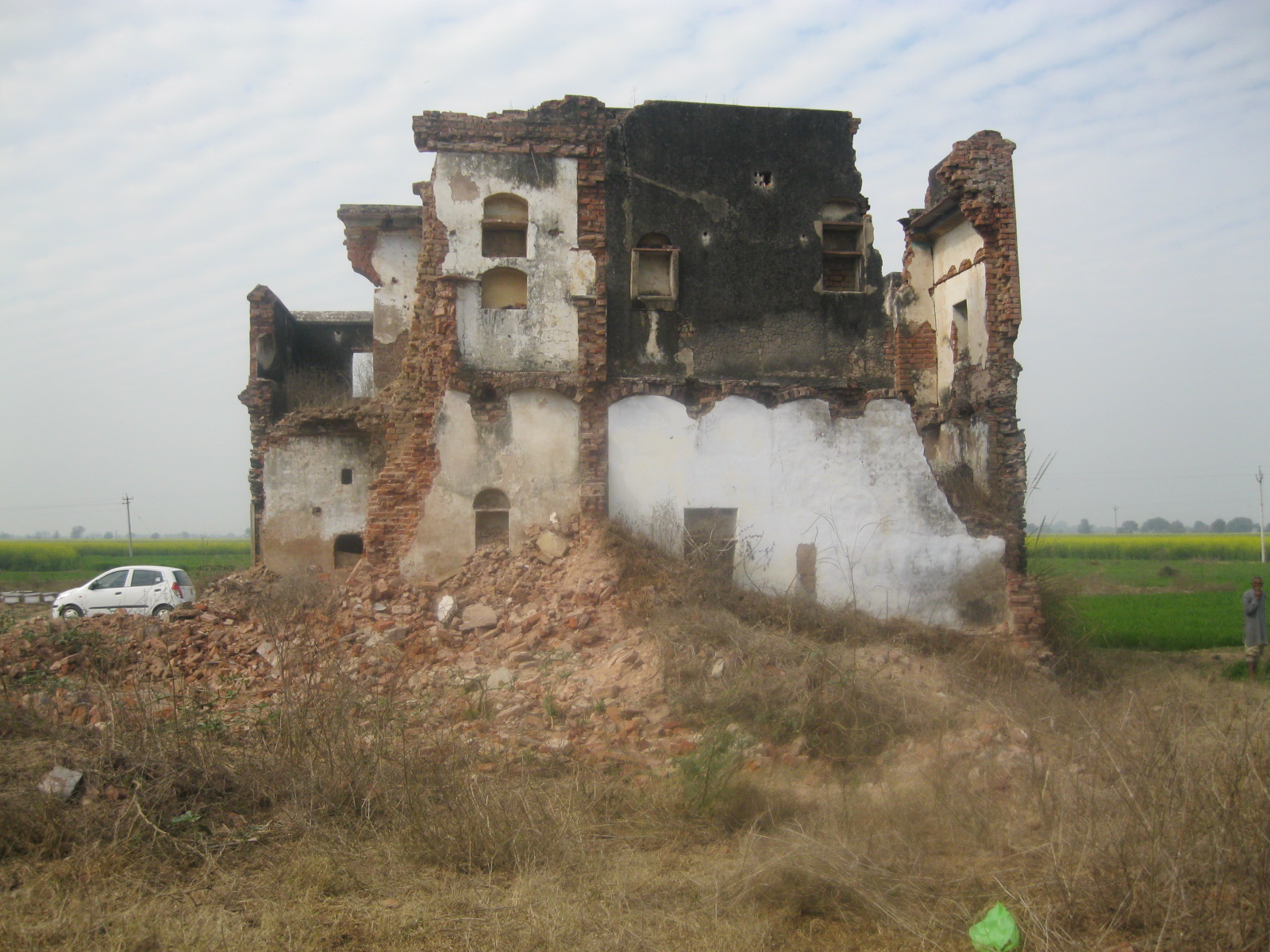 What: discovery of two sites linked to 1984: (1) Hondh Chillar, discovered January 2011. (2) Pataudi, discovered Februrary 2011. Both are in Haryana. Excerpts from Press Releases from Sikhs for Justice reveal that 32 men, women, and children were brutally tortured and killed in Hondh Chillar and 17 in Pataudi.
Why is this discovery important: So far all the investigation into the violence of 1984 has been done via interviews, eyewitness accounts, judicial commissions, and lawsuits. For the first time, we have living evidence of the genocide: the buildings speak for themselves. Though there are thousands of names on the ever-growing list of those killed in 1984, many of us have very little connection to those names since we don’t personally know the families. Even if some of us know or are related to survivors of the violence, it’s difficult and painful to have those individuals recollect and narrate their memories and experience.
Those of us with no familial connection to Operation Bluestar, those of us who were too young to remember, or were not born when this genocide tookplace now have a physical, tangible, alive, and direct relationship to this significant period of Sikh history through these sites. Since memory of any tragic event is intrinsically linked to physical location[s], it is absolutely crucial that we realize the value of Hondh Chillar and Pataudi as sites that provide us with a direct link to the memory of 1984. They are living sites, open for everyone to access and connect with. They are silent victims, that, just like the human victims of 1984, represent a crucial moment from the recent Sikh past.
Today, March 8th, is the 100th annual International Women’s Day!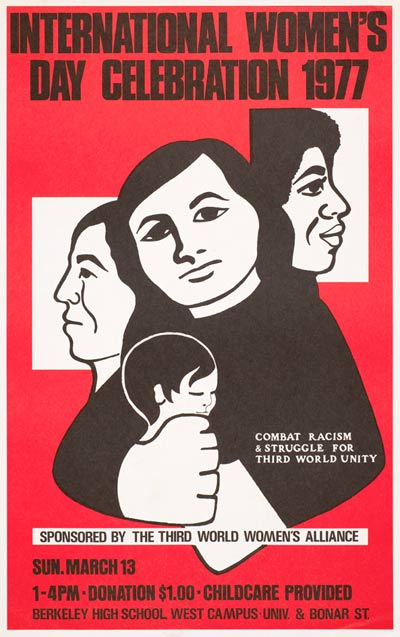 This year’s theme is “Equal access to education, training and science and technology: Pathway to decent work for women.” The first International Women’s Day was celebrated in 1911 in Austria, Denmark, Germany, and Switzerland, and is the brainchild of Clara Zetkin, a leader in the Social Democratic party in Germany, who fought for a space where women could press for their demands. This day is a celebration of the ability for women and men use our voices to advance gender equality, and the need.
Gender equality has been central to Sikh social, economic, and political life since the time of the Sikh Gurus. Bebe Nanaki was the first Sikh in history to recognize Nanak as her Guru. Under Guru Amar Das Ji women were central to Sikh administrative manji system. The women of Meer Mannus prison endured extreme forms of torture and watched their children slain before their eyes but stood strong against the corrupt and brute governor of Lahore and his compatriot Kaura Mal. Fearless women warriors like Mai Bhag Kaur, Bibi Baghel Kaur, Bibi Daler Kaur stood on the frontlines of the Khalsa fauj to defend the marginalized and oppressed against authoritarian rule. Today we stand with brave Sikh women of the past and present, Mata Khivi Ji, Bibi Amrao Ji, Bibi Bhani Ji, Mata Gujri Ji, Mata Sahib Kaur, and Bibi Harnam Kaur, whose contributions to Sikhism must not fall into the shadows of Sikh religious, social, and political life as it would go against our own doctrine and values.
Please take minute on watch the clip below by three brave Sikh sisters of today willing to uphold the vision of Nanak with strength and courage. Let’s use this day to reflect on what we can do to move this community to the front lines of the Sikh vision for gender equality. #IWD in solidarity.

The Sacramento Bee is reporting that two elderly Sikh men were shot while going on an afternoon walk in their suburban neighborhood on Friday. One of the men, 67-year-old Surinder Singh died from the attack on Friday, and 78-year-old Gurmej Atwal is in critical condition, suffering from two gunshot wounds in his chest. The Bee article states:
Relatives and friends in the tightknit Sikh community to which the two men belong were not as hesitant to call the shooting a hate crime.
Singh and Atwal, like many Sikh men, had thick beards and wore turbans – traditions that have made Sikhs the target of bigotry and violent attacks since the Sept. 11, 2001, terrorist attacks.
“The turban is a big problem for us,” said Gurjatinder Singh Randhawa, chief editor of the Sikh newspaper Punjab Mail USA. “We look the same as Afghan Taliban – but we are not Taliban.”
Randhawa recalled the beating of a Sikh cab driver four months ago in West Sacramento.
The driver told authorities that two passengers had uttered anti-Islamic slurs as they attacked him and then beat a female passenger who tried to stop them. Police have since arrested two men on charges of felony assault with a deadly weapon and commission of a hate crime in connection with the attack.
 The Sikh American Legal Defense and Education Fund (SALDEF) has announced the Congressional Internship Program (CIP) as part oftheir new initiative called SikhLEAD. The objective of SikhLEAD is to inspire, train, and support motivated and enterprising young Sikh American leaders as they prepare for a lifetime of community engagement and community leadership. The CIP is the first effort under this new and dynamic initiative.
SALDEF’s CIP partners with congressional offices to place Sikh American college students in internship positions on Capitol Hill with members of Congress. Through this program, students will be afforded first-hand perspective into the functioning of the federal government, as a way of providing experience-based training to individuals interested in civic engagement and government affairs.
Through the experience of interning in a congressional office, interns will:
- • explore a potential career track
- • create a network of professional and personal contacts
- • develop real-world skills
- • build confidence and professional work habits
The application deadline for summer 2011 internships is March 27th, 2011!
Visit www.sikhlead.org for more details and to apply. Spread the word and tell your friends about this exciting opportunity.
Last month our friends over at Sepia Mutiny posted an interview with Montreal-based hip hop producer Sikh Knowledge, which I think many TLH readers will find of interest. Sikh Knowledge aka Kanwar Anit Singh Saini has worked with many favorite Sikh hip hop artists including Humble the Poet, Mandeep Sethi, and Hoodini and breaks stereotypes right and left as he carves out his own path.
[W]hat really made an impression on me was Sikh Knowledge’s confidence in pursuing his life. At the age of 20, he decided to stop being what other people wanted him to be, dropped out of engineering school and re-started honestly. “I dropped out, came out, and rearranged my whole life,” he stated. “I reapplied and did my undergraduate degree in music with a minor in linguistics. It was the happiest time of my life. I felt good about the decisions that I made.” He’s currently pursuing his Master degree in speech language pathology while having the dual career of mixing some of the ill-est beats in North America.
You read right, Sikh Knowledge is an out and gay hip hop tattooed turban wearing artist. “I’ve definitely lost friends along the way,” he said. “Working relationships have gone sour. But at the end of the day, those artists that choose to work with me… not because of how I can brag, but because of what I do. They’re working with an underdog. That just proves to me that I’ve got something to offer.”
“As an out hip hop, dancehall artist,” he continued. “…people hear the music first and then they reach out to me and we make tracks. Subsequent to that if they find out if I’m gay, my philosophy is that’s their problem. It’s not something I wear on my sleeve but I don’t hide it either.”

The massive pro-democracy uprisings in North Africa and the Middle East have gained tremendous momentum since the successful ouster of Egyptian president Hosni Mubarak two weeks ago. My thoughts and prayers are with the people of Libya this week, as their calls for the end of Moammar Gaddafi’s 42-year reign have been met with brutal repression. Gaddafi’s forces (including mercenary soldiers) have killed an estimated 640 to 1,000 protesters so far in just one week. The world is watching as the people of Libya sacrifice their lives for freedom and self-determination. May Waheguru bless them in their righteous struggle against tyranny.
Check out the below report from ABC News, but note that the message at the end about US-Libya relations is highly misleading. Though the US government has a complicated history with Gaddafi, he has been a strategic ally of the US in the region for over a decade. Until Obama’s statement on Libya just yesterday (after almost a week of brutal repression), the US has turned a blind eye to any human rights concerns in Libya. While his statement strongly condemned Gaddafi’s use of violence against the protesters, Obama stopped short of calling on Gaddafi to step down.

Like many Sikhs, I grew up eating meat. It was something I never really questioned until I was in college and started learning more about the treatment of animals on factory farms and the environmental impact of the meat industry.
But growing up I never thought about where my spicy deep-fried chicken strips were coming from. Or the living (and dying) conditions of the cow that made up the thinly sliced pieces of meat in my Arby’s roast beef sandwich. As long is it wasn’t halal, it was all good.
I never understood what halal truly meant, but the message I got from my parents and others in the community went something like this: Halal is the way Muslims slaughter animals, and it involves killing the animal slowly and painfully. And lots of gushing blood. We Sikhs don’t believe in torturing animals, so we don’t eat halal meat. Sound like a familiar story line?
This, of course, contributed to my perception of Muslims as barbaric people who were dirty, had multiple wives and questionable morals, and killed my ancestors during partition. In the context of the messages I received from family and community growing up, the story about halal fit right in – yet another way Muslims are backwards.
As is abundantly clear in my writing on this blog, this is in stark contrast to how I see Islam and the Muslim community at this point in my life. But I grew up with these messages and stereotypes just like most of my Sikh peers did.
Really, what’s all the fuss about halal? Why aren’t Sikhs supposed to eat halal meat?

