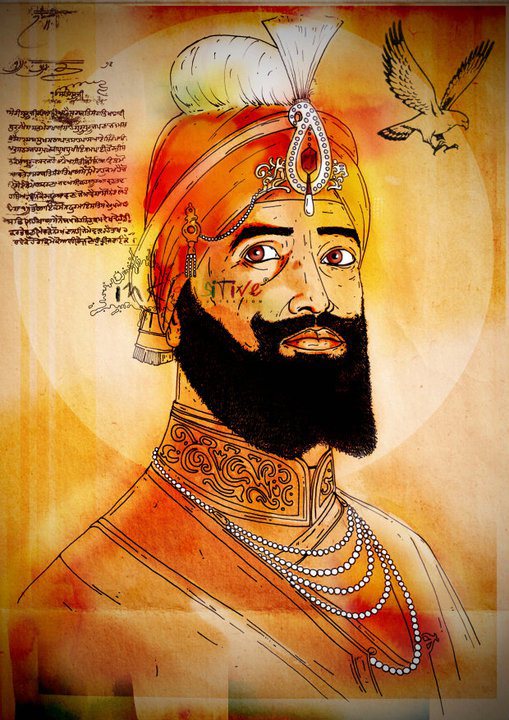
Image from Inkquisitive Illustration
 This season, Americans are spending $465 billion, according to the National Retail Federation and a substantial portion of that is on gifts. Luckily, the final days of the year are a chance to give in a different kind of way and by doing so, gain a benefit – namely, contributions made to a charitable organization by December 31st count as a deduction on your 2011 tax return.
In Sikhi, there is the tradition of dasvandh – or giving a tenth of your seva, time or profits. The concept of dasvandh was implicit in Guru Nanak’s own Gurbani in the line: One who works for what he eats, and gives some of what he has – O Nanak, he knows the Path (SGGS p 1245).
While it’s not clear how much the Sikh community actually participates in this tradition (perhaps we just don’t discuss it publicly), it’s nevertheless clear that giving is an integral element of our faith. According to the Stanford Center on Philanthropy and Civil Society, the fact that 35 percent of all American giving went to religious organizations in 2010 reflects how closely bound many of us are with our place of worship. In 2011, the United States now ranks the highest in terms of charity in a massive global survey that put the nation in fifth place just last year. According to those surveyed, two out of three Americans said they donated money to charity (65 percent), more than two out of five volunteered their time (43 percent) and roughly three out of four helped a stranger (73 percent). Finally, according to a new study by the Center on Philanthropy at Indiana University in nearly 90 percent of certain households, women are either the sole decision maker or an equal partner in decisions about charitable giving.
Gendercide is a well-known problem in India. The BBC and ABC 20/20 have highlighted this issue. The low sex-ratio in Punjab, India shows how the soil, which gave birth to Sikhi is not devoid of this problem. The land on which our Gurus proclaimed the equality of women when others considered her impure has now become the dumping ground for unwanted baby girls. Their pure bodies are thrown onto piles of garbage for dogs to nibble away. Dead fetuses are stuffed into water wells.
A seminal research study conducted by Monica Das Gupta on selective discrimination against female children in Punjab states that Punjabi Sikh women are highly educated and well-treated in Punjab compared to other states. The harsh reality is that a rise in “status” has not changed the value of women. Women can be loved and cared for, but still under valued. They can be highly educated and treated well, but families want one of these daughters not two. But two sons would be okay. The value of daughters and sons is displayed when couples develop family-building strategies. How many children to have? If we have one daughter or two, will we be content with another daughter? Should we have only one son? Studies show that common answers to these questions are strongly rooted in a distorted value system, which reinforces the secondary status of women and allows for structures to be created to perpetuate this inequity. Thus, value systems and structures produce a circular cycle of mutually reinforcing each other.
The Sikh Gurus gifted us a value system that does not permit this secondary status of women. However, many have chosen not to implement it in their lives. It has even seeped its way into how Sikhi is practiced. Women are not allowed to do all kinds of seva at the Harmandar Sahib and our granthis/ragis’ kathaa most often highlight how a Sikh woman went to the Guru to request only a son.
If Sikhi is a key element to any solution for gendercide within the Punjabi Sikh community, wouldn’t kathaa/sikhyaa in the Gurdwara be the most logical place to start? We do enter the house of our Guru to understand and reinforce our Sikh value system.
The legal banning of the burqa and niqab has once again been in the headlines this last week, b ut this time beyond Europe, in Canada (or as Tanmit from G.N.E. called it last week at Lahir, “America’s pagh”).
Minister of Citizenship, Immigration, and Multiculturalism Jason Kenney, known for his conservative and anti-immigrant policies, announced that new Canadian citizens will now be forced to remove the burqa or niqab while taking their oath of citizenship.
According to the Associated Press,
Jason Kenney said most Canadians have misgivings about Islamic face coverings and said new Canadians should take the oath in view of their fellow citizens…
The Conservative minister called the issue a matter of deep principle that goes to the heart of Canada’s identity and the country’s values of openness and equality. He said women who feel obliged to have their faces covered in public often come from a cultural milieu that treats women as property rather than equal human beings.
 For many of us school is out and the holidays are upon us. Throughout the season, many Sikhs throughout the world engage in seva to support members of the community in which they live. We expect this year to be no different.
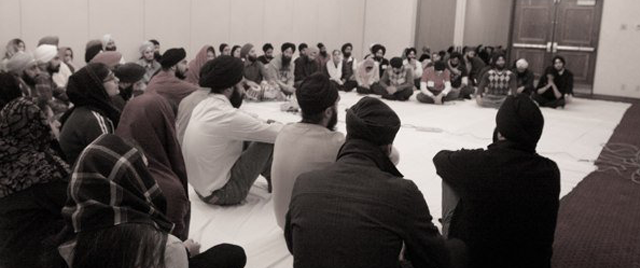
We hope that commenters will use this section to highlight events or drives that may be occurring in their local communities. Here is one such effort by the youth of the Fresno Jakara Movement group.
Part of something larger and hoping to set an example for other communities, the Sikh youth of Fresno are coming together to organize their annual Sikhi, Seva, Cinema event. More information can be found on their facebook page. They are hosting fundraisers for items that will be distributed to those that are currently houseless in the city. The event is completely youth driven and they are calling for other Sikhs to be generous with their time on December 17 or generous with their money to assist others. The national press has highlighted the preponderance of poor in rural central California. We hope other Sikhs become active in their communities, just as these youth are doing.
 Guest blogged by Mewa Singh.
Earlier this year, I wrote an in-depth post, summarizing the workshops and questions raised at the Jakara Movement’s annual Lalkaar conference. I was hardly alone. Our sisters at Kaurista shared their thoughts, as did a number of individual participants.
So now is something big and exciting. For years a criticism of the Jakara Movement was that it was California-centric. Recently an exciting collaboration opportunity availed itself. Sevadars of the annual Surat Sikh Conference were seeking fresh blood and ideas. The Jakara Movement was seeking an opportunity to begin unveiling its numerous local projects in more venues. Synergies were found and Surat-Lalkaar 2012 was born.
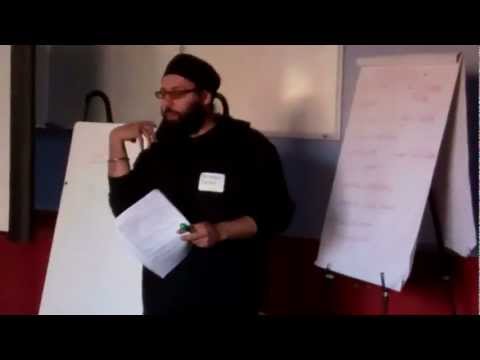
As promised, here is my follow-up to Monday’s post about the Inquilab hip hop workshop in New York.
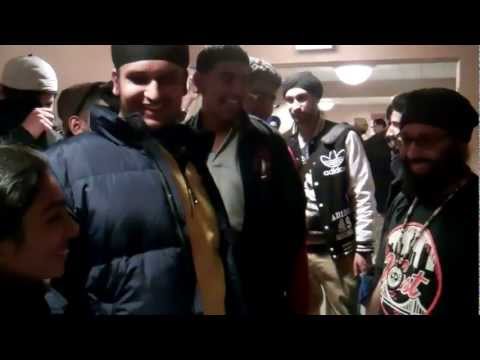
This past Saturday night brought together hundreds of Sikhs (and others) for the fourth annual Lahir: Move the Movement. I always seemed to have a conflict the last several years, but finally made it out to New Brunswick, New Jersey this year for my first Lahir. I am grateful for it.
Again, I’ll keep my words short as the video below speaks for itself. But a couple of things that were especially noteworthy to me about the experience.
The audience was really multi-generational. It was much more like a typical gurdwara sangat than I had expected, crying babies, hyper adolescents, and plenty of elders included. The energy was positive and empowering, and the high school and college-aged youth, in particular, were fired up.
The performances were extremely diverse and full of raw talent and passion. As you’ll see below, the performances (only a few of which I captured) went far beyond the spoken word and hip hop that I was expecting.
A friend of mine leaned towards me while a pre-pubescent high school student with a patka was rapping passionately about post-9/11 racism and said, “I am so excited about this new generation.” Indeed, I share her sentiment. These young people are indeed moving the movement, and in doing so, in the words of the event’s organizers, perhaps they are also “bringing Sikhi back.”
Guest blogged by Ranjanpreet Nagra and Jaskiran K. Mann
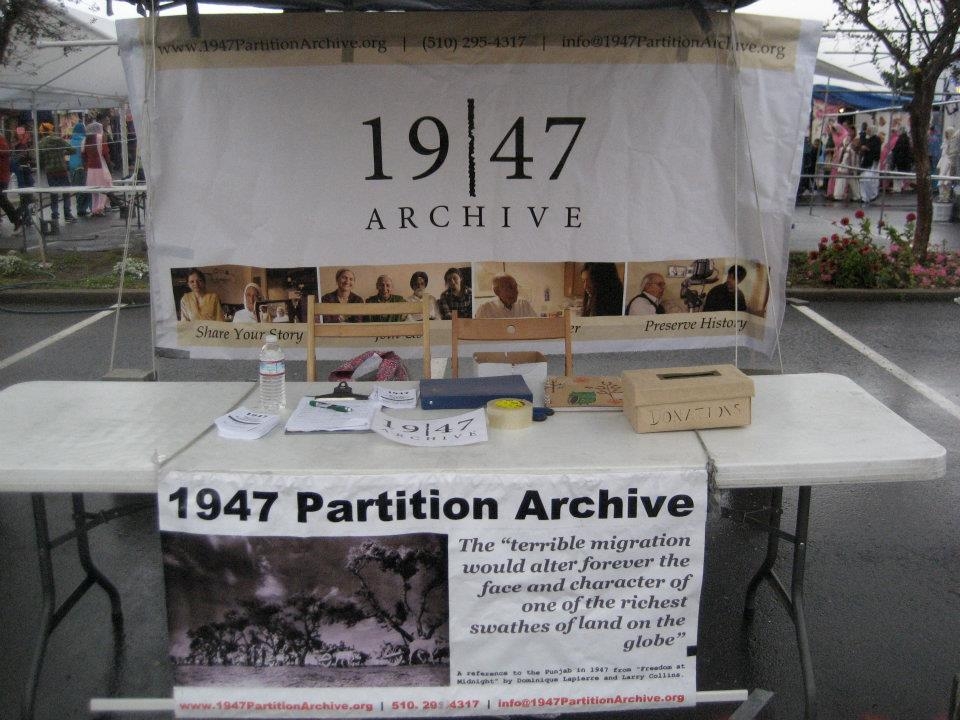 In February 2011, six months after finishing my Master’s in South Asian Studies from University of Michigan, I moved to Berkeley and was still looking for a job and a place to live when I met the founding members of The 1947 Partition Archive, an entirely volunteer-based effort aimed at collecting and preserving the stories of the 1947 Partition of British India. I expressed my interest in conducting interviews as well as helping out however I could, since I was fluent in both Punjabi and Urdu. I also had experience conducting interviews in college and for my Master’s thesis. Since that first meeting, I have loved every aspect of my volunteer work with the Archive.
I’ve had the good fortune to interview people in English, Urdu and Punjabi, and to travel to places throughout California, as well as Toronto, Canada. Presently, I am traveling through East Punjab, conducting interviews. I’ve heard some amazing stories of adversity, fear, violence, and strength.
My first outreach work was that following March, tabling at Hayward Gurdwara on a cold and cloudy day. I enjoyed talking to people and telling them about the project. That was the first time I had to explain – in Punjabi – what we do and its purpose. I had some difficulty translating at first, but since then I have had many opportunities to explain, and become more comfortable doing so as a result.
As Sundari blogged about a few days ago, we just had an exciting weekend of Sikh youth art and activism in the NY/NJ area. I was lucky enough to sit in on the Sikh Coalition’s “Inquilab: Raising Our Voices” hip hop workshop for a few hours on Saturday and then ride the bus to New Jersey with the youth to attend Lahir 2011: Move the Movement.
I managed to get some video footage of both events, so I will keep my own words to a minimum. Today I am posting a brief montage from the Inquilab workshop, and on Wednesday I’ll post some highlights from Lahir.
I walked into the workshop on Saturday in the basement of South Asian Youth Action in Elmhurst, Queens while the group was in the midst of a writing activity. Many of the young people of diverse backgrounds (mostly South Asian and many Sikh) ended up putting their newly honed writing skills to the stage — a pretty large stage — at Lahir that night. Their pieces were honest, real, accessible and courageous. I was truly inspired. And found myself wondering what my teenage years would have been like had something like this (both the workshop at Lahir) had existed.
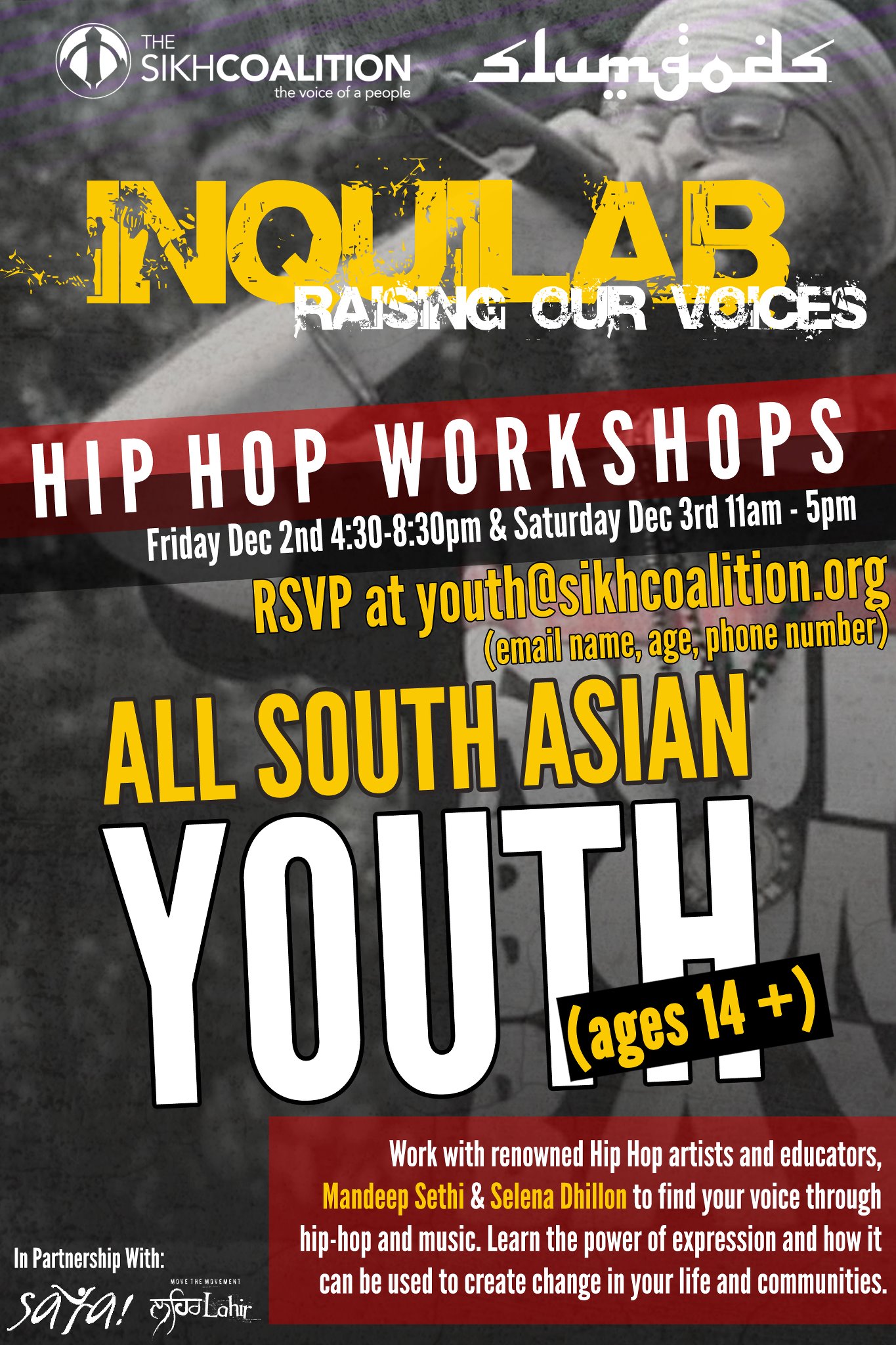 On December 2nd and 3rd, Sikh youth will have the opportunity to participate in a special workshop that will allow them to learn the power of expression and how it can be used to create change in their life and communities. Inquilab: Raising our Voices, organized by The Sikh Coalition and Slumgods, will bring together hip-hop artists, Mandeep Sethi and Selena Dhillon, to work with South Asian youth as a way of encouraging their engagement with expression. Through this participation, youth can learn how to effectively use art to inspire positive change within their own communities.
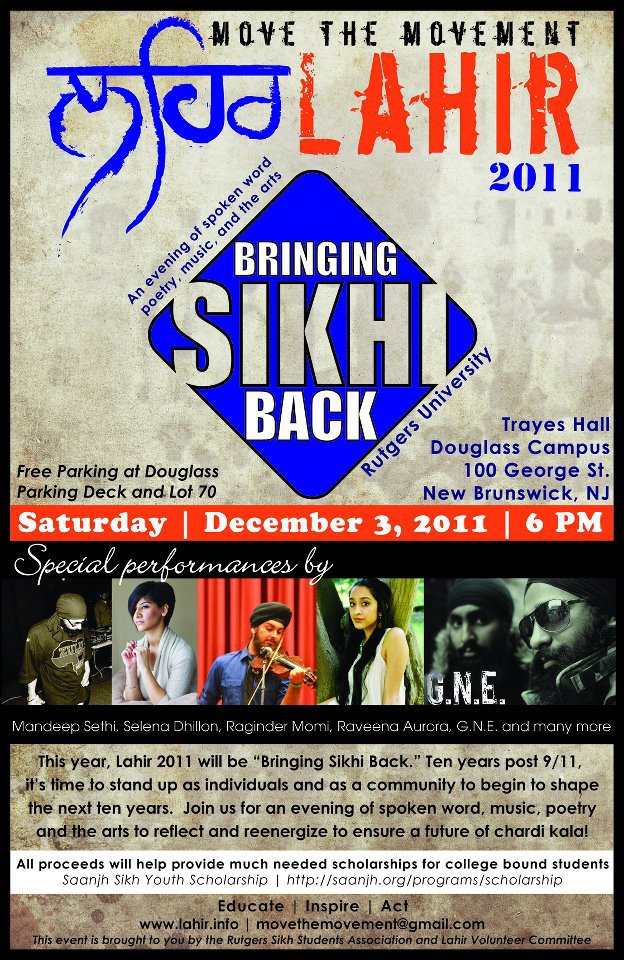 Following the workshop this weekend is Lahir – an event that aims to inspire, educate and awaken the community to rebuild the panth and encourage youth to become activists. The concert will provide a much-needed platform for powerful Sikh artists to express themselves through music, art, film, and poetry. Some more information from the organizers:
In past years, Lahir’s central theme focused on 1984 and Punjab. This year, Lahir 2011 will be “Bringing Sikhi Back”. Ten years post 9/11, it’s time to stand up as individuals and as a community to begin to shape the next ten years. Join us for an evening of spoken work, music, poetry and the arts to reflect and reenergize to ensure a future of chardi kala! This year, all proceeds will go to the Saanjh Sikh Youth Scholarship. We need strong voices in our community and we need diverse voices to help us educate others and ourselves about the historical, political, social, and economic issues that affect our community. Therefore, this event is not just for us, but for our future.
Inquilab will take place on December 2nd and 3rd 2011 at South Asian Youth Action Inc | 5405 Seabury St, Elmhurst, NY.
Lahir will take place on December 3rd 2011 at Rutgers University
We encourage you to learn more about these events, and if you are in the area – please attend and let us know how it goes!

Tears and Ashes, an event to remember 1984, is happening this evening in Toronto, Canada. The event will be a night of reflection remembering victims and survivors. It would be great to see this event organized simultaneously in cities across the globe as a way for our community to come together and remember 1984 and the events that followed. The Sikh Activist Network is organizing the event and have made arrangements for transportation from neighboring cities. See the event page for more details.
This week, The Human Rights Law Network (HRLN) and the World Sikh Organization of Canada (WSO) announced the inauguration of the “Khalra Centre for Human Rights Defenders” in New Delhi, in honor of Jaswant Singh Khalra. The announcement was made during The National Consultation on Human Rights Defenders conference, which brought together human rights activists from across the country. The Center has been established to serve as a legal resource for human rights defenders who find themselves in danger or who are attacked. The center will also undertake research into human rights issues.
The inaugural address of the conference was delivered by Paramjeet Kaur Khalra, widow of S. Khalra. Mrs. Khalra spoke about her husband’s work and the way in which the human rights abuses that took place in Punjab have not been addressed by successive state and federal governments. WSO’s legal counsel Balpreet Singh addressed the gathering and expressed solidarity with Indian human rights defenders. He said that because the abuses which took place in Punjab such as torture and disappearances were not addressed, the same pattern has perpetuated itself in other areas such as Kashmir and Nagaland and impunity has become systemic there. [link]

This video from the popular South Indian television show Adhurs Ultimate Talent Show has gone viral in the last couple of days. In it, the so-called Warriors of Goja, a group of Sikh men “performing” with a giant Khanda as their backdrop and upbeat bhangra music as their soundtrack, win a cash prize of 300,000 rupees for their efforts.
There is much to say about this video, how it reflects upon our community, and how it fits nicely into the Indian media’s representation of Sikhs. Others have written about Sikhs and Bollywood, and I am not going to do a thorough analysis or history here. But what is painfully clear to me is that this “performance” of chest-beating (literally), hypermasculine Sardars acting like a bunch of baffoons as they pound themselves into bloodiness is simply a more blatant, egregious version of how Indian popular culture has represented Sikhs for as long as most of us can remember.
What does the viewer take away from this video? What does the average Indian (and non-Indian now that the video is going viral) learn about Sikhs as they see this group of men, proudly wearing their turbans and very deliberately representing their Sikh identity through their performance, smash each other with sledge hammers and run over each other with cars and motorcycles? Is this the kind of Sikh bravery and courage we want to show the world? Is this Guru Gobind Singh’s legacy? Or is this a bunch of clowns trying to make a quick buck and get their five minutes of fame by perpetuating stereotypes about Sikhs being violent and blood-thirsty on the one hand, and idiotic buffoons on the other.
Stereotypes sell, don’t they?
Seems to be a rather slow week for me and the fellow langa(w)riters. Maybe we’re at #occupywallstreet, or preparing for Fauja Singh’s appearance at SikhLens this weekend in Los Angeles, or who knows what else we’re doing. Still one thing we all made sure to do is vote for United Sikhs in the Chase Community Giving. As of my posting, they are currently #2. Can’t help but think that the competition has gotten considerably less over the last few years as the money has increased. Other Sikh orgs (read: ENSAAF), where you at!!
Regardless, vote NOW. You have to “like” Chase Community Giving. Many of you probably already have done it from the Jakara Movement’s win back in 2009. So now just go back and keep on voting. Let’s help push United Sikhs to the win. VOTE NOW! The competition ends on November 22, 2011. Let’s push United Sikhs to first place!

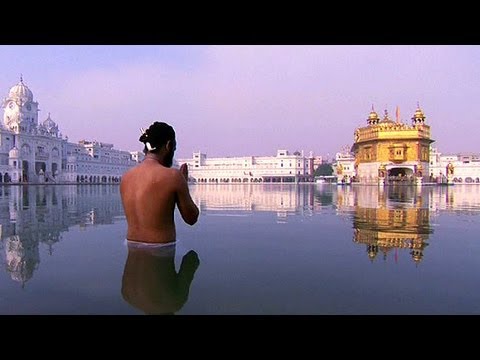
This video, part of a longer version produced for the Discovery Channel, invites viewers inside the Darbar Sahib in Amritsar [via Gurumustuk Singh]. It’s a rare opportunity to see some remarkable moments inside the complex and apparently this is the first time it has been televised. I believe it was recently shown in India and will be shown worldwide soon.
Some thoughts after the jump…
From all of us here at The Langar Hall, wishing you a very happy and inspired Gurpurab.
It’s that time of year again!
For those Southern California natives, you (hopefully) know it rolls around once every year. This year, SikhLens is proud to announce its annual Sikh Arts and Film Festival to be held November 18th – 20th, 2011 at the prestigious Dodge College of Film and Media Arts at Chapman University in Orange, California. As avid supporters of Sikh Arts, and creativity in general, I am hoping our readers would be especially interested in this event coming up in the next couple of weeks.

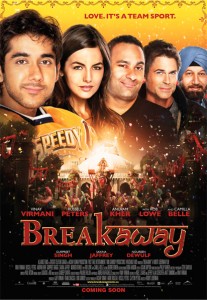 The Sikh Arts and Film Festival serves as a central venue for artists to showcase and share Sikh heritage and culturethrough the mediums of film, literature, art, music, social media and fashion. As an often-misidentified minority, this type of forum has proven to be essential for Sikhs to transcend cultural boundaries, generate awareness, and connect with the broader community.
For tickets, scheduling and more information, visit www.sikhlens.com.
In October I wrote a piece about Sikhs and the Occupy Wall Street movement, stating, “I haven’t seen one other person who was easily identifiable as a Sikh. I’m sure other Sikhs have come through at different times, but to be sure, this is no significant Sikh presence.” I am glad to report that this has most definitely changed. I see Singhs and Kaurs at Zuccotti Park aka Liberty Square almost every time I am down there (which is quite often!). In fact, one day last week, there were six turbans in Liberty Square at one time. Needless to say, I was pretty excited, and proud.

"Occupy Yoga" at Liberty Square
In my last post, I made an argument for why Sikhs should be supportive of the Occupy Together movements from a Sikh philosophical perspective, discussing the Khalsa revolution’s “plebian mission,” as Jagjit Singh calls it, and our Gurus’ calls to stand with the poor, the “lowest of the low.”
This time I want to focus less on the ideology and more on the process of Occupy Wall Street, on what is actually happening there.
The primary decision-making body at Occupy Wall Street (and most of the other Occupy movements) is the General Assembly, which is a large gathering run by consensus process (technically modified consensus where a 9/10 vote is needed to pass a proposal if consensus cannot be reached). In NYC’s Occupy Wall Street movement, we have just adopted an additional consensus-based model for decision-making called a spokes council, where each working group or caucus will have a “spoke” in the large wheel of the movement, and each group will have to rotate its spoke for each meeting to ensure collectivity and prevent hierarchies.
When I met Sonny, I felt that his story demanded to be told. I was moved by his willingness to share difficult stories about how racism, xenophobia, and islamophobia impact him in a very daily and intimate ways. But more importantly, I was inspired by how he had turned this hardship into a motivation to fight for social justice for all people. I was welcomed with incredible warmth, and inspired by the Sikh traditions seeing the divine in all people, and fighting for equality. – Christina Antonakos-Wallace, Producer and Director of Article of Faith
To continue a discussion about bullying and bias-based harassment that seems to be appearing both here on The Langar Hall and also within langar halls across the nation, we wanted to take the time to highlight an inspiring documentary which discusses this very issue. Article of Faith is a short film, directed and produced by Christina Antonakos-Wallace, portraying one Sikh activist, Sonny Singh, who organizes New York City Sikh youth to combat harassment in their schools. Sonny shares his own, very personal experience with bullying recognizing how incredibly important it is for us to openly dialogue about these issues, so that other children who are experience similar challenges do not feel like they are alone.
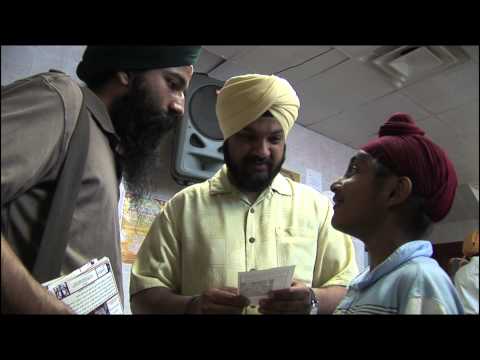
Do you know how to tie a patka? The following video, an original creation by Keerat Kaur, was produced by Saffron Press in an effort to educate about the Sikh identity – allowing educators (and curious children) to learn how to tie a patka/dastaar and see what actually lies beneath the piece of cloth that covers a lion’s mane. As one blogger writes,
The video [reminds] me of a vague recollection I had of sitting in a room while two teachers were trying to figure out how to re-tie my patka on my head. I remember trying to explain how the patka was supposed to be tied, but the teachers couldn’t figure it out. I also recall how vulnerable I felt when, to attempt to re-tie it, they removed my patka and my hair was exposed.
Another blogger has similar memories of his childhood,
For most of my childhood, I was the only Sikh kid in school that had long hair. Never mind that the other kids didn’t know nor appreciate my Sikh identity, even my teachers were clueless about my faith.