
Many of our recent posts have involved discussion about relationships and gender differentiations in our community. So on Thursday, when I drafted this post, I decided to read the “hukamnama” from Darbar Sahib Amritsar and see what Guru Granth Sahib Ji had to say that day.
For those of you who are novice to hukamnamas – a “hukamnama” is a royal edict or decree. In the Sikh context, the hukamnama serves as a command from the Guru, a lesson in the Sikh perspective, and is something to reflect upon for (at least) the day. The hukamnama for that day was as follows:
Sorat(h) Mehalaa 5 Ghar 2 Dhupadhae
Ik oa(n)kaar Sathigur Prasaadh ||
Sagal banasapath mehi baisa(n)thar sagal dhoodhh mehi gheeaa ||
Ooch neech mehi joth samaanee ghatt ghatt maadhho jeeaa ||1||
Sa(n)thahu ghatt ghatt rehiaa samaahiou ||
Pooran poor rehiou sarab mehi jal thhal rameeaa aahiou ||1|| rehaao ||
Gun nidhhaan naanak jas gaavai sathigur bharam chukaaeiou ||
Sarab nivaasee sadhaa alaepaa sabh mehi rehiaa samaaeiou ||2||1||29||Sorat’h, Fifth Mehla, Second House, Du-Paday:
One Universal Creator God. By The Grace Of The True Guru:
Fire is contained in all firewood, and butter is contained in all milk.
God’s Light is contained in the high and the low; the Lord is in the hearts of all beings. ||1||
O Saints, He is pervading and permeating each and every heart.
The Perfect Lord is completely permeating everyone, everywhere; He is diffused in the water and the land. ||1||Pause||
Nanak sings the Praises of the Lord, the treasure of excellence; the True Guru has dispelled his doubt.
The Lord is pervading everywhere, permeating all, and yet, He is unattached from all. ||2||1||29||
Initially, I read the hukamnama for its obvious meaning: the light of the Almighty is in every person. But as I tried to make sense of the hukamnama in relation to the ongoing discussion about relationships, it dawned on me that perhaps the Guru’s message is deeper than just acknowledging the inherent God-light in our fellows. Ultimately, if we see the spark of God in every person with whom we interact, we would treat that individual differently.
I realize presenting this hukamnama is no solution to the problem of gender inequality/differentiation/bias, but I think that a lot of the time we lose sight of the point that our Guru demands that we treat others in a certain manner.
If we were given the change to meet and interact with Akal Purakh on a regular basis – how would we behave? Would we deceive, abuse, or abandon Him? As a Sikh then, how must we treat each other (especially our companions) in light of the above hukamnama?
Earlier this week the Haryana and Punjab high courts struck down a provision in SGPC-run schools that reserves 50% of its seats for Sikhs under the same concept as the federal provision for reserved seats for historic minorities. The SGPC is contesting the ruling, arguing that while Sikhs may constitute a majority of the Punjabi population, Amritdhari Sikhs, for whom seats are reserved, are a very small comparative minority.
This issue made me think of previous conversations I’ve had with friends over whether or not Amritdhari Sikhs, or even just Keshdari Sikhs, are a shrinking minority. Within the diaspora this is certainly the case — the number of Sikhs, particularly second- and third-genners, who choose to take amrit seems to decrease every year. I’ve met many folks who discuss their hesitancy; perhaps we don’t know Punjabi as well in the diaspora, or the lack of training within sangats makes it hard to pass on knowledge. But for many, being an Amritdhari Sikh also vastly limits their relationship choices and options.
As a community, do we see this as a problem? I always find this news disheartening, but I would be lying if I said I would line up to take amrit anytime soon. How does the growing expansion and changes of the demographics of the Sikh community make things easier, or more challenging, when it comes to advocating for issues together? Do different subsections of the population feel more or less lonely/alone in their experiences?
I recently had a conversation with a friend whose relationship with his fiancée is in a bit of turmoil …
Let’s call him Jasdeep and his fiancée- Palwinder. They’ve been dating for a few years, told both parents who gave their consent/supported the relationship and a formal engagement date was set.
They’ve already been through some minor trials and tribulations thus far (long-distance + demanding jobs) but made it through ok. The formal engagement was set to take place late next year but recently I started hearing that the engagement would be delayed, not because of any familial or community pressures, but by a decision made by the couple themselves… From what I’ve seen in the past, a delay means an inevitable cancellation at some point in the future.
From what I know, they both felt that something was amiss in their relationship, a disconnect, though I don’t know what the source of it was. But their reactions to this disconnect are what have left me searching for an answer.
Palwinder is willing to do whatever is necessary to save the relationship. She’s willing to change, to continue long-distance if circumstances demand. Jasdeep, on the other hand, is willing to try only if circumstances make it easy, and hasn’t mentioned any need to change himself in any way.
Now, Jasdeep is normally not an alpha male, demanding his way in every small matter, he is willing to compromise in most circumstances… which is why this catches me off guard.
It could be the case that Palwinder is going through something (whether short term or long term) that’s harmful to her and the relationship, and it would in fact be healthy for both her and the relationship if she worked through it. Maybe she recognizes that and that’s why she’s willing to do so much.
But this reminds me of a pattern I’ve seen often, even if it turns out that this case isn’t an instance of it…
Amongst various sets of parents, cousins, uncles & aunts, friends- when something is amiss and in need of change, in overwhelming instances, it’s the woman who is more than willing to do whatever’s necessary to compromise to try to save the relationship. Maybe this partly stems from the traditional assumption that we’ve grown up with, where the failure of the relationship is considered to be a failure of the woman… (I recognize that such an assumption would be false in many ways, but it’s still out there…)
My question is: Why do women work so hard to compromise when the other half of the equation doesn’t want to budge?
And how, if at all, is this subtle imbalance in relationships linked to the harsher violence against women in Punjabi (maybe all South Asian) communities?
I always get asked about how my spouse and I met; those that are aware of Desis and the “arranged marriage” are always curious as to whether my marriage was in fact arranged. My first thought– how do you define arranged? We were introduced, by mutual acquaintances. The introduction – was under the pretenses of marriage. So essentially our first conversation was: “I want x number of children, and I am x feet tall, and I have the following expectations of a spouse”. I’M KIDDING!
I digress…
Our parents were involved, they spoke before we spoke, but that was the end of their role. Our conversations, and relationship progressed in an organic, albeit SUPER SPEED way. My response to the question is always vague, full of “ums” and quite honestly, it changes every time I am asked the question.
So this past weekend, when a coworker asked me if my marriage was arranged, I gave my usual: “Not really. Um, we were introduced. Our parents were involved. But the decision was ours. etc etc”
Usually I get a smile, and a “oh that’s cool”. This time: “I’m actually pro-arranged marriage”.
SAY WHAT?
You, the very liberal, forward thinking, all things unconventional co-worker – are PRO the arrangement of marriage?!
Disbelief, relief, confusion. A few things I felt.
Our discussion became increasingly interesting at this junction. Let’s call my co-worker “Yogi” – as in one who practices/teaches Yoga, not the bear.
Yogi, having traveled to exotic India, being aware of different cultures (yet extremely American) and has been in a committed relationship for the last 15 years, claimed that love has very little to do with a successful marriage.
BUT THE BEATLES SAID ALL YOU NEED IS LOVE!
According to Yogi (and maybe even BooBoo), it doesn’t matter who one marries, as long as both parties want to be part of an open, communicative and authentic relationship, a marriage will work. Love is a romanticized notion that sets up false expectations.
Um why does Yogi all of a sudden sound like my dad?
We got into a fairly lengthy and personal conversation and it still has me thinking. What is making my marriage work? What will guarantee it will continue to work?
Obviously there are examples of toxic relationships in both the “arranged” and “love” world. But what is the common denominator?
Does this imply that you don’t in fact “need time to get to know the person” before marrying them? Where do values, habits, likes and dislikes come to play? Is it an over-generalization? Easier said than done?
Or does it hold some truth….
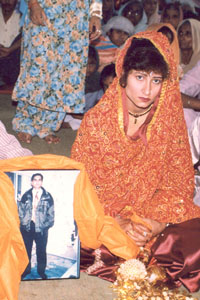 Blimey. Last week National Public Radio picked up a story about one of the newest scams to hit the community, that of Runaway Grooms. If NPR is doing a story about Punjabis and/or Sikhs, you’d hope it would be for something like this instead. So forgive me, if I think it’s disappointing (although maybe not surprising) that instead our community is the focus of an issue that seems to be quite prevalent in the Punjabi community in India and has links to England and North America aswell. Actually, it is very prevalent. Data suggests that 15,000 women in Punjab alone have been victim to men who, after getting married (and after taking the dowry money) return abroad never to be heard from again. Yup, these guys pull a Houdini. Here’s an excerpt from the NPR piece:
Satwant Kaur was full of hope and happiness on the day she got married. She had landed a husband who lived and worked overseas in Italy before returning to India to find a bride. She was looking forward to leaving her home in Punjab, northern India, for an exciting new life in Europe. Less than a week after the wedding, it became obvious that her husband, Sarwan Singh, had no intention of taking her with him back to Italy. She was the victim of a scam.
Women in India pay these men a hefty dowry in anticipation of the marriage and the promise to travel with them abroad. However, as it’s becoming increasingly clear, these men have NO intention of bringing their brides overseas and instead extort them of, what often is, their family’s savings. NPR may have picked this story up just recently, but this tale is not new. Ali Kazimi, a filmmaker, made a documentary about this called Runaway Grooms which has screened at various film festivals across the country. It’s a powerful film that leaves you in disbelief that this continues to happen in our community. What impacted me most about this film, however, was the strength that existed within these women who had quite clearly been abandoned. It reminded me of the same strength I see from Punjabi and Sikh women, that I know, who have come through similar tribulations.
At the root of this problem, and many others, is the tradition of daaj or dowry. Is this going away or has it’s form simply changed? I would suggest listening to the NPR piece and watching Runaway Grooms and then thinking about the impact this is having on our community. Our religion does not condone injustice, but more often than not, when those in our community are victims of fraud and lies, we always seem to look the other way…
Since May of this year a competition has raged throughout the Indian subcontinent. On Saturday November 24th, 2007, the results were in…the 1st Amul Star Voice of India: Ishmeet Singh from Ludhiana.
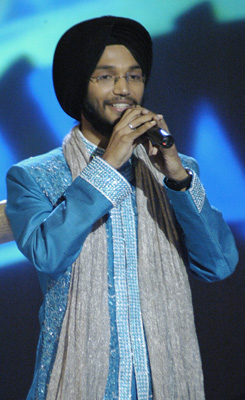 For those in the diaspora, who flip past the ZeeTV, Sony and all those other station as they channel surf, Amul Star Voice of India (SVOI) is the desi version of American Idol. After auditions throughout India, competitors are selected by the judges only to be later subjected to audience voting. Television viewers submitted text messages and finally after six months a winner was chosen.
The famed Lata Mangeshkar declared Ishmeet Singh from Ludhiana, Punjab the winner. However, the win was far from guaranteed. The runner-up from Uttar Pradesh, Harshit Saxena, had been much more popular by the voters from the West Zone (60% of the votes), East Zone (52% of the votes), and the South Zone (55% of the votes). However, the winner of the competition was not to be decided on the number of winning zones, but rather the gross total. It was here that the Punjab factor kicked in and propelled Ishmeet Singh to victory.
While the blogosphere and message boards are aflame about the results, my purpose here isn’t to engage on the merits of the Ishmeet’s voice or the fairness of the competition methodology. However, the results do bring to the forefront a number of different issues.
An important result of the competition is to highlight Punjab’s ‘tele-density’. Prior to the announcement of the SVOI winner, many members of the interviewed Indian public lamented that Ishmeet would be catapulted to victory based on the fact that while the national telephone per capita is 1:5, in Punjab it is almost double at 1:2. Their gloomy predictions proved correct. The sheer numbers of SMS text messages aided Ishmeet in his victory. While Punjab’s population will never give it a seat at the Lok Sabha and the national stage, its economic and telecommunication power gave it leverage in this competition. Are there other uses for such technology? The Dera Sacha Sauda incident earlier in the year also shows telecommunications powerful ability as a political tool to rally youth support and attendance. Grassroots movements will have to be able to employ this tool to mobilize the Sikh youth and will have to figure out new ways to utilize its tremendous capabilities.
Waheguru Ji Ka Khalsa
Waheguru Ji Ki Fateh
Welcome to The Langar Hall. This is a space dedicated to the experiences, reflections, and interests of a diverse group of young individuals – tied together by our common and varied identities as Sikhs in the diaspora.
Like the many conversations that take place in langar halls around the globe, our blog posts will sweep across a gamut of topics from Gurbani and Seva to Bhangra and Politics. We challenge ourselves to address the myriad of issues we face as individuals and as a community through a progressive lens, and reserve the right to rant, muse, and humor.
Do you have questions or the feeling that some things just have not really been explained? Then join our conversations as we untangle complexities, explore grays, or just share things we find interesting and funny.
Let us conversate!

