
 Despite the rich linguistic flexibility of Punjabi, it is telling that we do not have a single term for ‘depression.’ Mental health has been an ongoing conversation since the inception of the blog, repeatedly highlighted by Sundari and others. Often treatment is not sought and if it is sought it is usually terminated early as clients do not feel health professionals understand their world-view.
While we have numerous issues facing the Sikh community, there are few channels for those seeking mental health assistance. Thus, I was happily surprised when I came upon a medical article, titled “The Sikh Spiritual Model of Counseling.”
I reproduce the abstract in its entirety:
In accordance with the holistic principles of modern medicine, this paper will present the Sikh religious and spiritual view of mental health. With the continuing migration of a large number of South Asians, especially the Sikhs, to Western countries, mental health professionals should be aware of their clients’ world-view and cultural/religious specifi c models of counseling. Use of Sikh spirituality can reduce stress; help in treating psychosomatic disorders; and improve mental health of the individual and of the community. This paper will conclude that as the Sikh religion is a universal religion, everyone can use Sikh spirituality.
Dr. Kala Singh, the author of the article, is a physician that works as a multicultural mental-health liaison at Vancouver Coastal Health. I also want to personally thank the author for sending me a copy of his article!
 Assemblyman Warren Furutani (D-Long Beach) has introduced a new bill requiring awareness trainings and instruction on how to approach Sikhs for California’s law enforcement agencies and officers. If passed, California, which is home to the oldest Sikh gurdwara in the U.S. (Stockton) and one of the largest Sikh populations in the country, would take affirmative steps to ensure that the rhetoric around national security is not inappropriately utilized to prevent Sikhs from the free and fully practice of our faith.
Assemblyman Furutani explained the need for this protection specifically in the context of the kirpan:
Since the Sept. 11 terrorist attacks, Sikhs carrying the blade, which they consider sacred, have experienced a sharp increase in prosecutions, according to the legislation, AB 504, that Furutani has introduced.
“The Sikh community should not live in fear of arrest by law enforcement for carrying the kirpan, which is an integral part of their religious faith.” [link]
In light of the horrific experience of the Tagore family in Texas, it sounds like this kind of forward-looking legislation could prevent instances of ignorance-based harassment, or at the very least provide a legal basis for holding police officers accountable to culturally appropriate standards of enforcement for the diverse communities in which they work. The bill will be reviewed in March, and it will be interesting to see if it’s able to gain political traction in the upcoming legislative session.
We have talked about ‘Slumdog Millionaire’ many times here at TLH. We have criticized the corporate double-standards, celebrated dhols, and even discussed ways to get involved.
Yes, many have jumped on the Slumdog bandwagon (TLH included!). However, this one takes the cake. The Congress-led UPA government in Delhi now counts Slumdog’s success as one of the government’s accomplishments.
In an unmistakable resonance of the previous NDA government’s `India Shining’ slogan, Congress floated the idea of an `achieving India’ and listed among the milestones the Indo-US nuclear deal, Chandrayaan, near 9% growth and the total sweep of the Oscars.[link]
I wonder – is the government celebrating its role in the creation of the slums? The facts don’t seem to lie as one article wrote:
Fact: The number of people living below the poverty line has actually increased by a horrifying 20 per cent. India had some 270 million people below the poverty line in 2004-5, when the present Government took office. That number has gone up by 55 million, or 20 per cent, after five years of policies named after the ‘aam admi’ (common man) but shaped for the ‘khaas admi’ (vested interests).[link]
The ridiculousness didn’t stop there.
 Amidst all the “Slumdog Millionaire” Oscar hysteria, some have been asking how are we ACTUALLY going to combat the issues of poverty in Indian slums? I heard on “Entertainment Tonight”, or some show like that, the movie’s directors/producers have set up a trust-fund for the child-stars (who currently live in slums), are paying for their families to move into decent apartments, and will be paying for the children’s education.
But how about the rest of the families who were cheering away in Mumbai slums as “Slumdog Millionaire” won its eight Oscars? I came across this great blog post by Minal Hajratwala, “Slumdog”: Don’t Just Watch, Do Something, which took scenes from the movie and talked about how we can address those poverty issues in reality. I am going to copy a few of those segments here, but please do visit Minal’s blog for the full-effect.
 While many may still be reveling in Slumdog’s Sunday limelight, a darker movie about Indo-Canadians in Vancouver (the vast majority of who are Punjabi-Sikh), aiming to shed light on gang violence, is sparking criticism. [See trailer here.]
The film titled “A Warrior’s Religion” was made by Mani Amar, who describes it as a poetic documentary. When asked about what drove him to make the film, he said:
“It had to be done. How many more people need to die? We are past the 130 mark of deaths in our community. The issue is not slowing down … How readily we have accepted gang violence and how engrossed we are in it is what propelled me to do it. We are so relaxed about an issue that we should not be relaxed about at all.” [link]
In the film, Mani interviews Bal Buttar, a high-profile former gang member who is now blind and a quadriplegic after being shot in a gang related incident.
Mani said: “When I met Buttar, I laid it out on the table directly to him and said to Buttar, “I don’t respect you. You have an opportunity in your life to show youth that this is what gang violence will bring you.” For whatever reason, Buttar accepted the challenge. In the end though, I reaffirmed that it’s only death or jail to get out.” For Mani, what resonated most from the interviews was Buttar’s way of explaining karma: “You take blood. That blood gets taken from you.” [link]
Controversy has arisen from the film’s name, “A Warrior’s Religion,” and its use of visual references to Sikhism through images of gurdwaras, scenes from a Vaisaikhi parade, martyrs, and an image of a khanda in flames with bullet holes in the background. Mani explains how he chose the name:
The Center for Asian American Media (CAAM) is a group working to present stories that convey the “richness and diversity of Asian American experiences” to the broadcast audience. They do this by funding, producing, distributing and exhibiting works in film, television and digital media. One example is this video directed for Mandeep Sethi, a bay area MC. As he says, Where do we go from here, I thought my people would be proud of their heritage and instead they want to bury it.
Also presented by the Center, is the upcoming 27th Asian American Film Festival in San Francisco. For those of you in the area, here are some of the films you might want to catch.
Judging from everyone’s facebook status (yes, this is what it has come to), people are excited about the numerous awards Slumdog Millionaire won at last night’s Oscars (yes, Jodha, I watch the Oscars too). As was anticipated, the rag-to-riches film won Picture of the Year. Among it’s other awards was A.R Rahman’s win for Best Song, Jai Ho.
As anticipated, the Oscars presented this catergory’s nominations by a live song/dance number (the other songs nominated were another SM number, O Saya and Down to Earth from the film Wall-E which was sung by the lovely John Legend). The stage was full of multicultural bollywood-style dancers and instrumentalists. And if you looked closely enough, scattered throughout the audience were dholis. I tried to dig up some information about who these dhol players were and found nothing on the internet (PR anyone?). However, thanks to the fact that punjabi kids know what’s going on with all things bhangra-related (not necessarily a good thing may I add), I found out that the group of guys playing the dhol were the north american group called Dhol Nation Jess & Jag Tooray and Shawn Khalsi (see the comments below for the discussion of who it was – like I said, some PR would have straightened this out). Since the Oscars were quite clearly on a date with India last night, it was nice to see the dhol exposure. This is the best video I could find (start watching at 2:45, and again at 5:40). If anyone has any other information about last night’s performance – please share it with us.

 I have blogged about this issue before and since I find it so irritating, expect me to highlight them over and over. The most recent re-incarnation of the ‘abuse’ of the ‘Punjab Lesson’ comes from the always problematic Times of India. Swaminathan Aiyar, a libertarian columnist, in his “Swaminomics” has just written “Pakistan needs a Beant Singh”.
Decrying the truce reached by the Pakistani government and tribal forces in the Swat Valley, Aiyar sees parallels with India in the 1980s and specifically Punjab:
The Taliban’s rise in Pakistan has something in common with Bhindranwale’s rise in Punjab. A religious preacher, he sought to purge Sikhism of modern evils and return to pristine Sikhism. He was outraged by reformist Sikhs like the Nirankaris, and his followers killed many Nirankaris including the Nirankari Baba. [Emphasis added][link]
Nirkankaris were reformists? Claiming a living Guru that was greater than the Guru Granth Sahib and opening fire on protesting Sikhs in 1978 is reform? But I digress….
Photo by Howard Koplowitz.
Swaranjit Singh is running for New York City Council, representing Queens. An underdog in a new campaign for a new voting enclave, he’s running, in part, to ensure that “roti-eating people” have a voice, and a say, in New York’s politics:
“My biggest goal is to unite the roti-eating people. Only when we are united, that’s the way we can get any [political] positions,” Singh said… “We can make a difference…” [link]
He emphasized that he’s running to represent all people in the district, but that the desi population in the region is rapidly growing and that there’s a need for community participation and cultural understanding throughout government. At present, desis (mostly Sikh) represent roughly 34% of his district’s population.
 Growing up where I did, singing hymns and listening to the Our Father, Who Art in Heaven prayer were a daily occurrence. There was only one religion taught in my school. It was a point of discontent for those of us who followed other faiths and after years of students petitioning to be exempted from such morning meetings, my school reluctantly made exceptions for us. My school was a public school but it was also in England where separation of church and state did not exist.
I don’t have a problem with teaching religion in schools, actually I think religion should be discussed at school but practice should not enforced. I do recognize that this raises the question of Sikh-based schools where religious education is provided in accordance with the Sikh faith. However, I will emphasize that these faith-schools are private schools and children often have a choice to attend those institutions.
It seems that the concept of separation of state and church has in effect reduced the amount of time/effort which is spent on teaching religion in schools. A recent article discusses a school in Modesto, California which has decided that learning about world religions is an important subject and in fact, have even made it a graduation requirement.
Johansen High School in Modesto, California, sounds like any other, until the sacred Hindu sound – “ommmmmm” – vibrates from history teacher Yvonne Taylor’s classroom. Today, she’s talking about Hindu ideas of the cycle of death and rebirth. This nine-week course for ninth graders teaches the fundamental beliefs of Christians, Muslims and Confucianists, as well as Hindus, Buddhists, Sikhs and Jews – all tied in with the history of religious liberty in the United States. [link]
As the 25th anniversary of “1984” approaches us, TLH posts have covered some activities commemorating this devastating time in our history.
My most vivid memories of “1984” are watching Indira Gandhi’s funeral on television and the border of photos inside my local Gurdwara’s Langar Hall of the men who had been tortuously killed during the Khalistani movement. As I got older, I always wondered how Sikh women were impacted by these events, aside from the infamous photo of a widow crying with her child in her arms.

I read about a woman who was strongly involved in the Sikh student movement in Punjab but now lived on the East Coast (USA). At the Fremont Gurdwara, I remember the single picture of a woman who helped make the border of Shaheeds’ photos hung high in the Langar Hall. I recall the emotional testimonies of widows left deserted by our community and the Indian government in the film, “Widow Colony”. Most recently, I came across this poem, “Don’t Feel Sorry For Me, I Am The Daughter Of A Shaheed” written by woman who lost her family in the 1984 riots in Delhi.
The conflict between modern ideals of beauty and the requirements of the Sikh faith came up in a prior post. Recently, Sukhmandir Kaur Khalsa spoke eloquently on this issue in an Arkansas publication. Excerpted below are Khalsa’s perspectives on hair, beauty, and truth.
“I liken the inherent programming of the body’s ability to grow hair to truth,” Kaur said. “Truth always asserts itself and cannot be covered for long by a falsehood. Similarly, we can shave, pluck, bleach, color, trip, tweeze, and wax hair, but it will continue to be true to its programming. The hair follicle must be killed or removed to prevent hair from appearing on the face or body. . .”
Kaur had trouble with her own self-esteem in the beginning. “I had a lot of difficulty embracing my natural identity,” she said, “until I realized through a series of experiences that I was disgracing and defacing my God-given natural beauty.”
She said she developed a high degree of self-confidence through her self-acceptance. “I realize,” she said, “that many women do not have the confidence to face the world without masking themselves with cosmetic makeup and procedures such as hair removal. . .” [link]
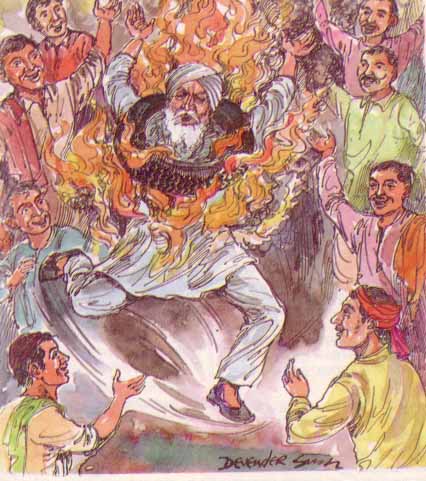 Michael Singh, a filmmaker, has been attempting for years to finish a documentary on his experiences during 1984. However, without support from the Sikh community (yes, money) he has found himself unable to complete this work. His goal has been to make a one-hour documentary based on materials he recorded and filmed during three days in Delhi when mobs were roaming outside the compound where he and his brother Surinder were staying.
The documentary-film-in-progress Riding the Tiger will recount filmmaker Michael Singh’s personal and intimate journey into self-identity as a half-Sikh young man who survived the atrocities of 1984, denying his Sikh heritage and passing for a white man. His story is set against the backdrop of the bloodiest year in modern Sikh history, a year of which many young Sikhs know little. [link]
The filmmaker is concerned that the traumatic events of 1984 are “quickly fading” from the Sikh consciousness and is asking the community, “How serious are you about preserving Sikh culture?” Micheal’s story begins when he and his brother return home, to India. After Prime Minister Indira Gandhi lay siege on the Sikh’s holiest site, Michael and his brother Surinder managed to infiltrate it and view the destruction following the gunning down of hundreds of pilgrims. Upon returning to the US Micheal publicized his story, and to his delight, three Sikh film producers showed up at his apartment, expressing their desire to hear his interviews and bankroll his film. Michael tells us of the tragedy of this visit,
Presidents’ Day in the U.S. is kind of a all-in-one holiday, you celebrate Lincoln and Washington’s birthdays while honoring all U.S. Presidents. Some just enjoy the day off too!
On this Presidents’ Day, C-SPAN commemorated the holiday by releasing the results of its 2009 Historians Presidential Leadership Survey (last time they did it was in 2000). Sixty-five historians chosen by C-SPAN and its academic advisors, ranked the last 42 American Presidents across 10 attributes of presidential leadership. These attributes ranged from “International Relations” and “Economic Management” to “Moral Authority” and “Public Persuasion”. There was also a category for “Performance Within Contexts Of Times” to account for the variation in issues encountered by each President.
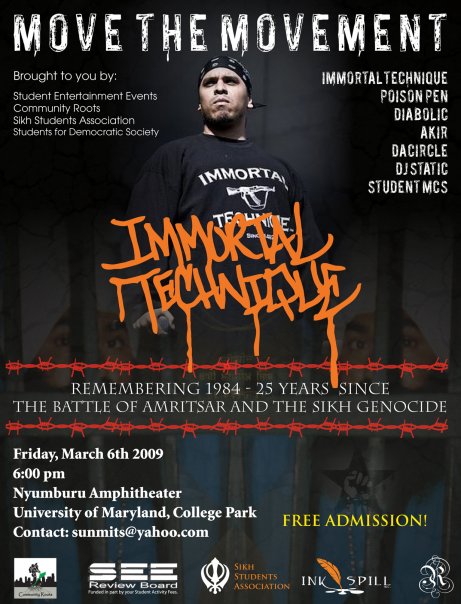 2009 marks the 25th year since the events of 1984. Tragedy and the vibrancy of life mark the ‘story’ that is 1984 and beyond. There will be many activities I assume over the next few months and I will do my best to stay informed and encourage participation by our readers, writers, and beyond.
Last year, I wrote that I was a HUGE fan of Immortal Technique. Although some of the commenters could not move beyond his usage of profanity, I think they are losing out on a phenomenal activist and inspiration. In that post I had mentioned his usage of a Sikh analogy, it seems next month he may be doing much more. The Sikh Students Association at the University of Maryland, College Park is one of the groups playing host to an upcoming performance on March 6th, 2009 at 6pm. The tagline of one of the posters (well one that I am sure the Sikh groups are promoting) is “Remembering 1984: 25 Years Since the Battle of Amritsar and the Sikh Genocide“. For more information visit Tech’s myspace page that states that free admission will be limited to the first 500 people.
Another great initiative that was recently brought to my attention is the “One Million Chaupai Sahibs” project. The target: 1,000,000 Chaupai Sahibs by June 2009. Whether individually or collectively, I hope the TLH community actively supports the project.
I have my own memories of kirtan class. During my prepubescent days, learning the harmonium was an option, but then as puberty struck this male, I quickly switched to the tabla. My days were soon coming to an end as I was entering 8th grade and I overnight, radically I came to believe I was “too cool” for such things. While at times I regretted my decision, still in a private moment near a harmonium or piano, I can still play the notes to “Jo Mange Thakur Apne Te Soi Soi Deve”.
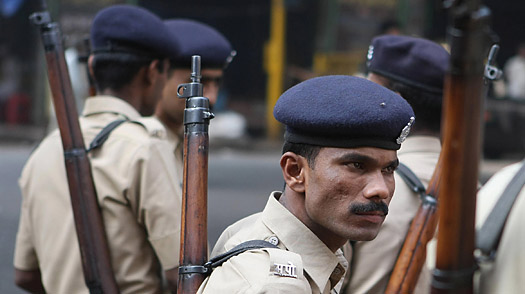
We recently posted on Ensaaf’s new report that studies the all too common practice of extra-judicial killings (usually referred to as ‘encounters’) and the mass cremations that followed by the Punjab police forces during the 1980s and 1990s. Well it looks like these practices were not limited to Punjab and these serious human rights violations are finally hitting the mainstream media.
This week, Time magazine writes about “Rights Groups Probe India’s Shoot-Out Cops“:
Scarcely a day passes in India by without news of an encounter between the police and criminals elements — “encounter” being the local jargon for shootouts involving the police, who are allowed to fire only in self-defense. On Wednesday, it was a “dreaded mafia don” who was gunned down by the Uttar Pradesh police — shot dead, and therefore unable to challenge the police account of the circumstances of the shooting. But some in India have begun to question the frequency of such “encounters”.
A few days ago we covered the story of Lakhwinder Kahlon – a father who was sentenced to life for the murder of his two-year-old daughter in B.C., Canada. Along the same lines we are hearing news about Moninder Singh Pandher who today was convicted of murdering a young girl, the first verdict in a case involving the deaths of 19 people. Pandher and his servant Surinder Koli were arrested last year after body parts were found near their home in Delhi. Most of the victims were children who had dissapeared in the area in years prior. Pandher and Koli were charged with murder, rape and abduction.
Residents say as many as 40 children disappeared in the area over two years before the crime came to light in December 2006.
The killings horrified people in India and the businessman’s Noida home was dubbed the “house of horrors”. The remains of the children were found hidden in bags. [link]
The crime shocked the country and many blamed incompetent police. Local residents said police failed to act over the abductions and murders because many of those reported missing came from poor families. A BBC article discusses this in more detail,
The UN Special Rapporteur for freedom of religion or belief visited India last year and just released her report on the country, highlighting, amo ng other things 2 matters that are of special concern to Sikhs: (1) the situation of religious or belief minorities (generally) and (2) justice for victims and survivors of communal violence (including Operation Bluestar in particular).
This report will serve as a great tool for future advocacy and education campaigns, as the UN Special Rapporteur is by mandate, an independent entity (though also a diplomatic entity whose mandate is funded by the States she monitors, so of course there are limits to what can be said and done). The office is also a widely respected authority, whose reports are persuasive and create pressure in courts and government offices. Having official international support and recognition of issues that have long been a struggle for Sikh activists to legitimate (lack of accountability, lack of compensation) should advance the Sikh movement to hold accountable Indian government authorities identified as responsible for innocent civilian deaths. Between this report, and the recently released Ensaaf report, 2009 looks like it’s going to be a good year for advancing accountability for crimes by Indian authorities against Sikhs in the 80s and 90s.
Last year we heard the story of Lakhwinder Kahlon, a Delta, B.C. man who had been arrested for the murder of his two-year-old daughter, Rajwinder. This past week, Lakhwinder received an automatic life term when he pleaded guilty to second-degree murder. The father, who admitted to strangling and decapitating his daughter, will have to spend 11 years in jail before he can apply for parole. A few days ago, the judge released the 911 call of Lakhwinder admitting to the horrific act. The call is chilling – Lakhwinder tells the operator that he killed his daughter by cutting her neck, that he is depressed, and that the police should come and arrest him.
While it is hard to come up with any explanation to describe why Lakhwinder murdered his daughter, several suggestions were made. In an immediate reaction to hearing the news, there was speculation that Lakhwinder was upset that he only had daughters. This suggestion was vehemently denied by Lakhwinder’s wife and the community was quick to denounce female inequality.
Outrage and sorrow have poured out in radio talk shows and letters to newspapers, including one from Tara Diakow of Richmond, B.C., who wrote: “Who will battle against the ugly stereotype that Rajvinder Kahlon’s death has unfortunately brought to many people’s minds – the seemingly disposable position of Indo-Canadian women?” In a forceful statement on Monday, Liberal MP Ujjal Dosanjh used the case to denounce the practice of aborting female fetuses, which he says continues to take place in Canadian families. [link]

