Guest blogged by Satvinder Kaur Dhaliwal
Admin Note: After completing her undergraduate studies in Anthropology, the author traveled to Panjab to volunteer. She spent her time volunteering at Pingalwara and working with the Baba Nanak Education Society (BNES). Below is an article she wrote for BNES to raise awareness about their impactful work addressing farmer suicides.
::
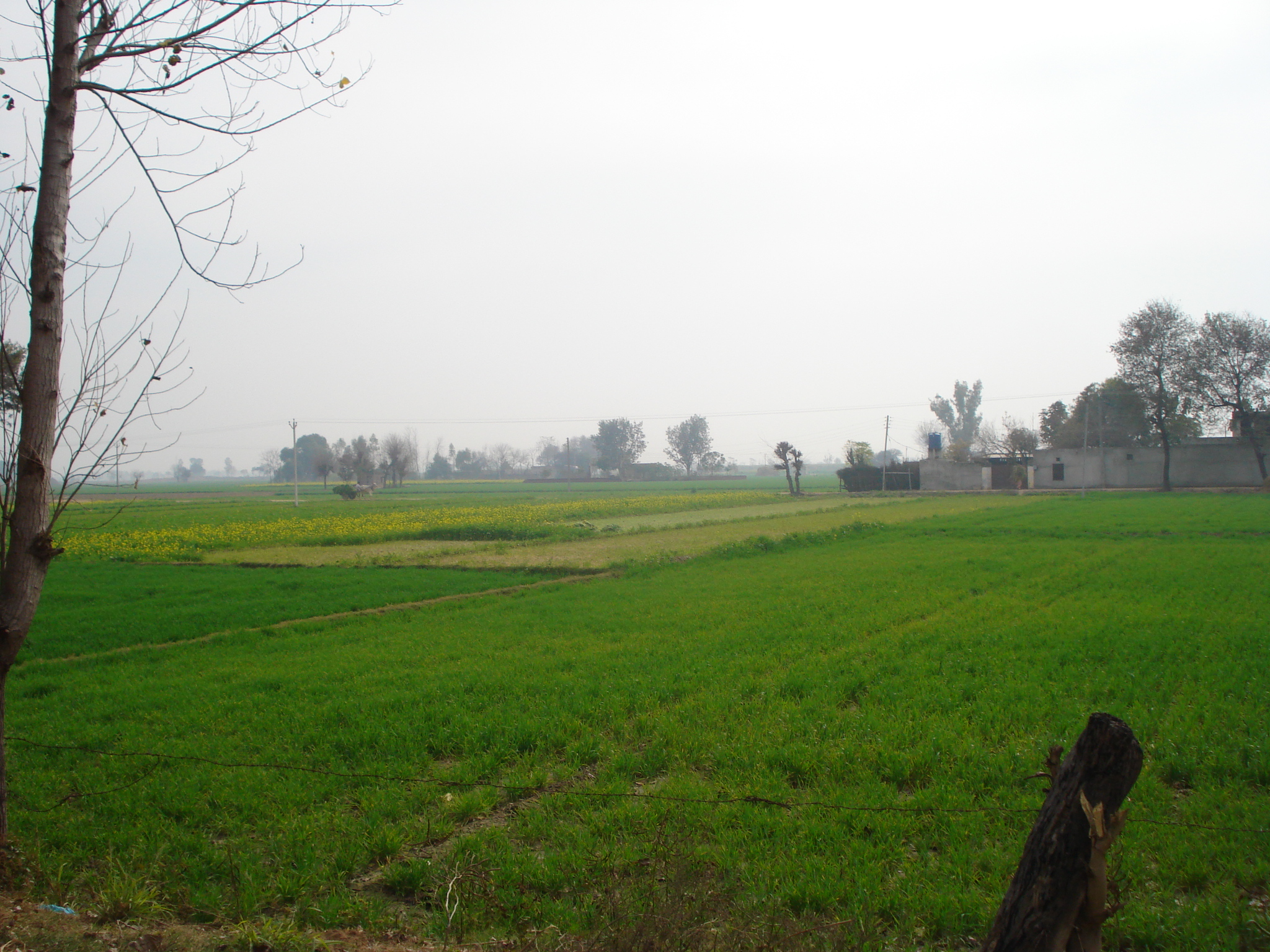 Village Barlan, District Sangrur, located near the Panjab-Haryana border, depicts the prosperous, joyful Panjab that many of us are eager to visit. Roads leading to the village are surrounded by what appearsto be flourishing farmland, stretching as far as one can see. Children have returned from school and are laughing and chasing each other through the streets of the village, the elderly have gathered to discuss recent happenings, and women can be seen carrying various necessities to their homes. This first glance overview of Balran disguises a harsh reality that a growing number of households in the village are facing – suicide.
Suicide is an equal opportunity visitor in Balran and many other villages throughout Panjab. Increasing farming costs, the removal of farmers’ subsidies, and low rates for crops are putting Panjab’s farmers in a never-ending cycle of debt accumulation. Each year, farmers in Panjab face increased agricultural costs and low returns for their crops. In order to cover these costs, farmers must take out loans, which they usually get from their local aarthiya or money-lender. The aarthiya often ends up being the same individual who will buy the farmer’s crop at the mandi or market, and then re-sell the crop on the public market. Sukhjinder Singh, a farmer, described the reason for debt accumulation as, “Let’s say that I sell my crop for 11 rupees per kilogram. When I need to purchase the same crop for my home, I have to buy it for 14 rupees per kilogram. So how can we profit?” Consequently, when a farmer’s costs are constantly exceeding his profits, he must cover his costs by taking out loans. Now, he has increased his debt by introducing extremely high interest rates, which are often decided by the aarthiya.
Unlike the west, the gendered demarcations of males and females in Panjab are much more stark, and it is common for women to be unaware of their family’s financial circumstances. Therefore, when the male becomes consumed in debt and can no longer bear humiliation from the taunting money-lenders, he begins to see only one way out – suicide. His surviving family members are not only left devastated, but they must find a way to provide for themselves and pay off the debt on their family, of which they may never have been aware in the first place. Often times the surviving family members include a wife, children, and elderly parents. In winter 2011, I visited the families of various suicide victims in Balran. Some families had lost their loved one a few years ago, while some had only experienced the loss a few days ago. Although I only visited seven families, the Baba Nanak Education Society has documented 91 suicides and numerous missing individuals in Balran since 1998. Nonetheless, all family members were still grieving equally and struggling to pay off their debt.

As mentioned last month, New York City-based Vishavjit Singh released his first “Sikhtoons” book this Spring. Entitled My Headcovering is Downright Sikh: An Illustrated Intro to Turbans, the book “uses a collection of cartoons from Sikhtoons.com to create a visual narrative to dispel the mysteries of the Sikh turban. Featuring Fauja Singh, Waris Ahluwalia and many other Sikhs from all walks of life this visual journey is a turbanful introduction to Sikhs.”
The book features 30 cartoons and can be ordered online in the US, Canada, and UK for $10.
Though I have not seen the book myself yet, it has the endorsement of Sikh scholar IJ Singh, who states:
Vishavjit Singh’s topic is serious, his touch light, but not comedic. The sense of the absurd is critically important to the cartoonist. That, too, will emerge, I am sure, for I see their seeds in his work. I believe that the lightest matters deserve a serious undertone and the most heavyweight issues need some levity, even comedic treatment sometimes, lest the burden becomes too heavy to carry.
Congratulations to Vishavjit on this accomplishment. As misconceptions and stereotypes about Sikhs continue to persist in the mainstream media and general public, I hope Vishavjit’s creative cartoon interventions reach a much wider audience through this book.
 A friend of the The Langar Hall and a Sikholar in her own right has started a fascinating website, called “Sikhs Wearing Things.”
The purpose of the blog states:
sikhs wearing things around the world.
inspired by the “muslims wearing things” tumblr. this is dedicated to showing a multiplicity of sikh styles in order to repudiate the notion of a single sikh identity.
And is dedicated to her late father, a very stylish Sikh.
The goals of the site is largely in keeping with our own vision of The Langar Hall – where there is no single Sikh opinion and the Langar Hall on-line or in-life is the place where a diversity of views and ideas can be shared, debated, and considered.
Check out the site and maybe even send the blogger some of your own thoughts and pictures!
It’s been over a week now. I’ve been wanting to write, but have been on the road, my head spinning with newspa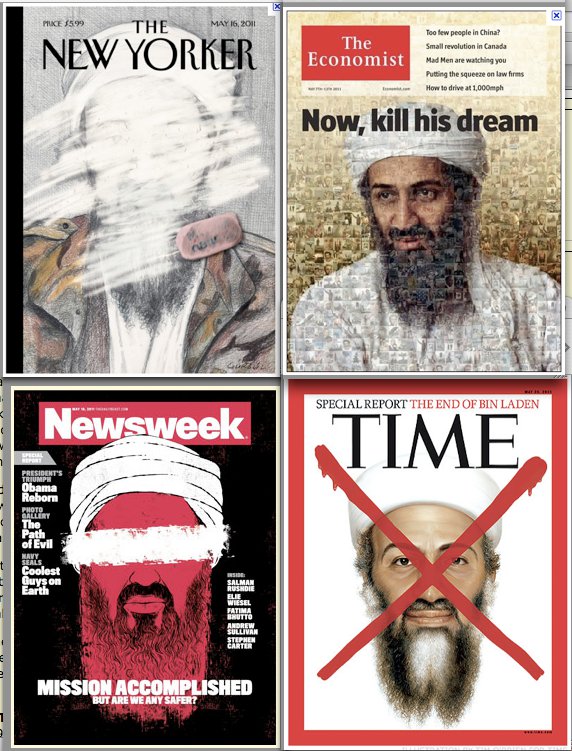 per headlines and the voices of cable news pundits. Navdeep posted some thoughtful reflections and questions here, and in the meantime, we’ve had the opportunity to see the response to bin Laden’s death throughout the country and world. By now, we are all probably well aware of the spontaneous celebrations of thousands at Ground Zero and Time Square in New York City and at the White House, with victorious chants of “USA! USA!”, the night President Obama made the announcement of bin Laden’s death.
I was traveling in New Orleans when the news hit, and the mood there was similar. God Bless Americas were being yelled in bars of the touristy French Quarter, people running down the streets (drunkly) yelling “We killed him! We killed him!” with a disturbingly rage-filled glee.
I happened to be exploring the city on my own that night, and was immediately nervous when I heard the news. Within a few minutes, several strangers made snide and/or aggressive comments about bin Laden’s death directly to me, as if to imply that I was related to him. Throughout my week of time in New Orleans and Texas thereafter, strangers heckled me with taunts of “Osama” almost every day. One day, a young kid leaving school (maybe 10 years old) asked me, seemingly earnestly, if I was a terrorist. And I was even pulled out of a night club in Houston by security because I was carrying a bag (which had an instrument in it).
Indeed, the death of bin Laden does not appear to mean the death of bigotry. Colorlines reports:
A mosque in Maine was vandalized with the messages “Osama today, Islam tomorrow” and “Go Home.” In Houston, a schoolteacher was disciplined for racially profiling a Muslim ninth-grader by asking if she was grieving her uncle’s death on Monday. Also this week, Mohamed Kotbi, an Arab waiter who is suing his employer, the Waldorf-Astoria hotel, for religious and racial discrimination following the 9/11 attacks, has reported more taunts from co-workers following bin Laden’s death.
I am curious if other Sikhs have experienced a similar rise in harassment. What does it mean that when the US claims victory over Enemy #1, the general public vilifies Muslims and turban-wearing Sikhs even more? Sometimes it seems we’ve made little progress since the hateful aftermath of 9/11, and perhaps are even moving backwards.
“I feel ashamed to call myself an Indian after seeing what has happened here.”
Few words could be more apt. They are not mine, but rather the Congress Party’s ‘heir-apparent’, Rahul Gandhi. Although he used them to criticize the Mayawati Government in UP’s autocratic moves to seize land from farmers, the words resonate with something bigger that ails India.
To look for the roots of the problem, Rahul doesn’t have to look far. His family – Nehru, Indira, Rajiv – have played a huge part in that shame. India is now a country where a farmer commits debt-related suicide EVERY 30 MINUTES! This has been the case for the last sixteen years. I shudder to think what it would be for just Punjab alone.
Yesterday, Smita Narula, a Faculty Director at the Center for Human Rights and Global Justice (CHRGJ), based at NYU School of Law, AND a Board of Director of ENSAAF, spoke on DEMOCRACY NOW!, a popular US radio show (pagh salute: Pali).
 And I was worried that no one was going to read my post J.
Over the past week, I’ve read through all the comments in detail and have had many conversations with people in person. The dialogue has been supportive as well as critical, eye opening, challenging but most importantly always respectful. Its reaffirmed my belief that we Sikhs can openly articulate our differences in a productive way. Here’s some additional perspectives that I’ll put out there for debate:
Liberals
Of course, Michael Ignatieff’s failure to connect with Canadians was a major reason for the collapse of the Liberals. But there are much deeper, systemic issues with the party and for the party to survive, it needs a transformation from top to bottom. This will require a redefinition of what it means to be a Liberal in today’s Canada. This also includes reaching out to all those stakeholders to whom they had grown complacent, Sikh-Canadians included.
The Liberal party has done great things for our community over the years, a lot of which falls on deaf ears because it is ancient history to the under-30 generation. These youth only remember sponsorship scandals, Chretien vs Martin and Ignatieff’s reluctance to support the 1984 petition. Having said that, the party and its Sikh representatives need to produce much better answers for the questions of “what have you done for us lately?” and “what are you going to do for us going forward?”

UPDATED: Picture added on bottom.
UPDATED 5/11 – Maple Leaf Sikhs responds! View here!
My fellow Sikh-Canadians, its the morning after the big party. How does it feel? You must be a little hung over? Why wouldn’t you be? You’ve been drunk on power over the last 5 weeks. You’ve had every leader in the country wining and dining you in style. Telling you how great you are, how important you are to him and how he can’t live without you. They’ve trotted you out to every event like a prized possession, your dastaar (turban) became the ultimate fashion accessory of the election. No political stage was complete without a token Sardar in his requisite blue, red or orange turban.
You took the leaders everywhere with you. They met your family and friends – heck you even introduced them to your Father Guru and foolishly praised their false kingdoms in the presence of the King of Kings. You invited them to your Khalsa’s birthday celebrations and if they were able to say the Guru’s Fateh, your heart melted because you believed they really loved you. It felt great to be in the spotlight.
After so many years of being insulted and neglected, being seen as an outsider and the Other, you were finally part of the cool kids crowd. You felt like a somebody – recognized on the national stage as a king-maker. Now its the morning after and what do you have to show for it?
The numbers are clear. Not a single Amritdhari left in Parliament. In fact you’re down to only one Sardar. 1984 petition supporters Sukh Dhaliwal and Andrew Kania both gone. Gurbax Malhi gone too. ALL defeated largely by Sikhs supporting their opponents. But, boy did it feel good to get rid of Ujjal and Ruby. Except at the end of the day they’re Sikhs too. Sure you’ve added a few Sikh faces but it remains a question of where their loyalties really lie and if they will fight for our rights.
Congratulations Sikh-Canadians. You’ve cut off your nose to spite your face.
 Although this election season had seen the largest Punjabi field of candidates in Canada’s history, the number of MPs of Sikh background did decline.
The winners: The Tory party had a field night and can now claim an all-out majority in the Canadian parliament. The NDP had a very strong showing becoming the official opposition party.
The losers: The Liberal party suffered a crushing defeat and the individual election results largely followed this trend.
On the way out/On their way in – Navdeep Singh Bains, previously covered and once seen as a rising star, lost to Eve Adams. Gurbax Malhi, who had been an MP since 1993, lost to Bal Gosal. Ruby Dhalla, a friend of murderers and thugs, was kicked out and replaced by Parm Gill. Sukh Dhaliwal, who gained special acclaim for raising the banner the Sikh cause, lost against Jinny Sims. Ujjal Dosanjh, long criticized for his divisive role in the Sikh community, was finally defeated (and hopefully ends his career) by Wai Young. Also, Jasbir Sandhu of the NDP successfully defeated incumbent Dona Cadman (pagh salute to Jagpal Tiwana for making me aware of my omission!)
Stayed safe – Conservative candidates Tim Uppal and Nina Grewal retained their seats.
Of note – Andrew Kania was defeated by Kyle Seeback.
Of interest – Jagmeet Singh of the NDP energized the youth and lost by a mere 500 votes in an election that only a month ago he was thought to be a non-factor. Also one of the most interesting pre-election article I ever saw was on the growing maturity of a Sikh electorate as described by the Toronto Sun’s Raveena Aulakh.
So this is the view from south of Canada’s border. Hoping to have a full-analysis later in the day and hope to hear from our Canadian brothers and sisters about the results and their meanings.
Earlier this week I went to a screening of the film Koi Sunta Hai, one of four documentaries produced by the Kabir  Project, an expansive music and film project directed by Shabnam Virani.
In their own words:
The Kabir project brings together the experiences of a series of ongoing journeys in quest of this 15th century North Indian mystic poet in our contemporary worlds. Started in 2003, these journeys inquire into the spiritual and socio-political resonances of Kabir’s poetry through songs, images and conversations.
We journey through a stunning diversity of social, religious and musical traditions which Kabir inhabits, exploring how his poetry intersects with ideas of cultural identity, secularism, nationalism, religion, death, impermanence, folk and oral knowledge systems.
I first learned about The Kabir Project a couple of years ago when they did a screening several clips from the films in Jackson Heights, Queens and featured a stirring performance by folk musician Prahlad Tipaniya, who is featured in the films. I was deeply moved and inspired by the films’ (and musicians’) explorations of Bhagat Kabir’s bani, and especially by the way the filmmaker and artists highlight the Kabir’s powerful message in the face of of contemporary manifestations of sectarian violence, caste oppression, and religious and national tensions in South Asia.
I was inspired again this week in watching Koi Sunta Hai, which highlights the Kabir-oriented journey of classical musician Kumar Gandharva. Kumarji, as he is referred to with admiration in the film, was a child prodigy classical Hindustani singer who developed an illness (the film says TB, Wikipedia says lung cancer) as a young man that forced him to not sing a note for five years. In that time of his world being turned upside down and his profession and main form of expression indefinitely at a halt, he began to hear singers from very non-classically trained backgrounds — folk singers, “common” people — singing the poetry of Kabir. This began to change his entire approach to music, spirituality, and life. The below clip from the film explains more about Kabir’s poetry and Kumarji’s relationship to it.
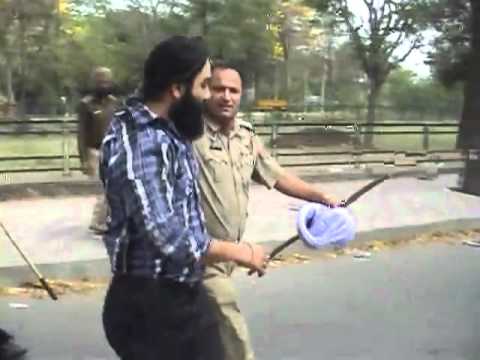
This past Sunday, violence erupted in an ongoing conflict between rival factions at the Gurdwara Baba Makhan Shah Lobana in Richmond Hill, Queens, the heart of New York’s Sikh community. Large kirpans as well as cricket bats and balls were used in the fighting. Dozens of community members and “leaders” were injured, and seven men were arrested.
Sunday was the escalation of an ongoing power struggle between leadership factions in the Richmond Hill Sikh community. There have been many violent incidents in the last several months at this Gurdwara (which itself was born out a violent conflict at the original Richmond Hill Gurdwara, the Sikh Cultural Society), resulting in a regular police presence there.
I don’t claim to understand the reasons behind the conflict at this Gurdwara, nor do I really care. This type of behavior is inexcusable and unjustifiable. And it is far too common in our community, and in particular, in our houses of worship. Much deeper discussions and interventions are needed about violence in our Gurdwaras than I will go into here.
That being said, as a follow up to Navdeep’s post about Sikhs and the Media yesterday, I want to focus on the news coverage of this incident in Richmond Hill. The New York Post* (one of NYC’s biggest newspapers with over 525,000 print copies sold daily) broke the story with this headline on Monday: Queens Turban Warfare: Sword-Wielding Sikhs attack praying rivals.
As the world celebrates the 41st Earth Day on April 22nd, to raise awareness about the state of the global environment (now recognized worldwide as International Mother Earth Day) the Punjab government this week announced that it would issue strong penalties on the use of polythene bags less than 30 microns in size (th ink of it this way, a piece of hair is about 50 microns across). The statement warns of strong penalties for violations of the Punjab Plastic Bags Control Act a regulation initially passed in 2005, barring the manufacture and distribution of the smallest polythene. Bags 30 microns and smaller have been stressed because they are more likely to fly through the air to lands and public waterways. Polythene bags above this size will continue to be manufactured. Violators could face up to three months in jail.
Plastic bags contribute to Punjab’s solid waste problem, one of the state’s growing challenges due to the number of small-scale industries producing disposable, manufactured goods. With the agricultural economy on the decline and the deflation in the price of agricultural land hitting rural areas hard, migration to urban areas and the demand for consumer products has increased the production of solid waste in recent years. Of all Punjab’s cities, Ludhiana produces the greatest amount of solid waste from urban and industrial units, followed by Patiala, Jalandhar, and Amritsar, each seeing a rise over the past two decades. Waste from small commercial units dump non-biodegradable waste right onto street, which can pose serious environmental health challenges. (Under U.S. law, we classify these lands as ‘Superfund’/’Brownfield’ sites indicating the presence of hazardous and otherwise harmful substances.)
Our mothers and grandmothers would be proud. If we take a moment to pause, we’ll see the amazing mobilization that is occurring in the diaspora around Sikh women’s issues, particularly by youth. I’m not quite sure if it is a legit rise in websites or events or whether we are simply paying more attention to the topic. Regardless, it is clear that there are now more forums and platforms for discussion cultivating the need for women (and men!) to come together and address issues affecting Half the Sky. This post will give a round-up of some amazing work that is happening in our community, bringing together our qaum to discuss important issues affecting Sikh women.
 {Kaurista} It is clear that Sikh women, like all women around the world, value an open space to discuss issues that directly impact us. Whether it is conversations about clothes, hair, identity or our activism – there needs to exist a space that is catered to providing Sikh girls and women with a sense of unity. This type of comraderie cannot be understated – it impacts an individual’s self esteem and confidence in a substantial way. With the launch of Kaurista.com and the immediate posting of the link all over Facebook, it is hard not to notice how much support there is for this type of forum. Kaurista provides conversations on six different topics including, Lifestyle, Style & Beauty, Family, Inspiration and Health & Wellness. One of my favourite sections of the website is “Ask Kaurista” where questions related to wanting to marry a sardar, going to prom, or overcoming alcohol abuse are answered. The site is not only aimed at Sikh girls. In fact, it actively includes Sikh men in discussions – and perhaps the hope is that through these types of discussions, Sikh men will value how truly dynamic Sikh women are!
{HERSTORY}

While Sikhs around the world were celebrating Vaisakhi last week, 78-year-old Gurmej Singh Atwal, one of th e two men who were shot in what was likely a hate attack in Elk Grove, California in March, died on Friday. The Sacramento Bee reports:
“He’s no more,” his son said. “First the kidneys went off, then the lungs and then brain. … He was shot in the upper right chest, one bullet went straight to his lungs and the other to his pancreas, liver and intestines.”
A grief-stricken Atwal said, “My dad was going to be a key witness” in the shooting. Also shot was Surinder Singh, 65, who died at the scene.
This tragic loss came two days after California’s “Sikh Solidarity Day,” initiated by State Senator Darrell Steinberg and California Sikhs to raise awareness about the Sikh identity in light of the horrific March 4th attack on Atwal and Singh in Elk Grove.
“Let us pick a day together when we are all Sikh Americans, we are all Californians and we all stand together,” state Senate President Pro Tem Darrell Steinberg said before several hundred members of the Sikh Temple of Sacramento in West Sacramento.
“Any attack on one of us is an attack on all of us,” the Sacramento Democrat said. He suggested that on a chosen day – which was quickly decided as April 13 – civic leaders and community members could wear either a man’s turban or a woman’s Punjabi suit with chunni, or headwear, as a symbol of support.
No arrests of suspects have been made thus far. The reward offered by the police department and Sikh and Muslim community groups for information leading to arrests is now $43,000.
Mourning the loss of Gurmej Singh Atwal and Surinder Singh (who died immediately after the shooting), we hope and pray for a day when the Sikh identity will no longer be under attack, when we can walk down the street with our dastars without fear.
Guest blogged by Preeti Kaur. Preeti wrote this poem for The Langar Hall in commemoration of the 312th anniversary of the birth of the Khalsa this week.
Vaisakhi
i’ve never seen a wheat harvest
never worried over winter punjab frost
monsanto seed or otherwise grown into grain
carried tender on the heads of women
to grind into a thousand rotis to feed the family
i’ve never seen jallianwala bagh
garden of colonial blood bullet 400+ bodies
a small boy at the bottom of the well the only hope left alive
the patka on his head a flag
our flag
i’ve never seen 13 Singhs standing
their blood the ink to keep the record straight
holy is the water which sheds from the mothers’ eyes
began with the first bullet into the belly of amritsar’s shaheeds
ended with flaming tires around dastars in delhi
or never ended at all
perhaps
i’ve never seen
i’ve never seen
all i’ve seen a phulkari of gulabi firozi
turban tractors atop john deere
sift california san joaquin valley silt
almonds pistachios raisins oh my
i’ve seen saag paneer packaged spacefood
five dollars on the TJ grocery store shelf
i’ve seen gossip fly continents
aunty-to-aunty gupshupper network to chacha’s pateeja to you-know-who to me to you
i’ve seen lines of taxis at the san fran airport
spot the pagg to pick up my overstuffed luggage
drive me home
jugni jaa vari umreeka
Continue Reading »
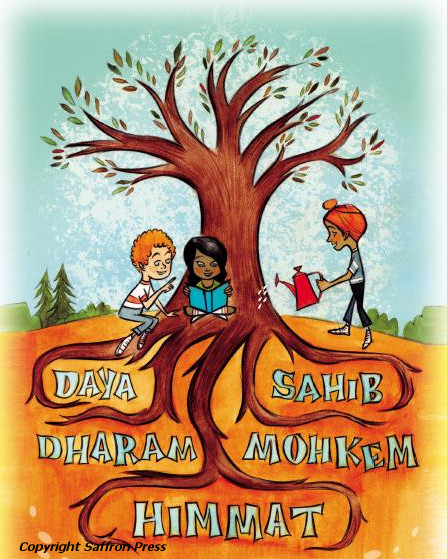
Image: Copyright Saffron Press
As a very proud Masi, I often find myself wondering how we can make events such as Vaisakhi, more meaningful for the next generation. Why is it that we exchange cards and gifts during Christmas, and yet for Vaisakhi, a Facebook status update suffices? While I fully support children exploring and participating in global celebrations, I think it is just as important (perhaps more so) that Sikh children are raised celebrating Vaisakhi in a similarly joyful way. For Sikhs living in the diaspora, Vaisakhi is often associated with nagar kirtans, melas, and gurdwara visits. This is a great way for children to celebrate the occasion with the community, however, I am not sure the event really resonates with them.
For example, did you know about the significance of kite flying during Vaisakhi?
The spring air of Vaisakh makes kite flying a popular pass time. A kite is called a Patang or Guddi Manjha in Panjab. The wood and bamboo roll on which the string is wound is called a Charkhadi. Children often give their kites a special name to reflect their personal designs such as: Pari (fairy), Chand Mama (man-in-the-moon/uncle moon), Shakkar Para (a panjabi sweet). Poetry may also be written in Panjabi on the Patang to send messages to a special person up on the roof. [link]
How fun would it be to have kite flying events for Sikh children? They could invite their non-Sikh friends and use it as a way to share their heritage. Don’t get me wrong, I think it’s important not to commercialize historical occasions – however, we have to be willing to celebrate our history so that it is meaningful. So I’m curious – what does Vaisakhi mean to you and how do you celebrate it? How would you like your children, your nieces or nephews to remember Vaisakhi? Or if you are a parent, how do you make Vaisakhi meaningful for your children?
Here is a useful document for parents and educators, describing ways to celebrate Vaisakhi with children. Happy Vaisakhi!

The controversial new French law that bans Muslim women from wearing the niqab, or full-face veil, went into effect today and was met with resistance in Paris. The New York Times reports:
The police detained two fully veiled women at a small protest outside the Notre Dame cathedral in central Paris, where demonstrators were easily outnumbered by police officers and journalists. But it was not clear whether the women had been held under laws forbidding unauthorized demonstrations.
French authorities estimate that less than 2,000 women in the entire country even wear the niqab, in a country of nearly 63 million. The NYT article continues:
The ban also applies to foreigners visiting France… Violators may be punished with a fine of 150 euros, equivalent to $215. But people forcing others to cover their faces are subject to much stiffer punishments, including a maximum 12 months in prison and a fine of 30,000 euros, equivalent to more than $42,000, or twice that amount if the person forced to cover their face is a minor.
I’ve argued before that France’s so-called attempts at “liberating” Muslim women in reality perpetuates racist and assimilationist notions of national identity. Some Muslims in France are organizing to challenge the law. One wealthy property developer has set aside some $2.8 million to help women fight the ban and is encouraging women to wear the niqab in the streets as a form of civil disobedience. (Check out this video of a French Muslim woman taking a train to Paris today wearing her niqab)
Advocates of gay rights celebrated after the Obama administration in late February said that it would no longer support the Defense of Marriage Act, a federal law that bans the recognition of same-sex marriage. The Defense of Marriage Act, or DOMA, signed into law by President Clinton in 1996, defines marriage as a legal union between one man and one woman.
The Obama administration, however, believes DOMA is unconstitutional.
President Barack Obama has concluded that the administration cannot defend the federal law that defines marriage as only between a man and a woman. He noted that the congressional debate during passage of the Defense of Marriage Act “contains numerous expressions reflecting moral disapproval of gays and lesbians and their intimate and family relationships – precisely the kind of stereotype-based thinking and animus the (Constitution’s) Equal Protection Clause is designed to guard against.” (link)
Although I take issue with the state having a role in defining what is and isn’t a legitimate relationship in general (and one’s romantic relationship defining whether or not they get access to certain benefits and privileges), I applaud the administration taking this strong stance against homophobic bigotry. So, I was disappointed (though not terribly surprised) to hear that the World Sikh Council, a “representative and elected body of Sikh Gurdwaras and institutions in the US,” has been lobbying the Obama administration to uphold DOMA and went so far as to co-sign a letter of protest to President Obama denouncing his decision to reverse DOMA. The letter states:

Happy 100th Birthday Fauja Singh!
New York City-based Vishavjit Singh, the creator of Sikhtoons, is releasing his very first Sikhtoons illustrated book next weekend at the Museum of Comic and Cartoon Art Festival in NYC. We’ve blogged about Vishavjit and Sikhtoons many times before, and are glad to see Sikhtoons going to the next level in book format.
According to Vishavjit, “The book focuses on dispelling the mysteries of the Sikh dastaar…target[ing] young and old, Sikh and Non-Sikh. The book features Fauja Singh, Hip Hop Singhs, Waris Ahluwalia and much more.”
Sikhtoons has long been a creative and light-hearted medium to tackle important issues for our community from 1984 to Hindutva, bullying in schools to contemporary Punjab politics. The details on the release event are below, and you can buy tickets in advance here and RSVP on Facebook here. Hopefully the book will be available to order online in the future. We’ll keep you posted.
Museum of Comic and Cartoon Art Festival
MoCCA Fest 2011!
Saturday April 9th and Sunday April 10th 11am-6pm
At the Lexington Avenue Armory
68 Lexington Ave (Between 25th &26th Streets)
New York, NY 10010
Guest blogged by Tarnjit Kaur
This essay was written as an introduction to ‘Sikhism and Gender Equality: Where do you See Yourself?,’ an event to be held in Ontario Saturday, April 2nd at 6 pm. All are welcome to attend.
Motivated by the empowering message of Sikh theology, Sikhi, Sikh history is replete with struggles against all forms of oppression, to protect religious freedoms, human rights and in the pursuit of self-determination. Although an expression often confined to an interpretation of Christianity, I have always thought of Sikh theology as a form of liberation theology: a theology that liberates in the here and now from social, political and economic injustices. It is from this perspective that I ask whether if a Sikh thealogy [1], that is a Sikh feminist theology, has political and social utility in advancing the cause for gender equality within the Sikh communities [2].
I argue that women’s oppression due to patriarchy is compounded by colonial factors and that the disconnect between the practise and theory of Sikhi is entrenched in socio-economic and political inequities. It is therefore seriously questionable whether there is any political utility in the efforts to reclaim the ”feminine voice” or the feminist nature of Sikh scripture as subscribed by Sikh thealogy [3]. I further ask how can gender equality be achieved? Does Sikhi empower women because of its emphasis on traditional gender roles and femininity? Or does Sikhi advocate that men should no longer exploit their own privilege arising from their status as men? Or are there clear messages of gender egalitarianism promoting gender equality? These are areas of Sikh thealogy that are pregnant for research, scriptural analysis and historical investigation and are part of a larger on-going work both within the academic sphere and by grass-roots Sikh organizations.
Guestblog by Fakir
I’ve been complaining for several weeks regarding the cricket craze and how educated, conscious south asians should be taking this moment of international spotlight on their ancestral or native countries to highlight their higher expectations for their countries much like what occurred around the world and in Beijing during China Olympics 2008 and educate their peers.
It especially angers me when I see Sikhs rooting for either Pakistan or India, when I see Muslims rooting for India (and Pakistan), etc etc, because these are oppressive machines not harmless patriotic identities. India v. Pakistan is going to happen today in Mohali, Punjab, India. Here is something else that happened in Mohali, Punjab, India just yesterday: