
Over ten years after 9/11, the persistence of hate attacks targeting Sikhs in the US, whether in the form of bullying in  schools, vandalism of gurdwaras, or even cold blooded murder, is a sobering reality for our community. Jodha and I have both discussed elsewhere that the root cause of much of the anti-Sikh violence we see in the United States is the overwhelming vilification of Muslims and Islam in our country, and in the world, today. Nevertheless, it is imperative that we have sound data about anti-Sikh attacks specifically so we fully understand the scope of the problem and thus can address it effectively.
It may surprise you that the US government does not in any way keep track of hate crimes targeting Sikhs. Even in the midst of the surge in attacks against Sikhs in the wake of 9/11/01, the FBI never kept track of anti-Sikh crimes. While some of us may not see the FBI as the most trustworthy of agencies to protect our communities and our civil rights given its history of spying and repression, it is nevertheless outrageous that there isn’t even a “Sikh” box to be checked when a hate crime has been reported. It says a lot about the continued marginalization and relative invisibility of our community in the United States.
In late 2009, we wrote a post about the growing number of homeless Punjabis and Sikhs living in Southall. Almost three years later, the situation in Southall continues to concern us. A recent article from the BBC discusses the plight of these young men who seek voluntarily deportation back to India but who, without documents, are unable to navigate an unforgiving bureaucratic situation.
Jagdeesh pulls away a piece of cardboard revealing a tiny hole in a concrete wall. He invites me to climb through, declaring: “This is my home, come in.”
“I was told that life was good here. It’s not just me, other boys came for work,” he says. “You can see what state we’re in, there’s no work, no government help.” Jagdeesh has cut himself off from his family, saying he is ashamed of his failure to find work and would rather they thought he was dead than knew he was living in filth. “They sold land and took out loans to get me out of India. What can I say to my family back home? The money we’ve invested is lost,” he says. [link]
According to figures from the UK Home Office, voluntary departures have risen steadily over the past few years, from 335 in 2005 to 15,537 in 2010. While many of these cases have been logged with the UK Border Agency, it seems that the Indian High Commission is dragging its feet on processing the cases. According to the article, the UK Border Agency admits that establishing the identity of illegal immigrants in order to issue them with emergency travel documentation is a “complex” process and that the time it takes to process these individuals varies by case. One individual, a man in his 30s, has been waiting for three years.
Many of these individuals abuse drugs and alcohol as a way to cope with the situation. Their thoughts often turn to suicide. Their only support system is each other and the majority of them haven’t even told their families, back in Punjab, about their broken dreams. It’s a difficult situation for these men – their lack of options in Punjab drives them to seek opportunities abroad but this promise of prosperity is not always what it seems to be.
As our UK co-blogger, Naujawani Sardar, states, “There are many questions being asked about the problems facing masses of illegal Punjabi immigrants in West London, but the most important questions that will prevent this situation from reoccurring in the long-term are not being asked: Why do so many youth risk everything to leave The Punjab? What is being done to curtail the agents that are facilitating their travel? And, what repercussions do UK citizens face for exploiting illegal immigrants?”
 The Sikh American Legal Defense and Education Fund (SALDEF) has announced the application for the 2012 SikhLEAD Internship Program. The objective of SikhLEAD is to inspire, train, and support motivated and enterprising young Sikh American leaders as they prepare for a lifetime of community engagement and community leadership.
The internship program is aims to put Sikh American college and graduate students, as well as recent grad, in competitive internship in the White House, on Capitol Hill and government agencies. Through this program, students will be afforded first-hand perspective into the functioning of the federal government, as a way of providing experience-based training to individuals interested in civic engagement and government affairs.
Through the experience of interning in a congressional office, interns will:
- explore a potential career track
- create a network of professional and personal contacts
- develop real-world skills
- build confidence and professional work habits
The application deadline for summer 2012 internships is THIS SUNDAY, Feb 26th, 2012!
Visit www.sikhlead.org for more details and to apply. Spread the word and tell your friends about this exciting opportunity.

(photo: Twitter user @ksalag)
I would like to follow up on Jodha’s recap of the third annual Sikholar’s conference that took place this past weekend at California State University, East Bay (in Hayward, California). I had attended the previous conferences in 2010 and 2011 and was happy to attend this year’s event. I’ve enjoyed all three of these meetings of the mind immensely, and I believe the 2012 iteration was a raising of the bar in the discourse it brought forth about our community and faith group.
What follows are some of my own reflections of the presentations and panels as a member of the audience.
This past weekend, CSU East Bay’s Ethnic Studies Department and Sikh Studies Chair along with the Jakara Movement held its third annual Sikholars Conference. Along with the 11 graduate students from all over North America, nearly 100 community members came together to share and engage in their research projects.
Opening on Saturday, Dr. Jaideep Singh welcomed the participants and discussed the burgeoning field of “Sikh Diasporic” studies that is finally beginning to bear fruit. The first panel showcased the projects of Bandana Kaur, a Yale graduate, on issues of ecofeminism, biodiversity, and social effects of the Green Revolution and Guneeta Kaur Bhalla on the challenges, development, and prospects of the 1947 Partition Archive. Both projects bring together social histories and the voices of non-elite subalterns to the fore.
The second panel, titled the “Identities of Law”, explored Sikh-Americans in a legal context. Jasmine Singh discussed the “racialization” of Sikhs in the United States, while Kiran Preet Dhillon reflected on the ways that Title VII, instead of promoting accommodation to religion in the workplace, have served to limit and demean. She called for a rigorous opening of the conversation with groups that fight for freedom from discrimination in the workplace, including SALDEF and the Sikh Coalition. The panel discussant was conference host, Dr. Jaideep Singh.
The last panel of the day involved explorations in musicology. Neelamjit Dhillon, a student at California Institute of the Arts, showcased his music talents and the convergence of technology and music, adding visual imagery to the auditory experience. Harpreet Neelam, from the University of Toronto, mesmorized the audience with her vocal talents and her explanations of the partaal through the shabad “Mohan Neend na Aavaey Haaveh.” View her amazing rendition (along with Neelamjit Singh on the thabla; pagh salute: RimmyKay) below and continue reading beneath the fold.

The first day concluded with a viewing of Harjant Gill (Sikholars, Class of 2010)’s documentary – “Roots of Love.”
 Sikhs around the world will come together again to celebrate the Gurdgaddi of Guru Har Rai Ji again Sikh Vatavaran Diwas (environment day) for a second year in a row. On this day, Gurdwaras worldwide will focus kirtan and katha on the concept of kudrat, and participate in a number of hands on activities to protect our environment.
Ask your Gurdwara to participate by:
- Focusing kirtan and katha on nature
- Hosting the Khalsa School Lesson on the Environment, created by the Sikh Research Institute
- Participating in a cleanup, tree planting, or children’s activity
All resources will be available on the EcoSikh website. Participating Gurdwaras should register to keep a database on worldwide activities, and respond with a ‘Yes’ on the Facebook invitation.
The purpose of Sikh Vatavaran Diwas is to bring Khalsa Panth together on issues of the environment. With Punjab ranking twenty-seventh out of thirty states in the environmental performance index (EPI), the need for Sikhs to connect Gurbani to the issues around them is real. The contamination of soil, land and water from intensive agricultural production remain high on the list of Punjab’s ecological challenges, in addition to industrial pollution and solid waste, low forest cover, and air pollution from thermal plants.

(photo: Shergill Law Firm)
You may recall the murders of Elk Grove, California residents Surinder Singh and Gurmej Atwal, two senior citizens and turban-wearing Sikhs who, while on their daily walk, were shot down in a drive-by last year. Despite last October’s Day of Action by the community to spread awareness of the murder and to help get some new leads, to date the killer(s) have not been identified and no motive has been established. However, the murders of these Sikh grandfathers are suspected to be a hate crime.
The Elk Grove, California Police Department provided an update yesterday in their search for the killer(s) of Sikh seniors Surinder Singh and Gurmej Atwal, who were shot and killed last year while on their daily walk. Based on witness accounts, the police have now have a confirmed description of the suspect’s vehicle:
At a press conference this afternoon, police officials said the suspect drove a lifted full-size pick-up truck, tan or gold in color, with a standard-size cab, similar to the one pictured at left. They do not have details on the make or model year of the truck.
Initially, police had been searching for a pick up truck, but have now been able to provide a little more detail about the vehicle. The investigation is still ongoing and the police are seeking more information, with a reward offered of $57,000. The Elk Grove Police Department can be reached at (916) 714-5115. If you live in northern California, spread the word about the suspect’s vehicle. Someone out there knows something that will help solve this crime.
 It’s sobering (and depressing) to hear about another hate attack in the United States fueled by Islamophobia, this one in the form of racist graffiti on a gurdwara under construction in Sterling Heights, Michigan. SALDEF‘s recent statement about the incident states:
…the vandalism happened between the evening of Feb 5th and the morning of February 6, 2012. The graffiti included vulgar language, racial epithets, the use of what appears to be a cross, a large drawing of a gun, and references to the attacks of September 11th.
SALDEF is urging law enforcement to classify the vandalism as a hate crime and prosecute the perpetrators, who have yet to be identified. Anyone with information about the attack are being encouraged to contact the local police department directly.
As you can see in the photo, the graffiti states “Don’t build,” and makes reference to the Prophet Muhamm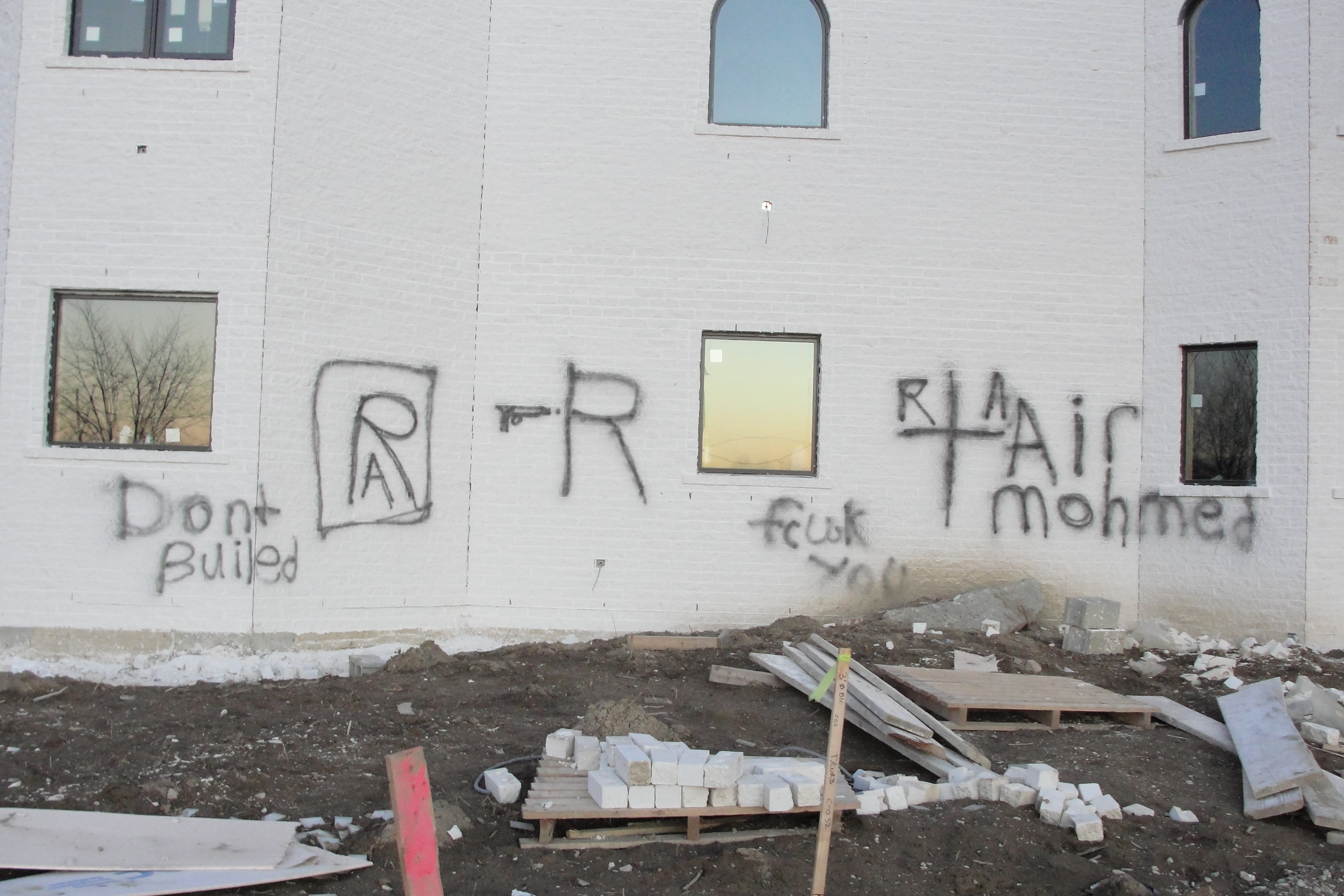 ad. While the spelling and grammar are poor, it seems safe to assume the perpetrator was fueled by Islamophobia of some sort.
We talk a lot about anti-Muslim bigotry here at The Langar Hall (as Jodha did on Monday), and it’s been at times disturbing to see comments on our posts reflecting the anti-Muslim sentiment in our community. Some who consistently make it a point to distance themselves from Muslims in every way and in every situation might struggle with this stark reality: the well-being, safety, and dignity of our community here in the US (and many other parts of the diaspora) is intimately connected to that of the Muslim community.

Cover of "Guru Tegh Bahadur: The Ninth Guru of the Sikhs" (photo: sikhcomics.com)
Let me first take the opportunity to thank the bloggers of TLH for welcoming me to this blog. A few might recognize me from americanturban.com, and I’m excited about the opportunity to engage with the audience on this blog in discussing many of the issues we face as a community, and particularly in the United States.
Most of my early education in Sikh history came from comic books, namely those published by Amar Chitra Katha, based in India. My father purchased every title related to Sikhism that was released by this company — covering the stories of the Sikh Gurus to those of Sikh legends and heroes — and I loved reading and re-reading these comic books until I knew the stories by heart.
It was a great introduction to Sikhism that captured my imagination. As I got older, I moved on from these comics to literary works on Sikh history that filled my growing mind with more knowledge and detail.
I started reading those comic books almost 30 years ago (I’m astounded as I write that number), and I’ve recently come across a new effort to bring such Sikh stories to today’s young audiences.
Gyan Khand Media has recently begun producing a new set of Sikh-based comic books. While now based in India, author Daljeet Singh Sidhu saw the opportunity for such a comic book after living in the west:
When Daljeet Singh Sidhu wanted to introduce his three-year-old son to Sikh heroes and history, he was not at a loss of words. But what he did not have, was a story that his boy could see, feel and later read. That’s when it struck Sidhu; that Sikh history has many heroes, but no graphics. So after 12 years in the US, he packed his bags and moved back to India to chronicle Sikh history, its great gurus and warriors and present them in the comics format. That’s how www.sikhcomics.com, a Sikh comics project, was born.
Gyan Khand Media has currently published three titles covering the stories of Baba Deep Singh, Guru Tegh Bahadur, and the Battle of Saragarhi. Many more are planned, and I had the opportunity to download and read the first two titles using Amazon’s Kindle app on my mobile device.
 It isn’t new in our community. A colonial official promises us money, land, and riches. Hundreds of thousands of Sikh javaans found themselves in the deserts of Iraq, the jungles of Burma, or even in the mountainous regions of France during WWI and WII seeking greater opportunities. One need not blame the individuals, but is there a space for a structural conversation in our community about our role in the world of global capital and neo-imperialism?
Poverty and the need to survive may indeed be motivating factors. But do we run the risk of being dispensable pawns in a Great Game? My fellow langa(w)riter, Brooklynwala and even JasdeepSingh in the comments section, bravely wrote about this larger issue in criticizing the core in the “right to serve” campaign. The criticism for those that may not remember is not that Sikh don’t have a ‘right to serve’, the bigger question is what exactly are we serving?
A reminder of this question became apparent in a news article I came across over the weekend.
Communities on the periphery of the Indian State, be they Sikhs, Kashmiris, Christians in Nagaland, or even Bengalis and Bangladeshis have long seen the brutality of the “world’s largest hypocrisy.” Despite claims of democracy, progress, and growth, the facade is held together by a sadistic security state. Here we see its face. What is not unique is the instance caught here on a video that was to be used to psychologically and collectively terrorize; what is unique is that the video has made it to the public.
The video has begun to leak into worldwide news outlets, but has not raised the proper level of concern and outrage in the Indian State. There are many brave individuals in India that fight for human rights and dignity; there are many more that are silently complicit.
The video shows BSF (Border Security Force) soldiers torturing a Bangladeshi man. Human Rights Watch in 2010 had documented the grave human rights abuses, committed by these soldiers. Titled “Trigger Happy“, the report documented the deaths of over 500 people due to the hands of the BSF since 2006. The Border Security Force will not be unknown to those that seek justice in Punjab. The BSF was known to have committed wide-spread human rights violations in the Punjab; this, too, was documented by the Human Rights Watch.
For those that may have friends or family that don’t believe widespread torture, murder, and rape occurs under the name of “Indian security,” here is your evidence:
 First off, my sincere apologies to all in delaying the posting of this entry for far too long. Over winter break, nearly 20 students participated in the Jakara j.Korps initiative that seeks to explore the issue of immigration. Here is a photo-essay composed by Josh Singh.
During winter break 2011 members of the Jakara Movement were brought together for the first annual SUJH Alternative Winter Break to examine the issue of immigration first-hand by visiting the so-called ground zero, the Mexi-Cali border. The issue of illegal immigration continues to be brought to the forefront as witnessed in the divisiveness this issue caused among 2012 Republican primary candidates and the recent rise of nativist sentiment that has been fueled by deteriorating economic conditions. In 2006, huge protests calling for a more open and humane immigration policy were lead mostly by our Chicano/a and Latino/a brothers and sisters. The Sikh-American response to this issue however has been largely indifferent and silent. Through this trip, our goal was to break down commonly held conceptions about undocumented migrants and their journey into the U.S. (sujh=becoming aware). One of the most common misperceptions among people is that illegal immigration is a Latino-centric issue and therefore primarily deserves attention from that community. However, as seen in the LA times article earlier this year highlighting the increasing number of undocumented Punjabi workers in the U.S. (1600 were caught and detained in 2010 alone), this is hardly the case. It is imperative for us to stand in solidarity with other communities, especially on issues we have a personal stake in. Otherwise, how can we expect them to support issues that are deeply important to us?
Oscar nominated director, Ashvin Kumar today offers a free preview of his film on the twenty year military presence in Kashmir, ‘Inshallah, Kashmir: Living Terror,’ a film that documents the treatment of the Kashmiri people at the hands of half a million Indian military troops. The film reveals through personal stories the experience of torture, enforced disappearances, and extrajudicial executions that have swept the region since 1989.
Here’s a short preview:

Chances are you’ve probably heard about Tonight Show host Jay Leno’s joke last week that has angered a lot of Sikhs in the US and around the world. In the segment, the voiceover stated, “Here’s a look at Mitt Romney’s summer home on Lake Winnipesaukee,” as a photo of Darbar Sahib was shown.

The New York group Sikhs for Justice has gone so far as to file a complaint with the Federal Communications Commission (FCC) and a California based Sikh doctor has filed a lawsuit for libel against Leno and NBC in the superior court of California. A petition to NBC is also circulating, which has over 4,000 signatures so far. The petition, in part, states:
…the sentiments of Sikhs worldwide are off limits to his monologues and cannot be used further his TV ratings. The Right to Speech under the First Amendment to the United States Constitution excludes defamation and spreading hate, incitement and false advertising.
I found this new video that Mandeep Sethi released last month beautiful and inspiring. Shot in London, the young San Francisco-based hip hop artist links up with a dhadi jatha for a freestyle session unlike any other.
I’ve always loved the power, poignancy, and rhythm funkyness of dhadi jathas. Sikh and Punjabi public education through music, in a sense. These same characteristics are at the heart of hip hop and draw many of us to it, including talented artists like Mandeep. As Public Enemy’s Chuck D stated years ago, “Rap is CNN for black people.”
A few years ago, a friend of mine gave a compelling presentation about the parallels between hip hop and dhadi at SikhRI’s Sidak program in San Antonio, TX. Mandeep Sethi was not in the room, but clearly he had the same thought. Hope you enjoy it.

Since the inception of Sikholars: Graduate Sikh Conference, we have featured it here on The Langar Hall. The past two years have been huge successes and the third year will prove no different. A terrific agenda of evidence and research-based topics, as well as current thinking and new ideas will be presented by graduate students and professionals in various fields to challenge you and get you thinking.
As always, this year, Sikholars will offer a balance of well-known experts along with new faces and a stronger international representation. Students and professionals will come together from all across the globe and have the opportunity to learn from each other, to interact and form personal and professional relationships and to focus on learning and spreading knowledge.
Everyone is invited to come to CSU East Bay on February 18th & 19th, 2012. For more information: www.sikholars.org
Below the fold, I’ll post the abstracts of this year’s presenters.
Here on TLH, we look forward to sharing stories about young Sikhs pursuing their passion.
YouTube, Lenovo, and Space Adventures are running a competition to find an amazing space experiment and 16-year-old Pranav Singh is one of the finalists! If he wins, his experiment will be carried out on the International Space Station and streamed live from space on YouTube.
You can view Pranav’s video below and learn about his experiment here. Don’t forget to VOTE! You can vote each day until January 24th. Pranav is a finalist and has a good chance to have his experiment picked! Remember, he is only 16-years old!

As you may have noticed, today is a national day of action to protest the Stop Online Piracy Act and the PROTECT IP Act, two bills being decided on in US Congress right now. Tons of sites, including Wikipedia, are on a 24-hour blackout to protest the bills and urge action.
Needless to say, we at The Langar Hall are deeply concerned about this threat to online freedom and encourage our readers to take action and spread the word.
I spent this weekend in Fort Lee, New Jersey across the river from Manhattan at the Surat-Lalkaar Conference, “Kaur Voices: Exalt, Express, Empower.” As discussed previously, this event was a new collaboration between organizers of the popular Surat Conference in NY/NJ and California’s Jakara Movement. Never having attended a conference put on by either group, I was curious what the weekend would bring and eager (and a bit nervous) to help facilitate dialogue in our community about gender, sexism, and intimate violence.
Perhaps others will also have report backs and reflections on the conference in the coming days and weeks (feel free to share your thoughts in the comments), but for now I wanted to share a few highlights, a few aspects of my experience as both participant and a facilitation at Surat-Lalkaar while it’s fresh.
What struck me the most this weekend was simply the theme of the conference: issues of gender and gendered violence in the Punjabi Sikh community. As I was co-facilitating an intense discussion about a case study (based on a real situation) about child sexual abuse in a Sikh family, I looked around at the dozen or so Singhs or Kaurs in my group and realized I had never talked about this issue with a group of Sikhs. Nor had the rest of the participants in my discussion group.
A shared experience of nearly everyone in the group (and likely everyone at the conference) was the resounding silence about domestic violence, sexual assault, and child sexual abuse in our families, our gurdwaras, and our communities. There was a sense from many that these issues are indeed problems in our community, but problems that are hard to know the scope or seriousness of because no one talks about them openly. Many participants saw a tendency in our Sikh families to brush any “problems” under the rug to preserve the reputation or “honor” of the family.
As many of us in the US and around the world have been celebrating the beginning of a new year this past week as well as  the Gurpurab of Guru Gobind Singh, a new draconian law has been brought upon us in the United States with near silence from the mainstream media. On New Year’s Eve, President Obama signed into law the National Defense Authorization Act, which includes provisions that allow the US military to round up and indefinitely detain people, including US citizens, without any charge or trial.
Obama himself originally threatened to veto the bill if the language of indefinite decision wasn’t taken out. Yet he proceeded to sign the bill into law as we move into 2012, perhaps giving him the legacy, as Human Rights Watch director Kenneth Roth states, ” as the president who legalized indefinite detention without trial or cause.”
The American Civil Liberties Union (ACLU) states:
We are extremely disappointed that President Obama signed this bill even though his administration is already claiming overly-broad detention authority in court. Any hope that the Obama administration would roll back those claims dimmed today. Thankfully we have three branches of government, and the final word on the scope of detention authority belongs to the Supreme Court, which has yet to rule on the scope of detention authority. But Congress and the president also have a role to play in cleaning up the mess they have created because no American citizen or anyone else should live in fear of this or any future president misusing the NDAA’s detention authority.

