
Fighting for our right to oppress: Gays, Sikhs & the Military
Last week the US military officially ended “Don’t Ask Don’t Tell” (DADT) after President Obama signed a repeal of the 18-year-old anti-gay policy last December. Gay, lesbian, and bisexual service members (note the absence of transgender people, who are still not allowed to serve openly) and advocates of gay rights have been celebrating the repeal as a civil rights victory.
The day the repeal went into effect, President Obama stated:
Patriotic Americans in uniform will no longer have to lie about who they are in order to serve the country they love. Our armed forces will no longer lose the extraordinary skills and combat experience of so many gay and lesbian service members. And today, as Commander in Chief, I want those who were discharged under this law to know that your country deeply values your service.
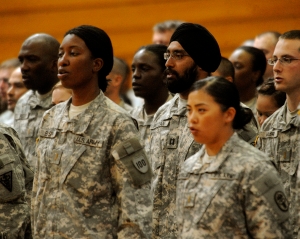
Captain Tejdeep Rattan at his graduation from the US Army basic training
This issue hits close to home for the US Sikh community, since the Pentagon’s uniform policy has not allowed Sikhs to serve with their kesh and dastaar since 1981. Similar to DADT, this is blatant discrimination and is an unacceptable policy for any employer, especially the federal government, which sets a powerful precedent for the rest of society.
Just as rights advocates have been fighting to end DADT for years (and finally succeeded), Sikhs launched a “Right to Serve” campaign in 2009, led by the Sikh Coalition and a Sikh doctor and dentist who were told by the Army to cut their hair when they report for basic training. The impressive efforts of Sikh cadets fighting for their rights and the tireless work of their advocates have resulted in the Army granting accommodations to three Sikhs, who are now serving with their turbans and unshorn hair in tact. The overall policy of the military nevertheless remains discriminatory.



18 Responses to “Fighting for our right to oppress: Gays, Sikhs & the Military”


WJKK WJKF Great post man! I don't know much about politics but I think of the same thing when people come to me and ask me about my experience in the Marine Corps and if it's a good idea for them to join. I served four years as a rifleman and served 7 months in the city of Fallujah (07'). I did thousands of counter "insurgency" patrols and raids, mostly on homes that had innocent occupants (bad intel) we tried to "rebuild" the city with little success. My Platoon operated in an area called Al-Dubat, which had been demolished by what seemed like carpet bombings (we called this section the Ocean). As time went on, I kept asking myself "what HAD these people done to me?" The answer scared me, but you have no choice, you fight on. Coming home was even worse, seeing more young Americans from poor working class families lining up to fight the "good" fight and my thoughts still to this day drift back to the kids who were growing up in the chaos with no choice but to live among the violence. I am sorry when any young Singh or Singhni joins up, not knowing that they are helping no body except the elites of this country and defense contractors get rich while they destroy the lives of people who have done NOTHING wrong. I say, if a young Sikh wants to join the U.S. military, please talk them out of it. My friends that are no longer here, died for what they believed in and what they believed was a lie, there is no debating about it, it was a lie. I'm so sorry for all those who stood up and never came back home, just as I am sorry for those families lives that were destroyed by those same kids. If there are any spelling errors, I apologize 🙂
Guru Fateh! I'm humbled by your honesty and courage in sharing your story hear brother. I said this in the comment below, but in case you didn't see it, I think it would make a lot of sense to have a community-led campaign to educate young Sikhs about what military service is really like and the real reasons behind US military aggression in the Middle East and elsewhere. Your story is a powerful one and could really have a positive impact on our community members. Thank you for speaking up and speaking out. Much much respect to you and hopes that we stay in chardi kala in our struggles to get closer to truth….
Such a powerful and courageous post, Jasdeep. Thanks for writing.
Provocative post, Brooklynwala.
I think the two Sardars and Sikh Coalition have been fighting for their basic rights…to have any job they choose in America. It’s only fair. To blatantly reduce your writing, the question you seem to raise is, ‘should we protect civil rights in America if they undermine human rights abroad?’
You could’ve also addressed the exact same campaign that African Americans ran against the Army. I remember watching the Jackie Robinson story as a kid. It opened the doors for AA’s in a range of employment opportunities. The sentiment seemed to be, ‘how can you not let a military hero take on a job, based on their identity?’
I’m also caught in this nexus: : fighting for local rights that I’m confident will move us forward as a community, while also seeing the heartbreaking decisions of top brass that increases blood and financial burden.
This is exactly the dilemma, and there's no easy answer. It is absolutely true that Sikhs (and everyone else) should have the right to choose any job, agreed. But the question is what are the consequences of the choices our social justice organizations and movements make, and how do we prioritize where to put our energies? In this conversation we're almost pitting civil rights and human rights/global justice against each other. Again I look to Dr. King on that dilemma…his entire Beyond Vietnam speech really just nails it.
Another way I sometimes think about the Sikh right to serve issue is: Yes, we should fight to end the military's discriminatory uniform policy, and simultaneously, we should have a parallel campaign, perhaps led by our brother @JasdeepSingh above, that educates our community about the horrific realities on the ground in military service, and the real motives behind US wars and military aggression. A community-based counter-recruitment campaign of sorts.
Brooklynwala, your post raises a dilemma that is incredibly complex with no easy answers. I suppose that’s why they call it a dilemma. General Sherman puts it best when he says, “War is hell.” But just because we aren't on the frontlines doesn't mean we are squeaky clean. Through fundraisers, donations, and just through our taxes, we are supporting what is happening "over there." It is obviously very different to be fighting for the right to be on the ground.
Even during the “good war,” (World War II) which was considered a morally sound war, there were plenty of conscientious objectors, who refused to kill another human being, even if they did happen to be Nazis. Ironically, the Ford Company that sponsored the human rights event you live blogged, was a major influence on supporting the Nazi party during that time period and spreading anti-semitism presumably with the money made from selling American automobiles.
The reality of warfare is that people die and there is an inevitable suspension of human rights in some capacity when you are in battle. The U.S. is not engaging in something out of the ordinary that other countries at war do not, but they are embodying ideals contrary to the morals the constitution was based on. Brutal regimes are expected to not care about innocent people, women, children, engage in torture, and suspend human rights. A “civilized” nation that acts as moral watchdog for the world is supposed to act accordingly.
“We” know more about what our military is really doing “over there” with youtube videos, facebook, twitter, wikileaks, and damning photos soldiers themselves are taking than previous generations have ever known. But this is not anything new. The blind “patriotism” is a frightening thing both over here and over there, but the fundamental right for Sikh-Americans to be given the choice to serve is something I do support. I don’t think there will ever be a time that there will be a consensus within the Sikh community to support going to a particular war, and that will be when we move forward to change military law.
The exceptions that were granted for the Sikh officers didn’t really set any precedent, as exceptions were granted and the officers were in a high-need area. If a turbaned Sikh wanted to be a soldier or a sailor, that exception would probably not be granted. So, it’s a nice gesture, but is giving the illusion of change. It is a good first step though.
One thing to consider is do Sikhs want to be permanently alienated from the rest of society, I would say no. if somebody chooses to be outside the mainstream of their society, as all countries military affairs are similar in then they can, but as a category Sikhs should be able to be like anyone else in the country. there is much good in being integrated into ones society and not being alienated from the majority of ones countrymen and women
sikhs have a responsibility that goes beyond allegiance to the arbitrary political borders/interests of any one nation-state. is there really any equal balance in joining the mainstream only to do something that is unjust?
If someone wants to do so that’s his or her choice, but in my opinion Sikhs including kes dhaari Sikhs as a category should not be alienated from the rest of society. To put it somewhat lightly the military is a central institution and in my opinion to have an entire community assume and be assumed to be outside of this is far too alienating. Individuals can make their own choices.
as a keshdhari sikh i agree wholeheartedly that keshdhari should have the opportunity to be part of the mainstream wherever they are. but if becoming part of the mainstream means abandoning one's values as a keshdhari sikh, then what's the point?
it is a paradox in a sense, and i resolve it for myself by putting my values above my desire to be part of the mainstream. insofar as my own values coincide with mainstream values, that's fine. where they differ, being part of the mainstream is never important enough for me to abandon myself.
you'd be surprised, what was once marginal can become mainstream if you get people to follow you rather than the other way around. even if it's on a local scale.
I agree wholeheartedly.
If your personal values don’t line up with military service then you should follow that. But its another thing to decide for Sikhs as a whole what their assessment is. This is an area quite a number of Sikhs have and do find value in participating in, and I think its incorrect to decide for them how they feel about military service. In my opinion asking others to stop their efforts here is an over reach
I agree on a personal level with what you are saying but just feel a person should be able to choose when they will walk that path rather than have options taken from them.
Agreed that a person should be able to choose. My perspective is that the discrimination in the military is wrong. But I have hesitations about whether we should be spending a whole lot of our community's resources and energy on this campaign, given the contradictions it involves, that sant sipahi is speaking too and that I also mentioned in my post.
Btw I plan on my birthday this year which is coming up to start wearing kes.
[…] have been posts here on TLH (link 1 and link 2) to remind us to examine the choices we are making as Sikhs and as citizens of whatever country we […]
[…] As Sikhs, as human beings, and as citizens of (insert country name here), we are often faced with ethical questions in relation to issues that affect us directly, indirectly, or seemingly not at all. Ethical questions present themselves like: Should we be supporting the right for turbaned Sikhs to join the U.S. military to fight an unjust war? (click link)�or, Does it go against fundamental Sikh tenets to work in fields or for companies that violate human rights and/or are prospering at the expense of the less fortunate (the latter is what the Wallstreet Occupation is all about)? (click link). […]
Nice Post, it was a good read, thanks https://goo.gl/ZJ0b4N