
 In some countries, those that perpetrate ‘crimes against humanity’ are punished. In India, too often (depending on the political party), the perpetrators are awarded at the ballot boxes or are decorated with cabinet positions. This is the story of Kamal Nath.
Kamal Nath is India’s current Union Cabinet Minister of Road Transport and Highways. It was on many of those same roadways in Delhi that Kamal Nath in 1984 personally led thousands of paid goons in the government-sponsored pogroms against the Sikhs. Thousands were bloodily massacred; thousands were raped; many lives destroyed and devastated. Many eyewitnesses have testified that Kamal Nath lead groups to attack the Sikhs seeking shelter at Gurdwara Rakab Ganj (the historic site where the body of Guru Tegh Bahadur was cremated after his shaheedi), killing many Sikhs and destroying the grounds of the Gurdwara.
Ensaaf’s report provides detailed information on Kamal Nath’s leadership and involvement during those dark nights in Delhi. The Sikh Activist Network in Canada (one of the spearhead groups in the coalition) has also prepared a short report, highlighting specific sections written by lead human rights attorney for the Delhi widows – HS Phoolka – in regards to the role of Kamal Nath.
Now, this month he has been invited to Toronto to lecture. As Sikhs, as Canadians, as people of conscious, as humans – we must act now.
Earlier this month a congressional hearing reviewing the Transportation Security Administration’s 2011 Fiscal budget occurred in committee. Representative, John Culberson (Republican from Texas) demanded to know why the US government refuses to engage in racial and religious profiling, when screening at airports.
The Representative stated:
It is disturbing [the TSA policy against profiling]. I mean it is something that needs to change. It just defies common sense.
SALDEF responded by issuing a letter a to the Congressman reminding him it is against the US Constitution to profile based on religion. In a rising climate of gross Muslimophobia, Sikhs are ‘racialized Muslims’. We must stand in solidarity against such practices. I am glad that Sikh groups are paying attention.
Due to unforseen circumstances, we were notified that the webinar has been postponed until Saturday, March 27, 2010. Register at the link provided below.
—————–
A few months ago, RP Singh wrote a wonderful review of a new children’s book called A Lion’s Mane by Navjot Kaur. The book takes young readers on a journey to cultures around the globe to explore the meaning of the dastaar. The book does an excellent job at celebrating diversity and encouraging inquisition in young readers. While the main character in the book is a young Sikh boy, the author and illustrator worked hard to create a story that was accessible to both young boys and young girls.
Educators are now asking – how can we create gender neutral curriculum and cultivate an environment of bias-free learning? In a webinar titled, “Gender Neutral Teaching: A Sikh Context,” the Sikh Research Institute will be opening this topic up for discussion and looking at gender neutral teaching from a Sikh context. We have an important role as a community to help to facilitate these discussions and ensure that our children and their children have the opportunity to learn in an environment that celebrates diversity. Below you will find information on how to register for this webinar. It sounds like an enlightening and much needed conversation!
Gender Neutral Teaching: A Sikh Context
Presenter: Jasmine Kaur, Director of Education at the Sikh Research Institute
Register here.
Guest blogged by Harbakhsh Grewal
At the start of this year BBC 1, Britain’s premiere tv channel, highlighted the importance of 1984 to the Sikh psyche with a film documenting the personal journey of a British Sikh woman, journalist Sonia Deol. The reaction from many Sikhs has been hostile and vocal. Did the programme insult the faith, demonise its leaders and miss a massive opportunity to set the record straight as some have claimed? And even if it did, does the presenter deserve the vitriolic response resulting in her deleting her facebook page to avoid any more abuse?
Whatever the rights and wrongs of the programme, the response to it shows the level of concern still in the community to the tragic and horrific events of 1984. However some of the criticism has been purely personal and deeply unpleasant and does nothing to redress the balance or aid the causes that those who are angry care about.
To discuss the programme in any detail requires much deliberation. And that in a sense is why the programme should be applauded: the issues covered were of such enormity and complexity the programme makers should be congratulated for daring to cover them at all in the first place – and to try and do so within an hour slot is a task of great difficulty.
And the fact that many younger Sikhs, as well as the wider non-Sikh public more generally, have discovered a whole chapter of their own community’s history in some depth and breadth I think shows that the BBC has provided a much needed service.
Those who criticise on specific issues such as the portrayal of Bhindranwale have their own points to make. But they seem at times illogical.
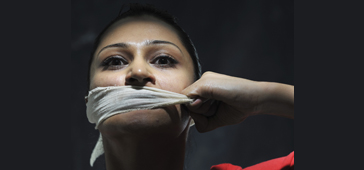 Many of you will recall the protests which emerged in 2004 when Gurpreet Kaur Bhatti went to stage her second play, Behzti. The play, which covered issues such as rape and violence within the setting of a gurdwara, caused an uproar in the Sikh community in Birmingham and was later canceled. Many community members welcomed the decision to cancel the play, while others argued that limiting the playwright’s free speech was actually detrimental to the Sikh community. It was nicely put in a Guardian article stating that, “The dispute became a classic conflict between the artist’s right to freedom of expression and a community’s wish to have their faith treated with dignity.”
The Rep had taken the unusual step of inviting Sikh community leaders to a private preview to air their concerns, after which they agreed not to oppose the play if the setting was moved to a community centre. Bhatti refused. “I wanted to write a play about religious hypocrisy,” she explains, “for which the setting in a gurdwara was non-negotiable. The attempt to establish a dialogue with the Sikh community was well intentioned, but ultimately misinterpreted as an invitation to rewrite my play.” [link]
Gurpreet Kaur Bhatti later found a card among her Christmas mail that read: “Seasons Greetings. This will be your last Christmas. You are a disgrace to the race. Sending you lots of hate.” Bhatti was forced to go into hiding. Behzti sparked protests and death threats, and now the playwright is attempting to address the controversy in her new play, Behud – which translates colloquially as “beyond belief”.
The details are still very sketchy, but it seems that a dera associated with the highly controversial Maan Singh Pehowa was burned down in Sacramento this past weekend. Maan Singh has been accused of rape.
I write this post partially to clarify that it was not at a Gurdwara in Sacramento, as well as to give a place for discussion and thoughts. The police seem to have some indication that the fire was not an accident, although very few details are being provided. Could it be an arson against immigrants? Could it be an accident? Could it involve frictions within the Sikh community in Sacramento? I do not know. I would be interested to hear thoughts, especially from those readers in Sacramento.
A video from the local news about the fire can be viewed here.
 Arundhati Roy, the author of “God of Small Things”, will be in San Francisco on March 26th at Mission High School Auditorium. The event will start at 7pm.
Tickets can be purchased here.
Roy will be reading from her latest collection of essays, “Field Notes on Democracy: Listening to Grasshoppers”.
This reading is a charity event for the International People’s Tribunal on Human Rights and Justice in Indian-administered Kashmir (IPTK). The proceeds will be used to institute the Peace and Justice Grant For Scholarship and the Arts In Indian-Administered Kashmir for those residing in Indian-administered Kashmir. The grant will be housed at the California Institute of Integral Studies in San Francisco.
Dear Langarites,
Over the next few weeks, we will be presenting posts by several individuals who answered our call for additional bloggers. We hope you welcome their writing and openly dialogue with them. Just this past week, you have seen two of our guest bloggers emerge. As a collective decision, several of these bloggers will join The Langar Hall team – your commentary and feedback will help us determine this next phase of our growth. Please join us in welcoming our guest bloggers!
– The Langar Hall Team
Guest blogged by Ajj Kaim
Two of my friends invited me to a Holi party in San Francisco last Friday(03/05/10). They told me the DJ was great and he always played awesome Bollywood/Bhangra music. Being an ardent dance lover this was enough motivation for me to say yes. The venue of the party was Supperclub, which seemed a lot different from any other club that I have been to. Once I was at the venue I found out that the event was organized by Asha (organization which promotes education of underpreviliged children in India) and Trikone (non-profit organization for lesbian, gay, bisexual, and transgender (LGBT) people of South Asian descent) .
Over the past several months I have been accustomed to the crowd at Rikshaw Stop for Non Stop Bhangra party every month so this atmosphere was a lot different for me. The DJ kick started the evening with a good mix of Bhangra and Bollywood music. The regular flow of the party was disrupted by two “artists” who tried to entertain the crowd with tasteless mix of bollywood dance, vulgarity and modern art. I had a hard time understanding what was being appreciated by some of the on-lookers. This break lasted for about 10 minutes and after that DJ Precaution started belting some more amazing tracks. It seemed like a perfect way to unwind after a hectic week at work. And then this happened.
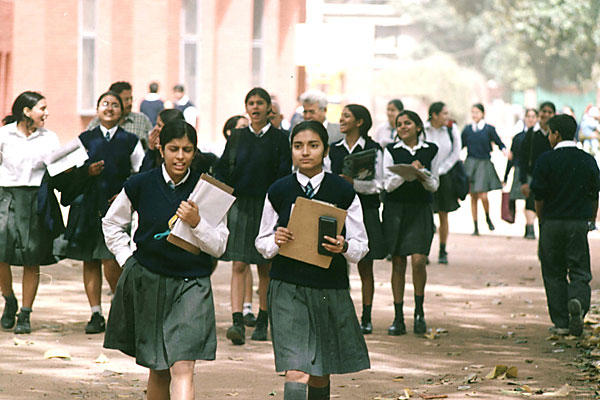 As communities around the world celebrated International Women’s Day yesterday, there were several interesting articles discussing the role of women in the world. Nicholas Kristof wrote about Three Proven Steps to Advance the World’s Women (education, micronutrients, and helping women start businesses). Another article talked about The World’s Best Countries for Women. The Christian Science Monitor discussed Gender Selection – an issue which we have often dialogued about here on TLH. The article talks about the repercussions of sex selective abortion – specifically, the gender imbalance leading to fewer women available to be wives.
Villagers here say that the dearth of females has already had a direct effect on dowry customs: Dowries are getting smaller or disappearing altogether; instead, the onus is increasingly on young men to provide well for their future brides… Baljeet Singh, a 37-year-old truck driver, says he began to despair of finding a local wife once he turned 26. Men in this village, where most are farmers, consider it ideal to wed between 20 and 25. “I’m a van driver, I don’t have many prospects, and it seems that you have to have a very good job to get a bride these days,” he says. So last year, Mr Singh used his life savings to marry a 16-year-old Muslim girl from Assam; though village rumors have it that Sonu Khutum is an illegal immigrant from Bangladesh. She is happy to be living in a predominantly Hindu village, she says, joggling the couple’s 7-month-old baby girl on her hip. But lonely bachelors’ new quick fix, buying brides from impoverished parts of India, seems likely to do little to enhance the status of women. [link]
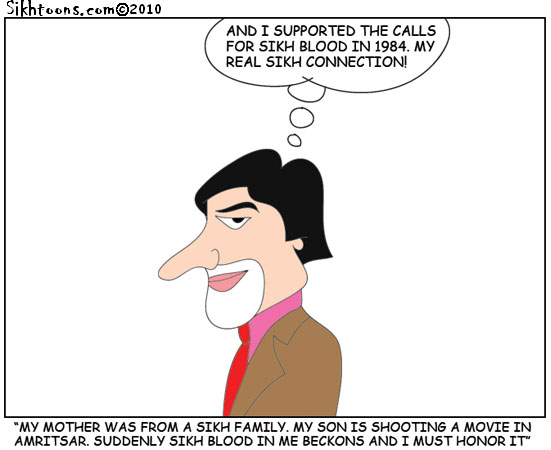 Of some note to Sikhs, members of the Bachchan actor family has caught the fancy of the Indian press in relation to our faith. It started with Amitabh Bachan’s blog post, where he wrote:
Abhishek shoots Bingo in the Holy City of Amritsar and his sister Shweta joins him to pay homage and prayer at the Harmandir Saheb. I wish I could do the same, but am unable to. Soon however I shall find the time. Or as they say in such situations, when the time comes He will call you and providence shall make the right moves and ways to permit us to do so. The Sikh blood in me beckons and I must honor it. It is rather strange, but in the last few months, my attraction and interest towards my Sikh links, attain some prominence and I feel drawn towards it. Two lockets of Guru Nanak ji, Sacche Padsha, are constant on my neck – one a gift from Guddi Behenji my cousin, daughter of my Mother’s elder sister Gobind Masi ji and the other I found as a gift to me that was lying on my desk unnoticed. Now they both adorn my neck. Raj Kanwar, one of Abhishek’s early directors had presented me with a photograph of all the Guru ji’s and they now are with me at my place of worship. I seek blessings from them each morning – ‘Sat Naam Wahe Guru’ , I recite, as I touch their images and a strange sense of fulfillment and strength consumes me.[link]
Now many Indian press website running headlines – “Big B Feels Drawn Towards Sikhism” and the like. New headlines are now coming out about his son – Abhishek – performing seva at Darbar Sahib.
While many Indians and even some Sikhs are impressed, I can’t help but have little care. Maybe it is because of long allegations in the community that have never been dispelled.
Guest blogged by Brooklynwala
This week the South Asian Magazine for Action and Reflection (SAMAR) along with Theaters Against War (THAW), published several letters of support they solicited for Syed Fahad Hashmi, a US citizen who has been held in solitary confinement since May 2007 in the Metropolitan Correctional Center in New York City. That’s right, solitary confinement, debatably a form of torture, for almost 3 years – not at Guantanamo Bay, but in downtown Manhattan. Fahad is awaiting trial and has not been convicted of any crime.
Journalist Chris Hedges wrote, “The case against Hashmi, like most of the terrorist cases launched by the Bush administration, is appallingly weak and built on flimsy circumstantial evidence… If it were a matter of evidence, activists like Hashmi, who is accused of facilitating the delivery of socks to al-Qaida, would probably never be brought to trial.”
I wrote a letter to Fahad last week, which you can read in its entirety below. Check out all the letters published in SAMAR here. To me, there is a deep connection between Fahad’s unjust incarceration and the discrimination and racism we as Sikhs face throughout the world. I hope that more of us get involved in the movement to free Fahad Hashmi and stop the draconian policies of the U.S. government, which continue under President Obama’s leadership.
The Saanjh Sikh Scholarship project is awarding 4 scholarships totaling $6,000 to Sikh students who are graduating California high school seniors or community college students pursuing higher education. The scholarship s are need & merit based. All California Sikhs who are graduating high school seniors starting the first year of undergraduate studies at a 4-year university or community college in Fall 2010 can apply for the scholarships. Also, current community college students who will be transferring to a 4-year university in Fall 2010 are eligible to apply for the scholarship. Go-online for more information at www.saanjh.org/scholarship. The deadline is April 01, 2010 April 15, 2010 by 11:59 PST (and no that is not a April fools joke). 🙂
The Saanjh Sikh Scholarships are one of the projects that came out of Saanjh-The Bay Area Sikh Retreat in August 2009. The project’s mission is to work with parents, students, and community members to encourage higher education for California Sikh students by providing need and merit-based scholarships to selected students entering their initial years of undergraduate studies. Awarding the scholarships to enterprising California Sikh students is a good way to support higher education in our community in an effort to create more human and social capital to address the issues impacting the Sikh Quam.
- Join the Saanjh Sikh Scholarship group on Facebook to stay informed!
- Saanjh Sikh Scholarship Sevadars can be contacted at: saanjhscholarship@gmail.com.
- More details about the scholarship and online application can be found at: www.saanjh.org/scholarship.
The four Saanjh Sikh Scholarships are named after contemporary Sikh activists. More information about them and the amount of each scholarship can be found below the fold.
Amongst the male youth in Punjab, drugs are a serious problem today. With high unemployment rates, and a  history of violence in the region, the environment is ripe for drug abuse. A Punjab government survey found that one out of three male students use at least a form of tobacco. And on a recent trip to the region, as we were driving between pinds, my relatives pointed out the jeeps, distinctive with their black lights, that carried young drug dealers. The young men sitting inside were all in their teens.
In response, Ajmer Aulakh, a well known Punjabi professor and writer has written a play, “Avesle Yudha Di Nayika” (An Unsung War Heroine), that recently attracted a large audience at the Government College for Boys in Ludhiana.
Aulakh is a noted playwright, artist and winner of Sahitya Akademi Award. He has dedicated his life to theatre and generally works on issues and problems confronting the common man. [TOI]
This much-needed play had students riveted, incorporating Punjabi poetry.
The play highlighted the menace of drugs, delineating how a family loses everything to the evil. Jodha Singh, a villager landlord, is survived by his wife and two children. Satwant Kaur, wife of Jodha Singh, wants their kids to go to school and study, but owing to drugs, the family property is lost. The play portrays the consequent struggle. It depicts how she fights odds to enable her children to continue their studies. The play was performed by artists who are part of Lok Kala Manch and was supported beautifully by Punjabi poetry. [TOI]
The young researchers that presented at last week’s Sikholars conference have made their papers available. Until March 15, 2010 they will be available at this link.
If you read the papers, we would love to hear your comments.
International Women’s Day is celebrated on March 8th each year and is a major day of global celebration for the economic, political and social achievements of women. We have previously posted about well known examples of women in our history who have made huge contributions to Sikhi. Perhaps on this day we can take the time to continue recognizing the numerous Sikh women who stood alongside Sikh men to help our qaum. I recently read about twenty Sikh women in a document titled, “Noble and Brave Sikh Women” by Sawan Singh. The author writes,
Bibi Rajinder Kaur and Bibi Sahib Kaur both belonged to the royal family of Patiala state. Their bravery in the battlefields and their skills in administration saved the state from being ruined. Mata Kishan Kaur and Bibi Balbir Kaur took part and suffered in the Akali movement for the control of Gurdwaras. Bibi Balbir Kaur even sacrificed her own life and that of her innocent child in this movement. Bibi Harnam Kaur has done wonders to spread female education among the Sikh women a hundred years ago. Mai Bhag Kaur has proved that Sikh women can lead and organize the Sikh men and win battles. Women martyrs of Shahid Gunj of Lahore like Bhghel Kaur cannot be found in the literature of many religions. Bibi Sharan Kaur and Bibi Shamsher Kaur have proved their skills in the battlefield and in administration. Bibi Anoop Kaur, Bibi Shushil Kaur, Bibi Harsharan Kaur, Bibi Basan Lata and Bibi Nirbhay Kaur have faced odds and sacrificed their lives to save their honor and faith.
The document is a great starting point to begin learning about the immense history of Sikh women that often goes untold. Are there any events in your community being planned for International Women’s Day? How do we, in general, recognize the contributions of women in Sikh history?
On TLH we have addressed various issues effecting the South Asian elderly community. The recent news article in the the New York Times on the difficulties encountered by many Sikh seniors in the California Bay Area was particularly heart wrenching.
In an article in New America Media, Paul Kleyman discusses the impact of depression on ethnic seniors. Many of his statements of seniors feeling alone and depressed resonated with the stories I have heard about Sikh seniors. I have often heard how Sikh seniors feel like America is a “sweet prison”. You have many material benefits, but also a tremendous amount of social isolation. Even when living with their children and grandchildren, the elderly miss their social life back in Punjab. In the US, the elderly spend the majority of their day separated from their children and grandchildren in time and space. Also, generational gaps coupled with cultural differences create social and emotional distance.
Kleyman writes that ethnic seniors are expected to have similar levels of depression as the white elderly population (about one in six people ages 50 and above), but the main difference is:
“… that African-American, Latino, Asian and Native-American seniors are less apt to get treated. That’s because of their higher levels of poverty, lack of insurance or access to treatment and the pervasive stigma of mental illness in many cultures. Left untreated, depression, anxiety disorder and related conditions can result in debilitating physical ailments, as people eat and sleep more poorly and become less physically active. ”
An interesting infographic circulating the Web has many people talking about the relationship between wealth and religion. The graphic, titled The Almighty Dollar, was created by GOOD and Column Five Media and breaks down income levels in the U.S. by religion. Data is based on information from the Pew Forum and it compares the income level of each religion to the national average. From the website: It’s no secret that the distribution of wealth is inequitable in the United States across racial, regional, and socio-economic groups. But there is a distinct variance among and within America’s faiths as well.

If you click on the image above, it will enlarge and you’ll see information broken down by several religious groups such as Jewish, Christian (divided into several groups), Buddhist, Mormon, Muslim etc. You’ll notice that Sikhism is not one of them (not sure why?). There are five income brackets (Less than $30,000 to $100,000+) listed and numbers signifying what percentage of each religious group falling into which income bracket.
Created with Admarket’s flickrSLiDR.
This past weekend was the first annual Sikholars: Sikh Graduate Student Conference. From Toronto and Vancouver, from New York and Boston, some leading young researchers converged upon Stanford University.
Beginning with the topic of the scholar in Sikhi, Harinder Singh creatively discussed the views of scholarship emanating from Gurbani and examples of community intellectuals from Bhai Gurdas to the recently departed Harinder Singh Mehboob.
The opening panel “Beneath the Surface” featured papers from Harvard’s Erik Resly, York University’s Kamal Arora, and University of British Columbia’s Iqbal Kaur. Discussions ranged from the usages of the janamsakhi literature in understanding the Sikh experience, understandings of trauma by the wives of shaheeds in Punjab and widows of the Delhi Pogroms, and issues of perceptions of adolescent suicide by Punjabi Sikh families in British Columbia.
The 2nd panel, titled “Locality: Old and New” saw topics on biodiversity, the role of izzat, and voices from North Delta. Bandana Kaur, Yale University, detailed the changes of Punjab’s ecology during the pre-Green Revolution period; Mette Bach, University of British Columbia, shared excerpts and accounts from her upcoming book about the changing people, lifestyles, and interactions in Punjabi-populated North Delta; Preet Kaur, York University, discussed the understandings of Canadian law by Punjabi Sikh immigrants.
The afternoon session, “Beyond Borders,” saw discussions beyond any national territory. Ajeet Singh of Columbia University provided a critique of the historiography of Punjab/Sikh studies, from the 1960s to the post-structuralist approaches popular among some today. Arvinder Kang of the University of Mississippi discussed his role and the ongoing debates in the promotion of Gurmukhi and Punjabi on the internet today. Mandeep Kaur, University of Texas Austin, gave a literature review of medical research related to the Sikhs. Finally, Harjant Gill, American University (Washington D.C.) concluded the panel with a discussion of Punjabi masculinities as reified and displayed in Punjabi films.
Over 80 community members from throughout California attended the event. Far exceeding the organizer’s expectations, it was standing-room only in this first event of its type – a Sikh graduate conference. Attendees and participants both left excited and exuberant. The event was made possible by the Sikh Spirit Foundation and the Jakara Movement. The Jakara Movement hopes to continue with such programming annually, while increasing its size and scope.
This week, the Wall Street Journal highlighted India’s decision to change some of its agricultural policies, in response to its 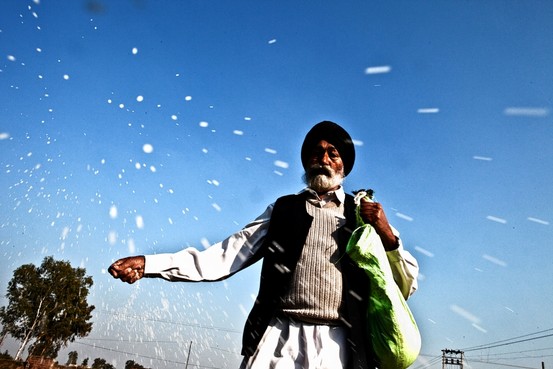 post-Green Revolution crisis. (Hat tip: Bandana)
In the 1970s, India dramatically increased food production, finally allowing this giant country to feed itself. But government efforts to continue that miracle by encouraging farmers to use fertilizers have backfired, forcing the country to expand its reliance on imported food. [WSJ]
Kamaljit Singh, a 55 year old from Marauli Kalan in Punjab, explained:
He says farmers feel stuck. “The soil health is deteriorating, but we don’t know how to make it better,” he says. “As the fertility of the soil is declining, more fertilizer is required.” [WSJ]
Behind the worsening health of the soil is India’s agricultural policy. In it’s effort to boost food production, win farmer votes and encourage the domestic fertilizer industry, the government increased its subsidy of urea over the years, and now pays about half of the domestic industry’s cost of production.

