
“Everybody can be great…because anybody can serve. You don’t have to have a college degree to serve. You don’t have to make your subject and verb agree to serve. You only need a heart full of grace. A soul generated by love. ” – Dr. Martin Luther King Jr.
Last week, in celebration of Dr. King’s legacy, the DC Metro satellite of Kid’s Against Hunger drew volunteers all across the DC, Maryland, and Virginia area for a hugely successful meal packaging event.
Kid’s Against Hunger (KAH) is a non-profit organization with the mission to significantly reduce the number of hungry children in the United States and to feed starving children throughout the world. This is accomplished through partnering with satellite organizations who raise funds, organize volunteers, and arrange events where meal packets (consisting of soy, rice, vegetable blend, and flavored vitamin powder) are filled, sealed, and packed for a population in need. Meals are then transported through KAH’s broad network of humanitarian organizations.
 Something remarkable has been happening over the past week. When an earthquake hit Haiti last week, individuals rallied together to raise awareness via facebook updates and email messages to raise funds and send aid to the devastated area.
In a similar way, the entire Sikh community came together this week to support two Sikh organizations who were competing in the $1 Million Chase Community Giving Campaign. Emails were sent out in support, facebook and twitter updates were constantly being posted, Sikhs were reaching out to each other and also to non-Sikhs to involve them in the process. The potential of building the first Sikh Museum in North America got the global Sikh community excited about the impact a group of committed people can have. Imagine a building dedicated to Sikh history, a place for future generations to pay homage to the deep and meaningful history of the Sikh Qaum. The point is, we no longer have to imagine these dreams. The possibility is real and if we, as a community, can mobilize – there isn’t anything we can’t do.
There is still time to VOTE. All it takes is one click on Facebook to support these initiatives and participate in one of the most notable mobilizations we’ve seen in our community. Voting ends in 24 hours – don’t delay, vote now!
VOTE for Jakara Movement: http://apps.facebook.com/chasecommunitygiving/charities/674186
VOTE for Sikhcess: http://www.sikhcess.org/
Drug abuse is an epidemic that is hitting Punjab at high rates. We hear about Punjabi men being addicted to drugs and the ramifications of their addiction on them and their families.
Prerna Suri of Al Jazeera reports on the devastating effects of drugs in Amritsar. The city’s location near Pakistan and Afghanistan has made it a primary target for drug trade and abuse. According to the report, seventy percent of youth (15-35 years) in Amritsar are addicted to heroin.
Suri highlights how the drug trade happens, its effects on those who abuse narcotics, and the ramifications of drug abuse for the addicits’ families.

I am a strong believer that Sikhi can play a strong role in both the prevention and recovery from drug abuse. Rather than allow drugs to take over our spiritual capital, we can use our spiritual strength to help heal those who are suffering from drug abuse and prevent others from entering this kind of addiction. You can read about one Sikh’s experience of visiting Akal Charitable De-addiction Centre , a drug recovery program in Sangrur, Punjab.
 The opportunity is now. We can make the first ever Sikh Women’s Domestic Violence Shelter.
Did you know a woman is battered in the US every 9 minutes. We cannot stand idle. We must take a stand!
HOW: you need to vote NOW: http://apps.facebook.com/chasecommunitygiving/charities/674186
HOW DO I VOTE: You can only vote if you are a ‘fan’ of Chase Bank Community Giving. If you are not sure how to do this, follow this simple instructional video

WHAT DO I DO AFTER VOTING:
1) Donate your profile picture for 1 week, until January 22nd. Use the purple SILENCE HIDES VIOLENCE on the right.
2) Encourage ALL your friends and family – Sikh and non-Sikh to vote by inviting them to this group, messaging them on Facebook chat, and telling them you will not leave them alone until they vote.
We are currently behind in the numbers, but if everyone on this list takes 20 seconds out of their time to vote, we will be in first place. IT ALL DEPENDS ON YOU!
For more information, visit www.end-dv.com
We can do this together! Only together! Inspire and be inspired!
Gur Fateh!
Happy Lohri! 
Lohri is celebrated around January 13th every year. In Punjab, it marks the beginning of the harshest part of winter. Here’s what you need to get started with your celebration: a giant bonfire, popcorn, sweets, and songs about Dulha Bhatti, a robber who helped the poor.
Lohri is usually celebrated in the outdoors by friends and family who get together and have a bonfire in the evening. Lohri signifies onset of intense winter in Punjab and surrounding areas. Cold weather is good for wheat hence farmers celebrate Lohri so that their crops lead to a good harvest.
During the day, children go from door to door singing folk songs in praise of Dulha Bhatti, a thief in folklore who helps the poor and fights for their rights. These children are given sweets and savories, and occasionally, money. These collections are known as Lohri, and they are distributed at night during the festival. Some may be offered to the sacred fire. Peanuts, popcorn and other food items are also thrown into the fire as an offering to the God of Fire, Agni. [wikipedia]
Usually, in Punjab, families have an especially large Lohri celebration if a boy has been born in the family in the prior year. We’re talking DJs, catered food, and dancing all night in the streets (at least in the city).
This year, you can make Lohri special by donating to Ladoos: Pink & Blue.
Religions derive their power and popularity in part from the ethical compass they offer. So why do so many faiths help perpetuate something that most of us regard as profoundly unethical: the oppression of women? [NYT]
An op-ed piece in the NYT, by the notable Nicholas Kristof, looks at the way many religions perpetuate and sanctify the oppression of women. He discusses that many abuses, such as mass rapes, arise out of a social context in which women are considered second-class citizens and argues that this social context is something religions have helped shape rather than fought hard to change. Kristof wrote this op-ed after listening to former President Jimmy Carter’s speech to the Parliament of the World’s Religions in Australia last month.
Mr. Carter, who sees religion as one of the “basic causes of the violation of women’s rights,” is a member of The Elders, a small council of retired leaders brought together by Nelson Mandela. The Elders are focusing on the role of religion in oppressing women, and they have issued a joint statement calling on religious leaders to “change all discriminatory practices within their own religions and traditions.”
 Sikh history is about to be made in North America. In December, throughout the United States, 500,000 nonprofit charities competed on a competition on the popular internet website, Facebook, for the Chase Bank Community Giving contest. The top 100 groups advanced to the second round for a chance at 1 million dollars.
Out of the top 100 groups, a Sikh youth organization was amongst the top 20. That Sikh youth organization was the Jakara Movement. The Jakara Movement has hundreds of volunteers throughout California and has been organizing Sikh conferences, retreats, camps for the youth for the past 10 years. Now they have a unique opportunity for seva for their community. The Jakara Movement has publicly committed that funds won will go towards the building of a historic Sikh Museum in North America.
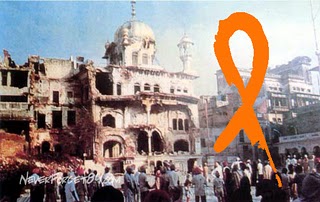 Guestblogged by Joo Kay Singh
I’ve just spent the past hour watching 1984: A Sikh Story on BBC1 in the UK, and came away mildly disappointed, but not altogether surprised.
The documentary was framed as a “personal journey” for the presenter, Sonia Deol, to “unravel the events of 1984, an iconic year for Sikhs”, and informs us that “the bloody aftermath that followed [of Indira Gandhi’s assassination] so shocks Sonia that she is forced to reappraise the depth of her commitment to her faith”
For the first part of the program, we were served up with interviews mainly with Mark Tully and K.S. Brar who sounded like they were both regurgitating paragraphs from their respective books on the subject on the background to the Invasion. Sant Jarnail Singh was given the usual ‘congress stooge turned bad’ treatment by both, and the Darbar Sahib invasion covered without a hint of investigative journalism. Sonia failed to enquire why 37 other gurdwaras were attacked on the same day, if as per Tully and Brar’s insistence, Indira Gandhi was merely interested in Sant Bhindrawale. She similarly fails to question either of the men on the timing of the attack, on why the entire state of Panjab was placed under curfew, the expulsion of all foreign media, or the killings of pilgrims by the Army.
For our TLH readers in the UK – this documentary is premiering tonight on BBC One at 10:55pm.
Just over 25 years ago, the storming of The Golden Temple, the most sacred of Sikh shrines, by the Indian Army led to protests around the world. Sonia Deol embarks on a personal journey to unravel the events of 1984, an iconic year for Sikhs. It culminated in thousands of deaths including the assassination of the Prime Minister, Mrs Indira Gandhi. The bloody aftermath that followed so shocks Sonia that she is forced to reappraise the depth of her commitment to her faith. [link]
As with every retelling of this part of history, the question is whether the documentary will be controversial. One article suggests the BBC may be stirring up a “hornet’s nest of controversy,”
[It] is likely to prove controversial with some Sikh groups because of its portrayal of the militant Sikh preacher Sant Jarnail Singh Bhindranwale. It is also likely to draw the ire of the Indian government for its story on how it reacted following the assassination of Indira Gandhi. [link]
Nevertheless, this is an event that has often been ignored in international media – so i’m sure many in the community will welcome the coverage. If any of TLH readers do happen to catch the show tonight, please share your thoughts!
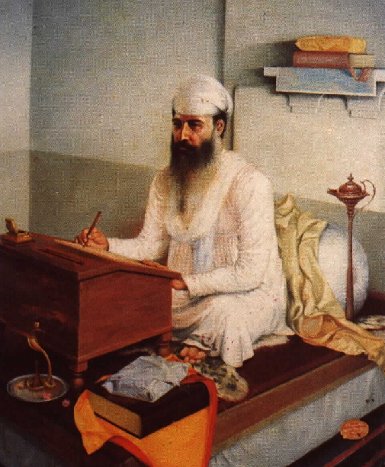 Months ago we announced the first Sikh graduate student conference – SIKHOLARS, being hosted by the Jakara Movement and Sikh Spirit Foundation.
Today, the confirmed participants have been announced:
- Ajeet Singh Matharu, Columbia University, History, N/A
- Arvinder Singh Kang and Amanpreet Singh Brar, University of Mississippi, Computer Science, Extending Gurmukhi Script into Twenty-first Century & Beyond
- Bandana Kaur, Yale University, Environmental Management, Reclaiming Natural Histories: Biodiversity and Landscape in Pre-Green Revolution Punjab
- Erik Resly, Harvard Divinity School, Divinity, (Re)figuring the Sikh: Theodicy, Discipleship and Narrative in Ethical Perspective
- Harjant Gill, American University, Anthroplogy, From Putt Jattan De to Munde UK De: The Transformation of Masculinities in Punjabi Cinema
- Iqbal Kaur Gill, University of British Columbia, Counseling Psychology, First Generation Canadian Punjabi Sikh Parents Beliefs about Adolescent Suicide and Suicide Related Behaviours
- Kamal Arora, York University, Social Anthropology, The Politics of Pain: Gender, Mourning and the Punjab Crisis
- Mandeep Kaur, University of Texas (Austin), Nursing, The Sikh Patient: A Review of the Nursing Literature
- Mette Bach, University of British Columbia, Creative Writing, The Changing Faces of Suburbia
- Preet Kaur Virdi, York University, Socio-Legal Studies, Silence: Resistance or Acquiescence? Sikh women’s perspectives on Canadian law
A thorougly diverse and intriguing display of scholars. We eagerly await for the conference. We hope others can attend February 20, 2010 at Stanford University.
For more information and to read the abstracts, see here.
- Ajeet Singh Matharu, Columbia University, History, N/A
- Arvinder Singh Kang and Amanpreet Singh Brar, University of Mississippi, Computer Science, Extending Gurmukhi Script into Twenty-first Century & Beyond
- Bandana Kaur, Yale University, Environmental Management, Reclaiming Natural Histories: Biodiversity and Landscape in Pre-Green Revolution Punjab
- Erik Resly, Harvard Divinity School, Divinity, (Re)figuring the Sikh: Theodicy, Discipleship and Narrative in Ethical Perspective
- Harjant Gill, American University, Anthroplogy, From Putt Jattan De to Munde UK De: The Transformation of Masculinities in Punjabi Cinema
- Iqbal Kaur Gill, University of British Columbia, Counseling Psychology, First Generation Canadian Punjabi Sikh Parents Beliefs about Adolescent Suicide and Suicide Related Behaviours
- Kamal Arora, York University, Social Anthropology, The Politics of Pain: Gender, Mourning and the Punjab Crisis
- Mandeep Kaur, University of Texas (Austin), Nursing, The Sikh Patient: A Review of the Nursing Literature
- Mette Bach, University of British Columbia, Creative Writing, The Changing Faces of Suburbia
- Preet Kaur Virdi, York University, Socio-Legal Studies, Silence: Resistance or Acquiescence? Sikh women’s perspectives on Canadian law
Where do the elderly fit into India new modern image? Often in South Asian families, caring for the elderly is not a question-it will happen. In West we know of the many stories of how the elderly are mentally, physically, and 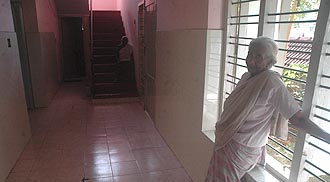 emotionally abused by their children. Often the elderly are forced into starting their life over again in a new country coupled with the strain of supporting themselves at an age when they can no longer work and are socially dependent on their children.
However, in India, we are told it’s not the case. Families care for their elderly-some are even forced to because all the property is in their elderly parents names. But New America Media reports that the number of elderly left to care for themselves in India is skyrocketing and the country has no infastructure to care for them. For example, with an aging population of 80 million, Indian old age homes do not accept patients with dementia. Dementia is a common problem that afflicts the elderly.
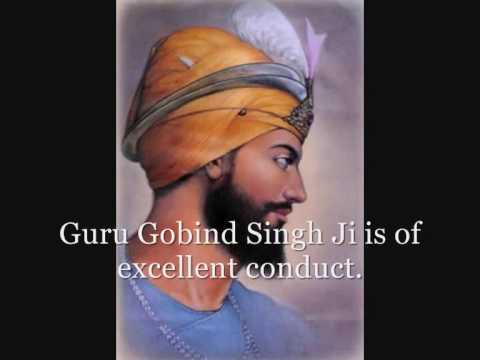
Today, January 5th, Sikhs around the globe will come together to celebrate Guru Gobind Singh Ji’s gurpurab. On this day we celebrate our Guru and the gift that was bestowed upon us. Guru Ji’s famous quote tells us that living as a Sikh is as much important as appearing as a Sikh and that with both, hand in hand, we are a Sikh of the Guru.

The shabad below, Nasro Mansoor, was written in persian by Bhai Nand Lal Singh. It’s beautiful! Gurpurab greetings to all!
A few weeks ago, Maple Leaf Sikh said that “We often lament the state of our gurdwaras but we should just as often stop and think about how much we have accomplished.” How very true! How often do we highlight communities where things are working well for the Sikh diaspora? 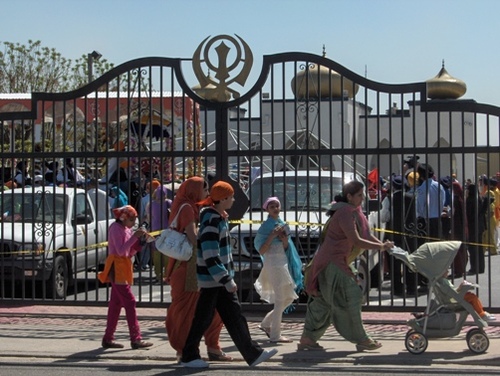 A recent article tells us how a small town in Central California, Livingston, is helping to bridge a gap created by a cultural, linguistic and religious divide between generations. Recognizing that language is the link to religion for Sikhs, the sangat in Livingston has ensured that children in the area have the opportunity to attend Punjabi classes and learn the language.
There’s a lasting link between the 35-character alphabet used to write Punjabi and the Sikh religion. The Sikh scriptures and the Punjabi language of many Sikhs were written in a script known as Gurmukhi. So to be fully initiated into the religion, you must know how to read it… Tripat Grewal, who helps teach Punjabi language classes, said that for many Sikhs the fact that their children couldn’t understand what was being said in the temple was at the heart of the effort to create Punjabi-language classes. “The religious part was very important,” she said. [link]
When the space at the local Gurdwara became too cramped, the leaders secured classroom space at a local elementary school. While these efforts aren’t the first of its kind, it’s always great to hear a community coming together to address a need. For those of us who are familiar with the small towns scattered across central california — these punjabi classes are vital to bridging the divide between generations. With large immigrant populations and many living in joint families – being able to communicate effectively with one another is and will continue to be an important part of the diaspora.
 Earlier I described the success of Sikh organizations in a competition being held by Chase Bank Community Giving on Facebook.
Now the second round manifesto for the 1 million dollar grand prize has been publically announced.
The Jakara Movement is publicly committed to use ALL money for the construction of 2 projects – the first North American Sikh Museum AND the Mata Gujri Women’s Center and Domestic Violence Shelter.
By voting for the Jakara Movement from January 15th-22nd, you will make this a reality.[link]
Wishing all our TLH readers a happy and prosperous New Year! May Waheguru continue to bless you with wisdom and strength in 2010. We appreciate your support. Without your readership TLH would have no real existence. Thank you and always stay in Chardi Kala!
Our resolution this year is to provide thoughtful and engaging posts.
What are your new year resolutions?
This time, Bollywood actually picked an interesting lens through which to depict life in a Punjabi-Sikh household. An 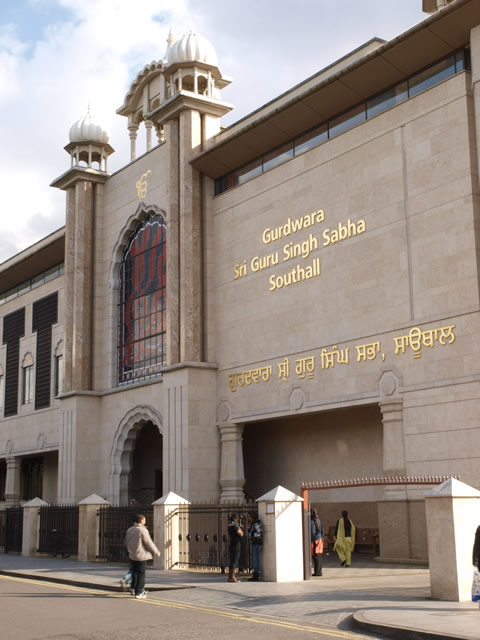 upcoming movie, Patiala House, is a look at cross-generation cultural assimilation in Southall.
At heart, says Nikhil, Patiala House is a father-son story. “Like Billy Eliott where the father is a coal miner but the son wants to be a dancer. In my film, Rishi Kapoor feels his dreams as a Sikh immigrant in England are being destroyed by his son. But the son Akshay Kumar has his own dreams to pursue.” [TOI]
How we view our 2 pronged identity of Punjabi-Sikhism, and how each is depicted by outside communities such as Bollywood is often, understandably and rightfully, a controversial issue. But Patiala House seems only superficially concerned, if at all, with the Sikh identity.
The filmmakers met with Sikh elders at the Southhall Gurdwara, where cameras are ordinarily not allowed, to talk about the ideas behind the film. The film partly takes place during Southhall’s 1979 race riots, which many of the elders had lived through.
Update: The SWAT team provided an update on their progress. See end of post.
The Sikh Welfare Awareness Team is a new charitable organization in the UK focused on bringing awareness to drug and alcohol abuse in our community and reducing involvement in crime by providing youth with activities and organized events to participate in. The organization’s primary goal is “to establish relationships amongst the youth and… aim to bring together the local Sikh Community and focus on projects which benefit the youth of today.” I came across information about this organization after viewing a troubling YouTube video about homeless Sikhs (since the video below has been made private by the owner, log on and you can also watch the videos on Facebook). The Sikh Welfare Awareness Team (or S.W.A.T.) is currently working to bring awareness to the growing number of Sikhs, many who are recent immigrants from Punjab and are homeless living on the streets of Southall.

A few months ago, RP Singh wrote a very timely post on compassion and what it means to Sikhs. In Gurbani, the word Daya often translates to compassion, a trait which is long known in our history. One of the Panj Pyara or beloved five was Bhai Daya Singh and thus, Compassion along with Justice, Courage, Discipline and Leadership are important elements of the Khalsa.
As a reminder of this and as we get ready to begin a New Year – I wanted to share with you the Charter for Compassion – “a call to bring the world together.” It is stated that, The principle of compassion lies at the heart of all religious, ethical and spiritual traditions, calling us always to treat all others as we wish to be treated ourselves. Compassion impels us to work tirelessly to alleviate the suffering of our fellow creatures, to dethrone ourselves from the centre of our world and put another there, and to honour the inviolable sanctity of every single human being, treating everybody, without exception, with absolute justice, equity and respect. [link]
I would encourage you to watch the video below and sign the charter. It might be a passive form of activism, however, let it be a nudge to hold ourselves accountable in the coming years – to live compassionately and emulate Sikhi in one of it’s purest forms.

 The events following the June elections in Iran continue to reverberate. The allegations of widespread election fraud led to hundreds of thousands of Iranian youth to take to the streets and asking “Where’s My Vote?”
A regime unable to answer its citizenry and an escalating use of repressive tactics has led many to begin questioning the legitimacy of the government. Born out of a revolution in 1979, a generation has grown up on legitimizing the current regime through understanding of the tyranny of the Shah’s. However, the tactics unleashed in the wake of the elections has shifted the public from asking about votes to calling for the ouster of the Supreme Leader. Khamenei has none other to blame than himself through his partisanship in siding with Ahmadinejad, rather than standing above the fray.
A few weeks back, while skimming through the news, I found an interesting report on Canadian Prime Minister  Stephen Harper’s recent visit to the Darbar Sahib in Amritsar. Although I didn’t care much for the hoopla around his visit, I did find it interesting that he “offended” Sikhs by refusing to accept parshad or langar.
As I understand it, the preparation of parshad (grace) is unique in that it is ceremonially touched by a kirpan (kirpan bhet), which serves as an indication of the Guru’s acceptance and blessing. It is then distributed to 5 Amritdhari Sikhs representing the Guru Khalsa Panth. A Sikhs’ consumption of parshad displays a submission to the Guru. So accepting parshad is essentially “accepting His grace.” I’ve also been taught that parshad should be distributed after the hukamnama is read, as accepting parshad symbolizes acceptance of the hukamnama.
Now, whether or not Sikhs themselves understand the hukamnama, or even listen to it is another post for another day – but, if accepting parshad is accepting the Guru’s hukam, should a non-believer accept it? Although the Rehat Maryada states that parshad should be offered to everyone equally (as it should), should we be offended if someone rejects it? If a non-Sikh understands the meaning behind our practice and politely refuses it out of respect, shouldn’t we appreciate it instead?
I remember years ago at a Sikh Day Parade in Washington DC, as a handful of us were walking through the sidewalks handing out “Who are the Sikhs” pamphlets and answering questions from onlookers, an elderly BibiJi was darting through the crowd distributing parshad to random strangers. As shocked as I was to see this, it couldn’t compare to the shock on the face of those who received it. Most were not sure what to do with it, or joked about it with their friends, while others were seen throwing it away. I’m sure the BibiJi’s heart was in the right place, but what were we hoping to accomplish by this?
My question is…how can we value our traditions if we don’t even understand them?
And if we don’t value our traditions, how can we expect others to?
Continue Reading »

