
25 seconds of your time could lead to $25,000 for your community. Don’t get Billa angry!

Vote for ALL Sikh organizations. You get 20 votes! For links to the groups and directions on how to vote click here.
Please help spread this video to all your friends and family! Most importantly, make sure they follow Billa’s advice. GET OUT AND VOTE! Brothers and sisters, Singhs and Kaurs throughout the world – WE NEED YOUR VOTES and SUPPORT!
The exciting part 2 will be released later this week – exclusively on The Langar Hall.
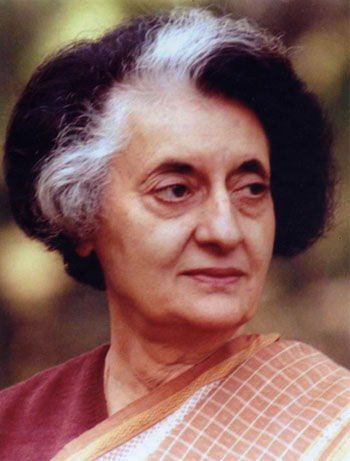 It was only a matter of time. Indira Gandhi created many myths during her tyranny. She created the myth of herself as ‘Kali’, the goddess of destruction following the war in Bangladesh in 1971. She created the myth of herself as “Mother India”, with a strong matriarchal love and care for her subjects. However, the most important myth that she helped create that has long captivated western audiences was the foundational myth of India’s independence – the nonviolence of Gandhi.
Richard Attenborough’s Gandhi is one the most well-known films about the subcontinent. In 1982, the movie was awarded the Best Picture by the Academy Awards. Ben Kingsley, who played Gandhi, and the director, Attenborough, also received individual credits. However, few have ever delved into the politics in the movie’s creation. In many ways, we find ourselves far removed from the world of art and into the territory of propaganda.
The funding of the Gandhi was highly unusual. Fully one-third came directly from the national treasury – could we ever contemplate money coming directly from the Treasury Department to fund a commercial, errr I mean movie? Propaganda at its best requires whitewashing and in the film we see a guiltless Nehru, the evil villain Mohammad Ali Jinnah, and a de-Hinduized Gandhi, without patriarchy, caste prejudices, or hypocrisy.
It was to be expected as the screenplay was checked and rechecked throughout the whole process, often directly by the then-Prime Minister, Indira Gandhi herself. Many noted that the opening credits of the film should have had the message: “The following film is a paid political advertisement by the government of India.”
I leave out a discussion for M. Gandhi for now, but will hope to take it up later. For now, we focus on the film. The success of the movie in terms of cultural capital cannot be emphasized enough. It was this movie that helped solidify the myth of India as related to Gandhi – overthrowing colonial rule, nonviolent, and wedded to the belief of equality for all. Indira Gandhi’s purchase still continues to reap rewards for India almost three decades later.
We now get the sequel.
Many politicians in America and Canada appeal to their Sikh constituents by visiting local Gurdwaras. Sometimes these visits include a brief speech and other times just a saroopa. Regardless, it’s usually an ask for votes.
What I particularly find powerful about Canadian politicians is that they will walk along side their Sikh constituency during Nagar Kirtans and visit the Harmandir Sahib. To me that is representative of the political power the Sikh community has in Canada. Politicians are not only appearing to give a “vote for me” speech or state a “thank you” for the saropoa. They need to do more to get the Sikh vote.
Sam Grewal of the Toronto Star writes:
“The Liberal party took us for granted and is now paying the price,” Gill says. “It would be a mistake for the Conservatives to think that simply appearing at functions is enough to win votes.”
An appearance by the Prime Minister, at the place most revered by Sikhs, may be the exception.
Almost two years ago I blogged about an NPR story that highlighted the issue of Runaway Grooms. Today, I once again write about the same issue – this time the media terms it “Holiday Brides” – a different name telling the same story. We should be outraged that years after we first heard about this issue, we are still having the same conversation. We are told that about 20,000 women have been deserted by men in the UK, US and Canada who promise to return to India and never do. The most recent questions is then, why are Punjabi women still falling for this obvious scam?
In a dusty village in the Jagraon district of Punjab, northern India, 35-year-old Suman (which is not her real name), lives with her widowed mother in a small room in a crumbling building. Four years ago, the secondary school teacher married a British man in a wedding arranged by relatives. Shortly after the ceremony, her husband, who is in his 50s, left for London with the promise he would send for her. At first all appeared to go well. “He would visit two to three times a year. “Whenever he came to India, we had a good time,” she said. However, on one visit he claimed her application for a spousal visa to the UK had been refused. It was like being a prostitute you take along and have a good time with and then leave behind ‘Suman’, 35 “He told me he had applied for an appeal. “But he has never shown me a copy of that appeal. He’s never shown me any documents.” The visits and calls ended, and for the past six months Suman has had no contact with her husband. “In hindsight, it was like being a prostitute you take along and have a good time with and then leave behind. [link]
 3 clicks are all it takes. JPMorgan Chase Bank partnered up with Facebook to have sort of an “American Idol” of charity giving. The 100 charities with the most votes by December 10th will receive $25,000.
CLICK HERE to vote for the Jakara Movement.
There are a great number of Sikh charities that are participating. The Jakara Movement has the most votes for the Sikh groups – and needs your support to bring $25,000 to our community to support projects by the Sikh youth. This weekend alone, the Jakara Movement had 6 events. There were 5 camps, titled, “A Nation Never Forgets” that were hosted in Los Angeles, Turlock, Stockton, Yuba City, and Orange County. Here are some pictures from just one.
In the Bay Area, the Jakara Movement helped host the forum “Women and 1984”, bringing scholars and activists such as Cynthia Keppley Mahmood (author of Fighting for Faith and Nation and a champion for human rights), Navkiran Kaur Khalra (daughter of the late Shaheed for human rights, Jaswant Singh Khalra), and Jasmine Kaur (a human rights lawyer and member of ENSAAF).
To keep programs, like this going – WE NEED YOUR HELP. We are asking for ALL Sikhs – whether in the US, UK, Canada, India, Punjab, Malaysia, Australia, Africa, and beyond to rally around the Sikh organizations and provide your support. Get your non-Sikh friends to vote too!
Log into Facebook and click HERE to vote for the JAKARA MOVEMENT. And with your 20 votes, do not forget to vote for other great Sikh organizations (ENSAAF, SALDEF, and many others) too. Inspire and be inspired; together, we are the movement.
Please forward and circulate this widely. We Need the Entire Community to Rally Behind the Sikh Youth!
Last weekend I attended the Sikh Lens Sikh Art and Film Festival in Hollywood. I have attended film festivals all over North America and strongly believe in their need and presence in our community. Many times, however, the events get overshadowed by the glitz and glamour – the red carpet, the photographers, the eccentric outfits… I was therefore grateful that my experience at the Sikh Arts and Film Festival was a fulfilling one – I left knowing that Sikh Arts and Films bring value to our community and need to be supported. In addition, I felt the organizers made a special effort to keep the event focused on the directors, artists, musicians, actors, authors and organizations who were present. They recognized the fact that we are all in this together. Sikh Arts and Films are only beginning to be acknowledged, there is so much potential and growth that will still occur. However, this isn’t going to magically happen overnight, and it most definitely won’t happen without the community’s support.
 I was recently told that Sikhs in the UK spend 7 times more on license plates than they do on books (yes, 7 times!). While I’m not sure of the statistic in the US, the point is clear – perhaps we’re not investing in the right places? I think as a community we have begun to establish the need to support non-profit organizations that are working to address human rights, legal, education and activism issues (although we still have a long way to go to enhance our support). However, what goes hand in hand with this is the support and advancement of Sikh Art and Media. Without a doubt, events such as Sikh Lens are helping to pave the path – however, we as a community need to ask ourselves why we are so hesitant to spend money on independent films, children’s books, on historical references and on paintings. When I think about other immigrant communities, I notice that their advancement as a community comes from their support of one another. Whether we like to admit it or not, our community is extremely frugal and competitive with each other, and unless we start to move away from those stereotypes – we will not be creating a better world for our children.
 I was really moved by this audio essay from Cecilia Muñoz titled “A Little Outrage Can Take You a Long Way” on NPR’s This I Believe segment.
In her reflection on activism, I connected with the statement about defeats outweighing victories, and how it motivates her to continue her work. Like many of the TLH readers, I too take time out my schedule for service activities. And after serving 100 or so meals at a homeless shelter, I go home feeling good about myself and the good deed I had done. Unlike Muñoz, I don’t stay awake thinking of the 100 or so people who were turned away that day at the shelter, or those who wouldn’t have a place to sleep that night. Maybe this is what separates me from real activists. To me, service has become an event or an activity – for an activist, service is a part of their life…part of who they are. They are constantly looking for ways to serve.
And I agree with Muñoz, “a little outrage can take you a long way.”
Although I don’t believe Guru Nanak was motivated by anger, I do believe he was outraged. Outraged by a society complacent with the rigid caste hierarchy, outraged at the imbalance of justice, and outraged by the barbaric methods of the State to suppress a minority. You can almost hear the outrage, when Guru Sahib describes the horrific events of Babar’s invasion:
Two great events are happening this Saturday: in San Francisco- “Women in 1984”; in New York- Lahir.
If you’re anywhere near either of these 2 cities, you better be there, or you’ll regret missing out!
Women in 1984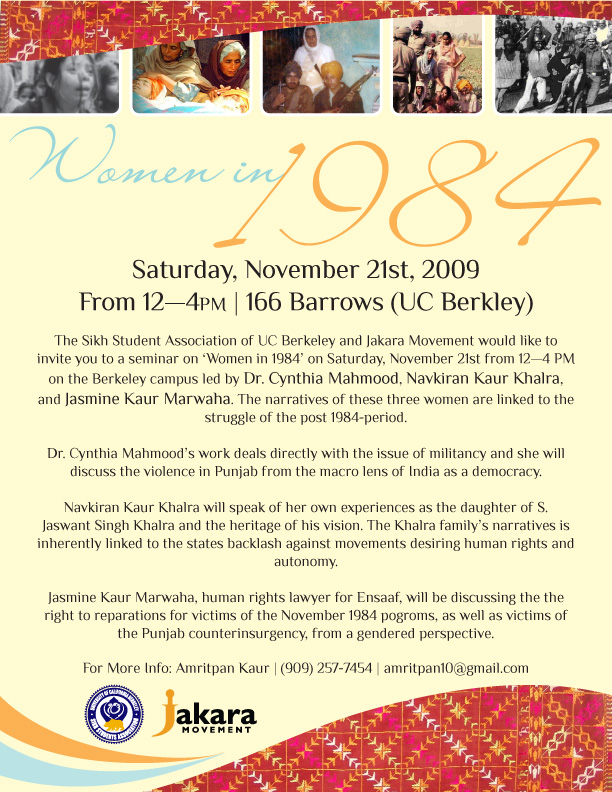
Dr. Cynthia Mahmood’s work deals directly with the issue of militancy and she will discuss the violence in Punjab from the macro lens of India as a democracy.Navkiran Kaur Khalra will speak of her own experiences as the daughter of S. Jaswant Singh Khalra and the heritage of his vision. The Khalra family’s narratives is inherently linked to the states backlash against movements desiring human rights and autonomy.Jasmine Kaur Marwaha, human rights lawyer for Ensaaf, will be discussing the the right to reparations for victims of the November 1984 pogroms, as well as victims of the Punjab counterinsurgency, from a gendered perspective.
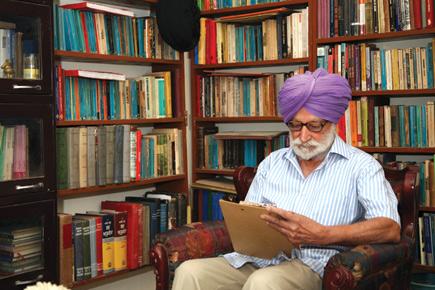 To be or not to be? Well, apparently for Surjit Singh Hans – it is to be. Hans, an academia based in Mohali, is undergoing the feat of translating Shakespeare’s work into Punjabi. Hans retired from Guru Nanak Dev University in Amritsar, where he had once been head of the department of history having done extensive work on Sikh literary sources and in particular the Janamsakhis. He has been working on this task for the past sixteen years.
The translation follows the original line by line—you want to locate line 20, Act II, scene (i), in the Arden edition of Hamlet, all you have to do is look at the corresponding line in the translation. The iambic pentameter of Shakespeare has given way to the chaupai in Punjabi, but what matters is that these lines are almost as resonant in Punjabi as they are in the original English. They work well when read aloud, as Shakespeare is meant to be, and there is little here that a Punjabi can’t take to heart. Indeed, the heavy-headed revelry ‘takes from our achievements, though performed at height’. [link]
As for how well Shakespeare’s work translates into Punjabi, Hans suggests that King John could parallel the story of Aurangzeb and Two Noble Kinsmen could be a scene out of a Punjabi village (two men, one girl – hardly promising).
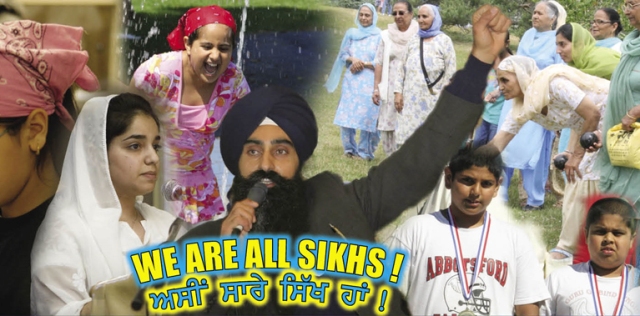 Although Gurdwara elections are usually not celebratory topics, the news surrounding the Guru Nanak Sikh Gurdwara in Surrey is especially noteworthy. We have covered the topic in the past a few times and the results seem to be in (again). The Youth Slate wins (again).
An overwhelming reason the story is worthy of discussion is due to the Canadian national media own interference and frequently call for Sikhs to vote against the “fundamentalist”/”conservative” slate. Statements such as these were far too common:
If elected, a slate of Sikh youth fundamentalist candidates could overturn a long moderate tradition of using tables and chairs for temple mealtimes.[link]
Well the community decided again and returned the “fundamentalist” candidates. I wonder if the Canadian media has ever delved and chose sides and support in church elections in the past? For some reason, I have a feeling this is rather a unique scenario. Although the media may not like the results the community speaks for itself.
The new committee under Bikramjit Singh will have a lot of work to do. They hardly built confidence after the last election, when it was discovered there were irregularities in their nomination processes. Still their agenda is broad and may have long-term ramifications in Surrey.
Regardless a victory of the community over the Canadian media’s portrayals and desire for specific results. Now we wait and see. The real work is about to begin.
Flu season along with H1N1 are in full swing right now. We worry about catching it at schools, in airports, and work. Often we hear of recommendations for people to stay home if they are sick so they don’t infect their co-workers and give themselves time to get well. However, for some staying home when you are sick comes at a large cost-a day(s) worth of wages. According to the Union Voice, “Thirty-nine percent of us have a difficult choice to make when we’re sick: go to work and risk infecting our co-workers (and risk making our illness worse), or stay home and put our finances and our jobs in jeopardy”. (hat tip: Sonny)
Thus, Senator Chris Dodd and Rep. Rosa DeLauro are pressing forward the passage of the Healthy Families Act, which was first introducted by Senator Edward Kennedy.
The Healthy Families Act would provide 7 paid sick days to all workers at companies with at least 15 employees, and would prevent employers from retaliating against workers who get sick. The bill has 113 sponsors in the House and 21 sponsors in the Senate, and has been endorsed by the Obama administration.
This bill would ensure that 3/4 of workers in the food and service industry who do not get paid sick days will be able to stay home rather than come into contact with their co-workers and the public. Taking action to pass this bill will be a positive step forward in fighting the spread of H1N1.
TAKE ACTION NOW by clicking here and sending your congressional representative an e-mail asking him/her to support this bill.
By neglecting art, we’ve been neglecting our spirituality. And perhaps vice versa. Perhaps we could practice receiving a little more, instead of doing, as we normally do.
Most of us, especially in Asian communities that so highly value scientific endeavor, and want the next generation to all be doctors, grossly undervalue art. Sadly, this might be stunting our spirituality.
How often have your teachers, parents, and other adults in your life impressed upon you the importance of active effort, purposeful thought, and discipline? The scientific methods we rely upon to explain our environments and the universe all rely on these traits and oh-so-important- rationality. Through decades of education, we’re pounded into submission, learning to accept that rationality is good, and irrationality, bad.
But that’s not entirely true. And in the last week, I noticed that both Japji Sahib and a popular American site (especially amongst techies) bypassed rationality to focus on the importance of a different kind of knowledge – intuition. And it rang true. Intuitively. Irrationally.
From the 13th Pauri of Japji Sahib:
Kash Gill, who grew up as a farm worker, will be sworn in today as Yuba City’s first Punjabi-American mayor. As many of you know, Yuba City (often referred to as the pindh of California), has a large Punjabi Sikh population. Just last weekend, 75,000 people gathered in Yuba City for the annual Nagar Kirtan. It is perhaps not surprising, therefore, that finally a Punjabi-American will be taking the seat of mayor. The event does, however, signify a signficiant step for a community that makes up about 12 percent of the population in Yuba City. The story also embodies the dream, which many immigrant communities carry with them – that by working hard and perservering, anything is possible.
“You’d never think you’d be picking peaches one day and the next day you’re the mayor of Yuba City,” he said. “That’s why we call it the land of opportunity.” After moving to the United States when he was 3 years old, Gill’s parents stressed that education was the path to leaving the life of farm laboring. [link]
Gill said his priority will be to improve flood protection for the community, reduce gang activity and offer opportunities for young residents. It should be added, that in Yuba City the mayor is chosen on a rotation system and while many of the comments (in the linked article) do discuss his Punjabi-American background, many more are focused on discussing his priorities and how they will benefit the people of Yuba City – as they should be.
Note: The Appeal-Democrat is hosting a live streaming video tonight of City Councilman Kash Gill being sworn in as mayor of Yuba City at www.appealdemocrat.com.
 This weekend Sikhlens will be presenting its annual Sikh Art and Film Festival 2009. The film festival showcases the best in Sikh movie-making talents from around the globe. It also presents a forum for aspiring Sikh artists to also come and display their burgeoning talents. A few book launches are planned with a particular emphasis on children’s books. Authors of A Lion’s Mane and The Royal Falcon are planned to be in attendance to do a live reading.
The inaugural Sikh Art and Film Festival will be held at the historic Egyptian Theatre in Hollywood, CA on November 13-15th.
In previous articles on The Langar Hall, I have written about how certain Sikh-film haters groan in jealousy and spew hatred, about the Sikhs’ taking advantage of new forms of media. Such efforts in the community should be encouraged and more platforms created.
The weekend features a number of different clusters, highlighting issues on the youth, creative Sikhs, short films, feature films, and even Remembering 1984. The Remembering 1984 cluster on Sunday afternoon will be co-hosted with the Jakara Movement in conjunction with it’s Visions of Truth film series.
So whether you come for the entire weekend, make it out to just one cluster (at $15 pre-sale, you won’t find a better price), or at least to Sunday’s mela, check the schedule, check out the films, and make sure you come out and support Sikh arts! We’ll be in attendance and will post on our experience after the event.
 Guest Blogged by: Harinder Singh
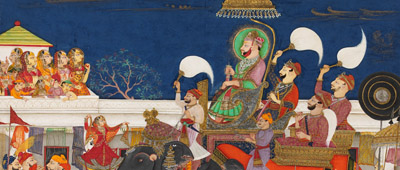
Last week I walked into the first exhibition to “comprehensively” explore the extraordinarily rich culture of the maharajas. “Maharaja – the splendor of India’s Royal Courts” is the feature exhibit at the Victoria & Alberta Museum in London and will be available through mid-January 2010. It was Susan Stronge, senior curator at V&A and friend of the Sikhs, who literally showed me the way to the V&A after a candid conversation over cafe latte about Sikhs, art, Orientalism, Barak Hussein Obama and Patwant Singh (late transnational Sikh ambassador). Her interest in my take on the Indian Maharaja’s depiction became the unusual catalyst to see the exhibition through two lenses: that of a Sikh and a South Asian.
Given that the number five in the Hindu numerology spans around business, marriage and romance, the five zones of exhibitions made sense. How the British have harbored such romantic notions of arbitrary boundaries of marriage and power in what it termed India! My journey through the exhibition started with the “Royal Spectacle” followed by the “Kingship in India.” It solidified with the “Shifting Power” that legitimized “The Raj’ which divided its subjects into “Princely India.” The only thing missing were the people, today’s South Asians.
The role of Sikh women often remembered in 1984 is that of victim. Yes women were raped, killed, and left to care for their families when their male relatives were kidnapped and killed. However, the strength and perseverance to move forward without justice is often glossed over. I find it powerful to hear Sikh women’s stories of “moving on” while continuing to speak out against the horrific injustices of 1984. Often there is talk about how Sikhs have been in a state of “victimhood” for the past 25 years. I believe the stories of the women below show how some Sikhs have empowered themselves to move forward with their daily lives in the past 25 years while living with the pain and not giving up on the demand for justice. This is agency and not victimhood.
Yes institutions, memorials, and marches show how Sikhs are attempting to move forward as a community; however, these women have done something that is far more difficult-picking up the pieces of their lives in the midst of devastation and mending them together as best as they could for themselves, their families, and their community. These women are inspirational and their lives for the past 25 years show why.
Watch the videos below in Hindi to hear their stories (hat tip: Mallika). One of the most powerful reflections of 1984 I have seen.
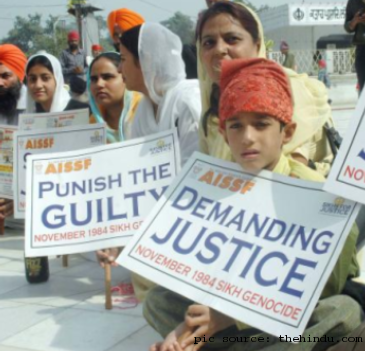 On Tuesday (November 3rd, 2009), various Panthic groups (‘radical’ Sikh organizations, if you follow Indian newspapers) called for a peaceful shutdown of stores, businesses, and state services to protest the continued impunity in which the perpetrators of the Indian Government-orchestrated pogroms in 1984 still roam free today.
The ‘bandh’ was an overwhelming success in terms of its immediate call to action, although the larger purpose of its calling will probably continue to yield little results.
The strike call was given by the Dal Khalsa and was supported by the Khalsa Action Committee (KAC), Damdami Taksal, Delhi Sikh Gurdwara Prabandhak Committee (DSGPC), All India Sikh Students Federation (AISSF) and Shiromani Panthic Council.
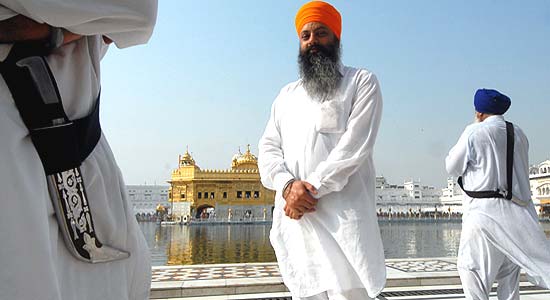 History often remembers transformative figures through the public images they become. Glimpses and insights into their private lives are rare. So an interview with Sant Jarnail Singh Bhindranwale’s son is a rare treat.
Ishar was just five years old when Jarnail Singh Brar was anointed the 12th jathedar of the Damdami Taksal. He left home and adopted the “Bhindranwale” after the village of Bhindran Kalan where the sect was originally located. “After that we only saw our father at his satsangs,” Ishar said. “But we were well looked after.” Did he miss his father? “From the family point of view I was sad, but from a Sikh point of view I was very happy.” The Jalandhar editor waved a laminated family photograph at me—a very young Ishar Singh with his eyes shut, an oddly self-conscious Sant Bhindranwale, his younger son Inderjit, his wife Pritam Kaur. [Outook India]
Ishar is the oldest of Bhindranwale’s two sons, and now a land realtor near Amritsar. He was 12 yrs. old during Operation Bluestar, studying Gurbani under Mahant Jagir Singh at Akhara village near Jagraon. [OI]
25 years ago history was made for several different reasons. Today, as we reflect on the invasion, on the assassination, and on the massacres, we come across multiple news articles which provide information and commentary on the events of that year. I wanted to take the time to document and highlight these articles as they’re worthy reads in providing information to readers around the world. I encourage you to read these pieces – they are vital to our understanding and they will inform Sikhs and non-Sikhs alike about events in our history.
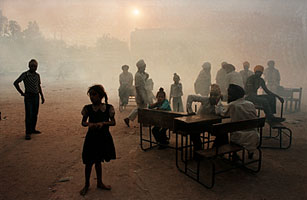 1. TIME magazine featured an article titled, “India’s 1984 Anti-Sikh Riots: Waiting for Justice.” Our readers have previously argued against the use of the word “riot” and suggested that “genocide” is the more fitting description of what happened. Regardless, this is an important article which discusses the often silent victims of 1984 – the widows and their children and the impact the events (and lack of justice) has had on their future.
The widows’ colony in Tilak Vihar is a cheaply built and neglected cluster of homes, which were given by the government to hundreds of women and their children who survived what have become known as the anti-Sikh riots of 1984. But as the grim event’s 25th anniversary nears at the end of this month, crime, addiction and prostitution have taken root in what was supposed to be a survivors’ safe haven. Residents say this is because of the damage to the mental health of children who were witness to their parents’ and siblings’ murders and who grew up in impoverished homes and weren’t given any medical help — physical or mental — for their problems. [link]
Of note: for the 25th anniversary of the event, advertisements by Ensaaf — showing an old woman wiping away her tears, with the words, “25 years ago, our loved ones were burned alive in front of our eyes,” and in the next line, “Why has India, the world’s largest democracy, denied us justice?” — are scheduled for the month of November in the San Francisco Bay Area’s transit system!
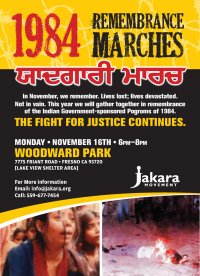 Through Sukhmani Sahibs, conferences, scholarships, film festivals, floats, and even ongoing camps, the Jakara Movement adds the next event to its on-going “Remember 1984″ campaign.
This November they begin their Remembrance Marches.
25 years ago there was a government-sponsored pogrom in Delhi and throughout many parts of India that left tens of thousands dead. Orchestrated by the Indian Government, the perpetrators of these pogroms roam free today. Join us and connect in solemn remembrance with Sikhs and non-Sikhs alike as we commemorate the events of 1984 and call for justice and bear witness to the genocide. We will not be silenced.[link]
The Event will consist of a series of silent marches in the various regions, followed by video screenings, speeches, and a candlelight vigil.
Attend one at a city near you:
- BAKERSFIELD – Silver Creek Park – Saturday, November 7th, 2009, 5-7pm
- BAY AREA – TBA
- FRESNO – Woodward Park – Monday, November 16th, 2009, 6-8pm
- RIVERSIDE – Glen Avon Heritage Park – Wednesday, November 18th, 2009, 6:30-8:30pm
For those in Bakersfield, this week (date to be updated) watch ABC affiliate KERO, Channel 23, to see members of the Jakara Movement talk about this weekend’s Remembrance March in Bakersfield.
For more information on the march visit the Jakara Movement blog, website, or Facebook page. See you there!

