
Tragedies have a way of uniting people. As did 1984 for Sikhs. In the 25 years since, divisions have again formed in the panth. But a great new initiative in Toronto is asking people to put aside the differences that keep us apart and unite in remembering 1984. [Hat tip: Mapleleaf Sikh]
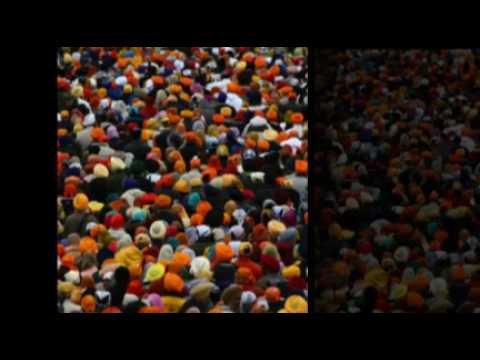
This past week I came across two videos that are just… cool. The videos are not necessarily Sikhi-related but they show everyday Sikhs in their element. This first video was taken at a U2 concert where a lucky fan [Amp Bains] was invited onstage to sing “Sunday Bloody Sunday” with Bono. So lucky.


In this second video Shakira performs her new song Gypsy. One of her musicians in this video is Shamsher Singh, a Sikh from Florida (hat tip: Sikh Swim). The video can be viewed here.
A few weeks ago I attended the Sikh Education Conference hosted by the Sikh Research Institute that brought together educators from across North America. One of the presentations focused on the importance of language education. The presenter made it quite clear – teaching young children multiple languages does not confuse them or hinder their development. In fact, research has shown that bilingualism and multilingualism is advantageous in several aspects. Exposure to two or more languages increases critical thinking skills, creativity, and flexibility of the mind in young children.
According to neurobiologists, the human brain is “hardwired” to learn languages as an infant and toddler. Any language learned during this period is stored, literally, in a different part of the brain than language acquired later in life, and in the right environment young children can learn up to four languages without significant slowdown. [link]
It seems, however, than in immigrant communities there is often hesitation around raising children in multilingual homes. The fear is that children will not learn English fast enough which will pose an obstacle to their assimilation into American society. It happens in our own community – young Punjabi children not being able to communicate with their older Punjabi grandparents. There is a language gap and if we consider the importance of oral tradition in our history – you can just imagine how much information is not being communicated and in fact being lost between generations.
Despite tanks rolling into the Guru’s Court (Darbar Sahib)
When a Singh’s head, becomes hunted as a sport (Delhi 1984)
Despite Kaljug sitting on his throne supreme
When the world trembles from tyranny’s regime
And Still We Will Fight
Although hardly a newsflash, last week a Delhi Court acquitted three murderers. Although low-level players in the Government-sponsored pogroms in Delhi and throughout India in November 1984, their acquittal further illustrates that it is Kaljug that reigns supreme in India.

Toronto Star reporter Raveena Aulakh, posing as an expectant mother, is handed bags of pills in an industrial area in Mississauga by Kanwar Bains, news editor of a Punjabi-language newspaper.
Just in case the rest of the world didn’t know what a sorry state Punjab was in with respect to its gender imbalance, there has been two headline reports from Canada’s biggest newspapers in recent weeks. The first deals with the problem in India and the second talks about how the problem has been exported to Canada.
The first from the Globe and Mail entitled “Land of the Rising Son”, examines how India has responded to the decline of female births. There’s two sad learnings from the article. One is that Punjab is still in the worst position with respect to male-female gender ration and the second is that an individual’s level education has does little to reverse generations of discrimination.
All help is needed to locate Karamjit Kaur,16, a Punjabi Sikh teenage girl from Reno, Nevada who went missing on Wednesday evening while r iding her bike. She had arrived from India eight-months ago and recently started learning how to ride her bike. On a hot Wednesday evening around 6:30pm Karamjit went outside in her black top and blue cotton pajamas to ride her bike and never came back home. The Reno police suspect foul play. Karamjit’s bike was found a quarter of mile away from her house by a skateboarding park.
Karamjit is approximately 5’7” tall, 140 pounds, with long black hair and brown eyes. She has a scar on her forehead, and her left canine tooth is longer. She was last seen wearing a black v-neck short-sleeve t-shirt, bright blue cotton pajama bottoms and black flip-flops. Her family is devastated and praying that she returns home soon.
The Reno Police Department is asking for the public’s assistance in locating her. Anyone with information relating to this incident should contact the Reno Police Department at 775-334-2115, Secret Witness at 775-322-4900, or www.secretwitness.com. All calls to Secret Witness remain anonymous, and Secret Witness pays rewards for information on all crimes.
Gurmeal Singh, the British Sikh police officer who was humiliated for practicing Sikhi, will be compensated for “indirect harassment” and humiliation. Judge Murray Creevy ruled that the Greater Manchester Police (GMP) viola ted his dignity.
The BBC reports that the Assistant Chief Officer at GMP, Julia Rogers felt that they had always acted in the best interest of Singh. However, GMP accepts the ruling and has already updated their policies.
After a heated conversation with his Sergeant about his inability to remove his turban while on the job, Singh feared that he would be made to look like a comic character on television by wearing a modified turban.
Ultimately the ruling according to Singh’s lawyer:
“… leaves him in difficulty in relation to his future career but will hopefully open the eyes of Greater Manchester Police. He joined the police because of his values as a Sikh. What is important now is what Greater Manchester Police will do to help him come back.”
Sometimes you don’t have much to post.
I received a link from a friend about the new Yahoo “Anthem” Ad and apparently it is about “you” and I guess at about 10 seconds you get a brief glimpse of “us” (men and women). Well enjoy your Thursday.

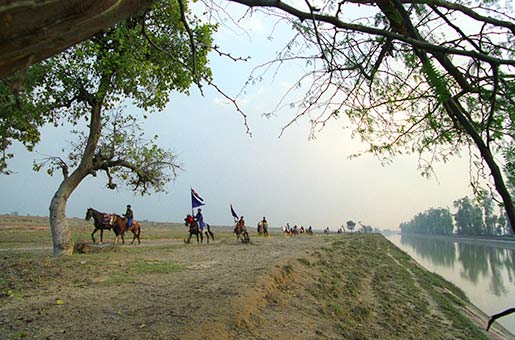 Environmental issues have taken a backseat for way too long. Even under this administration – which promised to create jobs through new and clean energy initiatives, and rejoin the international community to reduce worldwide carbon emissions – environmental issues have taken a backseat to health care overhaul and reviving our frail economy.
Crisis
We should be especially concerned because the consequences of misusing resources are all too clear in the near-crisis state that Punjab’s ecology is currently in. Those who still have relatives in Punjab know that this past summer, electricity outages were a daily occurrence and lasted 8 hours at a time – the worst in many years. These shortages in electricity occur because the government subsidizes electricity for farmers so that it’s free or nearly so and they can pump water for irrigation to their heart’s content. However, this leads to electricity shortages, overuse of waterpumps, and water wastage. [Forbes-India]
An article in Forbes-India asked yesterday, “Is India running out of water?” For Punjab, the answer is yes.
And Punjab, as the breadbasket of the most populous nation in the world, may be an indicator of other similarly situated agricultural communities.
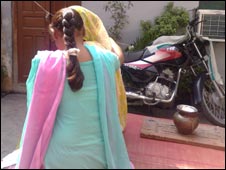 One of our goals on The Langar Hall is to raise awareness about issues affecting our community around the globe. Whether or not we identify or relate to these specific issues may not be as important as much as the acknowledgement that these issues do occur and that individuals and families and even children are affected. We hope that by raising awareness we can begin, as a community, to stand up against injustice in all its forms.
A recent article from the BBC reports that, according to campaigners in Punjab, British Asians are hiring contract killers to carry out up to 100 murders in India each year. One of the most well known cases is that of Surjit Athwal, a British Sikh woman who disappeared in Punjab in 1998. Eventually it was revealed that she had been murdered in a so-called honor killing after her in-laws discovered that she planned to divorce her husband. They had hired criminals in India to kill her. She was strangled and her body dumped in a river. Her brother, Jagdeesh Singh, now campaigns for other victims’ families.
“I think Surjit’s case exposed for the first time in this country overseas outsourced killings. How the Punjabi community, settled in Britain, send their females back to the land of origin, in the full knowledge that they can have them murdered easily, swiftly and efficiently.” [link]
On many occasions, I have noted my dismay at the joke of journalism that calls itself the Times of India. They never cease to provide stupid nonsensical and ill-researched articles. Here is one more example.
It appears that the writer ‘Divya A’ has recently been making his/her rounds at various Sikh film screenings and festivals. Instead of lauding a young community on its tenacity to promote arts and encourage creativity in the community, the author can only wonder:
But how healthy is it for a community to focus on a painful past and present itself to the world as a suffering and wronged people?[link]
Who is the author to decide what is right or wrong for the community?
The author continues to push a nonsensical ‘Khalistani’ conspiracy theory as the raison d’etre behind the shift to visual arts. Instead of looking at the broader context of the proliferation of youtube with film and television being the visual media of the masses, the author believes there is something far more sinister.
So Abercrombie & Fitch is at it again or I should say has been at it for a  while-practicing bias against those who “don’t look the part” of mainstream White American society. In Tulsa, Oklahoma, a college age Muslim girl who wears a hijab is filing suit against the retail store for not hiring her because she would violate the “Look Policy”.
What is Abercrombie & Fitch’s “Look Policy”? The policy jargon aside, the bottom-line for this retail store is that hijab’s aren’t “sexy” because mainstream White America doesn’t view them that way and only sex sells.
Now of course Abercrombie & Fitch will not outright say that; though I am sure they will fight to preserve this “status quo” through legal, “objective” and “logical” means. It also seems like the very legal right that is supposed to protect religious freedom will be used to defend Abercrombie’s stance. Title VII of the Civil Rights Act of 1964 prohibits religious discrimination. The 197 amendment to Title VII defines religion to,
“… include all aspects of religious observance and practice, as well as belief, unless an employer demonstrates that he is unable to reasonably accommodate an employee’s or perspective employee’s religious observance or practice without undue hardship on the conduct of the employer’s business”.
Blogged by: Amritpan
 The presence of the Sri Guru Granth Sahib and its message of universal fraternity of the human race and ultimate destination of oneness with the Supreme Being imparts an unparalleled serenity and contentment on its disciple. When I listen to the chants of Om-mantar in a Mandir, hear Hamza Yusuf deliver the Friday Kutbah in a nearby Masjid, witness a Jewish Hallel or meditating Buddhist in a park … I see each as another form of reverence to the Almighty, but every single of theses experiences leave me searching for more…
A few days ago I was invited by a Muslim friend to join her community in a fundraising Fast-A-Thon for Ramadan… (participants fast for a day and a local business donates a certain amount of money per fast-er to a charity or Masjid). I acquiesced and signed up, happy to help with their efforts for daan, or as they call it, zakat.
Coblogged by Reema and Sundari
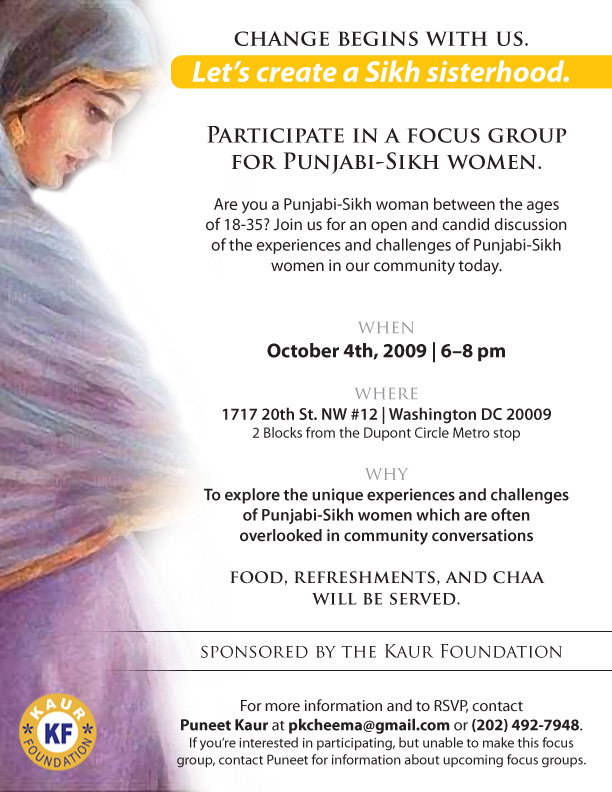
There is a deafening silence that surrounds Punjabi-Sikh women. Too often, when discussing challenges that some women may be facing, the conversation is shut down and de-legitimized by one or two angry voices. Interwoven into this is the unrelenting identity debate of labeling actions “Punjabi” versus “Sikh” which often distracts us from the true issue at hand.
 For example, recent posts about issues affecting women turned out to be way more controversial to a few commentors than anything in the original post merited. A post on forced marriages drew virulent ire from a few readers for discussing forced marriages under a title that included the word “Sikh.” A post on a change in asylum law which also included “Sikh” in the title drew the same virulent response. Earlier in the year, a post named “The Rise and Fall of Sikh Girls,” was accused of creating unnecessary attention with it’s title.
This reaction is reminiscent of the treatment that was meted to Harshinder Kaur by an Indian government official when she attempted to talk about female feticide in Geneva.
She said in her talk at Geneva she had pointed that it was very essential to educate the women and girls of Punjab to make them aware of their rights and to alleviate their sufferings. For this, UN must give aid to needy girls in their education directly as it should reach at grass level where the aid is not reaching. She said he is giving monetary help to 300 needy girls for their education through her own trust. This issue was disliked by a participant P. Srivastava and she [sic] threatened her after she finished her talk and came out of hall and advised her not to visit UN ever again if she has to utter any [words against the] government. She clarified repeatedly that said [sic] she has not uttered anything about government but was worried only about education of poor girls of Punjab. [PunjabNewsline ]
Besides the insult felt by readers at the idea of Sikhs not living as Sikhs should and the fear that a negative image of Sikhs was being portrayed, there is another stream of thought shutting down these conversations that I think needs to be addressed.
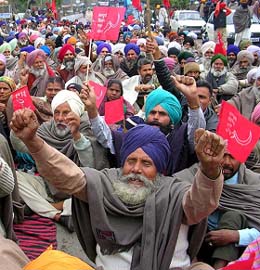 While I do value the role films play in telling stories, I wonder if at times it can do more harm than good. I recently heard about a new bollywood movie called Kisaan and had the opportunity to watch it last night. I had been told the movie was about farmer suicides in punjab and while i was aware it was a bollywood production, I definitely made time to watch it as it is such an important issue.
The movie touched upon issues such as the role illiteracy and dowry play in the lives of farmers – the reality of poverty overpowered by the hope of prosperity. These are important issues and should be discussed. Films are an important tool to utilize in order to raise awareness about such issues.
Suffice it to say, Kisaan is a bollywood production and is distracted by it’s commitment to bollywood requirements. I can’t say i wasn’t disappointed – this is such an important issue which needs to be explored. While i commend the director for attempting to raise the issue, i do question if this genre of film was the best vehicle for it. The issue was so entangled in the film, mixed in with songs and awkward jokes, that i can’t imagine how serious the issue will be taken.
Today is a global cease-fire day. Since 2001, every September 21st is declared an International Day of Peace- a day of  cease-fire and non-violence by the UN. The unanimous declaration from the UN General Assembly was brought about by the non-profit organization, Peace One Day.
What is the point of a day of peace, and can it even be realized? The video at the end of the post responds to these questions. Plus, if Valentine’s Day can be the monstrosity it’s become, then surely a day of peace is less trivial.
… to have a UN resolution calling for a day of non-violence and to have an actual day where no violence occurs are two radically different things. And when the initial celebrations of Peace Day came and went without any cease-fires or other official humanitarian action, Jeremy’s [founder of Peace One Day] elation began to wane and he grew concerned that the UN resolution might prove itself a Pyrrhic victory. “I could hear the cynics getting louder,” said Jeremy. “‘Peace Day will never work,’ they said. ‘Nobody will ever stop fighting.'” [POD]
 When hallowed grounds make way for fairway greens, you have a lens into contemporary elite culture in Punjab. Tales of the loss of our historical materials and architecture form a common topic here in The Langar Hall as throughout conversations of Sikhdom. Destruction of historic Gurdwaras for the vanilla blandness of marble monstrosities is well known.
Although I am hardly a fan of the Times of India, a recent article did get me to think.
The article describes a hallowed space that will soon become a golfing green. The history of that space is as follows:
Barely 20 km away from Chandigarh, off Kharar-Landran road, lies Chhappar-Chiri village — once known for its plentiful ponds and mangroves on the banks of Patiala Ki Rao — where in 1710, the brave Banda Singh, anointed general of the Khalsa army by Guru Gobind Singh and sent to stop the tyranny of Mughals, defeated the army of Wazir Khan, the subedar of Sirhind who had ordered the killing of Sahibzada Zoravar Singh and Fateh Singh by bricking them alive. Khan was put to death and his body dragged to Sirhind, about 25 km from the village, before the Khalsa army proceeded to decimate the town.[link]
A couple of months ago the Sikh community was elated to see the Queen of England make two Sikh gentlemen her bodyguards. Thisact was seen as a huge step forward for Sikhs in the fight against discrimination for our religious articles of faith. It tremendously inspired many of us to continue the fight against Sikhs in the US Army and other places in the United States and Europe. It reflected what generations of hard Sikh work against discrimination for our religious articles of faith had done in the UK.
However, a recent case of a Sikh police officer in the UK feeling humiliated and offended for refusing to remove his turban as part of the Greater Manchester Police has shown us that as we take great steps forward we are still far away from taking a great leap against discrimination.
Gurmeal Singh, who is based in Wythenshawe Police station, near Manchester, said that he was coerced into walking into a petrol fire and told to wear a modified turban by colleagues. Despite telling police trainers that he had applied a flammable gel to his beard and refused to look like a character on a British comedy show, the officers told him- “this is what you signed up for”.
Singh said,
“My turban is not an article of clothing like a shirt or tie – it is part of me, a part of my religion and I feel as though my religion and I have become an issue for GMP.
“It has made me feel alienated. I was deeply offended and humiliated.”
The British Sikh Police Association are supporting Singh in his legal action. The hearing in his case continues.
 Jasmeet Kaur Sidhu is a 21-year-old aspiring journalist, who currently writes a climate blog for the Toronto Star (she even has The Langar Hall listed as one of her links!). She was recenly chosen as one of the Top 10 College Women for Glamour Magazine (hat tip: Maple Leaf Sikh). The award is usually given out to college students in the US, however, Jasmeet (a Canadian) was picked to be part of the group this year!
Jasmeet is the founder of the Peel Environmental Youth Alliance (PEYA), a network of students in the Peel Region working to implement environmental programs in all 220 Peel Region schools. She is currently studying Peace and Conflict Studies at the University of Toronto. Her dream is to become an international journalist.
As a sophomore, Sidhu wrote to the Toronto Star suggesting ways for the paper to improve its coverage. She was promptly asked to join the Community Editorial Board—the youngest member ever—and soon started writing opinion columns for the Star, Canada’s largest newspaper. Sidhu, whose family moved from Malaysia to Canada when she was a baby, has covered everything from HIV/AIDS in Africa to climate change. As the peace and conflict major says, “My mother used to deliver the Star when we first came to Canada. Now her daughter writes for the very same newspaper. Amazing, right?!”
Sotheby’s is having an auction today in New York of South Asian Modern and Contemporary Art including Miniature 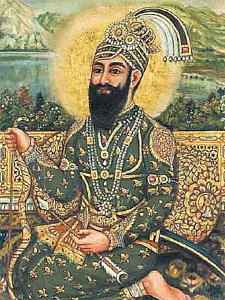 Paintings.
Sotheby’s September 2009 auction of South Asian Art features a carefully-curated offering of works by leading modern and contemporary Indian artists, accompanied by an eclectic group of miniature paintings from the Rajput and Punjab Hills courts of northern India, as well as a selection of cutting-edge contemporary art from Pakistan. [Sotheby’s]
Of interest is a 1912 large portrait (approximately 5’x3′) of Guru Gobind Singh Ji estimated at $50,000-$70,000, as well as a miniature of all the Sikh Gurus with Guru Nanak Ji at the center, and a miniature of Maharaja Ranjit Singh on his stallion with weapons, accompanied by foot soldiers.
This large portrait of Guru Gobind Singh Ji, according to a Times of India article, is part of a series of four closely-related paintings depicting Guru Gobind Singh. Apparently each portrait was the inspiration for the next. It’s unclear where in the series this painting belongs or who the painter was, but the last painting in the series is currently on display at Hazur Sahib in Maharashtra and was created by Hari Singh.
Which leads to questions- if the last in the series is at the Hazur Sahib and this is at Sotheby’s, where are the other two? What path have these pieces taken? The works in this collection were probably passed down from one legitimate private owner to another. Perhaps they were commissioned by British officers. I have no evidence of anything otherwise.
But in general, the plunder from wars and violence often ends up on sale somewhere far from its source. The art and artifacts that were lost in Operation Bluestar weren’t inventoried. We don’t even have a way of identifying lost or stolen art in order to make a claim that it rightfully belongs to the community. Perhaps a budding art historian will be interested in a research project… attempting to document artwork remembered as being held at the Darbar Sahib or other sites of looting so that if it shows up on sale, we’ll be able to recover it.
According to a Deputy Director of Sotheby’s, the collector base for miniatures is largely made up of European, British and American collectors. It includes only a small group of NRIs. [TOI] Glad to see that we’re keeping our heritage intact for future generations! 😉

