
Apparently the police have arrested over 70 Sikhs in Mumbai for vandalizing MTV’s headquarters there. The reason for the protest and vandalism? Apparently MTV’s poster promos featured a sardarni massaging a man, which they found offensive to the faith community and its principles.
Now, I typically do not advocate vandalism or violence as a means of protest, but I think this incident brings up a larger issue around representation, especially for minority communities. Is it possible that there is a Sikh girl, somewhere, who is a masseuse? Probably. However, the issue at hand is whether or not such a representation is offensive to the teachings of Sikhi (I have not seen the poster, so I can’t comment on how salacious it is), and if so, what an appropriate response would be.
Like many other minority communities, Sikhs face a unique task in trying to combat stereotypical and lampooned representations in the media while dealing honestly with the diversity of experiences and viewpoints within the broader faith community. This event, while very different, reminded me of the gurdwara incident in the UK a few years ago. Many feel that it is dangerous to “indulge” negative representations because they tend to produce new stereotypes or to violate the ethic core of the community (a good example of stereotypical Sikh representations would be the buffoon/drunkard or villain/nemesis in Bollywood films). So, if this poster was offensive, how should the community have dealt with the issue? I don’t know if they had tried other tactics (e.g., letter writing, phone calls, non-violent protest), but then again, it’s not hard for a non-violent protest to turn to vandalism or other outward action.
In the U.S., SMART (now SALDEF) originally started as an organization to combat misleading and incorrect stereotypes in American media. The Mumbai case is different on many fundamental levels: Sikhs are a much larger and much more visible minority in India, there is less of an “excuse” for ignorance on the part of national media networks (or international, in this case). However, it doesn’t seem like there’s a great mechanism for dealing with incidences like this.
How can Sikhs work to balance negative representations against the reality of community issues without recasting themselves as another stereotype or caricature?
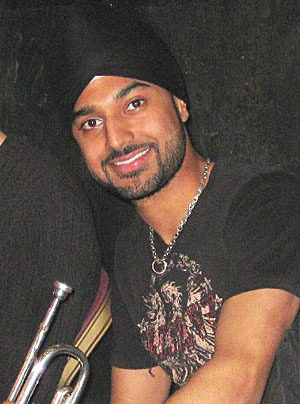 For a place that makes money off turban-wearing and multicultural disney characters, it seems a little ironic that a turban-wearing employee of Walt Disney would be fired for not having the “Disney look.” Uhh what?
This story has been getting a lot of press lately (so for the two of you who haven’t heard) Sukhbir Channa applied for a job (as a trumpet player) with Disney in September 2006 but was told that he couldn’t be hired unless he removed his religiously-mandated turban. He was told that he did not conform with Disney’s grooming and dress requirements known as the “Disney Look.” (Okay, but Aladdin does?) Our friend over at SikhSwim makes a good point,
On my last visit to Disney World, little kids, when they saw me, would say, “Hey look, it’s Aladdin!” So I think Disney’s position has no basis. I think Sikhs have the “Disney look” if average people confuse us for some of the popular Disney characters! [link]
SALDEF has stepped in to help Channa with his lawsuit,
“Disney’s position is fundamentally un-American because it forces Sikhs and also observant Jews and Muslims to sacrifice religious freedom in order to pursue their career goals,” said SALDEF Chairman Manjit Singh. “It is also hypocritical for Disney to make millions of dollars promoting cartoon characters that wear turbans and simultaneously reject the right of an employee to wear a turban in accordance with his faith.” [link]
Having earned a bachelor’s degree in music, Channa just completed a nine-month U.S. tour with the Broadway show Annie. We’ll update you as soon as we hear more about this story. In the meantime, what are your thoughts on this and am I the only one impressed that we know a Sikh trumpeter?!
Revolutions come in strange shapes. Sometimes ‘French,’ sometimes ‘Islamic,’ other times ‘American,’ and maybe even ‘Russian.’ Closer to us, they may even be ‘Sikh.’ However, they may even be in the form of a carbohydrate.
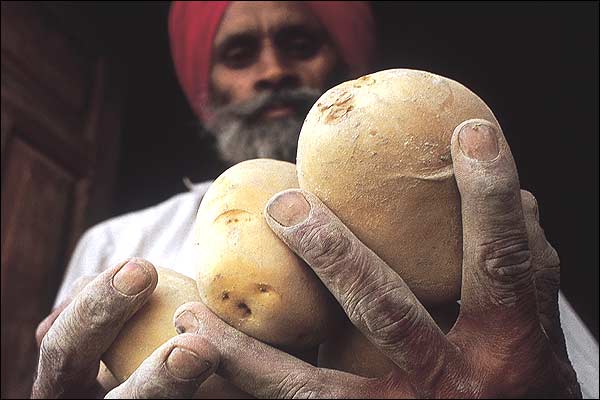
During the 16th century, an expansionist Spain accidentally found itself in the ‘New(?) World.’ Armed with firearms, but mainly syphilis, the Conquistadors devastated a continent and saw the near annihilation of the native people. Along with the silver wealth brought back to Europe came the potato.
While the history of the potato is a famous story in its own right, the potentiality of the potato is becoming more impressive for a number of different policy makers. Recently the world stage is beginning to forecast a “food crisis” in the making. Those of us that keep an eye on Punjab and the rest of the world should begin paying more attention to the growing ‘food crisis.’ With an expanding world population and increasing consumption, some experts are predicting increasing global insecurity. An agrarian-sensitive Punjab would feel the repercussions of such insecurity manifold.
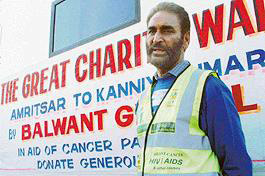 72 year old Balwant (“Bobby“) Singh Grewal is walking 500 miles (800 km) from the Scottish Parliament Building in Edinburgh to the House of Parliament in London in five weeks. He began on June 5th and is scheduled to finish on July 9th. He is raising 100 million pounds for cancer research. (If you can’t tell by the bolded format, I’m rather impressed by this feat.)
Grewal is undertaking the walk to raise one million pounds for research into bowel cancer and other bowel diseases at St Mark’s Hospital, Harrow, a hospital unique in the U.K. [link]
This isn’t the first time Bobby Grewal has walked to raise large sums of money for medical research.
In 2001, he ran the London Marathon in just over five hours, and in 2004-5 (aged 68), he completed a walk covering 2,500 miles across India from the North-West frontier to the deep South…The walk raised 100,000 pounds for research into cancer and AIDS. [link]
Do you think Bobby Grewal is in the same class as the legendary Fauja Singh?
Few programs exist that provide an in-depth study of Sikhi. Fewer exist in the United States. While there are other ventures, such as the Jakara Movement that attempt to allow entry and inspiration, Sikh Research Institute’s (San Antonio, TX) Sidak provides
distinctive learning program for young adults seeking to increase their commitment towards the Sikh faith. This intensive two-week educational experience is a unique program consisting of instructional seminars on various facets of bani (scripture), tvarikh (history), and rahit (discipline). Sessions on leadership development and community building also serve as key foundations for Sidak. [link]
From Harinder Singh‘s esteemed pedagogy, to various learned guest-speakers, and the culmination in a final project, Sidak is an amazing educational and spiritual experience. This year Sidak is being held on 13 – 26 July, 2008. For more information visit www.sikhri.org

So this week, I blogged about two unfortunate murders in the community. Maybe as a release, maybe just to cheer everyone up for the weekend, I am returning to my Friday lite post.
We’ve seen the talent in Britain, with Suleman Mirza and Madhu Singh together as Signature. And as brilliant as they may be, I have a partiality towards Sardool Sikandar.
Sardool Sikandar is often known more for his marriage to the beautiful Amar Noorie than for his own singing talent. However, hits like Tor Punjaban Di and Mittran Nu Margiya still remain some of my favorites.
Here is a recording from the mid 1980s at Doordarshan’s Amritsar studios. It was this performance that launched the Sufiana classically-trained Sikandar’s career. Here he does various impressions of Mohammad Siddique and Ranjit Kaur’s classic “Aagay Roadways di lari, na koi sheesha na koi bari….”
While I am partial to his amazing Kuldip Manak and Yamla Jatt, do you have a favorite?
Adding onto prior posts concerned about the environment, it’s interesting that the Transport Minister of Punjab made a statement today by riding his bike to work.
In a rare display of a public official and a cabinet minister and that too the transport minister of a state at its austere best, Master Mohan Lal, Transport Minister of Punjab on Thursday chose a rather conventional mode of transportation to reach his office at Civil Secretariat, here… Master rode a bicycle from his official residence in Sector 39 to attend his office. [link]
His one day bicycle ride was in response to increasing oil prices. Like Earth Hour, statements such as these are beneficial, but ultimately ineffective unless backed up by real, sustained efforts to change peoples’ actions on a daily basis. So – great statement Mohan Lal ji, but is it just a show?
The police have apprehended two suspects and are charging them with the killing of Navtej Singh. The police are still searching for additional suspects and accomplices.
————————————————————
Many of our friends and family own small businesses. Whether gas stations or convenience stores, the hours are long and the risks are high. Few of us would probably not be aware of some friends or family that have not had some circumstance occur while working.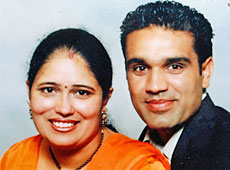
In Auckland, the New Zealand Sikh community suffered a tragedy with the killing of 30 year old, Navtej Singh, a father of three children all under 5 years of age.
Almost as disturbing as the cold-blooded murderers, who stole fifteen bottles of beer and a few dollars, was a callous customer that stole a box of alcopops as the victim lay in his blood.
The 12,000 member Sikh community in New Zealand is an established community with five gurdwaras and are asking questions. There is some division as to whether these crimes have a racial motivation or are crimes of opportunity:
“What is happening in South Auckland?” asked Sandeep Verma, who was with Navtej Singh when he was shot, and when he later died in hospital.
“All the people from the Indian community, whether they are Fiji Indians, Indians, Punjabis, Gujaratis; only those people are the main target.
“What are the police doing for the security of our people?” [link]
A recent play seems to have caught my attention. I provide the description here in length:
Dangalnama is a gripping account of sectarian rioting in India since the assassination of Indira Gandhi in 1984. It is also the story of a younger generation making sense of their history.
Through the voices and personal testimonies of Indian journalists, students, artists and politicians, director Prasad Vanarase presents survival stories, which shed light on the current social, economic and political climate in India today and the wide disparity between the poor-rural and modern-urban population. Performed in five languages (Hindi, Marathi, Gujarati, English and Kannada), this eye-opening and satirical take on Indian’s recent past also looks forward to a more unified future.
Dangalnama boasts a cast of 14 drawn from across India. Using satire and comedy, Dangalnama shows us the human side of India’s complex and often hidden issues in this powerful 90min production followed by a lively 30min discussion with the cast and director. [link]
Dangalnama A Flame Production directed by Prasad Vanarase
A Lift commission / UK Premiere
Fri 13 – Wed 18 June 13, 14, 15, 16, 17: 7.30pm – 9.30pm
15, 18: 2.00pm – 4.00pm
An immediate observation leaps out at me from the description. It is striking though that the play in being performed in five languages, yet the main language of the victims of the genocide, Punjabi, is left out. I wonder why?
In a day of updates, I figured I should update this one as well.
Although losing out on the 100,000 pound grand prize, the dynamic duo of Suleman Mirza and Madhu Singh have been invited by Michael Jackson to join him on his comeback tour in the UK. The newspaper report is a bit ambiguous suggesting that Signature may also perform with MJ in Las Vegas as well. Amazing job fellas! I am sure they are on cloud 9.
—————————————————————
We’ve been following Signature over the last few months. From their audition appearance, to their semi-final Thriller, to even an interview with me highlighting their place in British Bhangra, before we all suffer from Signature overkill here is Suleman Mirza (often misspelled as Suleiman ) and Madhu Singh’s final performance.
Our dynamic Muslim and Sikh duo finished second on Britain’s Got Talent (BGT) to the dancing talent of George Sampson. While I was hoping for a “Beat It” performance, Madhu’s busy work schedule at PC World may not have allowed him to come up with a new routine. They stuck to their bread and butter of Tigerstyle’s Nachna Onda Nahin. A fine performance fellas. You even got Simon Cowell and the rest of the dorky judges to dance in their chairs.

Since the Sikh community first learned about Navraj (Nuvraj) Singh Bassi, many on the internet have rushed to create facebook groups, orkut groups, and other fan displays. I think the CFL in general, but the SASKATCHEWAN ROUGHRIDERS, in particular, will see a new group of excited fans.
Many have wondered about Nuvraj Singh Bassi’s status and luckily here in The Langar Hall, we have made friends with some great Roughrider fans, including Behaving Bradley, photographer Downtown Aaron Brown, Giventofly (GTF), and others on the Roughrider Fan Forums.
So from what I gather, Navraj is still a ‘raw’ player, but many are excited about the player he may become. He seems to have suffered a foot injury, but is still in attendance at training camp. We hope him a speedy recovery and the Roughriders a great season! We’ll try to keep you updated with the help of Behaving Bradley and others from the forum!
——————————————
A long time ago, my fellow Langa(w)r-iter, posed the question:
Can a kesdari Sikh man excel at high levels of athletic competition in the U.S. and practice his faith? [link]
Back then she was introducing us to Darsh Singh, Trinity University’s keshadhari (turbaned) Sikh starter and co-captain.
Today, I introduce you to Navraj Singh Bassi.
In Ceres, California an 86 year old Sikh bibiji, Jagir Kaur Johal, was found stabbed to death in her home. The Modesto Bee reports: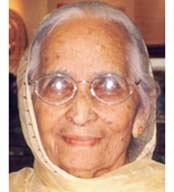
She died as a result of loss of blood from a stab wound to the chest and multiple slash wounds to the face, arms and legs, the Stanislaus County coroner’s office said.
Authorities said today the woman’s husband, 85-year-old Piara Johal, likely will be arrested.
Johal had a knife wound on his hand. The man was “suffering from some kind of confusion. He’s not sure what happened,” McKay said. “He acted as if he didn’t know of her injuries.”
“This is a hard case,” McKay said. “He’s old. He’s feeble. We don’t even know he if knows what he did — if he did it.” [link]
I had a long and interesting conversation with a friend of mine this weekend on different attitudes towards finance and charity between different world religions. We noted that both Judaism and Sikhi require a 10% charitable contribution, in addition to service, which has no upper or lower bound and serves a different purpose. This dovetailed with a conversation I had with a few friends, including one who is an Islamic banker in Dubai, about religious concepts of usury, interest, and charity.
For many low-income and poor communities, asset/wealth creation is a major hurdle, and access to financial/resource markets and services is non-existent. Although Sikhi has strong proscriptions against materialism, greed (moh), and attachment (maya), it also has a redistributive element. While simplicity is embraced, wealth is not necessarily wholly eschewed (if earned honestly and put to just uses).
If a financial institution were opened upon Sikh principles, what would it look like, to you? What kind of services would it offer, or how would it help address the structural exclusion of the poor? For example, I could imagine very low interest or no interest loans, but perhaps other infusions? In other time periods, Sikhs built free clinics and community schools. Khalsa College, on an endowment from one of its funders, still offers free college tuition to local residents (regardless of religion). What are the kinds of “assets,” beyond simply wealth, that could contribute to Sikh principles of economic justice? Do you feel such principles (i.e., economic justice) exist in Sikhi?
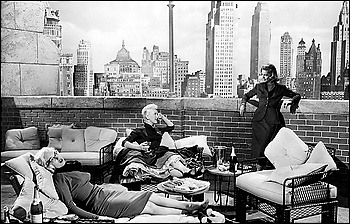 About a week ago, Sex And The City (SATC) hit theaters. Many may resist an association with the dating scene that the movie and show explored with the lives of Punjabi Sikh women, and wonder whether this is appropriate for The Langar Hall. But the stories and characters of SATC reflect broad ideas that apply to all women and since every woman I know has seen or is planning to see the movie, I’m curious about how these themes apply to Punjabi Sikh women in particular and how our experiences compare with other groups. This post does not promote anything portrayed in SATC, but instead explores the stereotypes in the characters and questions how our Punjabi-Sikh-ness affects how much of those stereotypes we embrace. First, what is SATC really about?
the three-girls-in-the-city movie… a cinematic staple since the 1920s, has been an unusually enduring and lucrative one, exploiting each succeeding era’s anxieties surrounding women’s changing roles and helping define those eras’ new ideas of modern life. In them, audiences can watch women negotiate and sometimes subvert the forces that limn and limit their choices. [link]
Prices go up after Monday. Take a moment at work, take a quick break from your finals, but take it now! A commenter asked to for a meet-up at the conference. A few of the bloggers will be in attendance so come meet a few of the faces behind the nonsense we write! Register now at www.jakara.org
———————————————————————————
From our discussions on dividing Gurdwaras to Green Gurdwaras; from confronting the demons within to forging a new consensus; from questions of grassroots movements to moving beyond generation two blues; all are invited to attend JAKARA 2008 and discuss face-to-face these important issues.
 The Jakara Movement Sikh youth conference is only three weeks away with registration closing on June 16th. REGISTER NOW to avoid late fees.
Who: YOU!
What: JAKARA 2008: Growing with our Gurdwara
Where: FRESNO, CA
When: June 19-22, 2008
Why: Because YOU need to be there. Visit the website for more information.
Yes I had urged all to attend in a different post, but consider this a friendly reminder.
Plan to attend, even if you just want to see life beyond bhangra or shoooooooooot, because you just want another Sikh T-shirt (no, you don’t get those ones).
WARNING: This is MY opinion and DOES NOT not represent anyone else on The Langar Hall. Hopefully, unlike Ennis, I won’t have to take this one down.
I am sure I am going to be labeled as a hater. I don’t care it must be said.
Scouring the news I came across a recent press release by the Sikh Council on Religion and Education. I almost feel even more embarrassed by highlighting it. SCORE, for the uninitiated, is a Sikh organization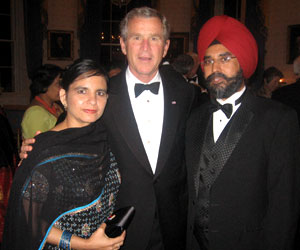 based out of Washington DC. It is the child of Dr. Rajwant Singh, a Maryland-based dentist. He is definitely one of those guys that likes to ‘speak for Sikhs.’
Like many Sikh organizations, SCORE is a one-man show. Don’t believe me, check out the pictures on the website, you’ll find few without Dr. Rajwant Singh. He may be the most pictured Sikh-American. (Look to the right, I just added one more!)
Now I really don’t know what SCORE does, other than look for photo opportunities, but to Dr. Rajwant Singh’s credit, he has established relationships with many political figures in Washington DC and has ingratiated himself as the ‘Sikh’ representative in many interfaith functions and communities in DC. DC loves interfaith functions! That is a good thing. Sikhs should have a representative and in the meantime we have Dr. Rajwant Singh.
In certain cultures, memorization has always been a means of oral transference of knowledge through the generations. My father can quote so much random poetry. I see others that can quote entire passages from Waris Shah’s Heer. Although some of us still take the time to memorize Sikh prayers and gurbani, I wonder how much oral knowledge is about to be lost in our generation?
Here is a look at one government school in Punjab. Interesting how nursery rhymes there are sung in a manner different than elementary schools here. Does anyone else notice the subtle differences in promoting a ‘rote’ model? Well, even if you don’t and I am just seeing something that isn’t there, enjoy the video and enjoy your weekend!

Guest blogged by Mewa Singh
Yesterday’s post by Sundari got me thinking. When I saw the videos of the from the BBC footage from those days in 1984, I began wondering can the Sikh community mobilize like that again? Under what circumstances could it or even should it mass mobilize?
I thought of the mobilization that occurred with the Ram Rahim incident last year. Then while reading the internet news, I came across this Bay Area video.
CLICK HERE TO WATCH VIDEO (sorry the website doesn’t allow me to embed the video)
The media was given the title as the “Spiritual March for World Peace.” Although I have been out of the loop with friends for sometime with my Bay Area friends, what was the ‘real’ reason for the gathering? Was it celebrating the shaheedi of Guru Arjan? Do we really have Nagar Kirtans to remember martyrdoms in our history? Should the march be construed as an anti-war protest? Partially to raise awareness, but partially to learn about the initiative as well, I would love to hear about the background, perspectives, or even your thoughts on this Nagar Kirtan.
Through various posts on this blog, we have discussed the idea of activism (and even lacktivism) within the Sikh community. Recently I have been thinking about what activism meant to our parents’ and grandparents’ generation and in what form they expressed their personal and political thoughts. Twenty four years later, as we remember the events of 1984, we are reminded of how much these events raised Sikh consciousness. It is also a historic event in another sense. The response to the events of 1984 allowed for our parents and grandparents to stand in solidarity with other Sikhs and in doing so, mark their place in Sikh history on both a personal and political sense.
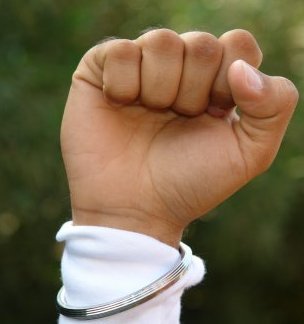
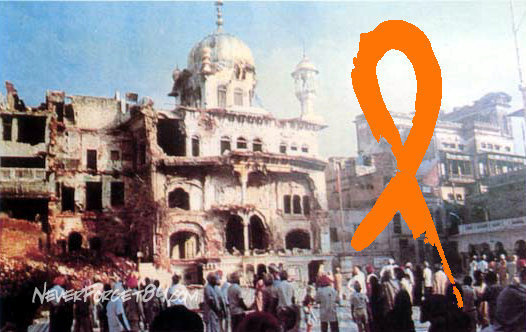 During those days and weeks following the invasion of the Darbar Sahib, hundreds and thousands of Sikhs took part in protests. I remember hearing about these stories from my Dad who ardently took part in these protests in London and Liverpool. However, what was more striking to me, was the role my Mum Mom played in these protests. I remember visiting a museum whilst on a school trip (a few years after 1984) and seeing pictures of the protests on display. I was caught off-guard as I saw a picture of my mother with her fist in the air protesting alongside other Sikh men and women. That image has stayed with me – essentially the activism that has always existed and remains to exist within our community. I wasn’t able to find much press about these protests, but did come across this clip.
Please share your thoughts/memories.
A couple of weeks ago while driving with my friend Rajpreet, I started speaking Punjabi in the middle of an English conversation. I was caught off-guard by Rajpreet’s response, “… why are we speaking the ‘secret language’ when it’s just us two in the car”? Rajpreet for some reason thought we only spoke Punjabi amongst ourselves around other English speakers when we had something “secret” to say [in the past we also spoke it when there was another Punjabi-dominant speaker with us]. However, for myself, it just happened, after some thought I feel I spoke out of the comfort of knowing that Rajpreet also understood Punjabi … not to say anything “secret”. Rajpreet’s statement made me think about how at department stores and other official places of business, I sometimes spoke a mixture of Punjabi/English to family and friends because we did not want other English speakers to know what we were saying in “translation” … but it was not always the case. Sometimes it was out of comfort, group/ethnic solidarity, or just plain funny. In my eyes, I wasn’t using Punjabi as a “secret language”, but more as a form of code-switching or hybrid language use.
Code-switching is a sociolinguistic phenomenon where bilingual speakers (i.e. Spanish/English and Punjabi/English) use terms from both languages in a sentence or conversation. In the past researchers have argued that code-switching was a sign of language inability. For example, the speaker did not know the terms for bowl or potato in English so used the Spanish or Punjabi terms. However, now sociolinguistic researchers believe it is a marker of group identity, ethnic solidarity, and relationship-building. I remember one person telling me that as part of his research on hybrid language use at a major state-owned park, he found that one park employee spoke “Spanglish” to their largely Latino cliental because she wanted to convey safety, comfort, and other feelings of “home” at this large American “place”. By creating such an environment through language she felt that the Latino cliental was more likely to explore the site and ask questions.
Thus, I ask do you ever speak Punjabi to English-speaking friends and family? If so, when?
Do you code-switch? Why?

