
While exploring the Sikh blogistan, I came across this link from Sikhswim (Thanks Savraj!) and wanted to share it with the rest of the Langar-ites.
Late last year, November 2007, a Sikh Seattle taxi-driver, Sukhvir Singh was brutally attacked by a drunken Luis Vazquez. Luis had been placed in Sukhvir’s taxi by two police officers, after he had been denied entry into Husky Stadium for public drunkenness and alcohol-induced bellicose behavior.
The story may have ended with the sentencing of Luis Vazquez, but it doesn’t. The story is also about the Sukhvir’s courage, faith, and forgiveness. Sukhvir was the vehicle for Waheguru’s forgiveness. Luis has been given another opportunity. The video is a bit extended, but well worth the watch.
Reflection for Monday by Guru Nanak from SGGS (p. 223) in Raag Gauri:
Khima Gahi Brath Seel Santokh
Extending forgiveness is the (true) fast, (the true act of) kindness, (the true path of) contentment
So we have seen two (here and here) performances by Signature. Although most Langar-ites did not seem to enjoy the second performance as much, it impressed enough people to propel the duo into the finals of Britain’s Got Talent. In fact they were the first team to be voted in by the public.
Now, in their first interview, Suleman (often incorrectly spelled Suleiman ) Mirza and Madhu Singh shed some light and perspective on their performance:
“Our routine is about togetherness and overcoming conflict,” said the rather handsome Mirza, who has been a Jackson fan since he was six years old. “I start the act with a Western dance, and then Madhu comes on stage. I look down on him because I don’t understand his culture. But he surprises me, and he works really hard, symbolising immigration, and then we work together, and show that everyone can get on.”[link]
Heavy stuff, but I’ll buy it.
Sharon Stone’s recent comments about whether or not the earthquake in China was due to bad karma over Beijing’s occupation of Tibet has caused quite a stir. Stone is now facing a backlash in China with her films being boycotted (Um, what films?) and luxury retailer Christian Dior pulling advertisements featuring Sharon Stone from stores. The Chinese earthquake killed at least 68,000 people. China has been under much scrutiny in recent months over Beijing’s policies in Tibet. “I thought, is that karma – when you’re not nice that the bad things happen to you?” she mused at the Cannes Film Festival. However, many people feel that Stone’s contextual use of Karma is simplistic and in fact, inaccurate (the actress later apologized for her remarks).

Karma is an important concept for Buddhists, Hindus and Sikhs. Translated from the Sanskrit, it means simply “action”. Because karma is used in a number of ways and contexts this can be confusing…Stone’s take on karma is common – glossed over as an outcome that is the result of something done in the past – or even a past life. But the law of karma states that it’s the motive behind one’s actions that affects the outcome of that particular act. “The earthquake in China or the cyclone in Burma have much to do with environmental factors,” says Dhammadassin. “To invoke karma is more to do with our desire to nail things down and find someone to blame. But that’s not ours to do.” [Link]
So, it got me to thinking about what Sikhi says about Karma. Sikhs use the term generously (and sometimes, not so generously) but perhaps we don’t have a solid understanding of what it really means. The doctrine of karma, according to Sikh belief, is a part of the Divine law (hukam). “The whole universe,” says Guru Arjan, Nanak V, “is bound by action, good or bad” (GG, 51). Guru Nanak declares in the Japji that “all forms, beings, greatness and lowliness, pain and pleasure, bounties and wanderings are subject to the indescribable hukam and there is nothing outside the realm of hukam,” (GG, 1) and then adds that “karma determines the kapra, i.e. body or birth we receive and that it is through nadar (God’s grace) that one secures the threshold of moksa” (GG, 2). [Link]
Do you believe in Karma?
The Punjab government has finally allocated funds to assess the breadth of farmer suicides in the state.
The Punjab Government seems to have finally woken up to the need of having a census on farmers’ suicides in the state. The state government, it is learnt, has the [sic] entrusted the arduous task of completing the census to the Punjab Agricultural University. As per Dr R.S. Sidhu, head of the Department of Economics, PAU, “The state government has asked us to do the work and we have taken it up as a research project. Though whole of Punjab is to be covered under the study, the state government has asked us to do a pilot project in two districts of Punjab, Gurdaspur and Sangrur initially.
The census will be conducted by the Punjab Agricultural University (PAU), based in Patiala Ludhiana. During the first phase of the survey, PAU will conduct a door to door survey in about 1,500 villages in Gurdaspur and about 575 villages in Sangrur out of the 12,000 villages in Punjab. The report from this initial phase is set to be completed in four months from the beginning of the survey, which is set to begin in the next couple of weeks.
The census will take into account farmer suicides occurring after April 1, 2005, excluding suicides of farm laborers.
Rising pesticide and fertiliser costs, shrinking land holdings, declining soil fertility and heavily-subsidized farming in wealthier countries are some of the factors blamed for these suicides.
In recent months I have witnessed the ceremonial openings of three new Gurdwaras in the Central Valley area. The number of new Gurdwaras are continually growing. Some people may applaud this action as an indicator of our success for having the ability to build million dollar Gurdwaras. But is this the right direction for our community to be heading?
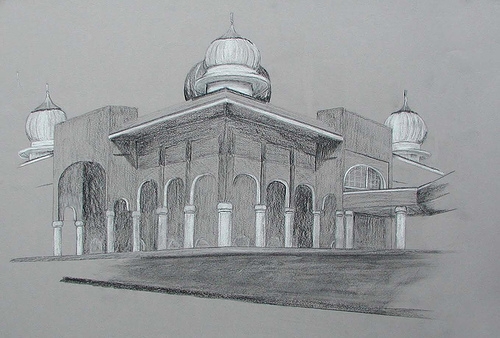 By building more Gurdwaras, we are dispersing as a community rather than emerging as one. Growing up in the UK, all the people we knew growing up attended the one Gurdwara in our town. After some time, the space capacity was too constrained and people began complaining about not being able to sit with the Sangat. Since there was no additional space around this Gurdwara, there wasn’t any expansion work that could be performed. As a consequence, another group opened a new Gurdwara in the same town which fufilled the capacity issues, since it was almost three times larger. So slowly the Sangat at the smaller Gurdwara began to dwindle due to more and more people attending the larger Gurdwara.
Why wasn’t it possible for the community to come together and move as a “whole” to the larger Gurdwara? In the Central Valley there are so many choices of Gurdwaras to attend, but I personally feel this is dividing us. Politics and ego are at play when these associations and groups get together to begin implementing a “bigger, better, more expensive” Gurdwara.
Have any of you witnessed similar divisions happening within your communities and Gurdwaras in your area? Do any of you think this is a positive progression? Is there anything we can do as a younger generation to unite the community?
I may be stealing Anandica‘s UK thunder, but I couldn’t resist.
A month ago, we were introduced to Signature, a phenomenal dance act by a Muslim, Suleman (too often misspelled as Suleiman) Mirza and his Sikh partner, Madhu Singh on Britain’s Got Talent.
However a big question remained. After their brilliant previous performance, Simon Cowell (better known to us Yankees as Simon of American Idol fame) asked, “Now that we know what the surprise is, what do you do in the next round?” Suleman answered, “We keep on surprising you.”

Anyone want to put money for their finals presentation: “Beat It“, “Bad” (although I always liked Weird Al’s Fat better), or “Smooth Criminal.” Any other possibilities?
My vote is for “Beat It.” I just think it would fit their format much better, plus Madhu would look great in that white ‘gangsta’ bomber jacket. Suleman would HAVE to wear that red zipper leather (or pleather) jacket. I can’t lie, I had one back in the day. It might not fit, but that might make it even work better. I am sure I could dig through the old stuff and let Suleman borrow mine. The knife scene between the two would be classic. Hopefully they can get in touch with Tigerstyle to do a mix for them. So Madhu and Suleman, here is your first vote! What about the rest of you?
Many of us either saw or heard of CBC’s broadcast (for those of us here in the US, it was on Dateline NBC) of “Forbidden Love” chronicling the death of a Sikh Canadian, Jaswinder “Jassi” Kaur Sidhu.
The basics of the story are as follows:
Jaswinder, or Jassi, was 25-years-old when she was kidnapped, tortured and killed in the spring of 2000 after going against her family’s wishes and marrying Mithu.
Mithu, a poor auto-rickshaw driver, was hacked by swords and left for dead after his wife was whisked away.
After several weeks in a coma, he awoke to be told that Jassi, whom he had secretly married, had been brutally slain. [link]
Punjab Police later revealed that Jassi’s family had paid up to $50,000 for the hit on their daughter. (I have commented a few times on the rise in contract killings in Punjab here and here) However, even after the death of his beloved Sukhwinder Singh “Mithu” still could not find peace. Jassi’s family was able to find a false witness, a former employee of theirs from their village, to lodge a false case against Mithu claiming that he had raped her.
 We’ve had a lot of discussion recently about various forms of identity discrimination. It seems that the UN is also paying attention to racial discrimination in the US:
A U.N. expert on racism and xenophobia arrived in Washington yesterday for a three-week fact-finding visit to examine human rights lapses in the United States.
Despite Obama’s recent speech acknowledging racial tension, which was a long time coming, US representatives continue to deny that there is a problem.
“I think it’s important for the [U.N.] Human Rights Council to spend its time on real problems and the problems of violations of human rights of countries that are notorious violators,” said Zalmay Khalilzad, the U.S. ambassador to the United Nations, offering a list of suggestions. [emphasis added]
Mr. Khalilzad is well respected in comparison to his predecessor John Bolton, but that wasn’t too difficult of a feat, considering Bolton infamously stated “there is no such thing as the United Nations,” and that “the Secretariat building in New York has 38 stories. If you lost ten stories today, it wouldn’t make a bit of difference.” [link]
Mr. Khalilzad’s blatant denial of the problem of racial discrimination in the US is embarrassing, even for a diplomat. And the strategy of redirecting attention to other nations to divert attention from the very real problems at home is getting tiring- the US has no moral currency left in the international community with which to continue condemning others while allowing discrimination at home to fester.
Usually on Friday, I like to post something musical, something funny, or even something just plain stupid. However, when I saw this news article, I was just so incensed. Yesterday I commented in another discussion that Sikhs need to begin to confront our own Muslimophobia. Another pervasive demon is our prejudice against those of African descent (and yes, dark skin in general).
Apparently at a cricket match at the Mohali Stadium, two black British cheerleaders were asked not to participate by an organizer due to their skin color. The women even allege that the organizer used the ‘n-word.’
Newton told a newspaper: “An organiser pulled us away. He said the people here don’t want to see dark people. The ‘N’ word was used and they said they only wanted beautiful white girls. We were crying. I could understand if it were the crowd, but they were very receptive.”[link]

Many of us have taken part in discussions on how the turban is being commodified and a target for hatred. Understandably there is a strong religious argument for why a turban shouldn’t become another fashion accessory or replaced with a beanie. This argument is anchored in the Sikh meaning of the turban.
The symbolisms of wearing a turban are many from it being regarded as a symbol of sovereignty, dedication, self-respect, courage and piety but the reason all practicing Sikhs wear the turban is just one – out of love and obedience of the wishes of the founders of their faith.
The turban serves as a mark of commitment to the Sikh Gurus. It distinguishes a Sikh as an instrument of the Guru and decrees accountability for certain spiritual and temporal duties. It is a mark of the Guru and declares that the Sikh wearing a turban is a servant of the Divine Presence.
But what happens to this meaning when the turban is being forced upon non-Sikhs? The Cheema Mandi (near Sangrur), Punjab branch of Akal Academy Buru Sahib is requiring all non-Sikh children to wear a patka or dastaar (i.e. type of turban). Most of these children are practicing Hindus who don’t spiritually identify with Sikhi.
Juan Cole drew an interesting parallel between the candidates vying for the Presidency and those competing in American idol’s finale:
I find it a little eerie how closely the finale of the television program American Idol resembles the presidential race. Here you have an older male from the school of hard knocks; a younger, soulful man who inspires his peers; and a woman candidate who shows amazing resilience.
The problem is that it isn’t necessarily a disservice to focus so much on the personalities of entertainers, though it’s much more so for presidential candidates:
when you cover an election as though it is a talent contest and you zero in on personalities
rather than issues, then this is pretty much the sort of melodrama you can construct. It becomes about determined women, less experienced young men, and more hardened older men who know how to mix a stiff drink. You would find these personalities in any tubby novel for sale at an airport bookstore. Mercado, Archuleta and Cook are far more complex and interesting persons than the stock characters that the media has imposed on them. But at least the wrong done them by simplification is minor; they are after all entertainers, and if they attain their potential they will have plenty of opportunity to tell their real stories.
With regard to our political leaders, the infotainment approach obscures the most weighty matters ever to face our Republic, and does a grave disservice to voters whose fate hangs in the balance.
Of course the candidates’ personalities matter to an extent- but it seems that 8 out of 10 articles/stories are more interested in personalities rather than candidates’ plans for office. Is anyone else tired of the excessive coverage and analysis of personalities?
Do some immigrant groups assimilate faster?
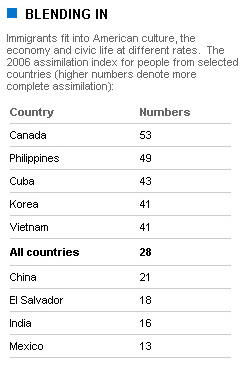 Last week, USA Today published an article summarizing the results of the Manhattan Institute for Policy Research. The institute has computed a quantitative assimilation index to compare groups historically and from various nations. The report defines their index as follows:
The assimilation index can be decomposed along several other dimensions. The overall, or composite, index is based on a series of economic, cultural, and civic factors. These sets of factors can be examined in isolation to produce three component indices. The economic index compares the labor force, educational attainment, and home ownership patterns of the foreign- and native-born. The cultural index focuses on English-speaking ability, marriage, and childbearing patterns. The civic index examines naturalization rates and compares the military service patterns of the foreign- and native-born. [link]
Now let me tell you, just skimming it, there are SOO many problems with the methodology. Does ‘civic assimilation’ really only rest on military service patterns?
Going along with the theme of music which has been popping up all over TLH recently, I came across a documentary from the Asian Network discussing (what the presenter calls) the arrival of a new music scene in which religion is playing a large role in the work of British Asian artists. Now, “religious” music in this innovative sense may not be new to those of us who have been exposed to this type of music before, however as the documentary suggests, religion-focused music is becoming more mainstream and accepted (which, as will be discussed, can be a both positive and negative thing). There still exists the contradictory acceptance of religious music, however, with music promoting Sikh, Hindu, or Muslim values being viewed as conventional and any type of Christian pop/rock music seen as too radical. The question asked throughout the documentary is why is religious music “cool” for British Asians?
 The argument is that an increasing number of youth are not attending Gurdwaras (or Mosques or Temples) and this type of music is much more accessible to this generation because of the medium in which the message is disseminated. Outlandish and Tigerstyle, two groups discussed in the documentary as promoting religious and political values through their music, are making music which is “real and more conscious” and by doing so, keeping the teachings of the religion alive. While we’re all familiar with Tigerstyle, Outlandish is a hip-hop group based in Denmark whose music includes themes about Islam and contemporary issues facing young Muslims in the west. For too long now, music within the Indian community has been lacking substance. While mixing religion with music is a challenge in secular communities in which these artists exist, there is an obvious desire for it too.
On the other hand, the documentary asks whether this type of music is further segregating British (or American or Canadian) Asians? The post 9/11 British Asian identity has largely been disintegrated into a British Sikh, British Muslim, and British Hindu identity. Is promoting religion-specific music going to augment this segregation? Are these artists such as Tigerstyle and Outlandish isolating listeners who may not be Sikh or Muslim? Or is this type of music somehow uniting us? Nusrat Fateh Ali Khan, for example, used Sufi music to cross boundaries amongst religious lines. His music is seen as uplifting and inspiring to people of all religions.
The violence breaking out in South Africa reminded me of the Islamophobia that Jodha posted on.
The man certainly looked dead, lying motionless in the dust of the squatter camp. His body seemed almost like a bottle that had been turned on its side, spilling blood. His pants were red with the moisture… Then, as people stepped closer, there was the faintest of breath pushing against his chest. “This guy may be alive,” someone surmised. As if to confirm it, the man moved the fingers of his right hand. The jaded crowd neither rejoiced nor lamented. After all, the horrific attacks against immigrants around Johannesburg had already been going on for a week, and in their eyes the victim was just some Malawian or Zimbabwean, another casualty in the continuing purge.
The xenophobia that is partially (though heavily exacerbated by economic reasons) behind the current attacks on foreigners in Johannesburg seems to me to be a better explanation for the attack on the Sikh student in New Jersey and the soldier’s horrific act of using the Quran for target practice. Though I’m not usually one to defend the current administration, I do think it is a stretch to say that there is a domestic policy promoting Islamophobia, that is greater than the normal xenophobia created in most wars of the past. I am in NO way apologizing for excusing this xenophobia, but just wanting to put it into historical perspective. The soldier’s act, using the Quran for target practice is horrific and despicable. But it was the act of a single individual. Similarly, Green‘s act, and also his teacher’s reaction were acts of individuals.
In today’s LA Times, I read an article that I thought was just horrifying. It seems that an American soldier was using a Qur’an for target practice.
U.S. commanders moved swiftly to avert a crisis after a soldier deployed in Baghdad was found to have used a copy of the Koran for target practice.
Iraqi police found the desecrated copy of the Muslim holy book on May 11 at a small shooting range near a police station in Radwaniya, a mostly Sunni district on Baghdad’s western outskirts, Buckner said. The volume was riddled with bullets and had graffiti inside the cover. [link]
The journalist noted that the quick apology and removal of the offending soldier helped to keep various Sunni Arab alliances with the American forces intact, averting a possible disaster.
However, for me the problem runs much deeper. I cannot help but draw a link between this incident and the patka burning incident from last week. In America, there seems to be a domestic policy promoting Islamophobia. Islamophobia is not limited to merely Muslims, but includes all that have become racialized as Muslims. Sikhs fall most prominently within this category. However, while promoting this type of behavior at home, the Bush administration is trying to foster Arab and Muslim allies abroad. However, the two are linked and this accounts for another systemic failure and contradiction in the Bush doctrine.
A few weeks ago, I wrote a post titled, “Metrosexual Murdabad!” Although I gained the ire of some commenters, I think amongst the Langar-ites, the ‘metrosexual’ trend is not the preference.
Waris Ahluwalia, of Inside Man fame and a sort of favorite in The Langar Hall — see here and here — made the following comments: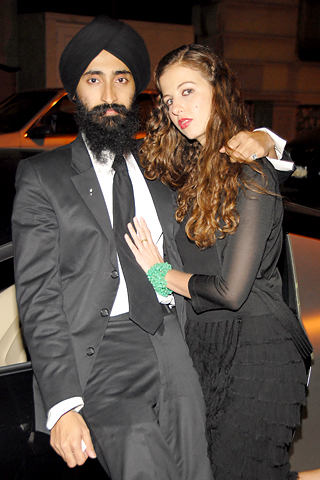
Waris Ahluwalia has been wearing makeup for about ten years, he told us last night at Chanel’s Tribeca Film Festival Party at the Greenwich Hotel. “I’m only telling you this because it’s New York Magazine, but I’m actually 68,” he quipped (he’s not, he’s in his thirties). We asked if his friends would be into man makeup, like Jean Paul Gaultier‘s new male cosmetics line, Monsieur. “No, no. I stopped hanging out with the theater group a long time ago,” he said. Oh, har! Ahluwalia also shuns the men-in-tight-pants trend. “I love trends,” he said. “Doesn’t mean I have to follow it.” Other trends Ahluwalia dislikes include the overusage of words like “bespoke” and “luxury.” “Everyone just calls things that. Bespoke olive oil?” he said. “I saw an ad in Wired for the new Acura. That ad was four lines, and they said ‘luxury’ fives times.” [link]
While bespeaking for Waris’ and our readers’ patience may be a luxury I can ill-afford as I write this sentence, still I am pleased that our turbaned Sikh Mr. Waris Ahluwalia seconds my thoughts on the ‘metrosexual’ trend. (Ok there really wasn’t a purpose for that last sentence other than I was looking to use ‘bespoke’ (or ‘bespeak’ in the present) and ‘luxury’ in the same line. Happy Monday!
I have mentioned Bant Singh before in a previous post, but yesterday while scouring through Youtube I came across a great video of him, his message, and his voice.

To those that may not have heard of him, Bant Singh is from a so-called lower caste background from Pind Jabhar in Zilla Mansa in Punjab. He emerged as a labor activist and became a lead figure in the Mazdoor Mukti Morcha (Laborer’s Liberation Movement).
Although in the blogosphere, I was beaten again by Shinda’s blog, I did want to highlight it again here at TLH.
The Toronto Star reported today that “Brampton bridegroom murdered in Punjab.” Although the tragedy is fresh, the Toronto Star is putting together the story as follows.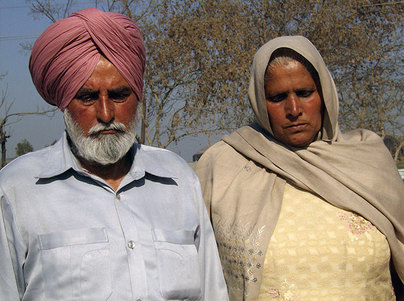
One Jasvir Singh Dhaliwal had been dating a girl, Amandeep Gill for four years. Recently he decided to break off their relationship and marry a woman from Punjab. At the pre-wedding celebrations in his native village, a car came and committed a drive-by shooting killing Jasvir and one of his cousins.
The Punjab Police have moved to bring charges against Amandeep’s Punjab-based parents and even have submitted extradition procedures to the Canadian government for questioning about the case.
Never too far from the scene, a crooked Punjab Policemen has also appeared:
Ashwini Kumar, a police constable with the Indian Reserve Battalion, has been charged with first-degree murder in the case. [link]
I have commented on this topic before, but, unfortunately, I am sure more and more new cases will continue to pop up.
Skimming the other Sikh blogs, I found this post (on a great blog that I am starting to like and not just because he is also an Immortal Technique fan) about a Sikh conscious rapper from Toronto. Although I couldn’t find too much on the internet about Kanwer Singh, other than the fact he is a recent college graduate, the comments on his works have received much praise on youtube. Kanwar goes by Humble the Poet (maybe an allusion to Bhat Bani? SGGS 1400). I personally found this track amazing. (Don’t worry Joolz/Bobby/Suzy, no bad language here)
The track deals with a number of incidents that have plagued the Punjabi Sikh community in Toronto, Canada (although unfortunately Kitimat is there too). However these problems are hardly limited to Canada. They are the stories of our diaspora. From male youth violence, AIDS, domestic violence, alcohol abuse, and drug abuse, this song hits on it all. In fact many of these are themes that get talked about at the Sikh conference I mentioned yesterday. In case you were interested, you can download Kanwer’s track here.
Looks like I have another favorite Sikh rapper along with Mandeep Sethi from the Bay. Your thoughts?

At the vanguard of civil rights, the California Supreme Court affirmed the right to gay marriage today by overturning two of the state’s previous bans. The legislative debate over “gay marriage” (now, simply marriage) began in California in 2004, when San Francisco mayor Gavin Newsom ordered the county clerk to issue marriage licenses to same-sex couples.

Already opponents of the decision have thrown down the gauntlet, saying that they will push to place a constitutional amendment on the ballot to ban gay marriage. I say bring it on — I hope that people vote down such an obvious attempt to abrogate a decision that, at its core, is based on principles of equality. And then, I hope they gather signatures and pass a constitutional amendment UPHOLDING marriage equality, just to make it perfectly clear that voters are willing to be proactive on this issue.
I’ve made my position clear, but I have to say that I am incredibly proud and honored to be a Californian today. I remember wondering if marriage equality was something I would ever see in my own lifetime, or if it would be delayed for generations to come.

