

 Remember that one particular Kenneth Cole ad in NYC that caught our eye? Yes, the picture of the sardar who received much admiration from Sikhs and non-Sikhs around the globe. Well, as it turns out – he’s back. Sonny Caberwal is being featured in GQ’s upcoming Spring/Summer 2009 (German?) publication. Unfortuantely, there isn’t much press around it yet – but what we do have are some pictures from the shoot in Germany.

–
As with the Kenneth Cole ad – it’s great that the image of the sardar is receiving positive attention. Perhaps it will encourage those who aren’t familiar with Sikhs to learn more. I said perhaps. More realistically, the page will be turned (no, not all Sikh men dress that well like that) and Sikhs will still be unknown. It’s in our human nature to see something unfamiliar, and then go back to our dinner and never think of it again (take Darfur for example). And while it’s great that Sonny is getting these wonderful opportunities (Sikh PR right?) – we should definitely save room for other Sikh male fashionistas… like this one from one of my fav sites The Satorialist! After the jump…

Canada’s problem with its Sikh minority should be of concern to Americans not just because Vancouver borders on the US, but for the broader lessons this story of ethnic conflict teaches. When a country imports an alien population, it often brings in all of the conflicts that bedeviled the immigrants in their homelands. Consequently, Western nations can get dragged into intractable conflicts that would otherwise be none of their business. Moreover, differences between the immigrant and host populations are likely to prove disruptive, even disastrous. Differences in history and culture pose difficulties enough, but most divisive are differences in nature. As long as we continue to ignore the possibility that there are biological differences among races that cause them to create different types of societies, we run the risk of importing populations that are prone to poverty and crime and hostile to white people and their values.
One could almost pity the plight of white supremacists these days. Their political influence has diminished greatly and their numbers are dwindling. A black man is the most powerful person in the world. Fearing public ostracization, they constantly have to ensure their words never betray their thoughts. In 2009, being a racist just isn’t cool anymore. But that hasn’t stopped this vocal minority from trying their best.
“White Pride” sites on the internet are full of rants against various ethnic and racial communities, blaming them for everything wrong with the world’s economic, social and political woes. Usually, its African Americans, Hispanics or Jews that are targeted. Now it looks like the Sikhs have caught their attention.
Harpal Singh Kapoor, Director of Miami-Dade Transit, must be the coolest bureacrat in all of Florida. At a recent office party he not only showed off some mad bhangra skills, he taught his non-Punjabi colleagues some skills too, to the beat of a live dhol.

I know there are some purists in the audience who think that bhangra might not be a good way to promote relations with Sikhs because it’s Punjabi culture, not Sikh, etc. … but I disagree.
Music and dance are a universal language. Kapoor probably already knows his office staff, and so he’s not a stranger to them, but unless they do bhangra in the office, they probably don’t get a chance to connect across the conference table like you can in response to the beat of a dhol. Connecting on that most basic human level, in response to music, reminds people that underneath our exteriors we’re all the same. And if they DO do bhangra in the office, then I’m moving to Florida to join their staff.
 Recent news from East London is that Gurdwara Sikh Sangat has been substantially destroyed in an attempted arson attack. An official statement of the Executive Committee of the Gurdwara Sikh Sangat states that,
On Monday the 16th March 2009 at approximately 1.30pm, whilst some women were attending a Satsang a male person unknown to the worshipers entered the Temple through a side entrance. One of the worshipers came from the main hall and confronted the intruder coming down from the top floor and inquired why he was in the building. He replied that he had come to meet someone and then ran out.
Shortly after a fire was discovered coming from the top floor Sachkhand room (this room is where the Guru Grant Shaibs/holy books are kept) within the Temple complex. [link]
Most of the gurdwara’s roof has collapsed and the community fears that all but one of the Granth’s kept inside the gurdwara have been destroyed. The women who were in the gurdwara at the time were able to rescue one Granth from the flames, but unfortunately not the others.
“I can’t describe how important those holy books were to the Sikh community,” he added. Kulvinder Singh Virk, 26, who runs a local off-licence and is also a member of the temple, said: “This is very personal for us. It’s as if a member of our family has been burnt to death.” [link]
One worshipper said that in the past few weeks he had noticed racist graffiti on one of the gurdwara’s outer walls.
What exactly is the function of a Sikh Student Association? Is it simply to bring Sikh students together on campus for token meetings? Is it to celebrate Vaisakhi by organizing bhangra parties? Is it a platform to mobilize students to act upon issues impacting Sikh youth and the Sikh community? Is it… okay, I’ll stop with the questions.
To be quite honest, I don’t know the answers to these questions. I can speak to what I think the potential of such organizations is – what they could achieve and how an active and effective Sikh Student Organization could impact change. For example, here on TLH we’ve previously discussed how Sikh Student Associations in California have organized student initiated Kirtan and come together for Nagar Kirtans. Last week Camille discussed an initiative taken up by the University of Texas Sikh Student Association (the post stirred up some issues about the role of Sikh student associations). While these events are sporadic and intermittent – they are an example of one of the functional elements of a Sikh Student Organization – to educate ourselves and others about Sikhi.
However, it has to go beyond that. While I think any and all Sikh Student Associations should be given accolade for planning and participating in activities such as weekly Rehraas – there is much more to be achieved. Perhaps what’s integral to the success of these organizations (and to ensure they are effective) is to create an umbrella organization which provides resources and support to local Sikh Student Associations.
Take B.O.S.S. for example,
The British Organisation of Sikh Students is a non-political, non-profit making, independent body which acts as an umbrella organisation helping to develop, assist and support Sikh youth groups. [link]
 Although it has been a few months since its ‘soft opening’, the National Sikh Heritage Centre and Holocaust Museum at Derby in the UK in July will soon host the Queen of England, Elizabeth II, to inaugurate the museum.
Although many Gurdwaras have a ‘museum’-room and apparently on the internet we have a cybersikhmuseum, the initiative to bring scattered items of Sikh heritage is much needed and should be lauded.
The Museum hosts a number of artifacts, including a canon that belonged to the Sarkar-e Khalsa during the time of Sardar (often erroneously called Maharaja by Sikhs) Ranjit Singh.
The library is currently featuring an exhibit ‘From Jawans to Generals’ and in May will begin an exhibit on the Sikh Holocaust of 1984. They are beginning to collect rare books and hoping that the library will become a hub for Sikh scholarship.
The museum by bringing many such historical artifacts, located throughout UK together is more proof of the burgeoning of the Diaspora Sikh community and its finding new ways to engage with its changing self as well as non-Sikh community members. One hopes we will see similar initiatives in the US and Canada as well.
We’ve definitely covered stories on the trials and tribulations Sikhs have faced recently in Texas. I saw this and thought it would be nice to share what students at the University of Texas – Arlington are doing to help dispel ignorance around our faith community.
The line outside the University of Texas at Arlington’s library this week wasn’t for intramural sign-up, a spring break travel package or even hot dogs sold off the grill for a fraternity fundraiser.
The organizers structured the event to trade off gift cards for a promise to wear a turban for a few hours, and during that time, to refrain from smoking, drinking, etc. It was the SSA at Southern Methodist (SMU) that came over and hosted events at neighboring campuses, relying on donations and outreach to the Dallas/Ft. Worth Sikh community.
Turban-tying throughout the week had two purposes: to raise consciousness around Sikhi as a distinct faith, and to expose non-Sikhs to the lived experience of, and discrimination faced by, Sikhs in the U.S.
It only took Keith Jackson two hours to understand the heft of American bias felt by Sikhs. The 31-year-old heavy equipment operator noticed the crowd in front of the library and decided to don a navy turban and an “Ask Me Why I’m Wearing a Turban” button. Then he went to lunch at Subway.
One man asked Jackson’s colleague, who also wore a turban, if he was part of the Taliban. Another man told them that bin Laden was their big brother. Someone on a bike started screaming at them. Everyone stared.
While the coverage in the article is imperfect, I thought it showed an interesting willingness, and engagement, of members of the UTAr campus community to take on a different experience. Overall, though, it sounds like it was effective in opening the door for changing the discourse/reflection on how non-Sikhs interact with their Sikh neighbors.
No longer are Punjabi “staarz” (i.e. Gurdas Maan, Arminder Gill, etc.) or Sukhbir Singh Badal’s Mrs., Harsimrat Kaur Badal (i.e. Nanhi Chhaan project), the only ones focusing on the “girl child”, but also a granthi at a California Gurdwara. I was recently surprised to hear a granthi support the idea of gender equity as part during his Punjabi kathaa of a shabad he was singing. No he wasn’t a renaissance granthi, but a common one you would encounter in your general Gurdwara. The sangat wasn’t full of progressive youth/parents, but consisted of lay-persons. AND the focus of his kathaa wasn’t gender equity, but our needs/yearnings. So you may ask how was he promoting gender equity? Well, he used the yearning for a thee (daughter) or puthar (son) in the SAME example to help the sangat understand the shabad’s message. In my experience, the yearning for a daughter and son are never used together to help the sangat think beyond their wants and just accepting Waheguru’s will. Common examples are a yearning for a betaa or a mother caring for a betaa (we could also add a big house and nice car to the list). I have never heard of a yearning for a betee or caring for a betee. It has been during these kathas that the contradiction between theology and contemporary practice of Sikhi have been poignantly highlighted for me. Yes, theologically we believe in gender equity (it’s in Gurbani with examples in Sikh history). However, the common examples used to intimately relate and rely the Guru’s message to an every-day (opppss … maybe I should say Wednesday and Sunday) sangat reify gender inequity. From my perspective, I was finally hearing a common granthi make an attempt to break away from mold.
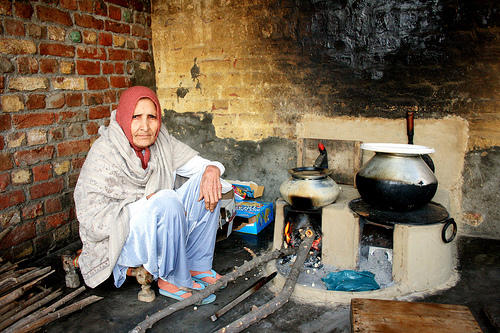
While driving home from a friend’s house one night I noticed something out of the corner of my eye as I passed the rows of darkened homes in his neighborhood. One garage door on the block was open and the garage lights were on, but there were no cars inside. Instead, there was an older Mata/Mai/Bibi/Bebe standing in front of a stove making roti, while a younger lady was dishing out what must have been some dal/sabzi.
The site was kinda cool and I had to resist the urge to stop my car and take a picture to post here – for fear of looking like a creepy weirdo. I did, however, think about it all the way home. What made it worth thinking about for a 10-minute drive is simple: it took me back to Punjab, where many farming families have two kitchens – one inside and one outside (where a bulk of the cooking is done).
I don’t know if it’s actually appropriate to say “Happy Hola Mohalla” or “Happy Sikh New Year” (doubt it) but these are the awkward felicitations we’re going to have since we blog in English…
According to the Nanakshahi calendar (a solar calendar which begins on what’s understood to be the day of Guru Nanak’s birth in 1469), the new year is approaching. New Year’s Day falls on March 13th of the Gregorian (Western) calendar. And Hola Mohalla, which is celebrated according to the Indian (lunar I think) calendar was celebrated today (March 11) in Anandpur Sahib. Too many calendars.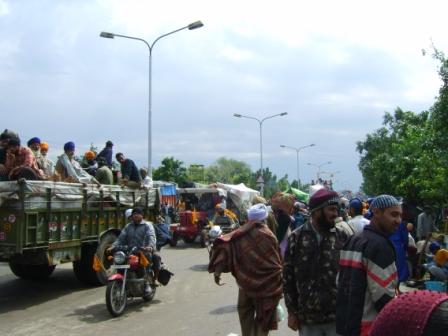
I had the immense pleasure of going to a Hola Mohalla a few years ago and have to admit that it was thrilling. The roads leading to Anandpur Sahib were teeming with Sikhs from all over Punjab, and some from further parts of the country. Buses came fully loaded, as did tractors and trucks with their backs open and passengers sitting inside, outside, and on top. Many people walked, some barefoot, from incredible distances. The roads were lined with sevadars serving langar to all the weary travellers- cha, samosay, cholay, pakoray! My mouth is watering at the memory… It was an amazing celebration and feeling of community. Gatka was fought, poetry was recited, and Holi revelers threw colors at anyone within range (such is the blend of celebrations in India… maybe everywhere for that matter).
Nihangs gathered to show off their weapons, athletic prowess and fighting techniques. Men of all ages- young and old- rode two horses at a time at full speed, standing up, (a few who had had too much bhang fell) down a long grassy field with the foothills that once gave their ancestors refuge from battle in the backdrop. It was easy to imagine that it was 300 years ago and these Nihangs (except the ones who fell from too much bhang) were preparing for a real battle.
[some more pictures below the fold]
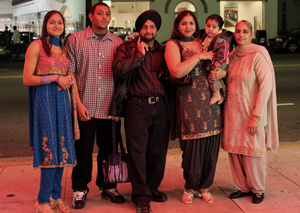 Although I am long since removed from the “bhangra scene”, still I thought this was interesting montage compiled by the Los Angeles Times in their “street culture” section, highlighting 11 great pictures on the Sights of Socal Bhangra.
The thumping, driving beat of bhangra –a style of folk music from the Indian state of Punjab, the Sikh homeland — reverberated through the walls of the Wilshire Theatre in Beverly Hills Saturday as young people from around the continent converged for the SoCal Bhangra Competition (socalbhangra.com).
Check out the montage.
If Baldev Mutta’s cellphone rings in the middle of a meeting, he picks it up. If it beeps over dinnertime or at midnight, he answers it. And if he has to go out to pick up a woman and find her a spot at a shelter at 3 a.m., he will do it. “It can mean the difference between life and death for a woman,” said Mutta, executive director of Punjabi Community Health Services in Brampton. “They are abused and don’t have anywhere else to go. This agency is their lifeline.” [link]
The Punjabi Community Health Services is an organization based in Brampton, Canada which provides various services to Punjabi women who have been abused. Instead of waiting for women to turn up at their doorstep, this organization takes a proactive approach by sending workers into the community to speak with abused women. They visit Gurdwaras and community centers to find women in distress. At times they must speak with the women secretly at doctor’s appointments, grocery stores, even parking lots, so their families don’t find out.
::
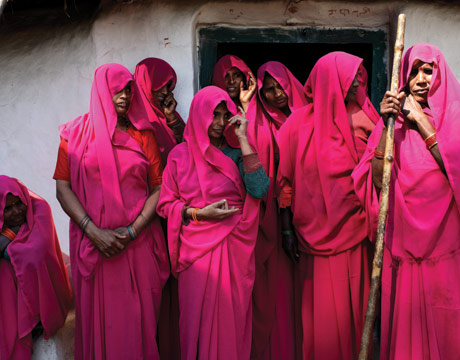 In related news, I recently read an article about the “Gulabi Gang” in an issue of Marie Claire which appeared on New America Media yesterday aswell. The Gulabi Gang are a group of women in India who have come together to fight against abuse. When local officials refused to take action against an alleged rapist, scores of pink-sari-clad women stormed the police station, demanding action – and thus, became know as the Gulabi Gang. For example, when Sampat Pal Devi learned that a friend had been beaten by her alcoholic husband and that the local police, chronically indifferent to violence against women, had looked the other way, something inside her snapped. In an effort to fight back, she gathered dozens of her female neighbors, armed them with sticks, and taught them how to fight back. Together, the self-declared Gulabi Gang have beaten up accused rapists, profligate officials, and husbands who’ve abandoned their wives.
 Last week, the International Criminal Court (ICC), issued an arrest warrant for current President of Sudan, Omer Hassan Al-Bashir. Al-Bashir has been charged with five counts of crimes against humanity: murder, extermination, forcible transfer, torture and rape. He also faces two counts of war crimes. The ICC may be growing its first tooth.
Behind the warrant were the many groups that have tirelessly worked to bring global attention to the matter. The ‘Save Darfur’ campaign has been extremely successful example in rallying public support, beginning in churches and university campuses, to influence the public dialogue and bring pressure upon public officials. Through organizing local events, but aiming to influence public opinion on a global level, the campaign is a model in their use of new media, internet, and public rallies and theatre to bring attention to the genocide and plight of a people. While I am in admiration of the campaigns strategies and efforts, it is still worthwhile to ponder on global culpability in allowing such genocides to continue to occur.
As part of these efforts, the campaign has been successful in bringing pressure upon China for its continued support of the genocidal regime and its willingness to condone the Sudanese government’s behavior in its bid to keep receiving returns on its billions of dollars investment into the country’s oil industry. Although on some level I understand realpolitik and China’s strategy of attempting to find oil supplies in those states that are considered pariahs by the US in order for China to satiate its growing oil needs. Still I cannot condone such actions and cannot trade human life for oil.
Grassroots efforts and political efforts are starting to show that the pressure upon China for its support of Sudan is beginning to have effect. Steven Spielberg’s boycott of the Beijing Olympics was one example. Protecting Sudan through its veto ability in the Security Council of the United Nations (UN), it is understandable why world pressure focuses on China. It is heartening that the pressure may even be beginning to have some effect.
However, left out of the equation is India.
We’ve talked a little bit about the Sikh Youth Slate that ran for gurdwara elections — and won — in Surrey, as well as how mainstream Canadian media was framing the event. In that election, youth won the vote with a platform promising a focus on Sikhi, community-based service, and support for youth diversion activities (ie., building community space at the gurdwara so that adolescents didn’t get sucked into another world of criminal complexity).
What I didn’t know, at the time, was that shortly after the election, the outgoing gurdwara president filed a lawsuit challenging the process/legitimacy of the nominations for election (but not the election itself). A press release circulated today regarding the legal developments in the case, and as a non-Canadian, it is more than a little disorienting.
 As International Women’s Day approaches us this weekend, I wanted to highlight the story of one woman who left a life of violence to a home of comfort built from creativity. Tanya Momi, a Bay Area South Asian woman from Chandigarh, is a painter and owner of “Spoil-Me Salon”, who left a long-term abusive marriage where she was treated like an “educated maid”. On March 8th her work will be launched in San Francisco as part of Amnesty International’s Stop Violence Against Women’s traveling art exhibit.
Vidya Pradhan writes:
“Tanya Momi rebuilt her life after a traumatic marriage and divorce and in her own quiet way she helps other women do the same. “Women come into my life through the salon,” she says. “They are like the missing puzzle pieces of my life.” Through her work in the salon and her paintings she reaches out to offer comforting messages of hope and renewal.”
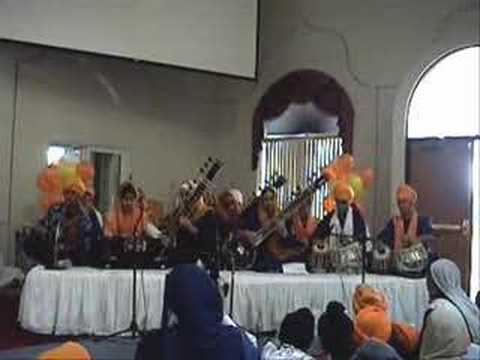
As I was randomly going through youtube clips a few days ago, I came across the above video of a group of Sikh children in Fremont, who learn kirtan in classical raags. Despite the poor audio, its obvious that they are good and I know this also from having heard them (and some of their contemporaries) in person – they are GOOD.
A couple of weeks ago Jodha reported on an article that brought to light the fact that Sikh children are practicing the tradition of kirtan, but what I think we didn’t discuss there is how this generation of Sikh musicians has really become one of classical musicians, learning stringed instruments of old and performing keertan in the Classical or raag framework. The growth has been obvious, especially in recent years – with the rise of institutions such as the The Raj Academy in Great Britain and the Gurmat Sangeet Department at Punjabi University Patiala, which specialize in providing instruction in traditional (classical) kirtan, and even the Miri Piri Academy in Amritsar of which the Chardi Kala Jatha (classically trained professional Sikh musicians who happen to be American in nationality) is a product.
 Yet another inexplicable case of profiling has come to light. On January 26th, 36 year old Rashad Bukhari arrived from Pakistan with a valid multi-entry visa into the US. Bhukhari is a former employee of the U.S. Institute for Peace, and currently the Urdu-language editor of the Common Ground News Service, whose goal is to build bridges between the Muslim world and the West. The news service is funded by the Search for Common Ground, a conflict resolution and conflict prevention ngo.
Immigration officials at Dulles could have easily verified all of this if Rashad had been allowed to make a phone call or if they themselves had chosen to check. Rather, they detained him for 15 hours, temporarily took away his cellphone and laptop, and eventually put him on a plane back to Pakistan. They prepared a transcript of the encounter in which an official justifies the United States not honoring Rashad’s visa by saying, “You appear to be an intending [sic] immigrant.” [Washington Post]
Bukhari was refused entry because the immigration agent he spoke with found that he was an “intending immigrant” or that he had an intent to remain in the US. His visa was a temporary visa (probably visitor). However, Bukhari has a wife and three children in Pakistan, a return ticket there, and a good job, all of which would normally indicate that he has no intention of remaining here in the US. The number of connections you have in your home country is what determines whether you have ‘an intent to remain’ in the US, and Bukhari’s connections, in ordinary circumstances, would be more than enough to assure authorities that he would return to Pakistan.
In words that don’t appear on the transcript of the case, the official told Bukhari that he could “voluntarily” withdraw, return to Pakistan, and reapply for another visa, or face a five year ban. So he left, and now faces the consequences that accompany being refused entry at a border.
Yes, I’m going to dare to talk about a film other than Slumdog Millionaire. This past weekend, I watched a film called Amal and I can’t stop thinking about it. While this movie has been shown at several independent film festivals, it hasn’t received the attention I think it deserves (actually, perhaps that’s a good thing – those films that get hyped are often dissapointing!). The story is quite simple,
AMAL, a multi-layered portrait of contemporary India, follows an auto-rickshaw driver in New Delhi (Amal) who is content with his small, but vital role in life. One day he drives an eccentric billionaire who, disguised as a vagabond, is searching the streets for the last morsel of humanity, and someone he can leave all his money to, and Amal’s life may change forever. AMAL serves up a visual feast for audiences. Filmed on location in New Delhi, India, this modern day fable asks the important question of what success means to each individual and ultimately reveals to audiences that the poorest of men are sometimes the richest.
It seemed pretty significant to watch this film during these pressing economic times. Amal, the lead role in the film, is played by Canadian actor Rupinder Nagra. A small role in the film is also played by Gurpreet Chana (The Tabla Guy). Gurpreet composed some of the music for the film too. If you manage to get your hands on this film, you won’t be dissapointed. In the meantime, here’s the trailer:

 I know, from personal experience, that Sikh student organizations are always looking for a way to “get involved” and participate in a good cause. So, when I read about a recent initiative encouraging this type of active involvement, I cheered (abeit silenty… and to myself). The Sikh Spirit Foundation is an organization dedicated to promoting sikh values through education. In line with this mission, the Foundation recently launched a contest looking for project ideas which could help sikh education or our local gurdwaras.
Help us assist the Sikh Community. Tell us how you would spend $25,000 to improve Sikh education or your local gurduara for a chance to win an iPod!
Submit two written paragraphs explaining what you would do and how it would help the Sikh community. Ideas will be judged according to feasibility, impact and need.
The Sikh Spirit Foundation intends to pursue the winning idea this summer by inviting the global community to submit proposals for the project. The Foundation will select and fund the best proposal among the submissions. [link]
Some of the organization’s grantees include: Ensaaf, Gyan Sewa Trust, Nanakshahi, Sikh Coalition, SikhNet, Sikh Research Institute, and Ujjaldidar Singh Memorial Foundation.
We’ve previously discussed involvement in the Sikh cause and lac(k)tivism – so it would be great to hear how youth and student organizations take the opportunity to suggest solutions to problems in gurdwaras and provide ideas for improving sikh education. Whether we acknowledge this or not, we are building a world today where our children will live tomorrow. To see the positive impact, it really comes down to how much we are willing to invest in our community today. We encourage you to go directly to the website to read submission guidelines – however, if you’d like to leave some thoughts here too – we’d love to hear your ideas!
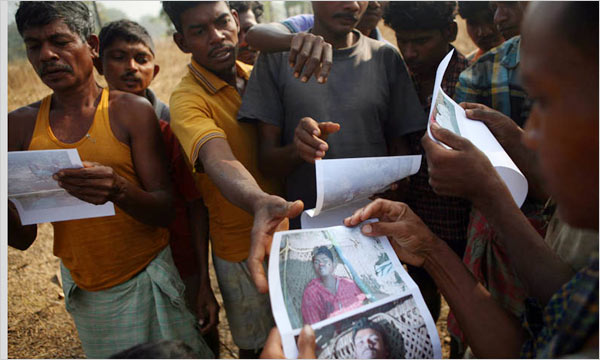 Not in India! In India, the state only engages in what is euphemistically called “fake encounters.” While many in the Sikh community remember the tragic events of 1984, in many ways the events did not just transform the Sikh nation, but has had a lasting effect on the Indian state.
Rarely do I see this line of questioning amongst Indian academics, elite, or the media. Violence does not only affect the victim, but the perpetrator is also transformed. Last week, I commented on one such transformation in the Indian State – when a mainstream journalist can openly call for “state terror(ism)” as a tactic to perpetrate against its own citizenry.
This week, in a related story, but still somewhat different, I highlight the euphemism “fake encounter”. Although this term had traction before 1984 and was one of the spearheads against which Baba Jarnail Singh Bhindranwale fought against, it was in the post-1984 Punjab that supposed “encounter deaths” became so widespread and with a complacent Indian press parroting the State’s reports soon found them relegated to back pages. If there truly is a “Punjab lesson”, it was that other Indian State agencies could engage in these “fake encounters” with complete impunity. The latest case comes from the state of Chhatisgarh and the rural areas near Singaram.

