Blogged: Amol Singh
 On the night of April 24, 1915, over 200 of Constantinople’s Armenian intellectual and civic leaders were taken from their homes and boarded upon trains headed eastward toward the city of Ankara. What followed over the next few months would be a concerted, systematic Ottoman project meant to eradicate the Armenian identity. Millions of Armenians, depicted by the state as dangerous Russian conspirators and hazardous to the security of the Ottoman Empire, were uprooted from their homes and marched across the Turkish desert. What transpired over the course of that summer was the raping, pillaging, and butchering of over a million people. Though the Ottoman forces might have failed in the complete liquidation of a people, genocide served as a near consolation prize.
As April 24th approaches, Armenians around the world will gather as they have for the past 90+ years and demand that the Turkish state take responsibility for its actions. This summer, as Sikhs also embark on projects to mark the events of 1984, it seems hard to escape the fact that we too, are becoming part of a global collective searching for some sort of acceptance of the atrocities that have been done to us. This sharing of spaces by the world’s downtrodden is allowing for more nuanced perspectives of each atrocity. In this understanding, the 1915 Armenian genocide becomes not a yearlong campaign to annihilate Armenia, but rather a set of events concurrent with a larger Ottoman decades- long campaign meant to undermine Armenian existence. In this sphere, Operation Blue Star becomes not a plan to rid Harimander Sahib of radicals hijacking the Sikh identity, but rather another incident in a set of systematic attacks on Sikh sovereignty by the Indian Center.
In this mold, we are becoming participants in a unique Genocidees Anonymous of sorts, where the recognition of our tragedies becomes cast into a set of layered political demands.
According to the Sikh Times, Sikh police officers are coming together to help address discrimination within the workforce in addition to addressing community relations between Sikhs and the British police.
The Association, which is to launch next Wednesday, lists its goals as follows:
The aims and objectives of the BPSA are;
- To establish a national forum for Sikh members of the British police services
- To assist the British police services in developing strategies to recruit, retain, and progress Sikh members of the service hence increasing Sikh representation in the police service at all levels
- To provide a religious, cultural and social forum for members of the BSPA through celebration of dates and festivals on the Sikh calendar.
- To promote an understanding of the Sikh Faith and the Sikh values of democracy, equality and justice within the police services
- To provide support and advice to Sikh members of the police service.
- To promote social cohesion and integration.
It seems like Canada is showcasing one socially conscious Sikh rapper after another. TLH has covered “Humble The Poet” and now here is “Sikh Knowledge” from Montreal. Sikh Knowledge raps with Lotus on issues effecting the 2nd generation and marginalized peoples.
Kanwar Anit Singh Saini, a.k.a. Sikh Knowledge, is the son of Punjabi Sikh immigrants. He works in the field of speech pathology where he contributes his musical knowledge to the health sciences field.
Check out his songs below and let us know what you think!
Disclaimer: There are graphic descriptions and swear words in the videos below.
 Sometimes some articles are too disturbing to not make a comment.
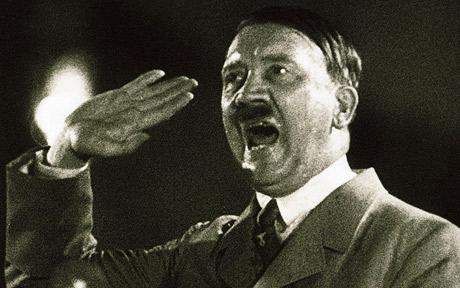
The word Mein Kampf immediately brings to mind Adolf Hitler’s deluded dream and genocidal paranoia of the “Jewish peril”. Long the Bible of idiotic Aryan supremacist groups, the book seems to have found a rather new (or maybe) old niche market in India.
Sales of Mein Kampf, Adolf Hitler’s autobiography and apologia for his anti-semitism, are soaring in India where business students regard the dictator as a management guru.
Booksellers told The Daily Telegraph that while it is regarded in most countries as a ‘Nazi Bible’, in India it is considered a management guide in the mould of Spencer Johnson’s “Who Moved My Cheese”.
Sales of the book over the last six months topped 10,000 in New Delhi alone, according to leading stores, who said it appeared to be becoming more popular with every year.
On TLH we have posted on the importance of Punjabi/Khalsa Schools. I have found that despite many students’ resistance to attend these schools, they plant the seeds for future exploration into Sikhi. At the age of 12 you may think you are too cool for school on Sundays, but at 19-20 or even 30 that experience creates a base for you to delve more deeply into your spiritual identity. Thus, I think it is extremely important that each Sikh community have at least one good Punjabi/Khalsa school. Ideally, I would want each Gurdwara to have one.
However, Punjabi/Khalsa Schools run into problems because in some way or another they become linked with communal politics. Most often this politics infiltrates schools within Gurdwaras. I think a fundamental component of a Gurdwara is a Punjabi/Khalsa School as is a Langar Hall. However, for many Gurdwaras, Punjabi/Khalsa Schools are a last priority. Gurdwara committees will fund new kitchen appliances before making a commitment to continually fund a Punjabi/Khalsa School. Thus, some community members have decided to create Punjabi/Khalsa Schools outside of the Gurdwara in local community-centers. When I hear this, I am both excited and disappointed. Excited that a school has been established; but disappointed that we are showing Sikh youth that we have to step outside of our main institution, the Gurdwara. How are we supposed to socialize our children into a Gurdwara-going culture when our leadership doesn’t support it in action? It’s a Catch 22. I don’t blame community members for creating schools outside of the Gurdwara. Their circumstances are real and, many times, this is their only feasible option. Or is it?
Today, I want to share with you, Nirpreet Kaur’s story. I highlight her story for 2 reasons. 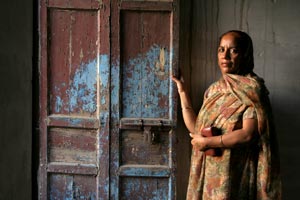
First, as we’ve discussed on this blog before, the majority of Sikh history as its been documented thus far really is his-tory. So this piece of her-story is a rare gem. And second, too often, we think of women in the Sikh community only in our roles as mothers, sisters, wives, and daughters. These are all important roles but our identity isn’t entirely defined relative to others’ or based on our relationships with others. Yet we recognize the additional roles we play outside of these expected roles too rarely. And so… Nirpreet Kaur.
Nirpreet was 16 years old on November 2, 1984 when the mob came for her father, Nirmal Singh…”[Khokhar- a Youth Congress leader] sweet-talked my father into coming with him for a compromise,” says Nirpreet. But Khokhar went straight to the mob and handed Nirmal Singh over. The oldest of three siblings, Nirpreet, ran to the mob but could only watch helplessly as her father was tied up and set ablaze. [link]
To avenge the killing of her father, Nirpreet joined the Khalistani movement.
As a functionary of the then dreaded All India Sikh Students Federation, Nirpreet came in contact with those involved with the Khalistan movement, an armed insurgency fighting for an independent Sikh homeland in Punjab, and became part of the militancy that ravaged the state for over a decade in the 1980s.[link]
I am a loyal listener of Chicago Public Radio’s weekly series, “This American Life.” No matter how many different types of media are out there, I still find the radio documentary to be a powerful medium. Since I can’t always catch it when it’s on, I made a point to subscribe to their weekly podcast.
A few months ago, I heard this fascinating story about Reverend Carlton Pearson, a renowned evangelical pastor in Tulsa, Oklahoma. This story talks about his rise in the evangelical arena, and his eventual fall because of his doubts in the belief of hell. He wondered if a loving God would really condemn most of the human race to burn and writhe in the fire of Hell for eternity. He then started preaching the theology of “inclusion-ism” which believed God was all-loving, regardless of what path he or she chose. He was ultimately declared a heretic by the church.
When I originally heard this, it made me think of how the concept of Ik Onkar would fly in the evangelical community. Take a listen…I’d be curious to hear what others think.
One of the underlying issues to many of the discussions we have here on TLH seems to focus upon whether or not elements of Sikhi are being redefined as we evolve in the communities within which we reside. We often take concepts such as Seva, Sangat and Simran for granted without wondering if they are being fulfilled in their true element. I post on this topic not to argue whether or not what we do is right or wrong – but rather in what forms we see these concepts exist today.
In the midst of this world, do seva, and you shall be given a place of honor in the Court of the Lord. SGGS p26
One example that comes to mind is how gurdwaras and the sangat (I include myself in this sangat) have essentially ‘outsourced’ the kitchen seva. Each time I have visited one of the gurdwaras in my area, I notice that the sangat departs after eating langar, leaving behind a kitchen full of dirty pots and pans. This does not seem to be an issue because many gurdwaras have now hired help to come in and essentially do the seva. I understand the gurdwara’s reason for hiring help (the dishes have to get done) but I wonder how we got to this point. I’m not sure if this is an issue unique to North America or whether it occurs in India and also in the UK, for example. During my last few visits to gurdwaras in India, I was so impressed by the amount of seva that was occuring in the kitchen and was also inspired by the energy that was produced from the sangat working selflessly towards a similar goal.
 With Obama’s move for a new strategy, recently, we have seen an avalanche of different articles from Af-Pak, the newly vogue name for the region. I will begin with some more macro-debates, before turning to the Sikh-specific.
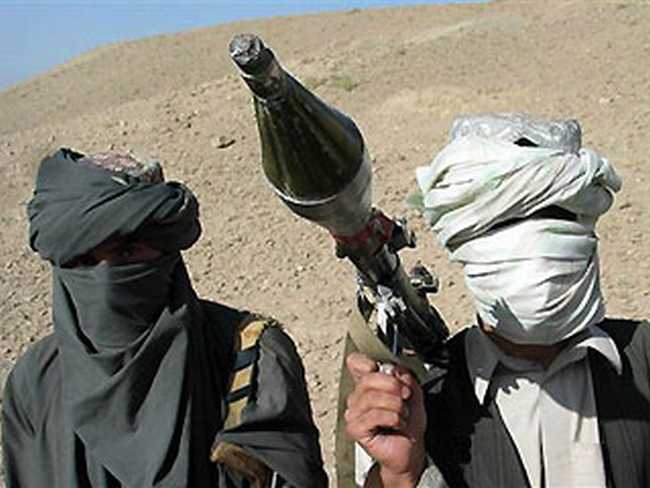
An interesting analysis was recently featured in the London Review of Books, in an article titled ‘Taliban versus Taliban.’ In the article, the Economist correspondent, Graham Usher, notes that Americans have a problem in understanding the complexities of the “Taliban” phenomenon because it means different things to different people at different times.
All politics is local and that is how the Taliban should be treated as well. Made up of diverse factions and groups with widely separate ideologies, we “lump” them under a specific tag – “Taliban.” While for the US, anyone that attacks them in Afghanistan is Taliban, for the Pakistani Army, their perspective is a bit different. The only issue that really matters is if the group works in India’s strategic interest. Thus there are ‘good’ elements and ‘bad’ elements:
The short answer is pro-India, in practice if not intent. Insurgents in the tribal areas are deemed anti-Pakistani if their actions advance the perceived goals of India in Afghanistan. They are pro-Pakistani as long as they don’t attack the Pakistani state or army, even if they launch attacks against Nato forces in Afghanistan, Islamabad’s supposed allies in the ‘war on terror’. Indeed, the Afghan Taliban is considered an ‘asset’, a hedge against the day when the US and Nato leave, but also a counter to India’s expanding influence in Afghanistan.
Blogged by: Mewa Singh
I haven’t written in quite a bit of time. Once in a while I share personal pieces, but as I like to protect my privacy I don’t do it too often.
However, this one is fresh (occurring just this weekend) and in some way I am soliciting the readers’ opinions as I set about my next course of action. A friend suggested that I share the story as maybe it will resonate with other males or females that ever find themselves in this position and spark a wider conversation about complicity and duties in our community.
Here goes….
Its been a good year so far for Sikhs and Canadian sports. First, we’ve had NHL regular season and playoff games broadcast in Punjabi. We’ve also the first NBA game broadcast in Punjabi. And this year, at the annual Vaisakhi game for the Toronto Raptors, four good looking Sardars sang the Canadian and American national anthems. Performing on drums is Jiwanjot Singh Gill, on dilruba Harman Singh, on dhol is “Tabla Guy“, Gurpreet Singh Chana, and on vocals and harmonium, Dr. Onkar Singh.
Updated: Friday, at 11:30PM
Last year we covered the story of a Sikh youth accused of brandishing his kirpan on the schoolyard. Accounts of the incident were hugely divergent; it was unclear whether an assault had ever actually occurred, or whether the report was a feature of animosity toward religious minorities in Quebec.
Yesterday that youth was fully acquitted of the kirpan-based charge, and his other possible charges were dispensed. The outcome of this case is a success for the youth involved, but also in that its outcome has no bearing on the interpretation or application of its effect to the kirpan in general. The judge in this case intimated that the case had gone too far and would never have been brought, were it not for the youth’s nationality and religious identity:
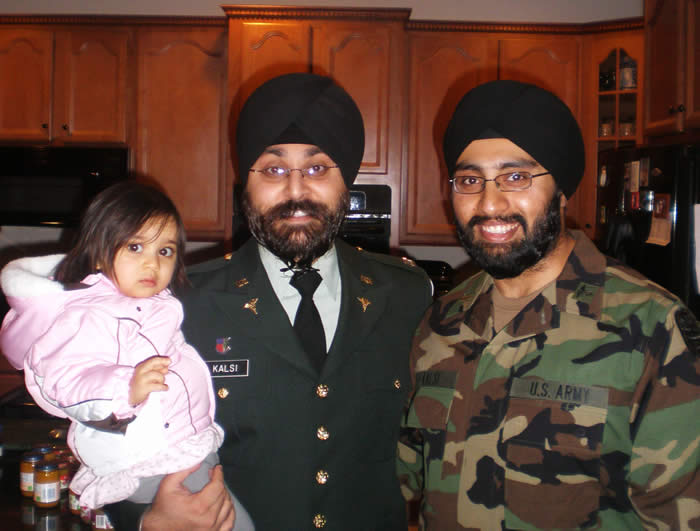
Sikhs Now: Kamaldeep Kalsi (L) and Tejdeep Rattan (R)
Two Sikh recruits in the U.S. Army, Kamaljeet Singh and Tejdeep Singh, were told they would be allowed to continue to wear their turbans as active members of the military. They describe this as being able to wear both their uniforms: that of a Sikh, and of a member of our Armed Forces. Now Army personnel have back-pedaled, claiming a 1981 ban prohibits soldiers from wearing “overt” articles of faith — including the dastar.
Despite a long history of Sikh participation in armed forces worldwide, Steve Levine, a former Army lawyer from 1992-1999, speculates that there are at least two policy reasons for requiring shorn hair: unit cohesion, and the ability to wear military equipment [link]. This seems incongruous given that Sikhs had served on active duty in the Army with full daris and dastars, and were perfectly well-protected, in the past. In light of previous exemptions, lawyers for these Sikhs argue the policy is an undue burden on the free excercise of faith under the Religious Freedom Restoration Act of 1993.
 I remember that night…election night, watching on TV students rejoicing in the streets outside of Howard University (a local Historically Black University). I’m not sure how much of it was about Obama’s policy, or just the “historic” nature of the event, but it was all summed up to me as an African-American student holding back his tears said to a reporter, “I’m just so happy to have one of our guys in power.” It was a common sentiment, but this statement stuck in my head for several days. What did he mean by this? What was his expectation of President Obama over the next 4 years? Did he think just because a black man is in office, all of a sudden the American experience will now change for black people? That the wrongs of their history will now become right? That discriminatory laws and policies toward black people will all of a sudden be overturned? If that is what he meant, then I understand the celebration…but I would celebrate with caution.
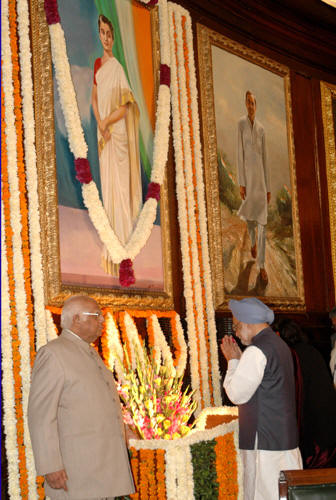
Five years ago, many Sikhs were celebrating in the streets as well. Finally, one of “our guys” had become Prime Minister. Manmohan Singh was elected selected as the 17th Prime Minister of India, by Sonia Gandhi herself. Sikhs all over the world rejoiced. Even many of the Sikh political prisoners in jail were celebrating with this victory, believing their release was now imminent.
Even some of my more progressive and panthic-minded friends got caught up in “Manmohan Singh Fever” and encouraged me to give him the benefit of the doubt. After all, how could we judge him? Who knows what he may do for us?
I, however, remained skeptical.
UPDATE: The 13-year old youth who was arrested that night has been charged with assault and is scheduled to appear in court on May 19. [source] Thanks to everyone who’s given more information in the comments!
———————————————————————————————————————————–
Some tragic news is coming out of Toronto tonight from the Dixie gurdwara’s Vaisakhi celebrations. 
A Mississauga teen was stabbed in the stomach and seriously injured Tuesday night during a [Vaisakhi] celebration at the Ontario Khalsa Darbar temple in Mississauga.
The 15-year-old male was taken to the Hospital for Sick Children in Toronto after the stabbing at around 10 p.m. in a kitchen in the temple’s basement. The victim was conscious and breathing, a Peel police officer said at the scene, and was believed to be in serious but not life-threatening condition.
Peel police arrested a teenager at the scene who is about the same age as the victim.
The stabbing happened during Vaisaki, an annual religious festival marking the start of the new solar years that, throughout the day, draws about 30,000 people to the temple, also known as Dixie Gurdwara. [link]
An equally young suspect is in custody, though no information about motive has been released yet. If any readers in Toronto can update us, your southern neighbors would really appreciate it.
A suspect, about the same age as the victim, is in police custody. Police say the knife used in the stabbing may have been set out with some food. [link]
I’ll refrain from speculating about possible motives since there is so little information to go on right now. What I can say at this point, regardless of the back story, is that there is no acceptable justification for this senseless act of violence.
I’ll update this entry as more information is released though. Our thoughts are with the young victim, his family, and Toronto’s sangat.
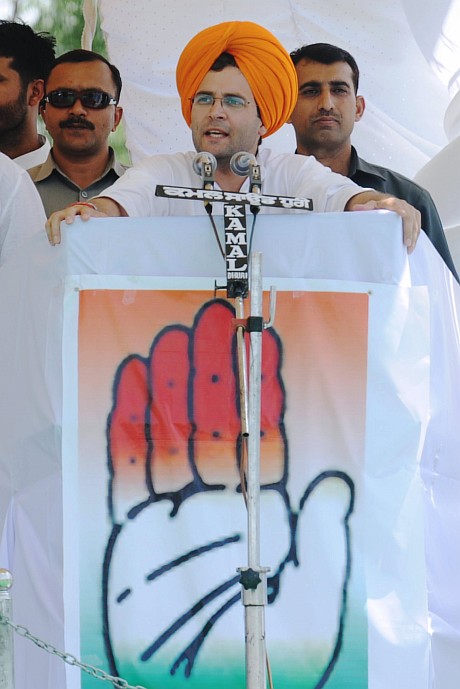 OR HOW NOT TO PULL A SIKH-RELATED PUBLICITY STUNT
I will leave the PR-stunt by Congress heir-apparent, Rahul Gandhi, son of Rajiv Gandhi, grandson of Indira Gandhi, and great-grandson of Nehru and his ill-advised (or rather ill-positioned pagri) to speak for itself. A pictures is worth 1000 words and ‘ridiculous’ is one of those that come near the top for this election stop near Takht Damdama Sahib.
On a bit of a serious note, although I hate writing short posts without analysis, I came across a finely-written article about the ‘Shoe-hurling Sardar and Deep-rooted Sikh Grievances‘ published in a Pakistani newspaper that I wanted to bring to our readers’ attention.
I initially cringed when I read stereotypical sentences, such as:
However, Sikhs are known for their forthrightness and carrying a level head in emotionally charged situations is not one of their strengths.
Eventually I got over it and just focused on the substance of the matter. Definitely worth a read.
For my previous coverage, see here and here.
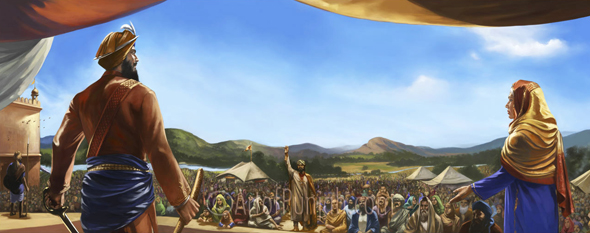
With Vaisakhi upon is, what is it you think of? Perhaps Anandpur Sahib, the city of bliss? Maybe the Panj Piaray, the five beloved ones? Or perhaps it is Guru Gobind Singh Ji’s message of fraternity and equality that resonates with you. Whatever it is that you think of, I wonder if it stirs you or moves you to see the world in a different light – in the light that our Guru hoped for us. On this day, in 1699, our Guru gave us the potential to be born again. Without caste, without discrimination, and without fear.
It is clear that issues of caste and discrimination still play a role in our communities today. However, I came across a promising article in the Guardian which discusses how a small café in India is challenging long-held caste taboos by hiring Dalit women to work within the café as waitresses. Although the Indian constitution banned untouchability sixty years ago, Dalits are still often forbidden, in villages and small towns, from doing anything other than low menial jobs. We all know it is not easy to challenge century-old beliefs, however this café is doing just that. As Sikhs, these issues should matter to us and we should stand up against injustice within any community.
An interesting paper, which I found on the Punjab Research Group site, titled “Dalits and the Emancipatory Sikh Religion” discusses the role Sikhi played in liberating Dalits.
It is beyond doubt that Sikhism emerged as an emancipator for the lowest of the low. Nanak, the first Guru, was clear when he says:
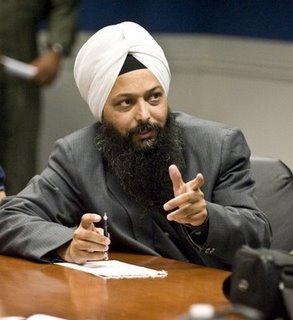 Last week, we saw the birth of a new Sikh folk hero. I am sure the dhadhi jathas (just as Chuck D called rap music the CNN of black people, dhadhi jatha is the CNN of the Sikhs) are already warming up their sarangi and dhad.
While other commenters have suggested material reasons for the turnabout in the Congress Party’s decision, I still contend that we must celebrate the Sikh masses for galvanizing the issue. The show of force came through Sikhs and their ‘rail roko’ with the shutting down of the railroad system throughout Punjab.
Although I am well aware of the political advantages that the Akali Dal and BJP sought to gain from the issue of the Delhi Pogroms of 1984, I hope for naysayers, worst of all those within our community, that like to state “the past is the past” and “let bygones be bygones” they realize the past does affect the present and life still does reside within the Sikh masses and polity.
Our so-called “leaders” rarely lead. Throughout Sikh history, it has been the masses that have had to goad these so-called leaders. Whether it was the movement to free the Gurdwaras from British-Mahant control during the early part of the 20th century or even the Sarbat Khalsa and subsequent declarations at the Akal Takht in 1986, the Sikh masses have always been the main impetus of the Qaum. The Guru Granth Sahib is our guide and the Guru Khalsa Panth (and not individual leaders, be they SAD Presidents or Jathedars) is our temporal collective body.
A few months ago, with our first TLH book club, Jodha blogged about Sikhs In Britain. The book was a fascinating insight into how the lives of Sikhs living in England have been shaped over generations. In a similar attempt to historically document the Punjabi Sikh community in the UK, The Southall Story is a project that celebrates a town that has “welcomed new communities throughout the last century, enabling them to excel and influence both the social and political structures of this country.” Through a series of public events, performances, exhibitions and forums, the project aims to educate and inspire people about their heritage.
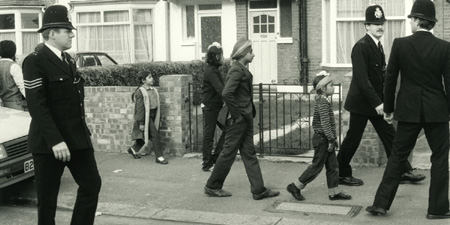
Southall is also a place that has come to be affectionately known as Little India, but for many it is much more than that. Being a port, (Heathrow is a stones throw away), Southall has been a home to such diverse groups as the West Indians, Indians and Pakistanis in the 50’s through to the Ugandan Asians in the 70’s. Most recently, new arrivals include Sikhs from Afghanistan and Somalians.
These settlements invariably have influenced and shaped Southall. Pivotal moments such as the racist murder of teenager Gurdip Singh Chaggar in 1976… meant that as a community issues of race and gender could no longer be avoided. [link]
As we remember 1984 through concerts and acts of rebellion, let’s not forget the visceral spirit displayed by Singhs IN that time period.
Watch below the original version of a Punjabi kavita sung by Bhai Gursharan Singh during those turbulent times in Manji Sahib Hall located in the Darbar Sahib complex . This kavita captures the mood and spirit of those days. Tigerstyle later used it in one of their Shaheedi CDs to REMEMBER that spirit.
Intellectually, we can try to REMEMBER those days; but this kavita actually makes us FEEL how it was to live through that time.