
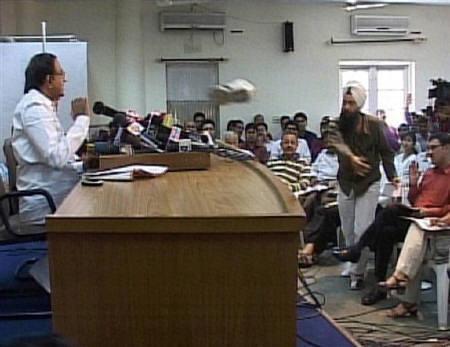
 I know many will object to this post and ask how does a shoe bring justice to the thousands that lost their lives in 1984? My reply – it doesn’t.
But what it does do is highlight the farce that calls itself Indian justice.
Earlier this week, I wrote about Sikh outrage against the Congress Party’s continuance of giving electoral posts to genocidal murders. While I still hold my claim of an independent position against Parkash Badal, the Akali Dal, and the BJP’s opportunism and the Congress Party’s celebration of impunity, the action of journalist Jarnail Singh warrants commentary and analysis.
Well, it seems like the sex ratio in Punjab is not improving despite the number of trees Mrs. Badal is planting and the SGPC’s desire to raise unwanted girl children.
The Tribune reports:
In 2001, the census of India recorded Punjab’s sex ratio at 876 females for 1,000 males, one of the worst in the country. The preliminary findings of a Lucknow-based agency AMS engaged by the government to assess the current situation shows that sex-ratio in many districts of the state has plummeted further.
First, AMS’s study has called out the Punjab government’s bluff in data collection. Apparently, the data collected by Punjab government agencies painted “… an unbelievably rosy picture of the situation”. The Social Security Department and Health Department have reported two different results. These results also do not match those of AMS.
An airline with potentially the best airplane food (for those with Punjabi palates) has just launched. Akal Air has just started bi-weekly flights (Wednesdays and Saturdays) from Birmingham, UK to Amritsar, a gateway for Sikhs to  Punjab.
Daljit Singh Birring, managing director of Akal Air, suggested that Birmingham International Airport is the “perfect base” for the airline. He said: “Access to Amritsar is of huge importance to the large Punjabi and Sikh population of the Midlands taking the pilgrimage to the Golden Temple and visiting family and friends.” [cheapflights uk]
The new flights are good news for the large Asian community in the Midlands. “Birmingham is the perfect base for Akal Air. Access to Amritsar is of huge importance to the large Punjabi and Sikh population of the Midlands taking the pilgrimage to the Golden Temple and visiting family and friends, as well as for business people trading with India’s emerging and developing economy,” says Akal Air managing director, Daljit Singh Birring. [link]
It seems that hospitality will be a major feature of the airline.
Akal Air customers will always be treated with respect, due care and consideration and be offered a pleasant flight experience by all Akal Air staff from Check-in, boarding, in-flight through to baggage claim. [Akal Air]
Happy travels to all in Birmingham! I hope to see Akal Air expand in the near future.
 I recently stumbled on a report from the Asian Centre for Human Rights (ACHC), titled Torture in India 2008: A State of Denial. This document claims to be “the first nationwide assessment of the use of torture in India.”
ACHC is a Delhi-based organization focused on protecting human rights throughout Asia, with what appears to be a specific focus on South Asia. I’m not familiar with this organization, so I’d be curious to hear if others can support or disprove their work.
The report focuses on the use of torture by police and security forces from routine arrests to counter-insurgency operations. Although it is clearly a preliminary analysis, it’s findings are quite alarming. The report notes:
The statistics of NHRC imply that in the last five years 7,468 persons at an average of 1,494 persons per year or four persons in a day died in police and prison custody in India. However, these figures represent only a fraction of the actual cases of torture. Cases of torture not resulting in death are not recorded.
Particularly troublesome was the section on custodial torture of women and children.
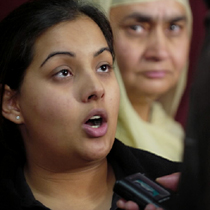
Tajinder (foreground) and Shalinder (background) Bansra.
Shalinder Kaur Basran is one of 19 recipients of the Carnegie Medal for heroism for intervening in a murderous domestic violence altercation in which a husband stabbed his wife. At the time, it was one of three cases in which desi-Canadian women had been killed by their families.
When Bibi Shalinder and her daughter heard a fight escalating downstairs, accompanied with cries for help, they ran downstairs where they found Jatinder Waraich had stabbed his wife, Navreet. She lay bleeding on the floor, crying for help. When he advanced on her, again, Bibi Shalinder forcibly removed him (while he held his knife) from the apartment while her daughter called 911. While police arrested Jatinder, his wife, unfortunately, did not survive his attack.
Reading about this award was really bittersweet for me. On one hand, I think interjecting yourself in the heat of a fight — with someone who’s already been acting crazy and is actively wielding a weapon — requires tremendous courage and strength. On the other hand, the underlying story of domestic violence and murder is heart-breaking. It made me wonder if others would have rushed to assist Navreet Waraich, or if they would have ignored it, assuming it was a domestic disagreement.
 As previously discussed, 1984 continues to haunt the psyche of a new generation of Sikhs. As justice continues to be denied to those that faced the Sikhs’ Kristallnacht in Delhi, the perpetrators of the heinous pogroms continue to roam the streets with impunity and some even continue to be awarded ministerial and cabinet positions by the government.
With the upcoming elections in India, Jagdish Tytler has been nominated by the Congress Party to run for the Lok Sabha Member of Parliament (MP) in northeast Delhi.
The Jathedar of the Akal Takht, Gurbachan Singh, and SGPC officials have called for a protest outside the residence of Congress Party president, Sonia Gandhi.
No Sikh should think that the call could have been given by the Jathedar without the expressed permission of Parkash Badal and that too for electoral gain. Kaka Badal, Sukhbir Badal, has already used the issue to call for Congress Party head, Captain Amrinder Singh (scion of the house of Patiala) to resign from his position.
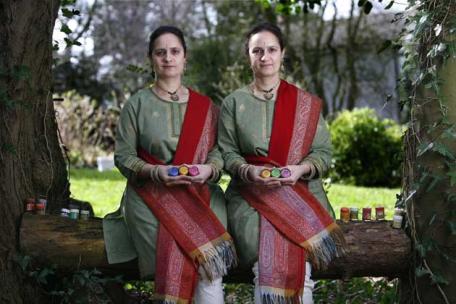 Does the West’s emphasis of the individual subvert community consciousness in the art world? UK-based artists Amrit and Rabindra Singh explain that the primacy of the individual versus other relationships does not resonate with art elites as naturally as it may for others:
“Western contemporary art is all about the individual, the inner self,” reflects Amrit… We were constantly being told that to be individual was healthy, that we had to be more different from each other, be influenced by different Western artists from each other, but that didn’t seem valid to us. From the point of view of Sikh, Indian or even Asian philosophy, the community comes first and the individual is second.” [emphasis added]
I thought this article was a fascinating description and reflection on the structural challenges Sikh artists, particularly Sikh women of color artists, face within the art establishment in the U.K.
The twins described their sense of community and of shared experiences when conceptualizing and creating their art. This first barrier — that art that does not conform to the frame of mainstream art teaching — seems obvious, and yet such a subtle feature that it makes it difficult to push around it. This is a fairly distinct difference (individual vs. multiple social awarenesses) of philosophical development between the canon of European/American philosophers and philosophers from the different regions of Asia, but it was fascinating to see how it repeats and excludes through artistic representation. Not only that, it creates a less obvious form of discriminatory thinking in the art academy than the standard, run-of-the-mill racism.
Last week, I posted on the Gurmat Gian Group’s performance of classical keertan. This all Sikh women’s group, expect 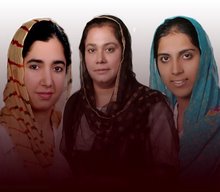 for a tabla player, is based in Ludhiana, Punjab. This week, I wanted to share a brief interview with one of its members, Keerat Kaur.
1. How did you come to join the Gurmat Gian Group? How long have you been with the group? How often does the group meet?
The Gurmat Gian Group was formed by my mother Gurpreet Kaur. My mother Gurpreet Kaur and myself used to do kirtan in the weekend gatherings of Gurmat Gian Missionary Trust. These programmes are held every Saturday and Sunday. Impressed with our singing, we were asked by the organizers and especially by Rana Inderjit Singh to train young boys and girls to do kirtan. Now Gurpreet Kaur takes regular classes at the Gurmat Gian Missionary College where many girls and boys of different age groups are learning kirtan.
Encouraged to go in to recording Gurabni Kirtan lead to the formation of Gurmat Gian Group which now has 5 CDs to its credit.
 I know this concert has already been discussed, but the event had been postponed to this coming Friday…and with all the local buzz…it got me thinking about how we remember 1984.
The Sikh Student Association here at the University of Maryland, in conjunction with other student groups, is sponsoring a free concert on April 3rd, 2009 to mark the 25th anniversary of the 1984 Sikh genocide. In a previous post Truth To Power – in reference to the recent Ensaaf report, I had stated:
We must read such reports and present them … anywhere and everywhere … to anyone who will listen: our gurdwaras, our local Amnesty International chapters, student groups, talk radio, public television, newspaper op-eds, etc. We must also create awareness of these findings in whatever format we can – through music, art, theatre and poetry.
The featured performer for the concert is Immortal Technique, an up-and-coming rapper who attracts a large and diverse audience, especially amongst college students. His intense style, controversial lyrics, and willingness to approach political subjects, such as the mid-east conflict, have made him a fan favorite amongst the politically aware.
It is refreshing to see students think “out-of-the-box” in remembering 1984, by attracting a mainstream artist and joining forces with other student activist groups under the tagline “Move the Movement.” The SSA plans to distribute background material on the 1984 atrocities and subsequent human rights violations, as well as feature short video clips and interviews with victims in between acts.
Radio Free Afghanistan 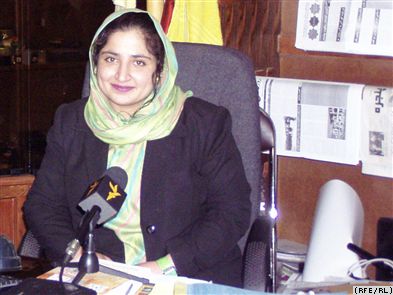 just chose Anarkali Honaryar for their “Person of the Year” award. Coincidentally, Anarkali is a member of Afghanistan’s minority Sikh community. At 25 years old, Anarkali is also a physician, a human rights activist, a member of Afghanistan’s Constitution Committee, and works for the Independent Human Rights Commission of Afghanistan. Oh, and she finished high school at 12.
Wow. I think another fitting title would be Sikh Role Model of the Year (or the decade?). She has definitely just become my role model. And we can definitely add her to our list of sheroes.
Just what exactly was Anarkali given this award for?
She is well-known for helping women who suffer from domestic abuse, forced marriages, and gender discrimination. Honaryar is also an advocate on behalf of Afghanistan’s small, embattled Hindu minority, which lives in squalid conditions and faces harassment and discrimination. “We are thrilled to recognize Anarkali for her tireless work in promoting democracy, human rights, and civil society in Afghanistan,” said Radio Free Afghanistan Director Akbar Ayazi. “Anarkali has been taking part in Afghanistan’s reconstruction since she was a teenager — this recognition is well-deserved.” [Radio Free Europe]
The G20 summit, which will take place in London on April 2nd, will bring together world leaders representing 85% of the world’s output to discuss issues affecting the international financial system. The goal of this summit is to encourage world leaders to make three committments:
- First, to take whatever action is necessary to stabilize financial markets and enable families and businesses to get through the recession.
- Second, to reform and strengthen the global financial and economic system to restore confidence and trust.
- Third, to put the global economy on track for sustainable growth.
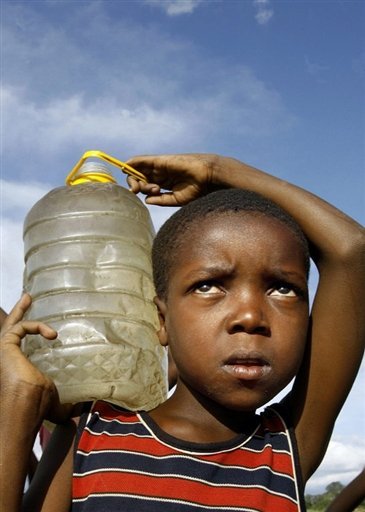 This week, religious leaders in Britain urged the G20 leaders not to forget their commitments to the world’s poorest people in the current economic crisis. In a joint statement, they quoted World Bank figures suggesting 53 million more people may fall into absolute poverty as a result of the crisis, and said the world’s leaders have a duty to help them.
In a communiqué issued in advance of next week’s G20 meeting in London, they call on political leaders to consider the moral issues at the root of the current financial crisis, and to pay special attention to the needs of poor, marginalised and vulnerable people: “to forget their needs would be to compound regrettable past failures with needless future injustices”. [link]
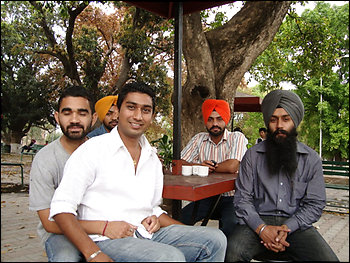 The story is hardly new. Every few weeks, we see reports by journalists that reinforce a well-known reality – many Sikh men in Punjab are cutting their hair and removing their turbans. I am hardly an alarmist. I do believe that despite the overwhelming trend, there are countercurrents as well. In an earlier post, I described what I have termed a ‘Sikh turn’.
Although many Sikh youths have for the time being removed their turbans, their sense of a religio-ethnic identity still remains strong. Maybe the temptations of modernity and especially the desires of the opposite sex are strong and many feel that at this point in their life they would rather pursue women and cannot live up to the great ideals of their Gurus. This should not be read as a rejection of those ideals but a realization of where they are and their priorities at this time. (Though this may be the case of those that remove their pagri on their own account and not in those families and children where they never had it as many in the diaspora)
As discussed previously, the ‘Sikh turn’ is occurring. The psychological tragedy of the post-1993 Sikh community is beginning to wane and we may be witnessing the dawn of a new era. It may not be in the Khalsa symbolic form that many hope, but a religio-ethnic movement is occurring. The youth are not disinterested and disconnected; they are engaged and can be mobilized. The pull of the pagri is not dead in Punjab either as we see many Bihari migrants joining the Qaum’s ranks. This is a good sign. A new generation will soon have its own version of ‘pagri sambhal jatta.’[link]
A recent article in the Washington Post revisits the issue, highlighting a looming impending court case.
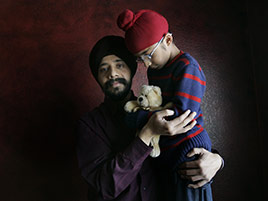 A couple of days ago Darshan Singh took his six-year-old son, Gurjot, to the post office to get a U.S. passport. Unfortunately, his experience is all too familiar: postal workers refused to take Gurjot’s photo, insisting he remove his “hat”:
A Frisco father says his family’s trip to the post office turned into an emotional experience after a postal worker refused to take his son’s passport picture while the boy was wearing a turban…
“We kept telling them, ‘it’s not a hat,’” Singh said. “I want to make sure that doesn’t happen to any other kid of my religion.”
I’m a bit of an NPR Junkie, and one of my favorite series I listen to is called This I Believe. This I Believe is a national media project that engages everyday people in writing, sharing, and discussing the core values and beliefs that guide their everyday lives. I’ve been following the series for quite some time now, but last week, I came across a story that really moved me – it’s called Finding Freedom In Forgiveness.
In 1984, Jennifer Thompson -Cannino testified that Ronald Cotton was the man who raped her. Eleven years later, DNA evidence cleared him of the crime.
This story speaks to the healing power of forgiveness.
Although I haven’t heard many Kirtanis or Granthis speak about this topic much, Guru Sahib in fact has much to say about “Khima” (Forgiveness). As I’m starting to research and reflect on this concept through Gurbani, I came across this line that I immediately connected with. From Bhagat Kabeer Ji, page 1372:
jehaa lobh theh kaal hai jehaa khimaa theh aap |155|
Where there is greed, there is death. Where there is forgiveness, there is God Himself.
Finding Freedom in Forgiveness is less than four minutes long and worth the listen. I would love to hear what others think of this audio essay and perhaps an experience of your own as you’ve discovered forgiveness on your own journey…
Recently we have discussed gurmat sangeet (i.e. classical keertan) on TLH. This past week, I came across an all Sikh women’s gurmat sangeet group from Punjab. Their voices are absolutely beautiful! The emotion that raags convey that words alone cannot express is actually felt in these women’s performances. You can visit the Gurmat Gian Group blog here. They also have a youtube channel here.
Here is their performance of the shabad, “Sur Nar Mun Jan Amrit Khojday”.
SGPC Chief Avtar Singh Makkar recently put forth the stunning idea that the Sikh religion doesn’t permit women to wear jeans. Apparently jeans, along with sleeveless shirts, “attract undue attention and distract others.” [link]
 The background story:
…authorities in educational institutions run by the Shiromani Gurdwara Prabandhak Committee are … advising girl students wearing jeans or sleeveless shirts to “go home and change”.
Though the gurdwara body does not have any written rule on the matter, its employees in schools and colleges across Punjab insist hip-hugging denims and bare female arms are too provocative and liable to distract male teachers and students. There have been many recent instances at Ludhiana’s highly-sought-after Guru Nanak Engineering College, where women students were turned out of classrooms and told to stay away unless they went home and changed into “more respectable attire”.
SGPC chief Avtar Singh Makkar actually acknowledges the unwritten rule. “We discourage girls from wearing anything other than the usual salwar kameez because Sikh religion doesn’t permit dresses like jeans, pants or other similar wear.” [link]
What’s wrong with his statement? So many things… only one of which is Makkar’s use of the Sikh religion to promote his personal viewpoint and ultimately, the failure in leadership it illustrates.

“A young woman scarcely had time to weave the fragile fabric of her dreams in our town.”
This is one of the opening lines of Bhira Backhaus’ debut novel, Under the Lemon Trees. The novel – published this month – is set in a small town in Northern California, and tells the story of two generations of a Sikh family facing difficult decisions about love, cultural traditions, and familial ties. The story focuses upon the life of 15-year-old Jeeto who stuggles between embracing her heritage and fitting in as an American and journeys through her reconciliation of the possibilities of freedom and love (I’m sure many of us can relate to one or all of these!). The publisher describes the novel as part Bend it Like Beckham, part Monsoon Wedding.
The book is based on the author’s own experiences growing up in a small-town Sikh community in California’s Sacramento Valley.
“It’s a story that I’ve [always] known I wanted to tell,” she said.
Dealing with cultural disconnect is one of the story’s driving forces, Backhaus said, but many of the novel’s themes, such as the search for love, identity and dignity, are cultural universals she hopes appeal to people of all backgrounds. Although she said she hopes “Under the Lemon Trees” will have similar success to the string of popular tales of the Indian experience, such as “Slumdog Millionaire” and the novels of Jhumpa Lahiri, Backhaus said her work is different. “Under the Lemon Trees” tells the story of Sikh Indians immigrating to California from lower-class villages in India, she said – a story that has not been told by other successful media depictions of Indian life. [link]
I’d be interested in doing a full review of this novel once I’ve finished reading it. In the meantime, here’s an excerpt from the first chapter.
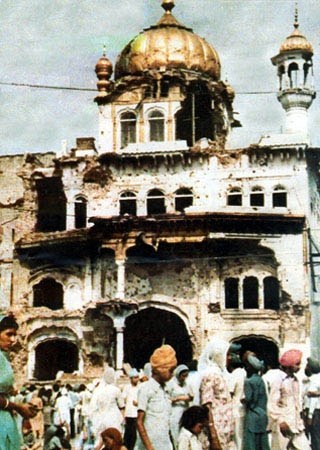 In time for the beginning of the Sikh New Year according to our own Nanakshahi calendar, the Shiromani Gurdwara Parbhandak Committee (SGPC) has released its annual calendar. In this 25th year of remembering the events of 1984, it is a moment for Sikhs to reflect and take lesson as well as maybe something for India to reflect and takes lesson as well (hopefully not the so-called morally-bankrupt, heinous ‘Punjab lesson.’)
This year’s calendar includes a picture of the Akal Takht, bullet-ridden and tank-bombed, after the Battle of Amritsar. The call for SGPC recognition has been long overdue. Activists within the Sikh community have been calling for official recognition of the Third Sikh Genocide (Third Ghallughara) for years. Finally the SGPC has taken action.
Unfortunately, the SGPC does not act at the behest of the community, but only at the behest of Badal. In an election year, many are seeing the picture’s inclusion as an attempt by the Akali Dal (Badal) to play upon Sikh public sentiments against the Congress Party in Punjab.
There was an interesting story recently on Cultural Diversity Day at a local middle school. In addition to featuring dancing, self-defense, and dialogues, a few speakers lectured on their experiences or cultures, including a Sikh speaker:
Wearing a bright blue turban that matched his outfit, Gurparkash Singh, a scientific writer for Bristol-Myers Squibb, told about the Sikh faith. He said it’s easy to identify a Sikh person by looking at the shape of his or her turban. Sikh turbans are triangular and stop at the nape of the neck.
The writers covering the story spoke of the event as going “beyond diversity” and pushing forward what cultural diversity days are all about. It sounds like the event was really well-rounded and incorporated a lot of communities and backgrounds (and probably went far beyond “cultural” diversity to many different concepts of community diversity). I find myself uncomfortable, however, with classifying a religious community as “cultural,” and further, with tokenizing different communities on a single day of diversity awareness instead of incorporating a diversity-framework or lens into an educational or pedagogical model.
I recently came across this CNN report of four individuals who discuss their experiences of wearing religious garments in the US. Two of the individuals are Sikh men (where are the Sikh women at) along with a Muslim woman and a Jewish man.
Ajitpal Singh Rania: Ajitpal lives in the Washington area and immigrated to the United States pre-9/11 into a college town. Aside from curious looks, he feels that he has not really been discriminated against as a Sikh wearing a turban because he arrived in a college town that was more open to diversity. Ajitpal also believes that educational workshops have helped many American learn more about Sikhs. Watch his video report here.
Syeda Martha Graham: Syeda of Kansas City, Missouri, converted to Islam and made a personal decision to not only wear a head scarf but also a face cover. Not wearing her head scarf makes her feel vulnerable, similar to how others feel about not wearing a top. She remembers an incident where a bank employee asked her to take her “mask” off; but another employee came to her defense. Syeda feels more people are nice than offensive. She also wishes people would assume less and ask more questions. Watch her video clip here.

