
 To my surprise, I came across a news article with the headline, “Sikhs Agree on a Global Civil Rights Agenda.” When did we do that??
It turns out that the United Sikhs — a non-profit organization that addresses various civil rights issues on behalf of Sikhs, especially and including the French ban on conspicuous articles of faith — issued a press release indicating that the group held the First Global Sikh Civil Rights Conference at which the First Global Sikh Civil Rights Report was presented and adopted.
At the outset, I should note that I respect the United Sikhs’ work, most notably its humanitarian efforts. I also appreciate its interest in developing a set of broad Sikh civil rights issues and recommendations on how to tackle those very issues. The Report itself contains a wealth of information on the Sikh experience in many different countries, most of which are often overlooked in discussions of the Sikh diaspora. The breadth of the report is impressive; a lot of effort seems to have been put into its publication.
That said, the United Sikhs’ characterizations of the conference and report are troublesome in at least several respects — its factually inaccurate, grossly misleading, and plainly self-serving.
For those of you in the California Central Valley, a small group of folks from the Tracy sangat will be giving out coats, blankets, and socks in Modesto, Stockton, and Tracy . If you’re in the area and would like to donate or know families in need who could benefit from some extra help this season, please head on over to the Larch Community Center this Saturday at 10AM.
WHERE: Larch-Clover Community Center, 11157 W. Larch Road, Tracy, CA
INFO: Dottie Smith, 831-5920
Yes, a company called IndiaNIC has developed a Sukhmani Sahib iPhone application. For $0.99 you can download the entire Sukhmani Sahib and with a single swipe, read through it on your iPhone. Information about this application reads,
This iphone book has following features:
– Full Sukhmani Sahib in Hindi Language
– No need for internet connectivity to view content
– Each page changes with swipe and button options
– No need of Language Setting
– Elegant Layout & Cool Design
– Easy to carry everywhere you go
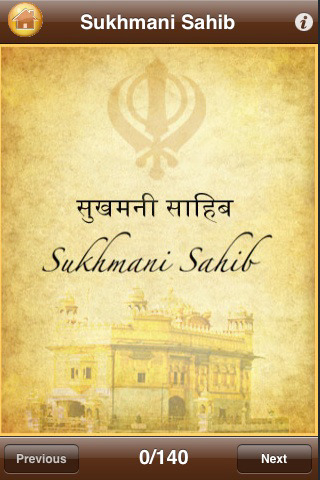 No, you did not read incorrectly. This Sukhmani Sahib is in Hindi and not Gurmukhi as … perhaps would be expected? There are few different questions that come to mind when trying to assess why the company chose to publish this application in Hindi. Who is their target audience I wonder? Are there many non-Sikhs who read Sukhmani Sahib (that’s great if that is the case!)? We’ve had the debate before about whether Punjabi is a diminishing language – so I wonder how much of that plays a role in this initiative. (I know, I know, I seem to be full of many questions and few answers). With the growing popularity of mobile-based content, it is nice to find these Sikhi focused applications. Mr. Sikhnet recently discussed his efforts and the need to develop applications for mobile phones. I assume there will be challenges associated with transitioning texts such as Sukhmani Sahib, which are predominantly read by using gutkas to reading Gurbani on your iPhone while you’re waiting for the bus. Personally, I think that Gurbani should be accessible to all and whether it is read in a gutka or on your mobile phone screen should not be important. Those individuals who do not already have an interest in learning Gurbani will probably not download this application anyway. It is likely targeted at those who are wanting to learn and if it so happens to be on an iPhone, then I don’t necessarily think that’s a bad thing. Nevertheless, I am still wondering about the choice of Hindi….
 Well I was hoping someone far more knowledgeable from our esteemed blog roster would write about this, but I figured since I feel it is extremely important and raises some critical issues, you’ll have to settle for me.
Yesterday when I was watching CNN, Jasvinder Sanghera came on to talk about the recent release of Humayra Abedin.
For those that may not be aware, Jasvinder Sanghera is the author of a biography called Shame and the founder of Karma Nirvana, “[an organization] with a view to create support project for women who experienced language & cultural barriers.” I have read Sanghera’s memoirs and although her particular story of her parents’ attempt to force her into a marriage and the consequences she experienced is more extreme than most cases, still it echoes the larger problems of “forced marriage” in our community and differences may only vary in degree.
So the other day on an NPR report (I don’t have a link, you will just have to take my word for it), a Latino immigrant man shared his own prejudices that have developed as he has achieved his “American Dream”. He spoke about how easily he began to forget the difficulties he encountered while “making it” in America as he nestled into his comfortable middle-class life.
From newspaper and pizza deliver-man to gardening and fast-food service, *he said his now comfortable middle-class lifestyle as a Network Engineer had made him blind to his own prejudices. He realized this when he went on a trip to DC and encountered an elderly blind African-American woman who sat under a monument with her hand out. He immediately thought she was begging for money and reached down into his pockets and emptied out all the change he had into her hands. Something many of us would consider an act of kindness rather than prejudice. However, the woman turned to him and said that she didn’t need his money … she only needed him to guide her to the nearest post-office. After guiding her to the post-office, he was grateful to this woman for helping him see his own prejudices that had long blinded him.
He went on to say that a major part of the “American Dream” he had forgotten about was to never become immune to the emotional pain of the prejudice one encounters as an immigrant striving to achieve the Dream. For example, the pain of having parents tell their children, “you never want to be a pizza-delivery man like him” in front of his face without knowing the circumstances that put him in that position (i.e. he was earning money to help pay for college and the family bills).
* Sorry, I forget his name and feel awkward using a pseudonym … so please bear with the repetition.
It’s The Langar Hall’s 1-Year Anniversary today and we would like to thank our readers and commentators for helping us sustain this blog!
 We would basically be nothing without your participation, aside from a bunch of bloggers who read and comment on their own posts. You all have helped us come a long way in 12-months with 422 posts, a growing readership of 600 peeps, and over 3,000 comments. We hope Waheguru will continue to keep us all in chardi kalaa so we can provide appealing posts that make you want to read and comment!
Your suggestions play a large part in our growth as blog … so keep them coming and thank you for making this blog what it is today!
Here are some virtual gulab jamans from us to you on this sweet occasion … maou thaa mitta karyaa (let’s sweeten our mouth) even if it’s virtual! 😉
A couple of weeks ago TLH reported on an incident involving the Tagore family in Houston who suffered what can quite easily be classified as police brutality after having called for help. The family called nine-one-one after finding out that their home had been burglarized, but when the Sheriffs arrived, instead of viewing and treating the family as victims of a crime (which was more than apparent from the fact that the Sikh family called the police for help) – the Sheriffs viewed and treated them as outsiders and criminals – seeing only their Guru given turbans and kirpans.
As a sign that things may change – there have been reports that the new Sheriff-elect, Adrian Garcia, has pledged:
I will be offering just a good ear…I think that this is one of those roles that an elected official serves. We’ve got to always be ready to listen to any segment of the community when there’s concern and understand it.
He also made a visit to a Gurdwara and:
[P]romised to expand the department’s cultural diversity training, to help personnel better understand the diversity of the county. “I think it starts with leadership,” he said, “and that’s why I’m making myself available.” [Source]
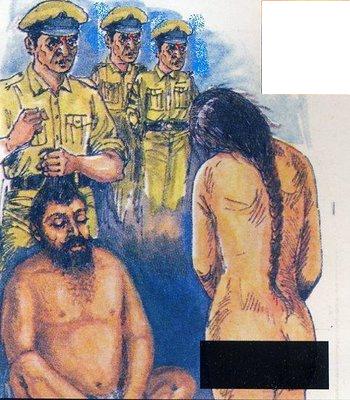 I am sick of these articles!
Every so often, usually an Indian (but not always – and yes I chose the term on purpose) picks some problem in the world and then asks the question “Where is X’s (insert troubled country here) KPS Gill?”
The most recent example, published in Toronto’s The Star, (I hope Sikhs in the Toronto area VOCIFEROUSLY respond to the editor’s message – mcohn@thestar.com and others write well-thought out ‘letters to the editor’ and submit to lettertoed@thestar.ca) suggests a “Punjab lesson” be applied to Afghanistan. A few years ago, Vinod of Sepiamutiny did the same in Iraq echoing one of his “favorite” blogs. Indian newspapers such as Express India have often printed such things as well.
The reason I am sick of these articles is because of the ‘sanitized’ and ‘white-washed’ erasure of the TRUE face of Gill’s ‘Punjab lesson’.
 The World Bank estimates that nearly six millon Indians working abroad sent $30 billion home in 2008. Of those, it is estimated that Punjabi non-resident Indians sent between $150 million to $160 million. It should come of no surprise that Punjab is feeling the ramifications of the global economic downfall (Maple Leaf Sikh recently blogged about the impact on Canada’s Punjabi community). Many migrants have learned to live frugally within their host countries so that they can save as much as possible to be able to send the money back home to Punjab. In turn, Punjab relies heavily on income invested back into the region by it’s migrants. Take Pyara Singh for example. He has been living in Germany for the past 14 years while his parents, wife and two children live in Giljian, Jalandhar.
Pyara Singh is on his annual visit home from Hamburg, Germany, where he works as a cook in a pizzeria… In this village of 300 homes, almost every family has sent one or more of its members to foreign shores. And the remittances they have sent back over the years have helped the residents here live a life of affluence that many in India can only dream of. Many of the houses have been built in the last few years and most are large. Some have expensive SUVs parked in their front yards. The conversation here is peppered with references to children and grandchildren making a living in the US, Canada, UK, Germany, Italy, France and Belgium. [link]
It is becoming starkingly clear that the global economic downturn has made individuals and communities more conscious of living within their means. Like the rest of the world, Punjab will also be struggling to make ends meet under its own circumstances.
A lack of industry and the outbreak of Sikh militancy in the 1980s also contributed to the flight of people to unknown shores in search of better prospects. “During the militancy, shiploads of men from Punjab fled to other countries and settled down there after getting political asylum. In time, they took their families and then friends and acquaintances too,” says Major Singh, a journalist in Jalandhar. “Punjabis can do only two things – they either join the army or they migrate. They have a craze to go abroad. But they are very hard working and they adjust well wherever they are,” he says.
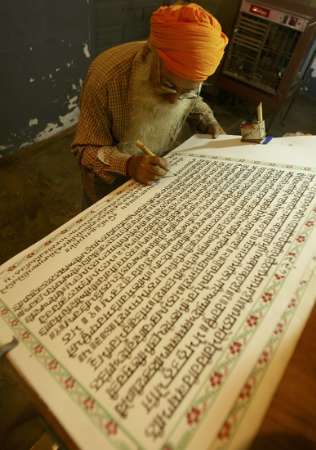
Reuters News Pictures Service (RNPS) recently announced its images of the year for 2008. One of them is the following picture taken of “Gurmeet Singh, 72, a Sikh, work[ing] on a hand written version of the ‘Guru Granth Sahib’ (the holy book of Sikhs) in the northern Indian city of Amritsar.”
I also enjoyed — and wanted to share — these Reuters images of gold medallist Abhinav Bindra and of the Golden Temple.
In the Sikh tradition, shoes have a particular connotation. When we enter the Gurdwara we take them off (and somehow it is noteworthy when a the Sheriff takes them off when visiting a Houston Gurdwara); before entering our homes we often take them off; and one of the worst insults is to get beat by a shoe. I know I have been threatened many times.
By now you may have already seen this video that is the talk of the world. Since in The Langar Hall you are usually required to take off your shoes, we wonder if it gets this much attention. Enjoy the instant replays and slow motion analysis!

If you must, here is an actual article on George Bush, Iraq, the Arab journalist, and the shoe thrown ’round the world.
Over the weekend it was reported that two Indian fighter jets violated Pakistani airspace. Although the Indian state is claiming the trespass was inadvertent, it seems that such a move is meant to engage in a ‘psychological escalation’ and pressure Pakistan into taking bolder actions against various militant groups.
However from talking to relatives in India and keeping abreast of the situation through Indian and Pakistani newspapers, it seems that an Indian strike against Pakistan is becoming a foregone conclusion. Anytime India and Pakistan have come to blows, it is the Punjab that is on the frontline. Thus while all South Asians should be aware of the ongoing situation, Sikhs in particular should be paying stark attention. Stratfor has provided an interesting analysis of the situation, which I try to summarize some of the points here.
For those of you that have never attended a retreat before, its not like the Sikh camps you went to as a kid. Its not Sikhi boot-camp, but a chance for you to explore you own spirituality and really examine how you’re incorporating Sikhi into your life.

The Toronto Sikh Retreat has been held in various forms for almost a decade. Never formalized into a full organization, its always been a fluid mix of Sikh students and young professionals coming together to put them on.
What I love about the retreat is that the workshops and activities are all planned by the youth and EVERYTHING is meant to be interactive. Even the divaans are two-way. At no point does anyone lecture to you or claim to know the right answer. The facilitators are merely individuals who have taken the time to do their homework on a particular topic so that they can guide the workshops.
Best of all, the retreats are a blast. They’re one of the funnest and most energizing weekends of the year for me. I look forward to them all year.
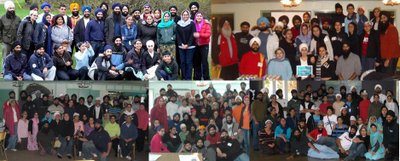 This year retreat promises to be amazing. The organizers have added an extra day to allow for lots of outdoor fun and more opportunities for informal discussion. The first workshop covers the life of Guru Tegh Bahadur and why his sacrifice is as relevant in today’s age as it was over three hundred years ago. The other workshop is going to be on we can use our creativity to express our Sikhi and spirituality. Also, this year there’s going to be an open mic night where attendees will be able to showcase their hidden “talents”.
The location of the retreat is also worth seeing. Nestled next to a great big toboggan hill, the Ecology Retreat Centre has separate buildings for the divaan hall, dining/meeting hall and sleeping quarters. As a creature comfort myself, I can tell you the accommodations and bathrooms are just fine. * So it doesn’t matter where you are on the path of Sikh, the retreat is a chance to recharge your spiritual batteries, push your own thinking and make a ton of new friends.
The Toronto Sikh Retreat runs from January 8th to 11th, 2009. It will be held at the Ecology Retreat Centre in Orangeville. For more registration and information visit the TSR website or the TSR blog.
 As someone who is excited about the incoming administration, I have thought about ways in which I would like to participate in the presidential inaugural, when President-Elect Barack Obama will become the 44th President of the United States. In particular, I thought about attending an inaugural ball — a politically-oriented prom of sorts. As a result, I reviewed this Washingtonian blog post, which contains a list of many of the inaugural balls taking place on or around the date of the inauguration, January 20, 2009.
To my surprise and delight, the list included a “Sikh Inaugural Ball.” The ball is hosted by an organization I had never heard of: the Sikh Community Center. The web site for the ball states:
Here is your chance to make a statement and be seen and heard — in WASHINGTON! — when the entire world will have their eyes and ears on the most important event ever to take place! Don’t you wish you were there?
On January 20th, 2009 the inauguration of America’s 44th President is just such an occasion that you will not want to miss.
You’ll also want to meet other like-minded people so you can make the connections you will need over the next 4 or 8 years!
The Sikh Community Center is proud to announce that the 1st EVER SIKH INAUGURAL BALL takes place just a few blocks from the White House – at Ascot, I-The Indian Experience Restaurant.
Whether or not to attend the inaugural festivities is an undoubtedly difficult decision — because of the exorbitantly high prices for rooms, parking issues, and the limits of public transportation, for example. But if you are considering making the trip to D.C., the Sikh Inaugural Ball is an option.
Please note: I make no representations about the quality of this event — as always, buyer beware!
Deh Shiva bar mohe ihe / shubh karman the khabhu na taro
God, grant me this: that I will never refrain from righteous actsna daroo ar siyoo jab jah laro / nische kar apni jeet karo
That I will fight life’s battles without fear, and will claim victory with courageAr Sikh hao apne hi mum ko / Eh lalch hou guna tau uchroo
That you will be ingrained in my mind / with my highest ambition to sing your praisesJab aav ki audh nidhaan nane / aut hee rann me tab joojh maroo
when this mortal life comes to an end, may I fight with limitless courage
“Deh Shiva” is often described as the Sikh national anthem, and it comes to us from Dasam Granth. As a shabad, it has been invoked on the (literal) battlefield as a rallying cry and a unifying call around Waheguru. The shabad analogizes the struggle in our daily lives to overcome issues that lead us away from Waheguru to a battle — with a single-minded focus on Waheguru, we are able to transcend our attachments to the material and emotional trappings of life.
But as a shabad it has also been used in a very literal manner to mobilize Sikhs in war. As Mewa Singh mobilize action around a political (and militarized) struggle. Does a literal intepretation, or recitation, of shabad convert its meaning? I’ve always found this specific shabad empowering and elevating, but not inherently “violent” or “militant.” As a child, I always felt strangely calm and elated by the words, punctuated at each phrase with “Bole So Nihal, Sat Sri Akal!” I have always heard this shabad as a call to the nation, not as a device or tool for violence.
We’ve heard the arguments (valid and not) before about why Sikhi is a martial faith or has a martial history or a martial outlook. There are certainly religious foundations that acknowledge the real challenges faced in every day life and the need to resist oppression. Resistance eschews, but does not forbid, violence. Nonetheless, at its core I believe Sikhi is a religion of love — love of the Guru, Granth, and community, defined in the context of humankind and creation.
Yes, now it’s our turn….The debate has been raging in the South Asian blogosphere and although this post is extremely late, the issue is still important, especially for those Sikhs in the diaspora.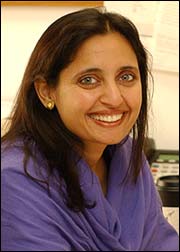
The issue surrounds that of Sonal Shah. Sonal Shah, like many young ambitious desis in the US, has an exceptional resume with the US Department of Treasury, the World Bank, the Center for Global Development, and even worked as a VP for Goldman Sachs. The most recent entry on her resume includes working as the head of Global Development Initiatives for google.org. With regards to the desi community she was able to establish the successful Indicorps project that serves as a conduit for those wishing to volunteer in India in 2001 (as a completely unrelated note, it is interesting to see the Sikh initiative FATEH in Punjab started almost 5 years prior to Indicorps).
Now before you start wondering why I am posting her biodata/resume, it will become pertinent if you keep reading, I promise. So during the recent American presidential election, Shah acted as a technology advisor to the Obama campaign team and was recently announced to be on the Obama-Biden transition team.
All was quiet on the western front until Vijay Parshad, a well-known academic that holds the George and Martha Kellner Chair in South Asian History and Professor of International Studies at Trinity College wrote an article on a popular blog, titled “Obama’s Indian: The Many Faces of Sonal Shah.” As he later wrote, this one created “a little kerfuffle.”
As many Punjabi Sikh homes across America celebrated Thanksgiving with the traditional Turkey dinner with all the fixins, chollaa puraa with a side of dhaee, or chicken/turkey cooked in good old Masalaa, I wonder about our internal struggle to feel “American”.
Although much of Jhumpa Lahiri’s work [previous TLH coverage] focuses on the issues encountered by middle to upper-middle class immigrant Indians and their children (i.e. Bengali) in America, her recent NPR interview on the struggle to feel “American” can resonate across the immigrant experience. Thus, complicating the notion of what it means to be “American” in the first place.
As a child of Indian immigrants born in the West, Lahiri says “there is sort of a half-way feeling [of being American]” for her.
However, her parents never thought of themselves as American:
“…they’ve lived here now for more than half of their lives, and they raised a family here and now have grandchildren here. … It has become their home … but at the same time, for my parents, I don’t think either of them will ever consciously think, ‘I am an American” [both are American citizens].
Last week on TLH we addressed the police brutality faced by the Tagore family in Texas.
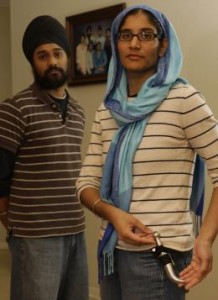 You will find here a consolidated list of how to TAKE ACTION NOW on this injustice. Different organizing tools are available for the Sikh community to act, we just need to use them. Taking action in at least one way is better than none!
Please remember, we have to empower ourselves as individuals and a community to take action and not just rely on a few community lawyers or media-based activists. Our actions as a whole are much stronger than a few!
Sign A Sikh Coalition Petition here: Harris County Sheriff-Elect Adrian Garcia is visiting the Sikh Center of Houston on Sunday, December 14, 2008. He will be the new Sheriff for Harris County next year. This petition will be directly handed over to him, so please help us gain as many signatures as possible.
Submit A Question here: Harris County Sheriff-Elect Adrian Garcia is visiting the Sikh Center of Houston on Sunday, December 14, 2008. During his visit the Tagore family and sangat members will be able to ask him questions on the actions he will take in response to the treatment of the Tagore family by police officers. Submit a question for the Tagore family to ask Sheriff-Elect Garcia directly when he visits the Gurdwara.
Call numbers available here, here, and here (numbers are also in the comments section): A few pointers when calling are-
- Be Polite and Respectful
- Express your concern about police brutality and specifically the needless handcuffing of Kawaljeet Kaur Tagore and her family members, including her 60 year old mother
- Express your concern about the needless use of foul curse words against the family by officers
- Express your concern about the lack of knowledge by officers on Sikhs and Sikh practices
Please tell your family and friends about these different ways to act NOW … at the end of the day your voice is stronger in spreading the word than a TLH post, any blog, or an organizational e-mail! 🙂
In a press release yesterday, SALDEF reported that the state of Indiana has recently implemented new guidelines for drivers license photographs:
The new policy incorporates the use of new facial recognition software and involves restrictions on smiling, head coverings, scarves, glasses, and facial hair. The security software is supposedly designed to protect customers from identity fraud.
Apparently, the new no-smiling license picture is to go into a database which:
[S]tores your undistorted image and if someone later tries to get a photo ID in your name, the computer will scan it’s facial files and find out. [Source]
Obviously, the state has a good motive for implementing the software, even though I’m not too convinced that it will be successful. In any event, the Sikhs are supposed to be safe in one regard – as it is reported that if you wear a head covering for religious reasons (read: TURBAN!) you can apply for a waiver. It is not clear how the policy’s facial hair restriction will apply to Sikhs.
Interestingly, with the new regulations having been in place for one whole whopping day now, there has already been a report from an Indianan Sikh that he was (a) not told of the exception for religious attire and (b) not provided any waiver documents.
If the state is going to provide you with an “accommodation” doesn’t it make sense for them to inform you of it when it is obvious that you are wearing a turban for a religious reason or when you inform them of that fact? As with so many other instances regarding security precautions, it seems that our community has to take a proactive role in making sure we are not pushed around by the state. So kudos to the Sikh for reporting to SALDEF, and to SALDEF for being on top of the Indiana licensing policy issue and reporting to us.
On an up note – Indiana is to be recognized for being wise enough to place an exemption for religion in their new guidelines – unlike France and the story reported a few days prior – where Camille discussed the how the European Court of Human Rights ruled against French Sikhs on the issue of being able to wear the turban/dastar in drivers license photographs there.
Karambir Singh Kang, the general manager of the Taj Mahal Hotel, acted with great courage during the recent Mumbai tragedy. (Thanks for the tip, It’sM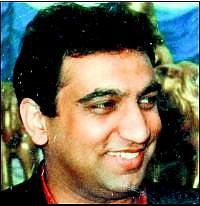 e)
e)
Karambir Singh lost his wife and two sons in the hotel when they were forced to barricade themselves inside a room on the 6th floor. They died from asphyxiation while hiding in the bathroom of their hotel residential suite. Karambir called his mom in Mohali, Kanwaljeet Kaur, to tell her what had happened. Her words, “Go save the others,” gave him the courage to help other hotel guests while his wife and children could not be reached.
It was, he said, his mother’s words of courage that prodded him to fight back after watching his world blow into smithereens in front of his eyes. “I got a call from Karambir and his voice was shaking,” his mother Kanwaljeet Kaur said, tears rolling down.”He told me that terrorists have entered the hotel and his family is stuck on the 6th floor and that he can’t save them. I just said, ‘You are a brave boy, go save the others.” [Times of India]
Karambir followed his mother’s advice and saved many guests at the hotel.
“He saved many amid firing and grenade explosions, but he could not reach the sixth floor where his family was trapped in their residential suite,” said Kamaljit. [Indian Express] Yet even after he learned of the death of his wife and children, the hotelier, originally from the Punjab, stayed at his post. On Saturday morning, when the final gunman holed-up in the landmark hotel was killed by commandos, Mr Kang was still working. Reports said that the hotel’s owner, the industrialist Ratan Tata, had to personally tell him to go home and be with his relatives. [The Independent]
Ardaas was held for Karambir’s wife and son at a gurdwara near their farmhouse in Kandala, Mohali. Outside of the gurdwara, the family installed a board where guests could pay tribute. Their message to the well-wishers was: “Now time has come to stand united and forget all differences, may it be political, ideological or religious to give a befitting reply to terrorism and those who perpetrate it.”

