
Guest blogged by Shahe Kaur
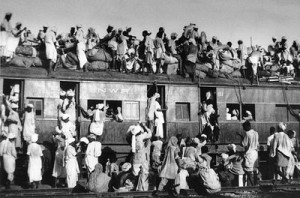 On the eve of India’s Independence Day, it is difficult to not think about the haunting stories I have heard from my parents, grandparents, and others who lived through the horrific partition of India into azaad (independent or free) India and Pakistan. This partition uprooted over 10 million people and resulted in murders and brutality far too numerous to count with official accuracy, with estimates ranging from a few hundred thousand to a few million.  Many of us will likely never truly understand how much our elders are haunted by the memories of forced migration, murder, and the other atrocities that occurred when they had to uproot to the newly independent India.
As a child and throughout the time I spent with my grandmother,  I was very interested in the history of who I was and where our family came from. However, when it came to topics like partition or the atrocities that occurred in 1984, my family, particularly my grandmother did not want to talk about it. The memories were far too painful for my grandmother to ever completely tell me her story. “ Those days have passed, let them be,†was the common response that I got. Of course the vakeel (lawyer) in me, even as a child, could just not let things be. I had to know more about who we were as a family and the history that is part of the fabric of who I am today. As I pushed and pushed for more details regarding my grandmother’s journey, I began to piece together an image of the atrocities she witnessed and endured to become the woman that I knew. As she would tell me her story, each time proclaiming she had told me the same story a hundred times before, I probed more and more to gain more of her experience and account of what she had endured. Eventually she told me all that she cared to speak of, which was enough for me to get a glimpse of how deep her courage, strength, and love for her family truly was.
 The Junior Sikh Coalition is an initiative of the Sikh Coalition to help develop leaders in local communities, providing young Sikhs with experience in organizing, advocacy, diversity education and civil rights.
In a new project, the Junior Sikh Coalition is harnessing the power of art in advocacy with an unprecedented art collection called the Nirbhau Nirvair Poetry & Art Book to bring attention to issues such as bullying and hate crimes. Young Sikhs across to country are invited to submit their art, poetry, and photographs, to showcase their perspective on the concept of Nirbhau Nirvair (“without fear and without hatred”), as first proclaimed by Guru Nanak in Jap Ji Sahib.
Find out more below about this unique opportunity for young Sikh artists.
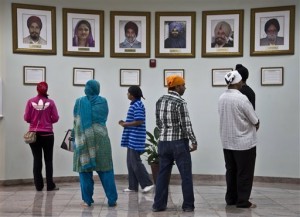 Last August, a gunman walked into a Gurdwara in Oak Creek, Wisconsin, leaving six dead and several injured. Â It was a day that is etched into the minds of Sikhs around the globe. Â While we would like to think that this tragedy is seen as an American tragedy, the mass shooting in Oak Creek did not receive the same media or government attention that other similar tragedies received. Â What many Americans don’t know is that the Oak Creek mass shooting was the most lethal attack on an American house of worship since the 1963 bombing of the 16th Street Baptist Church in Birmingham, Alabama.
Nevertheless, we push forward with our Sikh spirit intact. Â In light of this, communities across the nation are coming together to remember the victims and survivors of the Oak Creek mass shooting. Â Here is a list of various events taking place both locally in Oak Creek and nationally.
The Chardi Kala 6K Memorial Run & Walk will be taking place on Saturday August 3rd in Oak Creek, WI.  The event will be a community gathering honoring those we lost on August 5, 2012, as well as celebrating all that has been done to bring the community together.  More information can be found here.
The Oak Creek community will come together throughout the weekend in remembrance. Â The Akhand Paath will begin on Friday August 2nd and the Bhog will take place on Sunday August 5th. Â On Monday August 5th, there will be a candlelight vigil. Â More information can be found on the Gurdwara’s website.
Across the nation, communities are coming together for a day of service. Â Day of Seva projects will be occurring in New York City, Detroit, San Francisco, Modesto and Houston. Â Projects include feeding the homeless, park clean-ups and volunteering at the library. Â More information can be found here.
Other communities are gathering to write letters of support to the survivors and families of the victims. Â Information can be found here.
The Surat Fauj Running Club has organized a national run in solidarity against violence, taking place on Monday August 5th at 7pm. Â More information can be found here.
In San Antonio, community members will be participating in a solidarity Chardi Kala 6K Run/Walk, taking place on Saturday August 3rd. Â More information can be found here.
In Houston, community members have organized a Bring a Friend Day at their local gurdwara as a way of raising awareness. Â The event will be taking place on Sunday August 11th and more information can be found here.
In Canada, The Sikh Activist Network, Coalition of Sikh Organizations and One Panth have organized a run/walk/bike event which will take place on Monday August 5th in Brampton. Â More information can be found here.
*If we are missing any events, please leave them in the comments section.
 Over the past two years, the Sikh American Legal Defense and Education Fund (SALDEF) has enabled vital training in advocacy, self-empowerment, and community change to over thirty Sikh American youth through SikhLEAD’s Leadership Development Program. Now, with two classes already pioneering their own projects, SALDEF is proud to be gearing up for the third class of rising Sikh leaders.
The Leadership Development Program brings together approximately 17 young Sikh American leaders from across the country to participate in six days of training spread over Columbus Day and Memorial Day weekends. Attendees will participate in a series of workshops aimed to challenge, inspire and support a group of intelligent and motivated Sikh leaders. The purpose of the program is to empower Sikh American youth to be confident, aware and resourceful individuals, equipped with all the tools they need to not only fulfill their personal potential, but also become change makers within the Sikh American community. For more details please visit www.sikhlead.org.
SALDEF’s SikhLEAD Leadership Development Program will ensure that our youth remain engaged with the issues that affect our community today and will provide them with the resources and skills they need to enact real change in the future.
The deadline to apply for the SikhLEAD LDP is Sunday, August 4, 2013 at 11:59 EST.
Guest blogged by Simran Jeet Singh
As I strolled outside my Manhattan apartment this morning, reflecting on the Trayvon Martin decision, I had one of those moments that would shatter any possible artifice of living in a post-racial society.
I heard a woman cry in pain and turned around to see her lying on the street, clutching her bleeding knee. I rushed over and extended my hand to help her up. She looked up and her entire body recoiled the moment she saw that my face was adorned with a turban and beard. She shook her head and muttered “foreigners…” just loudly enough so that I could hear. I stepped away, understanding her reaction, and I turned to hold the traffic as she gathered herself.
I watched her limp to the sidewalk and was surprised when she looked back at me over her shoulder and mouthed the words “thank you.”
And I realize now that I should have thanked her. She reminded me that despite being a social construct, race is absolutely real in our world, and in the rules of this game, so many of us find ourselves to be the typecast. It’s a lesson we receive repeatedly throughout our lives, but it bears repeating for a reason.
To forget the rules of the game is to forget the reality in which we live. As Keyser Soze said in The Usual Suspects, “The greatest trick the devil ever pulled was convincing the world he didn’t exist.”
I’ve been invited to and participated in a number of interfaith gatherings, conferences, retreats, and discussions over the years. Time and time again I find myself being the only Sikh in these spaces. And often find that the well-meaning, progressive faith-based activists in these spaces don’t know other Sikhs besides me nor do they know much about Sikhi. So then it was refreshing to hear about the 2030 Faith in America Challenge, an interfaith gathering to strategize around creating a more just society, from a Sikh friend who is helping organize it. On October 6-7, the Nathan Cummings Foundation will host leaders in the 20s and 30s for a retreat in upstate New York to explore important and urgent questions around religious diversity. The application deadline is Monday, July 15th! Check it out and consider applying. Sikh voices are greatly needed in this discussion.
More information follows, and visit the website here.
In a rapidly changing world, where faith is as often a force for inspiration as well as polarization, how might we as people of faith, support individuals and communities connected to their religious and spiritual identities, to amplify their voice, vision and public leadership?
Is this a challenge that resonates with you or keeps you up at night? Would you invest four days of your life to wrestle with this challenge with a diverse group of leaders?
If yes, we invite you to complete an application to join us for the 2030 Faith in America Challenge gathering application due on by Monday, July 15, 2013. If selected, travel, food and lodging will be covered by the Nathan Cummings Foundation. Below you will find the articulation of the broader context in which we are locating this challenge, our belief in the importance of a strong religious and spiritual voice in the public arena, information about outcomes, methodology, profiles of potential participants, and a Frequently Asked Questions section.
Please review the required preparation and questions and please submit the completed application online by 11:59pm EST on Monday, July 15, 2013. Please send questions to 2030Challenge_FIA@nathancummings.org.
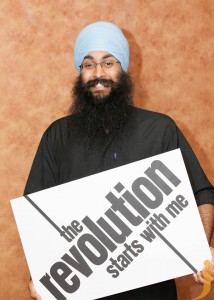 Guest blogged by CitizenSoulja, follow him on twitter at @citizensoulja
This year I went to the Lalkaar 2013 conference in Davis California. Lalkaar run by the Jakara Movement, a Sikh youth organisation, is now in its 14th year. This was by far the most interesting and inspiring Sikh educational event I have ever been to. Like many young Sikhs that grew up in the UK I failed to engage with the local Gurdwara, when it came to learning about Sikhi in an inclusive and non-judgemental environment. This gap in learning was filled by Sikh youth camps that sought to connect Sikh youngsters with the philosophy of the Sikh Way, but these too had their drawbacks.
I came across the Jakara Movement on social media and my first impressions were of a progressive, interesting and established organisation. I remember when I first saw Lalkaar advertised I really wanted to go but it wasn’t possible. When I began planning my travel to the States this summer my plan was to attend Sidak, a two week intensive Sikh Studies course run by SikhRi in San Antonio, I had no plans of coming to Lalkaar.
I spoke to my friend Narvir, who had attended Lalkaar previously and he had only positive things to say, I began seriously considering attending. My biggest worry was having a place to stay after Lalkaar. After I spoke to some of the sevadars, they connected me with other individuals that said they could house me. That’s when I packed my bags.

Christina Antonakos-Wallace, filmmaker of with WINGS and ROOTS
Christina Antonakos-Wallace is the filmmaker behind with WINGS and ROOTS, a 90-minute documentary that tells the stories of five people from different immigrant communities living in New York or Berlin, Germany, who have struggled to shape their identity in various ways.
The film features The Langar Hall’s own Sonny Singh, a Sikh living in New York. Part of his story was featured in the well-received short documentary Article of Faith, spawned from the with WINGS and ROOTS project, that portrays Sonny’s activism around bullying of Sikh school children in New York. Another short film, called Where are you from from? was also produced out of this project.
Below, Christina Antonakos-Wallace discusses the film and provides great insight about its intended message regarding the immigrant experience and the search for identity. You can view the trailer for with WINGS and ROOTS at the end of this post.
University of Massachusetts – Boston
Department of Counseling and School Psychology
100 Morrissey Blvd, Boston, MA 02125-3393
University of Massachusetts Boston
Researcher: Dr. Kiran S. K. Arora
Study: Religious Discrimination and Race-Related Stress among North American Sikhs.
We are interested in conducting research with Sikhs living in North America. The purpose of the study is to examine how experiences of religious discrimination and race-related stress may impact the relationships, mental health, and overall well-being of Sikhs. To gather this information, we are looking for individuals over the age of 18, who self-identify as Sikh, and are living in North America, to complete a set of anonymous questionnaires online.
This study hopes to contribute to a dearth of academic literature on Sikhs and their families. Your contribution is valuable, as it would provide insight for family therapists and other mental health professionals working with Sikh families. Your participation is strictly voluntary. Confidentiality is of utmost importance, and measures will be taken to protect your identity.
The purpose of this announcement is to alert you to the research project and invite you to ask any questions you may have about this project. You may contact Dr. Kiran S. K. Arora at Kiran.Arora@umb.edu if you are interested in participating, or learning more about the study. To learn more about the study or participate, you may also go to https://www.psychdata.com/s.asp?SID=153728.
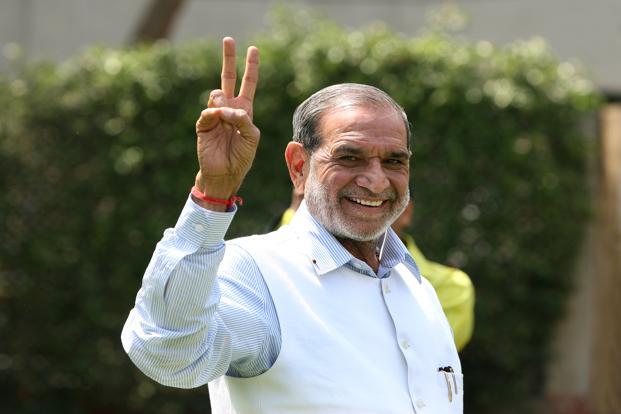
In a process that took three decades, Sajjan Kumar, a leader in India’s Congress Party, was recently acquitted for his well-documented involvement in the anti-Sikh pogroms during November 1984 in which thousands of Sikhs were murdered in three days in the country’s capital city. Five co-accused were convicted. (Source: Live Mint)
About two months ago, I observed the continuing engagement by representatives of the Indian government with the Sikh American community, which in that instance took the form of an exhibition on Sikh heritage in Atlanta, Georgia, sponsored by the Government of India. This exhibit has just recently been presented in Washington, D.C., as well, and it is consistent with increased engagement and activity related to the Sikh American community — be it directly, or through lobbying of US officials — by representatives of India. The increasing effort by Indian officials to promote the Sikh community in the United States is problematic, however, as it runs contrary to India’s track record with the Sikhs in its own borders over the past several decades.
Whether in the aftermath of a hate crime (such as in Oak Creek, Wisconsin, or recently in Fresno, California), or in what appears a deliberate attempt to brand the Sikh identity with Indian nationalism, representatives of the Indian government are insisting that they be the custodians of the Sikh community in the United States.
Two of my fellow Sidakers from the class of 2012 have written wonderful blog posts that are succinct and tell you concisely what their Sidak experience was like. Please do give them a read: Santbir Singh on Sikhchic “Why I’ll Be There.” and Ruby Kaur on Sikhnet with the aptly titled, “Amazing Sidak.” It should come as no surprise that my post about my experience is long, but I’ve inserted photos to hide this fact.
Last July was a busy one for me. I attended a playwriting workshop in Cape Cod, and directly after that, it was off to Texas for two weeks of Sidak, an experience I still find difficult to put into words. It is officially:
“a distinctive leadership development program for young adults seeking to increase their commitment towards the Sikh faith. This two-week intensive immersion in Sikh culture, language, values and community though understanding bÄnÄ« (scripture), tvÄrÄ«kh (history), and rahit (discipline), is held annually in the Hill Country of San Antonio, Texas.â€
There is nothing I disagree with in their description, but to me it is much more than just those things. I first learned about Sidak from a blog post on TLH by Sharandeep Singh, and I was very enticed by the Gurmukhi course. So enticed, I applied, despite my initial reservations. Those reservations were primarily based on the fact that I didn’t fit into the perceived demographic I had pinged in my head as the sort of person who would attend Sidak. I’m not a Sikh active in my community (at least not in the conventional sense), the gurduara, or even someone who had grown up attending Sikh youth camps, except one year at Jakara when I was 30 (http://ow.ly/l2F6X). I’m in my mid-30s, occasionally go to the gurduara, and while I read, write, and speak Punjabi “relatively well,†I am not well versed in Sikh theological terminology. I had no idea what the difference between a tuk, a var, or a bani were, when they’d be used in class or during Divan.
In 1984, as the Indian government was terrorizing Sikhs in northern India, mass campaigns of state-sponsored extermination were occurring in the Americas as well. The small Central American nation of Guatemala, under the rule of US-backed Efrain Rios Montt, was one such place. While Indira Gandhi’s army was attacking Darbar Sahib with an insatiable thirst for Sikh blood, Guatemala was in the midst of what is sometimes called a civil war. Another name for it might be the deliberate and targeted mass killing of indigenous and poor people. In both cases, though thousands of miles apart geographically and politically, campaigns of state-sponsored genocide were underway.
Yesterday, a Guatemalan court found Rios Montt, now 86 years old, guilty of genocide and crimes against humanity. He came to power in 1982 in a US-backed coup and oversaw “a scorched-earth policy in which troops massacred thousands of indigenous villagers. He entered the court on Friday to boos and cries of ‘Justicia!’ or justice. Prosecutors say Rios Montt turned a blind eye as soldiers used rape, torture and arson to try to rid Guatemala of leftist rebels during his 1982-1983 rule, the most violent period of a 1960-1996 civil war in which as many as 250,000 people.” (link)

Rios Montt awaiting the verdict in Guatemala. (source: New York Times)
The former dictator has been sentenced to 50 years in prison for genocide and 30 more from crimes against humanity. This is the first time in history that a head of state has been found guilty of committing genocide in his or her own country. The significance of this conviction cannot be overstated for the people of Guatemala as well as other parts of Latin America and the world where genocidal tyrants have never been held accountable for their atrocities.
What we’re not hearing much about in the US news coverage of this unprecedented trial is the US government’s role in Guatemala at the time (and earlier, beginning with the CIA coup against Arbenz in 1954, essentially for the benefit of the United Fruit Company). While there is much to celebrate in this conviction, key architects and underwriters of these policies of terror in Guatemala (and other parts of Latin America) have faced no consequences for their instrumental role in the genocide. Efrain Rios Montt was trained by the US Army at the school formerly known as the School of the Americas, infamous for training Latin American soldiers and leaders in the art of torture and repression. Rios Montt was close ally of the Reagan Administration, which considered his leadership style necessary in the so-called fight against communism. Revolutionary struggles were building in Nicaragua and El Salvador, and the Reagan Administration saw to it that they would be crushed as would anything or anyone that posed a real or perceived threat against multinationals corporations exploiting the continent’s rich natural resources. In practice, what this meant in Guatemala (and elsewhere) was if you are indigenous and/or poor, you must be a leftist and thus, you must be silenced, intimidated, and/or killed.
Sound familiar?
Many of us Sikhs and other South Asians in the diaspora have grown up with subtle and not so subtle messages of anti-black racism from our families and communities at large. While on the one hand we learn through Sikhi that all people are equal regardless of their race, caste, or gender, we simultaneously learn that we should not socialize with black people and certainly not date them. We learn they are not to be trusted, that we should keep our distance. We learn that they are unattractive and that we most certainly want to keep our (brown) skin as wheatish and fair and lovely as possible or else we might be called kala (which my Nana Ji used to jokingly call me, as I was the darkest in my family). I recall a family member bluntly telling me when I was a kid, “You can marry whoever you want when you grow up as long as she is not black.”
In his groundbreaking 2001 book Everybody was Kung Fu Fighting, Vijay Prashad explains the anti-black racism so pervasive in our  communities:
But all people of color do not feel that their struggle is a shared one. Some of my South Asian bretheren…feel that we should take care of our own and now worry about the woes of others, that we should earn as much money as possible, slide under the radar of racism, and care only about the prospects of our own children…
Since blackness is reviled in the United States, why would an immigrant, of whatever skin color, want to associate with those who are racially oppressed, particularly when the transit into the United States promises the dream of gold and glory? The immigrant seeks a form of vertical assimilation, to climb from the lowest, darkest echelon on the stepladder of tyranny into the brightness of whiteness.
Guest blogged by Mewa Singh
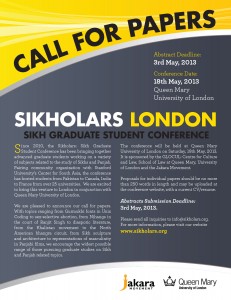 Earlier this year the Center for South Asia at Stanford University along with the Jakara Movement hosted its 4th annual Sikholars Conference (see the recap here). Â This successful endeavor bringing the latest academic research with an engaged community audience allows for fruitful discussion and exchange. Â Not limiting this event only to California, Sikholars conferences and workshops have been previously held in British Columbia, Canada and now in London, UK. Â Teaming up with Queen Mary College, University of London and Singh Sabha Southall, the Jakara Movement is proud to present Sikholars London.
For those in the UK (looking at you @Blighty), hope you get to check it out and experience Sikholars – London. Â For more information visit their website here.
Guest blogged by Herpreet Kaur Grewal
Editorial note:Â the author talked to her colleagues on the Sikh Feminist Research Institute’s editorial board about why they are feminists. This blog post collects their views to mark the Sikh festival of Vaisakhi, which took place this weekend.

Image via Kaur Illustration
When you hear the words ‘Sikh feminist’ what images does it bring to mind? Perhaps it evokes a general image of Asian women holding placards and angrily protesting? Or maybe it reminds one of a grand warrior saint like Mai Bhago riding her horse into battle? Or possibly a more contemporary incident comes to mind, like the one of Balpreet Kaur who last year deflected taunts from an Internet troll by eloquently explaining why she decides to keep her facial hair in a society where women are largely pressured to be perfectly formed and hairless. Or maybe it evokes none of these images.
As editorial board members of a Sikh feminist body we feel compelled to express our philosophy as a proactive and empowered one. All of us look to the Sikh (and non-Sikh) values of equality, honesty and strength (among many others), to anchor our lives in an everyday spirituality. But that doesn’t mean our motivation has always rooted from a positive place.
One of us was sexually assaulted which absolutely shattered a personal notion that being strong, assertive and smart can keep you insulated from an attack. If anything, it laid bare the vulnerability that exists if you happen to be born a woman in a world that can devalue one so extremely and how that devaluation is integrated into the culture and system we live with. A culture and system which many men and women internalise – sometimes, to a massive extent.
As you have probably heard by now, Boston is reeling in the aftermath of a few explosions near the Boston marathon this afternoon. Two people  have been killed and dozens injured and being treated at local hospitals. I’ve been texting, calling, and checking up on friends in the area all afternoon. We are all shook up and confused by what is happening, searching for answers or explanations for something so hard to comprehend (though something commonplace in other parts of the world like Pakistan, where 4 were killed by a US drone yesterday, and Iraq, where over 50 were killed in a bombing today). Very little is yet known about who did this and why, but of course, the mass media are already making lots of unsubstantiated claims, while accusations and assumptions are spreading quickly on Twitter and Facebook.
As something as horrifying as this afternoon in Boston is literally unfolding, as we are worrying about loved ones who may be affected, we already have to worry about the consequences of backlash violence. We have to worry about the sensationalism in the media. We have to worry about being attacked because of the color of skins, the turbans or hijabs on our heads, the beards on our faces. I pray that people in the United States and beyond have learned something in the last 11 and a half years. I pray that the collective response to today will be drastically different from the knee-jerk racism that pervaded the days, weeks, months, and years after 9/11/01.
But honestly, I’m not so sure how hopeful I am.
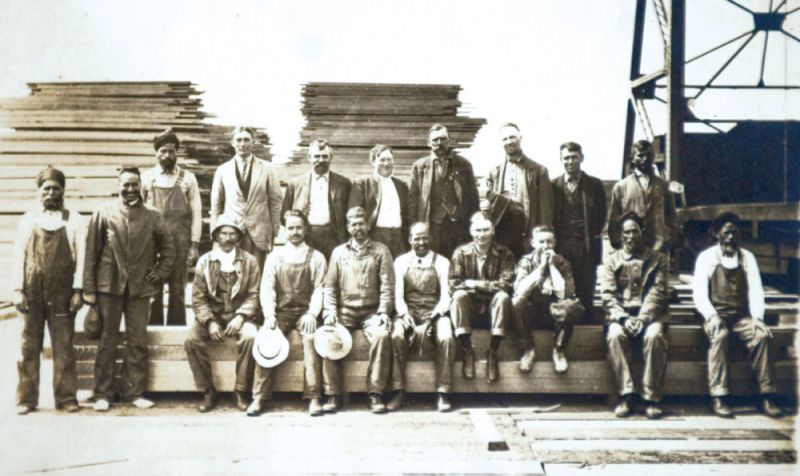
“Indians, many of whom were Sikh, worked at the Hammond Mill before its demise in 1922. During that time period, the Indians left their mark on Astoria, participating in wrestling matches, occupying Alderbrook also known as “Hindu Alley,” and forming the Ghadar political party. Courtesy of Clatsop County Historical Society.” (source: The Daily Astorian)
One of the legacies of the earliest Sikh and Indian immigrants to the United States at the turn of the twentieth century was the creation of the Ghadar Party, a political movement based in northern California that sought to promote India’s liberation from British rule.
Led by Indian expatriates in the United States, the Ghadar Party was formed in 1913. One of its main activities was the publishing of literature to promote resistance to British rule and for a free India. Obviously a threat to the ruling class, the literature was banned in India, and upon their capture, the Ghadarites were often imprisoned or executed as terrorists by the British.
This year, the San Francisco headquarters of the Ghadar Party has been opened to the public by the Indian Consulate as a museum. The printing press that the Ghadar Party used to print their literature is also now on display at the Gurdwara in Stockton, California. However, while it was previously believed that the Ghadar Party was founded in California, historians now place the genesis of the movement further north in the state of Oregon, where Johanna Ogden recently mapped a forgotten (and primarily) Sikh settlement of laborers in 1910 known as “Hindu Alley”.
Guest Blogged by: JSD
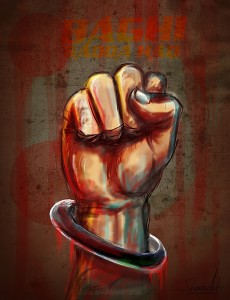 Today, the government of India has once again proved why it’s claim to being the world’s largest democracy is laughable. Not to mention the media in India, which claims to be fair and democratic in nature, however, this is simply not the case. India’s media is clearly state run and its news outlets make stories that create divides within communities. Why am I saying all this?
Sadda Haq is a fictional movie based on real events surrounding the militancy era in Punjab during the 1980s and 1990s. Showing accounts of “false encounters†and police brutality, the movie aims to show why average citizens were forced to take up arms against the oppressive regime. The movie was set to release worldwide today on April 5, 2013. Although the Indian Government can’t ban the movie worldwide, the Punjab government did manage to ban the movie in Punjab and other parts of India in just a few hours prior to its opening after the movie was privately screened to Punjab Police members and state government officials.
These officials who watched the private screening included the likes of DGP Sumedh Saini. Interestingly enough, the ban comes from the Punjab government run by Parkash Badal of the Akali Party, a party that is supposed to represent Sikh interests, but at the same time has promoted Saini to the ranks of DGP(Deputy General of Police) even after countless human rights claims exist against him for his participation in the post 1984 Punjab genocide of Sikh youth.
Over the past few days the Indian news outlets have been talking about Sadda Haq being a controversial film promoting Khalistan. It is no doubt that Sadda Haq discusses the militancy era, but its aim is to show the truth that has been pushed under the rug by the government and media.
A North American based Internationalist movement for the liberation of India
Guest blogged by York Ghadaris
On the centenary of the Ghadar Movement, a conference is being held at York University, Toronto, Canada on April 12 to April 13, 2013, to honour and remember its history, and its contemporary relevance to the revolutionary struggle of people of the Indian subcontinent.
It has been 100 years since the Ghadar Movement was formed by emigrant Punjabis and other Indian nationals in San Francisco in 1913. The Ghadar Movement ranks alongside other revolutionary movements of the early 20th century. In common with revolutionary movements in Latin America, Asia, Africa, and the Black Liberation movements of North America, the Ghadar Movement opposed imperialist powers, colonialism, and strived to develop working class internationalism.
This conference is called, with the participation of approximately 18 scholars and activist from North America and the UK, to remember the Ghadar Movement, its historical development, and to analyze its contemporary relevance to the revolutionary struggle of the people of the Indian subcontinent. The conference will examine the Ghadar struggle as a journey from the 20th century, “a century of revolutionsâ€, to its role in laying the foundation stones for the revolutions of the 21st century. These revolutions are crystallizing in response to the imperialist occupations of Afghanistan, Iraq, Libya, Haiti, the air attacks on Pakistan and the possibility of NATO attacks on Iran and Syria. The economic meltdown of the European Union (EU) and North America resulting in mass unrest are adding to the cause of revolution. They are taking shape in the form of the Arab Spring, the ongoing revolutions in Venezuela, Nepal, and the emerging people’s struggles in India.
This March marked ten years since the United States invaded Iraq in the name of Iraqi freedom. Ten years later, potentially over one million Iraqi civilian deaths later, where are we now? What are the people of Iraq left with? Aside from extreme instability and near genocide, Iraqis are now dealing with a legacy of cancer and birth defects as a result of our country’s military aggression. A few weeks back on Democracy Now, journalist Dahr Jamail discussed this harrowing reality. He stated:
“[The birth defects] are extremely hard to bear witness to, but it’s something that we all need to pay attention to … What this has generated is from 2004 up to this day, we are seeing a rate of congenital malformations in the city of Fallujah that has surpassed even that in the wake of the Japanese cities of Hiroshima and Nagasaki that nuclear bombs were dropped on at the end of World War II.”
What follows is the clip from the news program. Note that the images in the clip are horrific. This is reality. This is our tax dollars at work.

