
A few years ago I was putting up some flyers on street poles and bulletin boards in Williamsburg, Brooklyn promoting an upcoming concert for my band. If you’re from New York City, you know Williamsburg is a neighborhood covered with concert flyers and band logos, and the home of dozens of music venues filled with indie rock-loving, skinny jeans-wearing hipsters (for the record, this has nothing to do with me nor my old band).
After a few minutes of putting up a bunch of flyers with tape, I was suddenly surrounded by 4 police cars and their flashing sirens. One of the cops approached me, while the others stayed close behind. He had one of our flyers in his hand and asked if I put it up. I said yes. He informed me this was “graffiti” and was illegal. I apologized and said I was not aware of that. He took my ID, talked to his colleagues, and the next thing I know I’m being aggressively handcuffed and put into the back of a police car without any explanation.
To make a long story short, I was arrested because a few years prior to the flyering incident, I got stopped and cited for riding my bicycle for a few feet on a sidewalk (in the rain) and never appeared in court for this egregious violation of the law and disturbance to the peace.
But this isn’t a story about why I got arrested and how ludicrous it is that these cops arrested me rather than asking me to please not put up flyers on street poles (which were already covered with flyers). This isn’t a story about racial or religious profiling and about if these (white) cops were driven by bias or if they were paying special attention to a turbaned, bearded brown man walking down a gentrified, newly predominantly white hipster block of Brooklyn.
This is a story about incarceration.
When I was taken to the precinct, still not knowing why I was arrested or what the hell was going on, I was aggressively and invasively patted down (more like groped) and searched by the officer who arrested me. After a few conversations with other officers at the precinct, I started putting the pieces together in my head as to why I was arrested, and they assured me that I’d be out of there in a few hours. I felt a bit relieved, though still anxious. I was hopeful that I could keep my head up and make it through this with my self-respect and dignity in tact.

Crowdsourcing has its uses. Here is one.
This year the Jakara Movement is celebrating its 12th annual Lalkaar Conference with the theme Kaur Voices: Exalt, Express, Empower. Hosted in Sacramento this week, June 16-19, 2011 – I am sure the conference will be a success.
The email I received announcing this contest, reminded me about when I attended this conference on the same theme 5 years ago. Back then, we brainstormed about the need to create creative ‘community-solutions’ to problems in our community, like sex-selective abortion. The idea for Ladoos: Pink and Blue was born. Now 5 years later, they are making it a reality.
The guidelines to the competition are easy:
We aim to create a gift box that would include health-related brochures, inspirational Sikh literature, and a number of “Sikh Baby Firsts” – a kara, a gutka, a bib (proclaiming a proud new Singh and Kaur), and many other Sikh-inspired items. The decorative box will serve as a keepsake that will be found in the homes of all Sikhs and to be kept and cherished for years to come.
The winner will receive a $100 Visa Gift Card as well as the satisfaction of seeing their creation in the homes of all Sikhs, in a celebration of equality.
Please submit by July 15, 2011.
Submissions should be created using Adobe Illustrator. We will take submissions in other programs, but highly recommend Illustrator. If using Photoshop, please make sure to use minimum 300dpi. Hand drawn/scanned submissions will also be considered.
Please remember you have to design all sides (top, left, right, back, front panels)
As I can’t draw, if my life depended on it, I look forward to seeing all of your submissions and to the future of this project. I will keep you posted!
 Do you know a young boy, ages 13-16 that may have:
- problems in school or with family
- exhibiting low self-esteem or low motivation
- making poor peer and relationship choices
- defiant of authority
- refusing to take responsibility
- experimenting with drugs and alcohol
Maybe some of this describes your nephew, maybe a cousin, maybe a brother, maybe even a son.
There is a unique opportunity for them. It is a first in our community.
We have long heard about the problems of Punjabi masculinity, anger problems, substance abuse that are facts in our community. The cases in Surrey are the most well-known and documented.
We need community solutions. Here is one. The Jakara Movement is attempting to reach out to young boys, before these problems become truly manifest. For the first time, they are conducting the Bhujangi Youth Academy from August 1-10, 2011 in the Kings Canyon National Park, California.
The camp will consist of classes, outdoor adventures, fitness, and fun in a Gurmat environment.
The website is still being developed, but they are looking for both PARTICIPANTS and VOLUNTEERS for this unique experience.
There are LIMITED spots open for participants. Look at the details and APPLY NOW! (before 6/24/2011)
If you seek to be a member of the staff – maybe you have reclaimed your life, maybe you enjoy working with the youth, maybe you have a passion for the cause. Then APPLY NOW! (before 6/22/2011).
Please help circulate this widely – send it to listserves, post on your FB, tweet it for us. Help us get out the word!
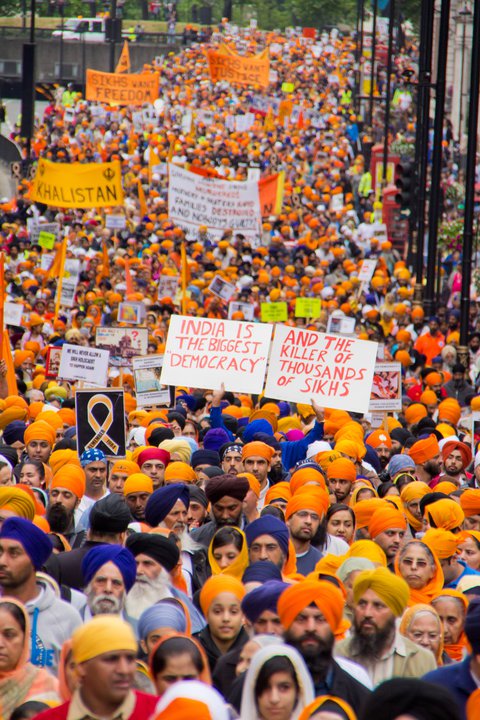 You can repeat your lies….This one comes from the Times of India:
The organisers claimed a figure of 25,000, but the Scotland Yard put the number at 6,000. The ‘Remembrance March’ began at Hyde Park and concluded at Trafalgar Square.[link]
But the truth will get out and you will look all the more stupid for it. Does this look like 6,000? Seems much closer to the 25-35K that was claimed. Sikhs have not forgotten. Until there is justice, Sikhs will never forget.
We will strive for justice for the innocent, such as Professor Bhullar (Watch this powerful video from the WSO’s Annual Parliamentary Dinner; on Professor Bhullar cue to 23:40); we will strive for justice against the guilty.
We live in Bakersfield; we live in Brampton; we live in Birmingham. We still yearn for Bathinda. Our brothers and sisters in London showed it this weekend. Let our brothers and sisters in Punjab know that we are still connected; we will still raise our voices; we still remember.
In Toronto, Lions will roar. A Nation Never Forgets.
Today we remember twenty seven years since June 1984.
We remember twenty seven years since Indira Gandhi sent the Indian Army tanks and artillery to the Darbar Sahib Complex and forty one Gurdwaras across Punjab on the shaheedpurab of Guru Arjan Dev Ji.
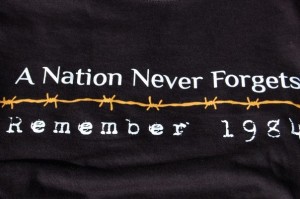
We remember twenty seven years since bodies lined the hot marble of the parkarma. Though Government reports indicate 493 civilian deaths and 83 army casualties, eyewitness accounts suggest the numbers were much higher since 10,000 pilgrims and 1300 workers were unable to flee the Darbar Sahib complex on this day.
We remember twenty seven years since books, manuscripts and other documents have been reported missing from the Sikh Reference Library numbering 10,534. The library which was intact on June 6th had been burnt down by June 14th. In April 2004, many of these writings, which included handwritten manuscripts were reported to be in the hands of the Union Government where they remain today.
We remember twenty seven years since the events that spurred the November 1984 pogroms and the government lead counter-insurgency in Punjab which left a generation of 25,000 missing.
We remember twenty seven years since Sikh women (and men) learned too well that coercion does not just come from tanks and artillery – that sexual violence can be a systematic and deliberate weapon of the State.
We remember twenty seven years since Punjab was left a political climate that hid the state’s impending agrarian crisis and its interrelated manifestations of farmer suicides, drug addiction and gendercide, even when reports as early as the 1985 Johl Report warned that the farming sector was faltering and the real need to diversify crops from the standard wheat-paddy rotation.
We remember the impact this had on the Sikh Diaspora, the communities New York, California and Canada, and the tireless nights many of our fathers and mothers spent out, mobilizing themselves even as recent immigrants with young daughters and sons.
We are a community that is well versed in Remembrance.
Guest blogged by Adi Shakti Kaur
For as long as I can remember, I can envision the imprints of patriarchy within the Guruduaras (Sikh spaces of worship). The Guru, was more than sacred scriptures; more than a living embodiment of the ‘word’; more than a Guru, who took us from darkness to light; but a portal for us to connect to our own Divinity, a genderless form that was beyond the simple, human constructions of defining, labeling and understanding. But in the Guru’s Darbar (court of the Guru), it was brimming with gendered representations. The examples of patriarchy in Guruduaras are monolithic – every role in the Guru Darbar is dominated by men, from the giving of prashad to the katha vichar. Sikhi emerged out of a cultural, political, economic and social period that privileged the masculine gender, and of course patriarchy (as well as other hierarchical constructions).
The revolutionary stance that Sikhi took on the existing beliefs challenged all aspects of the zeitgeist during the Guru period. I articulate this now as a grown woman who has had the honour of a lifelong relationship with Sikhi, with Sikh institutions and with Sikhs, and who also has had the privilege of critically engaging in the world around her, particularly through her academic pursuits. In most Guruduaras, I have had the sacred opportunity to enter, I have been greeted by scenes staged with men occupying the privileged positions in the Guru Darbar, in the langar hall and in seva roles. When the stage is constantly set with masculine representations of Sikhs, from the physical men before me to the Gurus who established and nurtured Sikhi into its current status as a world religion, I never really considered that there was an institutional space for me, for my sister, for my mother, and any Sikh woman to occupy. And for many Sikh women that male privilege extends into their homes and extended families (thankfully there are anomalies like my parents).
As I delved further into Sikhi, I saw an opening for my feminine identity. The Gurus, starting with Guru Nanak Dev Ji, not only placed value in my sex and gendered identity, but honoured us with our everpresent Kaur title. The cultural, economic, political, and social backdrop is still patriarchy, no matter how you present the egalitarian and feminist interpretations inherent in Sikh philosophy, men were privileged, men were hyper visible and that tradition continues today in the majority of Sikh institutions (including the Guruduaras) and communities. Now that I am far removed from my childhood naïve absorption of the Sikh spaces around me, absorbing the patriarchy of my spiritual space, how do I carve out the egalitarian and feminist standpoints as a grown woman, as a mother to my daughter, so Kaurs can begin to chip away at the institutionalized patriarchal vantage position given to the masculine?
Last week marked the 63rd anniversary of the Nakba, meaning catastrophe, when a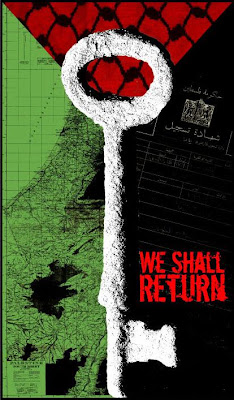 n estimated 700,000 Palestinians were displaced from their homes with the establishment of the state of Israel in 1948. I, and others, have argued elsewhere why the Palestinian struggle for freedom and self-determination is relevant for us as Sikhs, so I won’t reiterate that here (see Sikh Solidarity with Palestine statement).
Every year Palestinians and their supporters commemorate the Nakba by holding demonstrations, vigils, and educational events. This year saw unprecedented resistance by Palestinians in the Middle East, who mobilized at numerous points across Israel’s borders. Their resistance to occupation and their commemoration of one catastrophe was met with with violent repression by Israeli forces — catastrophe upon catastrophe. 14 Palestinians were killed and hundreds more injured as Israeli troops fired on the massive protests.
In an interview on Democracy Now last week, Fadi Quran, one of the protest organizers stated:
…we, as a youth movement, called for the protest because, as many of you know, there are about seven million Palestinian refugees who just want to go home, and they’ve been unable to go home for the last 63 years. So at the protest, initially what you had is a lot of people who are my generation, 23 years old, carrying or wheeling their grandparents to the border so that they can finally take them back and they can return to a normal life, where they are free, where they live justly, and where they can pursue happiness.
Today marks the 86th birthday of the late African American activist Malcolm X. We’ve been hearing a lot about Malcolm X lately since the recent release of a new biography about him written by the great scholar Manning Marable, who just passed away a few weeks ago.
A controversial and often misunderstood historical figure, Malcolm X was a Muslim and saw his faith in God as inextricably tied to his relentless fight against racism and injustice. At the end of the day, it all came back to human rights. We Sikhs know the long struggle for human rights all too well, and I for one take inspiration from this fearless leader who tragically lost his life at the age of 39 in his fight for human rights and dignity.

Guest blogged by Satvinder Kaur Dhaliwal
Admin Note: After completing her undergraduate studies in Anthropology, the author traveled to Panjab to volunteer. She spent her time volunteering at Pingalwara and working with the Baba Nanak Education Society (BNES). Below is an article she wrote for BNES to raise awareness about their impactful work addressing farmer suicides.
::
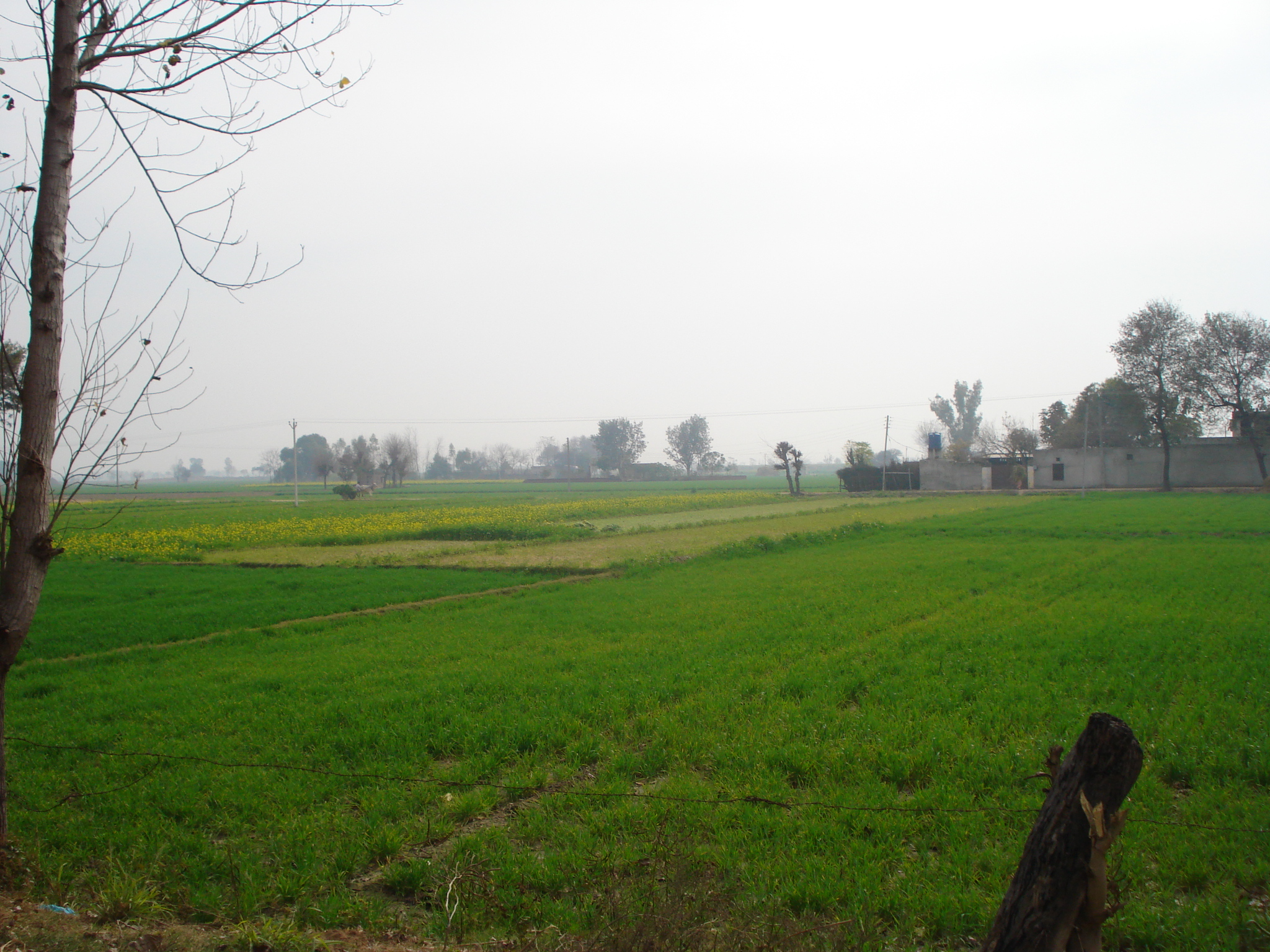 Village Barlan, District Sangrur, located near the Panjab-Haryana border, depicts the prosperous, joyful Panjab that many of us are eager to visit. Roads leading to the village are surrounded by what appearsto be flourishing farmland, stretching as far as one can see. Children have returned from school and are laughing and chasing each other through the streets of the village, the elderly have gathered to discuss recent happenings, and women can be seen carrying various necessities to their homes. This first glance overview of Balran disguises a harsh reality that a growing number of households in the village are facing – suicide.
Suicide is an equal opportunity visitor in Balran and many other villages throughout Panjab. Increasing farming costs, the removal of farmers’ subsidies, and low rates for crops are putting Panjab’s farmers in a never-ending cycle of debt accumulation. Each year, farmers in Panjab face increased agricultural costs and low returns for their crops. In order to cover these costs, farmers must take out loans, which they usually get from their local aarthiya or money-lender. The aarthiya often ends up being the same individual who will buy the farmer’s crop at the mandi or market, and then re-sell the crop on the public market. Sukhjinder Singh, a farmer, described the reason for debt accumulation as, “Let’s say that I sell my crop for 11 rupees per kilogram. When I need to purchase the same crop for my home, I have to buy it for 14 rupees per kilogram. So how can we profit?” Consequently, when a farmer’s costs are constantly exceeding his profits, he must cover his costs by taking out loans. Now, he has increased his debt by introducing extremely high interest rates, which are often decided by the aarthiya.
Unlike the west, the gendered demarcations of males and females in Panjab are much more stark, and it is common for women to be unaware of their family’s financial circumstances. Therefore, when the male becomes consumed in debt and can no longer bear humiliation from the taunting money-lenders, he begins to see only one way out – suicide. His surviving family members are not only left devastated, but they must find a way to provide for themselves and pay off the debt on their family, of which they may never have been aware in the first place. Often times the surviving family members include a wife, children, and elderly parents. In winter 2011, I visited the families of various suicide victims in Balran. Some families had lost their loved one a few years ago, while some had only experienced the loss a few days ago. Although I only visited seven families, the Baba Nanak Education Society has documented 91 suicides and numerous missing individuals in Balran since 1998. Nonetheless, all family members were still grieving equally and struggling to pay off their debt.
This past Sunday, violence erupted in an ongoing conflict between rival factions at the Gurdwara Baba Makhan Shah Lobana in Richmond Hill, Queens, the heart of New York’s Sikh community. Large kirpans as well as cricket bats and balls were used in the fighting. Dozens of community members and “leaders” were injured, and seven men were arrested.
Sunday was the escalation of an ongoing power struggle between leadership factions in the Richmond Hill Sikh community. There have been many violent incidents in the last several months at this Gurdwara (which itself was born out a violent conflict at the original Richmond Hill Gurdwara, the Sikh Cultural Society), resulting in a regular police presence there.
I don’t claim to understand the reasons behind the conflict at this Gurdwara, nor do I really care. This type of behavior is inexcusable and unjustifiable. And it is far too common in our community, and in particular, in our houses of worship. Much deeper discussions and interventions are needed about violence in our Gurdwaras than I will go into here.
That being said, as a follow up to Navdeep’s post about Sikhs and the Media yesterday, I want to focus on the news coverage of this incident in Richmond Hill. The New York Post* (one of NYC’s biggest newspapers with over 525,000 print copies sold daily) broke the story with this headline on Monday: Queens Turban Warfare: Sword-Wielding Sikhs attack praying rivals.
Our mothers and grandmothers would be proud. If we take a moment to pause, we’ll see the amazing mobilization that is occurring in the diaspora around Sikh women’s issues, particularly by youth. I’m not quite sure if it is a legit rise in websites or events or whether we are simply paying more attention to the topic. Regardless, it is clear that there are now more forums and platforms for discussion cultivating the need for women (and men!) to come together and address issues affecting Half the Sky. This post will give a round-up of some amazing work that is happening in our community, bringing together our qaum to discuss important issues affecting Sikh women.
 {Kaurista} It is clear that Sikh women, like all women around the world, value an open space to discuss issues that directly impact us. Whether it is conversations about clothes, hair, identity or our activism – there needs to exist a space that is catered to providing Sikh girls and women with a sense of unity. This type of comraderie cannot be understated – it impacts an individual’s self esteem and confidence in a substantial way. With the launch of Kaurista.com and the immediate posting of the link all over Facebook, it is hard not to notice how much support there is for this type of forum. Kaurista provides conversations on six different topics including, Lifestyle, Style & Beauty, Family, Inspiration and Health & Wellness. One of my favourite sections of the website is “Ask Kaurista” where questions related to wanting to marry a sardar, going to prom, or overcoming alcohol abuse are answered. The site is not only aimed at Sikh girls. In fact, it actively includes Sikh men in discussions – and perhaps the hope is that through these types of discussions, Sikh men will value how truly dynamic Sikh women are!
{HERSTORY}

Advocates of gay rights celebrated after the Obama administration in late February said that it would no longer support the Defense of Marriage Act, a federal law that bans the recognition of same-sex marriage. The Defense of Marriage Act, or DOMA, signed into law by President Clinton in 1996, defines marriage as a legal union between one man and one woman.
The Obama administration, however, believes DOMA is unconstitutional.
President Barack Obama has concluded that the administration cannot defend the federal law that defines marriage as only between a man and a woman. He noted that the congressional debate during passage of the Defense of Marriage Act “contains numerous expressions reflecting moral disapproval of gays and lesbians and their intimate and family relationships – precisely the kind of stereotype-based thinking and animus the (Constitution’s) Equal Protection Clause is designed to guard against.” (link)
Although I take issue with the state having a role in defining what is and isn’t a legitimate relationship in general (and one’s romantic relationship defining whether or not they get access to certain benefits and privileges), I applaud the administration taking this strong stance against homophobic bigotry. So, I was disappointed (though not terribly surprised) to hear that the World Sikh Council, a “representative and elected body of Sikh Gurdwaras and institutions in the US,” has been lobbying the Obama administration to uphold DOMA and went so far as to co-sign a letter of protest to President Obama denouncing his decision to reverse DOMA. The letter states:
Guest blogged by Tarnjit Kaur
This essay was written as an introduction to ‘Sikhism and Gender Equality: Where do you See Yourself?,’ an event to be held in Ontario Saturday, April 2nd at 6 pm. All are welcome to attend.
Motivated by the empowering message of Sikh theology, Sikhi, Sikh history is replete with struggles against all forms of oppression, to protect religious freedoms, human rights and in the pursuit of self-determination. Although an expression often confined to an interpretation of Christianity, I have always thought of Sikh theology as a form of liberation theology: a theology that liberates in the here and now from social, political and economic injustices. It is from this perspective that I ask whether if a Sikh thealogy [1], that is a Sikh feminist theology, has political and social utility in advancing the cause for gender equality within the Sikh communities [2].
I argue that women’s oppression due to patriarchy is compounded by colonial factors and that the disconnect between the practise and theory of Sikhi is entrenched in socio-economic and political inequities. It is therefore seriously questionable whether there is any political utility in the efforts to reclaim the ”feminine voice” or the feminist nature of Sikh scripture as subscribed by Sikh thealogy [3]. I further ask how can gender equality be achieved? Does Sikhi empower women because of its emphasis on traditional gender roles and femininity? Or does Sikhi advocate that men should no longer exploit their own privilege arising from their status as men? Or are there clear messages of gender egalitarianism promoting gender equality? These are areas of Sikh thealogy that are pregnant for research, scriptural analysis and historical investigation and are part of a larger on-going work both within the academic sphere and by grass-roots Sikh organizations.
Guestblog by Fakir
I’ve been complaining for several weeks regarding the cricket craze and how educated, conscious south asians should be taking this moment of international spotlight on their ancestral or native countries to highlight their higher expectations for their countries much like what occurred around the world and in Beijing during China Olympics 2008 and educate their peers.
It especially angers me when I see Sikhs rooting for either Pakistan or India, when I see Muslims rooting for India (and Pakistan), etc etc, because these are oppressive machines not harmless patriotic identities. India v. Pakistan is going to happen today in Mohali, Punjab, India. Here is something else that happened in Mohali, Punjab, India just yesterday:

Guestblogged by Mewa Singh

This past week members of the College Sikhs Collaborative and the Jakara Movement – created the first Alternative Spring Break – explored the issue of immigration by visiting so-called ground zero – the Mexi/Cali border. While the surge of the Tea Party movement has helped bring nativist sentiments to the fore, the Sikh-American response on the issue has been largely muted. In 2006, we saw huge protests calling for a more open immigration policy, led largely by our Chicano/a and Latino/a brothers and sisters. As is too often the case, Sikhs, who are also directly affected by issues of immigration – both documented and undocumented – remain passive bystanders to the national debate. [For those that do not know about the increasing number of Punjabi undocumented workers – including over 1600 that were caught and detained in 2010 alone, see the LA Times article ] Even worse, is some Sikhs even support candidates that have borderline racist views on such issues. While groups such as Sikh Coalition and SALDEF have tacitly supported the cause of immigration cause, it is a shame that we have not been more vocal. Without standing with others (especially on those cases where we have a self-interest!), why should anyone stand with us on the issues we care about?
Day 1 – Orientation Our trip began with an orientation with our partner organization – Border Angels.
Guest blogged by resistsingh
March 23rd, 2011 marked the Anniversary of the Martyrdom of Shaheed Bhagat Singh.
Bhagat Singh is a legend in many circles, a man who gave his life to secure the freedom of India from Colonial Rule. Today, many celebrate his bravery and he has become somewhat of an icon. Unfortunately, like other popular revolutionaries, such as Che Guevera the content of his revolution is lost.
Like the many oppressive systems we face everyday, our identity is consistently a target – a means to keep our community impotent, by robbing us of our history, our motivation and association to revolution and social justice. With that in mind, we should always be aware of the ideologies, the motivations and the history behind those we celebrate. Bhagat Singh is no different.
So today, we share a quote with you all, from the Final Petition of Bhagat Singh before his death, one that eloquently describes his resistance to Imperialist and Capitalist ideology and one that we should hold to our hearts as we celebrate his life. As injustice continues to prevail, the greatest honour to the shaheedi of our ancestors is to understand their struggle, today.
“Let us declare that the state of war does exist and shall exist so long as the Indian toiling masses and the natural resources are being exploited by a handful of parasites. They may be purely British Capitalist or mixed British and Indian or even purely Indian. ” – Bhagat Singh
 The aftermath of last Friday’s earthquake and tsunami in Japan is nothing short of horrific. I’m sure most of you have seen footage of the devastation on the news and on YouTube. My mind is boggled, my heart is aching, and I am all in all extremely overwhelmed by what is happening.
While I haven’t heard about any specific Sikh responses or relief efforts yet, United Sikhs, which sent a team to Haiti after last year’s huge earthquake, has a Japan earthquake/tsunami page up on their website. If you know of any efforts happening, please post them in the comments section.
While we keep the people of Japan in our thoughts and prayers, there are many ways we can be taking action. Below are a few simple things you can do to provide support. This is not intended to be a comprehensive list, so please add your own suggestions.
By now you’ve probably heard about Wisconsin governor Scott Walker’s attack on working class people and labor unions in Wisconsin. This week, Walker’s bill, which undermines public sector workers’ right to collectively bargain and slashes their benefits, among other things, passed through the state Senate, without a single Democratic Senator present for the vote, and the Assembly, in the face of three weeks of massive protests, the largest demonstrations in Wisconsin since the Vietnam War.
The Washington Post reports:
Wisconsin Gov. Scott Walker won his drive to strip the state’s government workers of nearly all of their collective-bargaining rights Thursday, after a three-week standoff that brought tens of thousands of protesters to the Capitol.
The new legislation represents a major setback for organized labor, but the political battle over public employees and their rights to bargain is likely to continue – not only in Madison.
The state Assembly passed Walker’s proposal a day after Republican senators outmaneuvered the 14 Democratic senators who had fled Wisconsin to deny a quorum needed for passing a budget measure. By stripping the bill of its spending language, they were able to pass it with only Republicans present.

Today, March 8th, is the 100th annual International Women’s Day!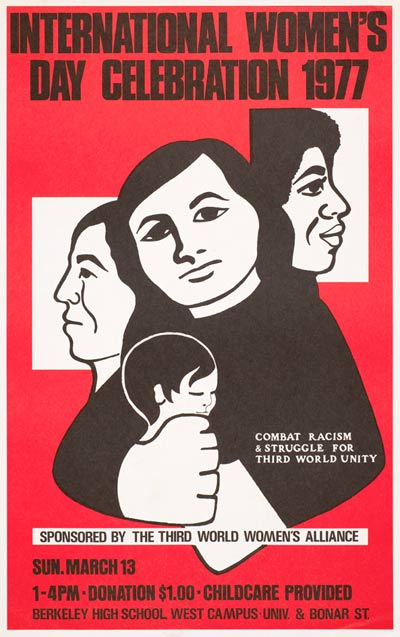 This year’s theme is “Equal access to education, training and science and technology: Pathway to decent work for women.” The first International Women’s Day was celebrated in 1911 in Austria, Denmark, Germany, and Switzerland, and is the brainchild of Clara Zetkin, a leader in the Social Democratic party in Germany, who fought for a space where women could press for their demands. This day is a celebration of the ability for women and men use our voices to advance gender equality, and the need.
Gender equality has been central to Sikh social, economic, and political life since the time of the Sikh Gurus. Bebe Nanaki was the first Sikh in history to recognize Nanak as her Guru. Under Guru Amar Das Ji women were central to Sikh administrative manji system. The women of Meer Mannus prison endured extreme forms of torture and watched their children slain before their eyes but stood strong against the corrupt and brute governor of Lahore and his compatriot Kaura Mal. Fearless women warriors like Mai Bhag Kaur, Bibi Baghel Kaur, Bibi Daler Kaur stood on the frontlines of the Khalsa fauj to defend the marginalized and oppressed against authoritarian rule. Today we stand with brave Sikh women of the past and present, Mata Khivi Ji, Bibi Amrao Ji, Bibi Bhani Ji, Mata Gujri Ji, Mata Sahib Kaur, and Bibi Harnam Kaur, whose contributions to Sikhism must not fall into the shadows of Sikh religious, social, and political life as it would go against our own doctrine and values.
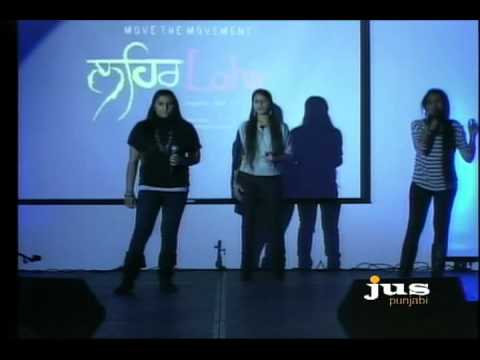
Please take minute on watch the clip below by three brave Sikh sisters of today willing to uphold the vision of Nanak with strength and courage. Let’s use this day to reflect on what we can do to move this community to the front lines of the Sikh vision for gender equality. #IWD in solidarity.
Visit the Sikholars website and choose to register for the entire weekend or just for the conference. There are a number of exciting presentations by leading scholars in the community. Mark down your calendars from February 25-27, 2011 as Sikh professionals, academics, and activists come together in the Bay Area. Hope some of our Langar-ites can also attend!

