
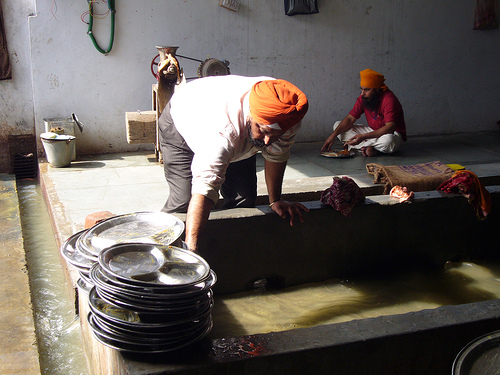
 On TLH we have discussed Green Gurdwaras. Part of this green initiative is to use steel plates (i.e. thaals) and cutlery instead of the common paperware. A couple of weeks ago at a local Gurdwara langar, I saw steel plates being used that had been stored away in cupboards for years. Every week disposable cups, plates, spoons and forks were used by the sangat. Somehow in a community with a growing immigrant Punjabi population disposable means modernity. I remember watching sangat members come stand in the standard langar line and show surprise as they reached the front and saw large piles of steel plates. The reactions were amazing. We had aunties with twitched noses who continued to scrub the steel plates although they had been cleaned and washed the night before and showed no signs of being dirty. Uncles made comments like, “hun taan aapaan Punjab ton nikal gaye, a hun desi kamm ithhe vi shuru kar taa”. Others just smirked and laughed.
There were also positive reactions where aunties and uncles supported the langar sevadars for reintroducing steel plates. These sangat members felt that these plates helped reduce waste while encouraging the action of seva. Interestingly, they said more seva is done by cleaning jutha plates than by just throwing them away. By cleaning jutha plates, it reinforced a sense of humility of cleaning other peoples’ waste. In addition, some people showed a lot of humility by refusing to allow the sevadars to take and wash their plates. For example, an elderly woman, who had difficulty walking, slowly took her plate inside the kitchen and washed it herself. Lastly, a number of sevadars, aside from the family doing langar seva that week, decided to help clean plates. An assembly line of cleaners and dryers was set-up. Some spoke and others just quietly felt the spirit of doing seva together. Ultimately, by reintroducing steel plates the spirit of seva was rekindled in a new way.
Many students face physical and psychological bullying in schools- elementary, middle, and high. But Sikh students, male and female, often face especially severe bullying. Over the past couple years, some severe cases have come into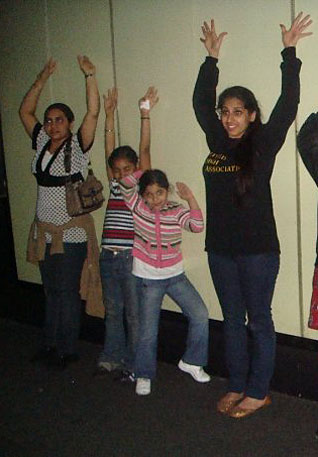 the public eye, including one teenager’s patka being set on fire, and others whose hair was forcibly cut. For statistics on the prevalence of harassment against Sikh students in New York schools, check out the Coalition’s report, “Hatred in the Hallways.”
One pro-active student at Baruch College (of the City University of New York) has come up with a simple and creative way to provide support to kids facing harassment. Through his school’s Sikh Student Association, he started a mentoring program called Sikh Scouts. The students, aged 5-12 are paired with older Sikhs of the same gender, and go on a day’s outing together.
Sikh Scouts is essentially a small-scale Sikh youth mentoring event that aims to forge and develop a long-lasting relationship with children in need of good Sikh role models to help them guide them on the path of Sikhi. [link]
One of the students from Baruch that participated in the program wrote about the experience.
After they warmed up to us and broke through their initial shyness, the kids couldn’t stop talking about their favorite movies, TV shows and music – the Jonas Brothers and what not. And in between all of that, we got down to the serious issues: a majority of the kids did not enjoy school and felt uncomfortable because of harassment or teasing by their peers. [link]
There might not be much that anyone, including the older Sikh Scouts, can do to make the bullying stop- after all, kids will be kids. But what we older Sikh students can do for our younger counterparts is to be a source of strength, share insights about why it’s important to be comfortable with who you are whether it fits someone else’s definition of cool or not, and be there to offer advice for specific situations. There are things we’ve learned in hindsight that can benefit those facing the same harassment today.
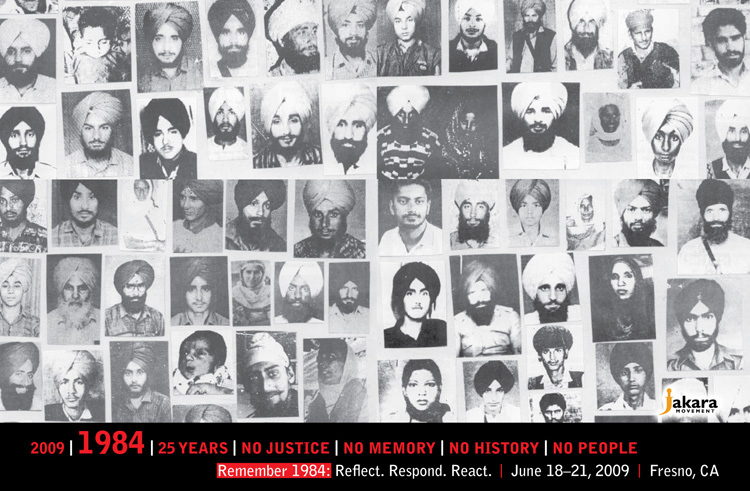
The topic of 1984 is hardly new in The Langar Hall and despite protestations from some amnesia-desiring commenters, we will not forget the Shaheeds of Darbar Sahib, the pograms in Delhi, the Ghallughara against the Sikhs from 1978-1995, or even the continuing impunity that continues today.
We have highlighted many events in the past and we will contine to do so.
In that spirit, I strongly urge TLH readers to attend this year’s Jakara Movement conference in Fresno, CA from June 18-21st. A number of invited guests’ names will be announced in the upcoming week. The title of the conference is “Remember 1984: reflect. respond. react.”
2009 | 1984 | 25 years | No justice | No memory | No history | No people
Despite the fact that many wish to forget the events that befell and have shaped the Sikh Nation, it is vital for the ‘next generation of Sikhs’ to be aware of our past and understand how it shapes our present and our future. While twenty-five years have passed since the attack on our sacred home, much has changed and much has remained the same. For the Nishan Sahib of our Nation to remain tall, it is for us to study our history, remember the past, and continue the fight for justice.
This year at Jakara, we will Remember 1984 and celebrate those Kaurs and Singhs that made the ultimate sacrifice for our Qaum.
Join us in Fresno as we Remember 1984: Reflect. Respond. React.
Register here TODAY and avoid a late fee. Below the fold you’ll find the agenda. See you there!
 Go to virtually any diasporan Sikh’s house that has an interest in Sikhi and you will find the ubiquitous blue book. On the cover is a dashing picture of Shaheed Jarnail Singh Ji Khalsa Bhindranwale. The title: Fighting For Faith and Nation: Dialogues with Sikh Militants. While too few Sikhs actually complete the book to those that are patient and willing, anthropologist Cynthia Keppley Mahmood explores the world of Sikh militants through their own voices, allowing them to air the very humanity that continues to be denied by a totalitarian state machinery.
At a time when even too many Sikh authors and scholars were silent as Dr. Mahmood, herself, laments:
“Sikh Studies,” a traditionally Orientalist field that has consciously steered clear of the topic of conflict in Punjab, even as tens of thousands of Sikhs perished, wants us to look at medieval religious texts while the heart of Sikhism is in flames. If we touch the fire, if then too we burn and say ouch! – then we are shunned. But then again, academia has never done well in perilous times.
The Sikhs found two strong voices who I call our Sikh Bibiyan of the Academy – Joyce Pettigrew and Cynthia Keppley Mahmood. In fact, Sikhs who have never had the fortune to meet them, lovingly refer to them by their first names [as if they are part of our family] – Joyce and Cynthia [contrast this with those involved in “Sikh Studies”, who are only known by their last names “McLeod”, “Oberoi”, etc.] Cynthia’s book is a classic and its place on the bookshelf of every diasporan Sikh is every bit warranted. If it is not on yours, make sure to add it.
While all this is covering the familiar, what inspired her to write and give pen to the voices of Sikh militants is every bit as inspiring as those that she interviewed. In my opinion just as those that inspire by fighting for faith and nation, Cynthia is a fighter, gifted with courage and inspiration.
As part of Sikh Chic’s “1984 and I” series, Cynthia reveals her own personal story for the first time:
In this deeply personal account, I describe for the first time how I was assaulted, beaten and raped by a gang of hired thugs or rogue police in a north central Indian state during fieldwork in 1992. A graphic narrative of this event leads into a brief meditation on the sorts of things readers would typically prefer not to know, and on our compulsion as engaged anthropologists to bring them into the conversation anyway. I conclude with the persisting hope of survivors of violence – like many of our ethnographic interlocutors in arenas of conflict – that healing is possible and that change toward justice can occur. Finally, I write of an anthropology that speaks from a spiritual, political and intellectual paradigm which recognizes that, unspoken or not, values of the heart are as central to our field as those of the mind. [Cynthia Keppley Mahmood, Senior Fellow in Peace Studies, Department of Anthropology, University of Notre Dame, U.S.A.]
I encourage ALL to read her entire piece.
Cynthia Mahmood, author of the groundbreaking work, “Fighting for Faith and Nation,” just published an incredibly personal and powerful account of her rape and assault, possibly by Indian police, in an attempt to silence her  anthropological work on Sikhs in Punjab in the early 1990s. Luckily for all of us, the rape did not accomplish its goal and instead seems to have fueled Ms. Mahmood’s fire. She courageously continued her work and has again shown courage in speaking publicly about such a deeply personal, and deeply difficult incident. Ms. Mahmood’s work has been incredibly important to revealing the human side of the violent Sikh movement for independence and the brutal suffering of Sikh civilians in Punjab during the 1980s and 1990s. Without her contribution, the movement for justice for 1984 and the following decade would not be where it is today. Through her rigorous scholarship and powerful writing, she exposed a side of the story of Punjab that otherwise perhaps would have been left uncovered. In addition to “Fighting for Faith and Nation,” she co-authored the also ground-breaking work, “Reduced to Ashes: The Insurgency and Human Rights in Punjab.” I can’t emphasize enough how important her scholarship has been to the Sikh community. She’s a frequent speaker, commentator, and expert on Sikh separatism and human rights in Punjab.
I’m astounded and inspired. You must read the entire account, though I’ve copied a few passages below. Ms. Mahmood reveals herself to be resilient, committed to truth, and irrepressible in spirit.
During 1984, Ms. Mahmood was in India studying ancient Buddhism for her dissertation, “Rebellion and Response in Ancient India: Political Dynamics of the Hindu-Buddhist Tradition” when the struggle between Sikhs and the central government was constantly in the news. She travelled to Bihar in 1992 to study a tribal group, and in a north central Indian state, was discouraged- severely- by (possible) Hindu nationalists from studying the Sikhs of Punjab. The discouragement came in the form of a severe assault and a brutal gang-rape.
Her account of the rape is visceral and will leave you haunted.
Slash, slash, blood. I see the blood dripping, even in the dark. I smell my own blood over the smell of the rotten tangerines.
I cannot fight back, not against this. I should survive, only survive.
Oh! I hadn’t noticed. Black-shoe man is raping me. [link]
 Earlier this month, worldwide Human Rights organization Amnesty International released a news article on the plight of Sikh Massacre victims of 1984, still awaiting justice after 25 years. This came shortly after the Delhi Court delayed ruling on Jagdish Tytler, due to the CBI’s inability to produce enough evidence against him. Ramesh Gopalakrishnan, Amnesty International’s South Asia Researcher stated:
“The fact that almost 3,000 people can be murdered without anyone being brought to justice is offensive to any notion of justice and should be an embarrassment to the Indian government.”
“For the Indian government to dismiss these cases due to lack of evidence is farcical. The various agencies responsible for carrying out the investigations failed to carry out the most cursory of tasks – including recording eyewitness and survivor statements.”
As troubling as it is to read this, I was pleased to find that Amnesty International had covered it at all. As many of know, AI, as well as other independent human rights groups and initiatives were either banned or prevented from conducting research in India in the late 1980’s and early 1990’s. It seems as though there is hope for an independent investigation on the 1984 anti-Sikh pogroms and perhaps the subsequent disappearances during the counter-insurgency.
Not so fast…in an un-related story, the Tribune reported that Amnesty International has decided to shut down its India operations. The decision is said to have been triggered by continued denial to the Amnesty International Foundation of the FCRA (Foreign Contribution Regulation Act) registration by the Government of India.
(more…)
It seems like Canada is showcasing one socially conscious Sikh rapper after another. TLH has covered “Humble The Poet” and now here is “Sikh Knowledge” from Montreal. Sikh Knowledge raps with Lotus on issues effecting the 2nd generation and marginalized peoples.
Kanwar Anit Singh Saini, a.k.a. Sikh Knowledge, is the son of Punjabi Sikh immigrants. He works in the field of speech pathology where he contributes his musical knowledge to the health sciences field.
Check out his songs below and let us know what you think!
Disclaimer: There are graphic descriptions and swear words in the videos below.
As we remember 1984 through concerts and acts of rebellion, let’s not forget the visceral spirit displayed by Singhs IN that time period.
Watch below the original version of a Punjabi kavita sung by Bhai Gursharan Singh during those turbulent times in Manji Sahib Hall located in the Darbar Sahib complex . This kavita captures the mood and spirit of those days. Tigerstyle later used it in one of their Shaheedi CDs to REMEMBER that spirit.
Intellectually, we can try to REMEMBER those days; but this kavita actually makes us FEEL how it was to live through that time.

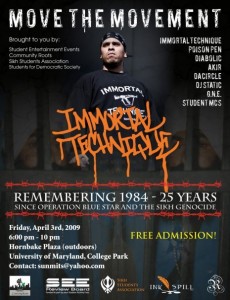 I know this concert has already been discussed, but the event had been postponed to this coming Friday…and with all the local buzz…it got me thinking about how we remember 1984.
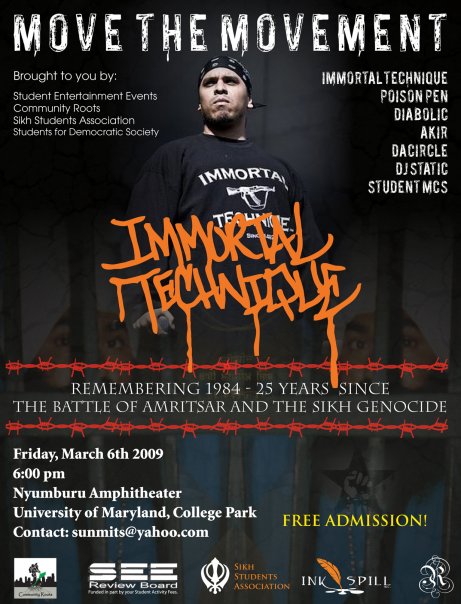
The Sikh Student Association here at the University of Maryland, in conjunction with other student groups, is sponsoring a free concert on April 3rd, 2009 to mark the 25th anniversary of the 1984 Sikh genocide. In a previous post Truth To Power – in reference to the recent Ensaaf report, I had stated:
We must read such reports and present them … anywhere and everywhere … to anyone who will listen: our gurdwaras, our local Amnesty International chapters, student groups, talk radio, public television, newspaper op-eds, etc. We must also create awareness of these findings in whatever format we can – through music, art, theatre and poetry.
The featured performer for the concert is Immortal Technique, an up-and-coming rapper who attracts a large and diverse audience, especially amongst college students. His intense style, controversial lyrics, and willingness to approach political subjects, such as the mid-east conflict, have made him a fan favorite amongst the politically aware.
It is refreshing to see students think “out-of-the-box” in remembering 1984, by attracting a mainstream artist and joining forces with other student activist groups under the tagline “Move the Movement.” The SSA plans to distribute background material on the 1984 atrocities and subsequent human rights violations, as well as feature short video clips and interviews with victims in between acts.
Radio Free Afghanistan 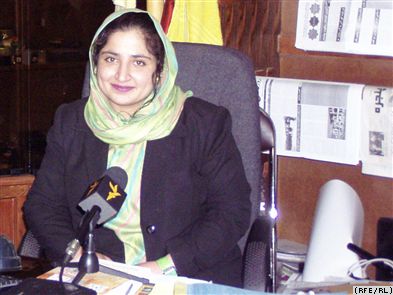 just chose Anarkali Honaryar for their “Person of the Year” award. Coincidentally, Anarkali is a member of Afghanistan’s minority Sikh community. At 25 years old, Anarkali is also a physician, a human rights activist, a member of Afghanistan’s Constitution Committee, and works for the Independent Human Rights Commission of Afghanistan. Oh, and she finished high school at 12.
Wow. I think another fitting title would be Sikh Role Model of the Year (or the decade?). She has definitely just become my role model. And we can definitely add her to our list of sheroes.
Just what exactly was Anarkali given this award for?
She is well-known for helping women who suffer from domestic abuse, forced marriages, and gender discrimination. Honaryar is also an advocate on behalf of Afghanistan’s small, embattled Hindu minority, which lives in squalid conditions and faces harassment and discrimination. “We are thrilled to recognize Anarkali for her tireless work in promoting democracy, human rights, and civil society in Afghanistan,” said Radio Free Afghanistan Director Akbar Ayazi. “Anarkali has been taking part in Afghanistan’s reconstruction since she was a teenager — this recognition is well-deserved.” [Radio Free Europe]
What exactly is the function of a Sikh Student Association? Is it simply to bring Sikh students together on campus for token meetings? Is it to celebrate Vaisakhi by organizing bhangra parties? Is it a platform to mobilize students to act upon issues impacting Sikh youth and the Sikh community? Is it… okay, I’ll stop with the questions.
To be quite honest, I don’t know the answers to these questions. I can speak to what I think the potential of such organizations is – what they could achieve and how an active and effective Sikh Student Organization could impact change. For example, here on TLH we’ve previously discussed how Sikh Student Associations in California have organized student initiated Kirtan and come together for Nagar Kirtans. Last week Camille discussed an initiative taken up by the University of Texas Sikh Student Association (the post stirred up some issues about the role of Sikh student associations). While these events are sporadic and intermittent – they are an example of one of the functional elements of a Sikh Student Organization – to educate ourselves and others about Sikhi.
However, it has to go beyond that. While I think any and all Sikh Student Associations should be given accolade for planning and participating in activities such as weekly Rehraas – there is much more to be achieved. Perhaps what’s integral to the success of these organizations (and to ensure they are effective) is to create an umbrella organization which provides resources and support to local Sikh Student Associations.
Take B.O.S.S. for example,
The British Organisation of Sikh Students is a non-political, non-profit making, independent body which acts as an umbrella organisation helping to develop, assist and support Sikh youth groups. [link]
 Although it has been a few months since its ‘soft opening’, the National Sikh Heritage Centre and Holocaust Museum at Derby in the UK in July will soon host the Queen of England, Elizabeth II, to inaugurate the museum.
Although many Gurdwaras have a ‘museum’-room and apparently on the internet we have a cybersikhmuseum, the initiative to bring scattered items of Sikh heritage is much needed and should be lauded.
The Museum hosts a number of artifacts, including a canon that belonged to the Sarkar-e Khalsa during the time of Sardar (often erroneously called Maharaja by Sikhs) Ranjit Singh.
The library is currently featuring an exhibit ‘From Jawans to Generals’ and in May will begin an exhibit on the Sikh Holocaust of 1984. They are beginning to collect rare books and hoping that the library will become a hub for Sikh scholarship.
The museum by bringing many such historical artifacts, located throughout UK together is more proof of the burgeoning of the Diaspora Sikh community and its finding new ways to engage with its changing self as well as non-Sikh community members. One hopes we will see similar initiatives in the US and Canada as well.
If Baldev Mutta’s cellphone rings in the middle of a meeting, he picks it up. If it beeps over dinnertime or at midnight, he answers it. And if he has to go out to pick up a woman and find her a spot at a shelter at 3 a.m., he will do it. “It can mean the difference between life and death for a woman,” said Mutta, executive director of Punjabi Community Health Services in Brampton. “They are abused and don’t have anywhere else to go. This agency is their lifeline.” [link]
The Punjabi Community Health Services is an organization based in Brampton, Canada which provides various services to Punjabi women who have been abused. Instead of waiting for women to turn up at their doorstep, this organization takes a proactive approach by sending workers into the community to speak with abused women. They visit Gurdwaras and community centers to find women in distress. At times they must speak with the women secretly at doctor’s appointments, grocery stores, even parking lots, so their families don’t find out.
::
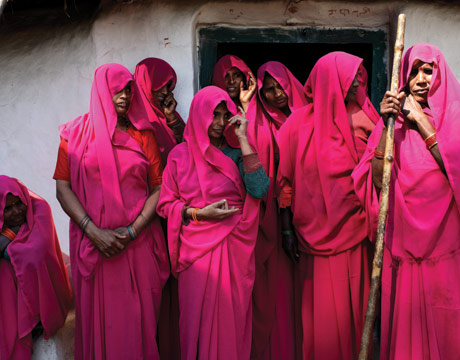 In related news, I recently read an article about the “Gulabi Gang” in an issue of Marie Claire which appeared on New America Media yesterday aswell. The Gulabi Gang are a group of women in India who have come together to fight against abuse. When local officials refused to take action against an alleged rapist, scores of pink-sari-clad women stormed the police station, demanding action – and thus, became know as the Gulabi Gang. For example, when Sampat Pal Devi learned that a friend had been beaten by her alcoholic husband and that the local police, chronically indifferent to violence against women, had looked the other way, something inside her snapped. In an effort to fight back, she gathered dozens of her female neighbors, armed them with sticks, and taught them how to fight back. Together, the self-declared Gulabi Gang have beaten up accused rapists, profligate officials, and husbands who’ve abandoned their wives.
 I know, from personal experience, that Sikh student organizations are always looking for a way to “get involved” and participate in a good cause. So, when I read about a recent initiative encouraging this type of active involvement, I cheered (abeit silenty… and to myself). The Sikh Spirit Foundation is an organization dedicated to promoting sikh values through education. In line with this mission, the Foundation recently launched a contest looking for project ideas which could help sikh education or our local gurdwaras.
Help us assist the Sikh Community. Tell us how you would spend $25,000 to improve Sikh education or your local gurduara for a chance to win an iPod!
Submit two written paragraphs explaining what you would do and how it would help the Sikh community. Ideas will be judged according to feasibility, impact and need.
The Sikh Spirit Foundation intends to pursue the winning idea this summer by inviting the global community to submit proposals for the project. The Foundation will select and fund the best proposal among the submissions. [link]
Some of the organization’s grantees include: Ensaaf, Gyan Sewa Trust, Nanakshahi, Sikh Coalition, SikhNet, Sikh Research Institute, and Ujjaldidar Singh Memorial Foundation.
We’ve previously discussed involvement in the Sikh cause and lac(k)tivism – so it would be great to hear how youth and student organizations take the opportunity to suggest solutions to problems in gurdwaras and provide ideas for improving sikh education. Whether we acknowledge this or not, we are building a world today where our children will live tomorrow. To see the positive impact, it really comes down to how much we are willing to invest in our community today. We encourage you to go directly to the website to read submission guidelines – however, if you’d like to leave some thoughts here too – we’d love to hear your ideas!
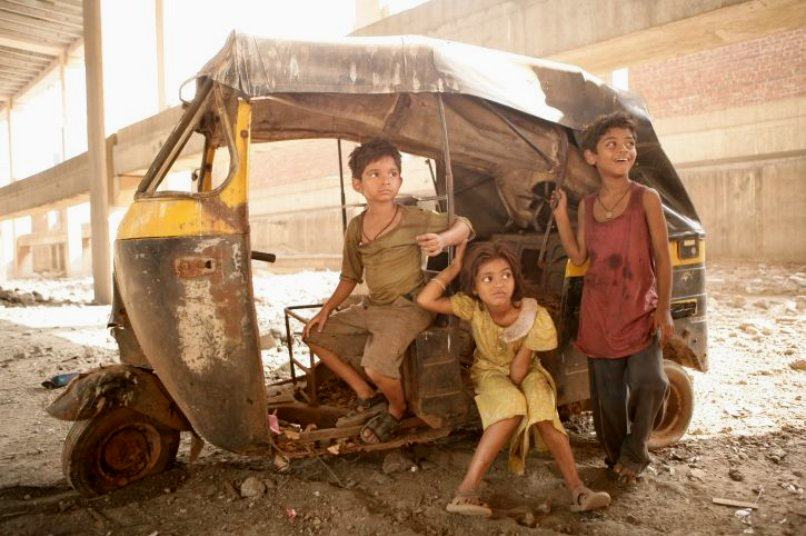 Amidst all the “Slumdog Millionaire” Oscar hysteria, some have been asking how are we ACTUALLY going to combat the issues of poverty in Indian slums? I heard on “Entertainment Tonight”, or some show like that, the movie’s directors/producers have set up a trust-fund for the child-stars (who currently live in slums), are paying for their families to move into decent apartments, and will be paying for the children’s education.
But how about the rest of the families who were cheering away in Mumbai slums as “Slumdog Millionaire” won its eight Oscars? I came across this great blog post by Minal Hajratwala, “Slumdog”: Don’t Just Watch, Do Something, which took scenes from the movie and talked about how we can address those poverty issues in reality. I am going to copy a few of those segments here, but please do visit Minal’s blog for the full-effect.
As the 25th anniversary of “1984” approaches us, TLH posts have covered some activities commemorating this devastating time in our history.
My most vivid memories of “1984” are watching Indira Gandhi’s funeral on television and the border of photos inside my local Gurdwara’s Langar Hall of the men who had been tortuously killed during the Khalistani movement. As I got older, I always wondered how Sikh women were impacted by these events, aside from the infamous photo of a widow crying with her child in her arms.

I read about a woman who was strongly involved in the Sikh student movement in Punjab but now lived on the East Coast (USA). At the Fremont Gurdwara, I remember the single picture of a woman who helped make the border of Shaheeds’ photos hung high in the Langar Hall. I recall the emotional testimonies of widows left deserted by our community and the Indian government in the film, “Widow Colony”. Most recently, I came across this poem, “Don’t Feel Sorry For Me, I Am The Daughter Of A Shaheed” written by woman who lost her family in the 1984 riots in Delhi.
 2009 marks the 25th year since the events of 1984. Tragedy and the vibrancy of life mark the ‘story’ that is 1984 and beyond. There will be many activities I assume over the next few months and I will do my best to stay informed and encourage participation by our readers, writers, and beyond.
Last year, I wrote that I was a HUGE fan of Immortal Technique. Although some of the commenters could not move beyond his usage of profanity, I think they are losing out on a phenomenal activist and inspiration. In that post I had mentioned his usage of a Sikh analogy, it seems next month he may be doing much more. The Sikh Students Association at the University of Maryland, College Park is one of the groups playing host to an upcoming performance on March 6th, 2009 at 6pm. The tagline of one of the posters (well one that I am sure the Sikh groups are promoting) is “Remembering 1984: 25 Years Since the Battle of Amritsar and the Sikh Genocide“. For more information visit Tech’s myspace page that states that free admission will be limited to the first 500 people.
Another great initiative that was recently brought to my attention is the “One Million Chaupai Sahibs” project. The target: 1,000,000 Chaupai Sahibs by June 2009. Whether individually or collectively, I hope the TLH community actively supports the project.
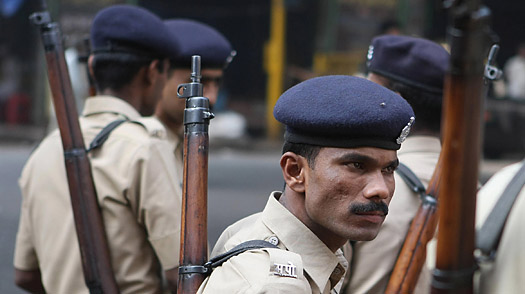
We recently posted on Ensaaf’s new report that studies the all too common practice of extra-judicial killings (usually referred to as ‘encounters’) and the mass cremations that followed by the Punjab police forces during the 1980s and 1990s. Well it looks like these practices were not limited to Punjab and these serious human rights violations are finally hitting the mainstream media.
This week, Time magazine writes about “Rights Groups Probe India’s Shoot-Out Cops“:
Scarcely a day passes in India by without news of an encounter between the police and criminals elements — “encounter” being the local jargon for shootouts involving the police, who are allowed to fire only in self-defense. On Wednesday, it was a “dreaded mafia don” who was gunned down by the Uttar Pradesh police — shot dead, and therefore unable to challenge the police account of the circumstances of the shooting. But some in India have begun to question the frequency of such “encounters”.
Satnam Singh Gurwara, a 16-year-old refugee from Afghanistan, is currently being held in a detention center in Manchester, UK after his application for asylum was denied. His mother, is begging officials to show “humanity” and release her teenage son from the detention center. The Home Office is understood to have rejected his claim for asylum amid questions over his claimed age of 16.
Satnam Singh Gurwara says he was just 12 when he was snatched on his way to a Sikh temple in his native Afghanistan. He says he was held for two days and needed 39 stitches in his leg when he was released. But his family continued to face threats – and they decided to sell everything they owned and flee the country in April 2007. They settled in Bolton, where Satnam became a student at the community college. [link]
The Refugee and Asylum Participatory Action Research Organisation (RAPAR) is calling for the Home Office to release Satnam immediately.
One Afghani woman has had enough. And her story has struck a chord with many Indian woman who are now supporting her struggle to hold accountable an Indian Army doctor who married and abandoned her in Kabul after three weeks of marriage. Major Pant eventually called her, after returning to India, to tell her he was already married and had two children.
Twenty-year-old Sabra Ahmadzai finished her final high school test in Afghanistan, took out a bank loan and then flew to India on the last day of November. She came to look for an Indian army doctor who she said had deceived, married and then abandoned her in Kabul, making her an object of shame and ridicule.
In India, Ahmadzai’s journey has become a rallying point for young women across college campuses who find in her a source of inspiration to question powerful hierarchies of traditional societies. The students in three universities in the capital are trying to set up a “Justice Committee for Sabra” by enlisting eminent lawyers, retired judges, professors and independent activists. [Washington Post] (emphasis added).
She had been pressured by her family and community to marry Major Pant who had been stationed in the medical hospital in Kabul. He was twice her age. Pant approached her family three times with marriage proposals. When her mother turned him away for not being Muslim, he returned with a priest who would convert him to Islam.
“I did not love him. He was my boss and twice my age. But the elders and the priest said, ‘We have given our word and cannot take it back,’ ” she recalled. “He had won their hearts by treating sick children of my relatives, too. They liked him. I followed their wishes obediently.” [Washington Post]
What’s striking are the layers of abuse that Ahmadzai is fighting against- from the marriage coerced by her community to a man twice her age, her battle to hold accountable an Indian army doctor for his lies and manipulation, to the stigma imposed on her as an abandoned bride. Ahmadzai has responded to the stigma by confronting the doctor who manipulated her. I’d be curious to know how she feels about the pressures from her own community, which journalists haven’t questioned her about. For now, Ahmadzai is at least confronting the Indian army doctor to regain, or perhaps gain for the first time, power and control over her own life.

