
185 Palestinians have been killed, thousands injured, and nearly 1,000 homes destroyed in the last week in Gaza by Israeli airstrikes (underwritten by American tax dollars). My last post about the dangers of Sikh alliances with pro-Israel groups has sparked some important and much needed discussion and debate in our community about this issue.
Many people I talk to (Sikh and non-Sikh alike) explain they feel like they do not know enough about the situation to take a stance or get involved. Or they feel overwhelmed about the complicated history of the conflict. If this sounds like you or anyone you know (or you just want a history refresher), check out this short video put out by Jewish Voice for Peace.Â
And if you don’t understand why this is a Sikh issue, see here, here, or here for more about that.

A rally in Brooklyn, NY in support of the BDS movement on Monday.
Monday evening in Brooklyn, about 50 people gathered to protest Israeli apartheid and encourage the boycott of Israeli goods, a part of the growing boycott, divestment, and sanctions (BDS) movement. Inspired by the effective use of boycott and divestment tactics in the struggle against South African apartheid decades ago, the BDS movement is growing with recent victories such as the Presbyterian Church (USA) and many colleges and universities deciding to stop investing in companies complicit in the oppression of the Palestinian people.
The mood of Monday’s rally was heavy. What was intended to be a celebration of the 10th anniversary of the BDS movement instead was a mourning of the many Palestinian lives taken in recent days by Israeli soldiers/bombs and civilians/settlers alike. Like Muhammad Abu Kheidr, a 16-year-old who was burned alive last week in what is widely assumed to be a revenge lynching by Israeli settlers after the bodies of three missing Israeli teens were discovered (blamed on Hamas without any evidence). Or Muhammad’s cousin Tareq, a 15-year-old Palestinian American who was badly beaten and detained for being at the wrong place at the wrong time (with the wrong ethnicity) a few days later. Or the 31 people in Gaza killed and countless others injured and displaced by 378 Israeli airstrikes in the last two days of its increasingly devastating “Operation Protective Edge.” Or the 10+ killed and over 360 kidnapped in Israel’s “Operation Brother’s Keeper” a few weeks ago in the West Bank, a form of collective punishment on the entire population after the  disappearance of three Israeli boys.
Guest blogged by Simran Jeet Singh
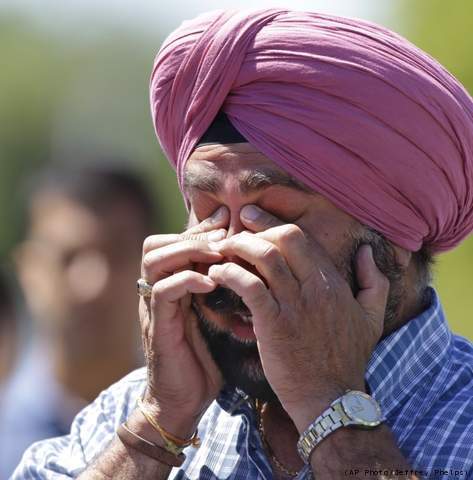
Last night, I received the kind of phone call that everyone dreads: a close friend was hurt, and on his way to the hospital. But the news got worse, as I learned that my friend, Dr. Prabhjot Singh, a young Sikh American professor at Columbia University, had been brutally attacked on a public street, the victim of a violent hate crime. My brother and I immediately jumped in a taxi and rushed to the hospital, where we finally saw Prabhjot being wheeled in, bloody and bruised, his face swollen from a fractured jaw. He couldn’t speak because many of his teeth had been displaced, but he waved limply to let us know that he was okay.
We joined Prabhjot in his hospital room and were surprised to find it already filled with officers from the NYPD and its Hate Crime Task Force. As he struggled to give his statement, we came to learn that his assailants had taunted him as they beat him, calling him “Osama” and “terrorist.” He described being punched in the face repeatedly until falling to the ground. And then he recalled how the punches to the head continued as he laid on the sidewalk.
I saw Prabhjot shudder as he realized how much worse it could have been. He had just returned from dinner, dropping his wife and one-year-old son at home before going for a walk. He reached from his hospital bed and grabbed his wife’s hand.
He recounted the scariest moment, seeing a young male put his arm inside his coat, as if reaching for a gun. He also remembered people pulling at his long beard. He couldn’t provide any descriptions about his assailants, and it seemed to me that in some way, he didn’t want to remember them.
Prabhjot has dedicated his life to serving the underserved. He is currently the Director of Systems Management at the Earth Institute, and he draws upon his experiences abroad to help improve the health of local communities like Harlem. In addition to serving as an Assistant Professor at Columbia University’s School of International and Public Affairs, he is also a resident physician at Mt. Sinai Hospital. His life’s work has been to help the underprivileged access quality and affordable healthcare, and he believes strongly that his countless hours of service are an investment in improving the health of impoverished communities.
Quebec is at it again. Just a few months after the Quebec Soccer Federation reversed its ban on turbans and other religious headwear on the field after a whole lot of public outcry, officials in Quebec have introduced a proposal to ban “conspicuous religious symbols” from public sector workplaces. These so-called symbols include the turbans, hijabs, and even yarmulkes.
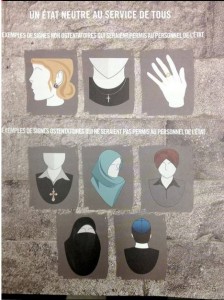
The proposed policy in Quebec would allow public service employees to wear the kinds of “symbols” on the top row but not the bottom five.
The proposal is drawing lots of criticism, including from federal government officials in Canada. Minister of Employment, Social Development and Multiculturalism Jason Kenney stated, “we are very concerned about any proposal that would discriminate unfairly against people based on their religion and based on their deepest convictions,” and promised to put any law that passes through constitutional review.
Ironically, two years ago, Kenney, not particularly concerned about people’s deepest spiritual convictions, announced a ban on burqas from citizenship ceremonies, citing women’s liberation as part of the justification. The new proposed policy in Quebec also includes a burqa ban:
The proposal also requires people receiving state services “to make their faces completely visible,” a measure aimed at banning the burqa, a traditional head-to-toe garment worn by some Muslim women.
Quebec premier Pauline Marois had told a Quebec newspaper that, for her, a day care teacher wearing a head scarf carries a “connotation of a certain gap between the respect of equality between men and women, of a sort of submission.” (link)
A recent BBC article titled, “Is there a Sikh code of silence on sexual grooming?” discusses how six men were jailed in the UK for offences including child prostitution – the case receiving significant attention since it was the first high-profile case involving a Sikh victim of sexual abuse leading to convictions.  As a follow up to the article, BBC’s Inside Out London showcased a 30 minute report uncovering the “hidden scandal of sexual grooming of young Sikh girls by Muslim men.”  The show is receiving much attention – particularly within the Sikh community – with much discussion around the tense issue, race relations and what’s being done (or not) to address the problem.
The documentary (which you can view below) showcases real cases where girls courageously discuss their experiences being “groomed” and forced into prostitution. Â Sexual abuse is a serious issue within many communities, the Punjabi community is no exception. Â Unfortunately, a lack of openness to talk about the issue often leaves victims and their families living in isolation. Â The report identifies the work of an organization within the UK called the Sikh Awareness Society that provides some assistance to these young girls and often bringing to light the criminal activity which local law enforcement agencies often neglect. Â The organization has committed to traveling to all the Gurdwaras in the UK to provide information about the issue and to help parents understand what their children may be experiencing. Â While it is unclear how large the issue really is or how long it has been occurring – it is nevertheless significant that this discussion is even taking place (especially in Gurdwaras!).
I found the report to be troubling for several more reasons.
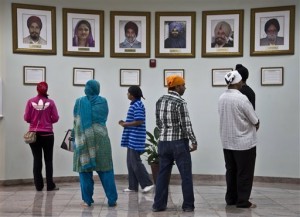 Last August, a gunman walked into a Gurdwara in Oak Creek, Wisconsin, leaving six dead and several injured. Â It was a day that is etched into the minds of Sikhs around the globe. Â While we would like to think that this tragedy is seen as an American tragedy, the mass shooting in Oak Creek did not receive the same media or government attention that other similar tragedies received. Â What many Americans don’t know is that the Oak Creek mass shooting was the most lethal attack on an American house of worship since the 1963 bombing of the 16th Street Baptist Church in Birmingham, Alabama.
Nevertheless, we push forward with our Sikh spirit intact. Â In light of this, communities across the nation are coming together to remember the victims and survivors of the Oak Creek mass shooting. Â Here is a list of various events taking place both locally in Oak Creek and nationally.
The Chardi Kala 6K Memorial Run & Walk will be taking place on Saturday August 3rd in Oak Creek, WI.  The event will be a community gathering honoring those we lost on August 5, 2012, as well as celebrating all that has been done to bring the community together.  More information can be found here.
The Oak Creek community will come together throughout the weekend in remembrance. Â The Akhand Paath will begin on Friday August 2nd and the Bhog will take place on Sunday August 5th. Â On Monday August 5th, there will be a candlelight vigil. Â More information can be found on the Gurdwara’s website.
Across the nation, communities are coming together for a day of service. Â Day of Seva projects will be occurring in New York City, Detroit, San Francisco, Modesto and Houston. Â Projects include feeding the homeless, park clean-ups and volunteering at the library. Â More information can be found here.
Other communities are gathering to write letters of support to the survivors and families of the victims. Â Information can be found here.
The Surat Fauj Running Club has organized a national run in solidarity against violence, taking place on Monday August 5th at 7pm. Â More information can be found here.
In San Antonio, community members will be participating in a solidarity Chardi Kala 6K Run/Walk, taking place on Saturday August 3rd. Â More information can be found here.
In Houston, community members have organized a Bring a Friend Day at their local gurdwara as a way of raising awareness. Â The event will be taking place on Sunday August 11th and more information can be found here.
In Canada, The Sikh Activist Network, Coalition of Sikh Organizations and One Panth have organized a run/walk/bike event which will take place on Monday August 5th in Brampton. Â More information can be found here.
*If we are missing any events, please leave them in the comments section.
Guest blogged by Simran Jeet Singh
As I strolled outside my Manhattan apartment this morning, reflecting on the Trayvon Martin decision, I had one of those moments that would shatter any possible artifice of living in a post-racial society.
I heard a woman cry in pain and turned around to see her lying on the street, clutching her bleeding knee. I rushed over and extended my hand to help her up. She looked up and her entire body recoiled the moment she saw that my face was adorned with a turban and beard. She shook her head and muttered “foreigners…” just loudly enough so that I could hear. I stepped away, understanding her reaction, and I turned to hold the traffic as she gathered herself.
I watched her limp to the sidewalk and was surprised when she looked back at me over her shoulder and mouthed the words “thank you.”
And I realize now that I should have thanked her. She reminded me that despite being a social construct, race is absolutely real in our world, and in the rules of this game, so many of us find ourselves to be the typecast. It’s a lesson we receive repeatedly throughout our lives, but it bears repeating for a reason.
To forget the rules of the game is to forget the reality in which we live. As Keyser Soze said in The Usual Suspects, “The greatest trick the devil ever pulled was convincing the world he didn’t exist.”
In 1984, as the Indian government was terrorizing Sikhs in northern India, mass campaigns of state-sponsored extermination were occurring in the Americas as well. The small Central American nation of Guatemala, under the rule of US-backed Efrain Rios Montt, was one such place. While Indira Gandhi’s army was attacking Darbar Sahib with an insatiable thirst for Sikh blood, Guatemala was in the midst of what is sometimes called a civil war. Another name for it might be the deliberate and targeted mass killing of indigenous and poor people. In both cases, though thousands of miles apart geographically and politically, campaigns of state-sponsored genocide were underway.
Yesterday, a Guatemalan court found Rios Montt, now 86 years old, guilty of genocide and crimes against humanity. He came to power in 1982 in a US-backed coup and oversaw “a scorched-earth policy in which troops massacred thousands of indigenous villagers. He entered the court on Friday to boos and cries of ‘Justicia!’ or justice. Prosecutors say Rios Montt turned a blind eye as soldiers used rape, torture and arson to try to rid Guatemala of leftist rebels during his 1982-1983 rule, the most violent period of a 1960-1996 civil war in which as many as 250,000 people.” (link)

Rios Montt awaiting the verdict in Guatemala. (source: New York Times)
The former dictator has been sentenced to 50 years in prison for genocide and 30 more from crimes against humanity. This is the first time in history that a head of state has been found guilty of committing genocide in his or her own country. The significance of this conviction cannot be overstated for the people of Guatemala as well as other parts of Latin America and the world where genocidal tyrants have never been held accountable for their atrocities.
What we’re not hearing much about in the US news coverage of this unprecedented trial is the US government’s role in Guatemala at the time (and earlier, beginning with the CIA coup against Arbenz in 1954, essentially for the benefit of the United Fruit Company). While there is much to celebrate in this conviction, key architects and underwriters of these policies of terror in Guatemala (and other parts of Latin America) have faced no consequences for their instrumental role in the genocide. Efrain Rios Montt was trained by the US Army at the school formerly known as the School of the Americas, infamous for training Latin American soldiers and leaders in the art of torture and repression. Rios Montt was close ally of the Reagan Administration, which considered his leadership style necessary in the so-called fight against communism. Revolutionary struggles were building in Nicaragua and El Salvador, and the Reagan Administration saw to it that they would be crushed as would anything or anyone that posed a real or perceived threat against multinationals corporations exploiting the continent’s rich natural resources. In practice, what this meant in Guatemala (and elsewhere) was if you are indigenous and/or poor, you must be a leftist and thus, you must be silenced, intimidated, and/or killed.
Sound familiar?
As you have probably heard by now, Boston is reeling in the aftermath of a few explosions near the Boston marathon this afternoon. Two people  have been killed and dozens injured and being treated at local hospitals. I’ve been texting, calling, and checking up on friends in the area all afternoon. We are all shook up and confused by what is happening, searching for answers or explanations for something so hard to comprehend (though something commonplace in other parts of the world like Pakistan, where 4 were killed by a US drone yesterday, and Iraq, where over 50 were killed in a bombing today). Very little is yet known about who did this and why, but of course, the mass media are already making lots of unsubstantiated claims, while accusations and assumptions are spreading quickly on Twitter and Facebook.
As something as horrifying as this afternoon in Boston is literally unfolding, as we are worrying about loved ones who may be affected, we already have to worry about the consequences of backlash violence. We have to worry about the sensationalism in the media. We have to worry about being attacked because of the color of skins, the turbans or hijabs on our heads, the beards on our faces. I pray that people in the United States and beyond have learned something in the last 11 and a half years. I pray that the collective response to today will be drastically different from the knee-jerk racism that pervaded the days, weeks, months, and years after 9/11/01.
But honestly, I’m not so sure how hopeful I am.
Last week, two separate brutal attacks against Muslim men took place in Queens, New York. On November 24th, 72-year-old Ali Akmal was nearly beaten to death while going on his early morning walk and remains in critical, but stable, condition.
CBS New York reports:
Akmal’s tongue was so badly swollen that he couldn’t talk for two days. When he finally could, he told police that when he first encountered the two men, they asked him, “are you Muslim or Hindu?”
He responded “I’m Muslim,” and that’s when they attacked.
The beating was so savage and personal, Akmal was even bitten on the nose.
Just a few days earlier, 57-year-old Bashir Ahmad was beaten and stabbed repeatedly as he entered a mosque in Flushing, Queens early in the morning on November 19th. The attacker yelled anti-Muslim slurs at him, threatened to kill him, and also bit him on the nose. Ahmad was hospitalized and received staples in his head and stitches in his leg.
These vicious attacks come just a few months after the white supremacist rampage that left six Sikhs dead in Oak Creek, Wisconsin in August, followed by a string of at least 10 separate anti-Muslim attacks around the country in the two weeks that followed. And just over a year after the elderly Sikh men Gurmej Atwal and Surinder Singh were shot and killed on their evening walk in Elk Grove, California.
Needless to say, I was horrified last week when I heard about the attack on Ahmad and am even more horrified today after learning about Akmal, 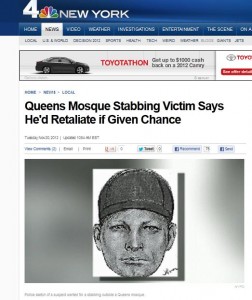 a grandfather, nearly being killed in this act of violent hatred a few days later. The trauma of the Oak Creek shooting is still fresh for us Sikhs in, and there is little doubt that these recent attacks on Muslim men in Queens are rooted in the same type of bigotry that has so often made Sikhs targets since 9/11. As I’ve said before, our struggles are deeply connected.
The way I heard about the attack on Ahmad last week, though, was almost as troubling as the attack itself. I read this headline on NBC New York’s website: “Queens Mosque Stabbing Victim Says He’d Retaliate if Given Chance.”
Guest blogged by Simran Jeet Singh
This past week, I visited a liberal arts college in Pennsylvania to introduce undergraduate students to the Sikh experience in America. I was pleasantly surprised to see that the professor had assigned Naunihal Singh’s piece from the New Yorker – “An American Tragedy” – one of the most insightful and well-written pieces published in the immediate aftermath of Oak Creek.
The professor had asked the students to submit short reflections on the shooting, and in reviewing their essays, I was struck by the consistent refrain that we have heard all too often: “If Wade Michael Page had only known that he was attacking Sikhs instead of Muslims…”
In other forums, I have discussed some problems with the framework of “mistaken identity,” including the implication of a “correct identity” to be targeted, the displacement of accountability, and the freezing of hate-violence within particular moments of time.
While I still stand by these arguments, I think there is a much more fundamental problem in our application of this idea to the shooting at the gurdwara in Oak Creek. We do not yet know Page’s specific intentions, yet we continue to assume that he actually intended to attack Muslims. For some reason, we have not seriously entertained the possibility that Page entered the gurdwara fully intending to kill Sikhs.
Guest blogged by Parvinder Mehta
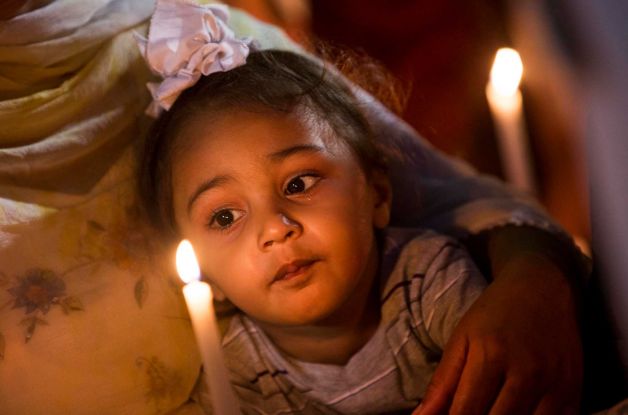 Amidst the barrage and frenzy of shock and surprise and the discussions about why the Sikh community has been targeted and victimized through history, I wonder how Sikh parents have tried to make sense of the massacre of six Sikhs and the suicide of the gunman who came with his hateful agenda to the Gurdwara in Wisconsin earlier this month. “How can one human kill another human being on purpose?” I am always haunted by this question. As a parent, I shudder at the thought of violence creeping up in our lives. It is tough explaining to your children why some people commit heinous crimes against innocent people and why some people do not like Sikhs or may have never known about Sikhs. Or explaining why a Michigan Gurdwara was vandalized last year and how ignorance can be a dangerous premise.
I knew I must tackle the endless questions that they would ask about why someone committed this heinous act. I knew I must not use any rhetoric of hate or fear when talking to my children, the same way as my parents had taught me. Terms like prejudice, bias, racism, and ignorance are part of my children’s vocabulary much sooner than I had hoped. As a teacher and a parent, as a proud and practicing Sikh, I have always shared the anecdotes from Sikh history with my children where courage, not fear, is the driving lesson. The crucial question that we, as Sikh American parents, are faced is how we reassure our children that such hate-driven incidents will never recur. What can we do as Sikh parents to promise our children a hate-free environment so they can assert their Sikh identities without fear?
 Over the past 12 hours #templeshooting has been covering the twittersphere. It is a reference to the tragedy that occurred early this morning in Oak Creek, Wisconsin, where a gunman entered a Gurdwara during Sunday divan and killed six sangat members, wounding many more. Sikhs around the country reacted almost immediately to this event – posting updates on Facebook and Twitter, speaking to news outlets, filling in gaps of misinfomation, supporting Sikh organizations who have been working diligently with local officials and government agencies and community members who started up a fund for the families of the victims. While this has been an incredibly traumatic experience for the Sikh American community, we are inspired by the actions of the police officer who came to the aid of the sangat members – potentially preventing a larger massacre. We are comforted by the support of our friends and colleagues who have reached out to the Sikh community offering their solidarity.
Here we have started a running list of articles, resources and community gatherings. We hope this will be a way for you to learn about the events and about ways for you to stay engaged.

(photo: Shergill Law Firm)
You may recall the murders of Elk Grove, California residents Surinder Singh and Gurmej Atwal, two senior citizens and turban-wearing Sikhs who, while on their daily walk, were shot down in a drive-by last year. Despite last October’s Day of Action by the community to spread awareness of the murder and to help get some new leads, to date the killer(s) have not been identified and no motive has been established. However, the murders of these Sikh grandfathers are suspected to be a hate crime.
The Elk Grove, California Police Department provided an update yesterday in their search for the killer(s) of Sikh seniors Surinder Singh and Gurmej Atwal, who were shot and killed last year while on their daily walk. Based on witness accounts, the police have now have a confirmed description of the suspect’s vehicle:
At a press conference this afternoon, police officials said the suspect drove a lifted full-size pick-up truck, tan or gold in color, with a standard-size cab, similar to the one pictured at left. They do not have details on the make or model year of the truck.
Initially, police had been searching for a pick up truck, but have now been able to provide a little more detail about the vehicle. The investigation is still ongoing and the police are seeking more information, with a reward offered of $57,000. The Elk Grove Police Department can be reached at (916) 714-5115. If you live in northern California, spread the word about the suspect’s vehicle. Someone out there knows something that will help solve this crime.
 It’s sobering (and depressing) to hear about another hate attack in the United States fueled by Islamophobia, this one in the form of racist graffiti on a gurdwara under construction in Sterling Heights, Michigan. SALDEF‘s recent statement about the incident states:
…the vandalism happened between the evening of Feb 5th and the morning of February 6, 2012. The graffiti included vulgar language, racial epithets, the use of what appears to be a cross, a large drawing of a gun, and references to the attacks of September 11th.
SALDEF is urging law enforcement to classify the vandalism as a hate crime and prosecute the perpetrators, who have yet to be identified. Anyone with information about the attack are being encouraged to contact the local police department directly.
As you can see in the photo, the graffiti states “Don’t build,” and makes reference to the Prophet Muhamm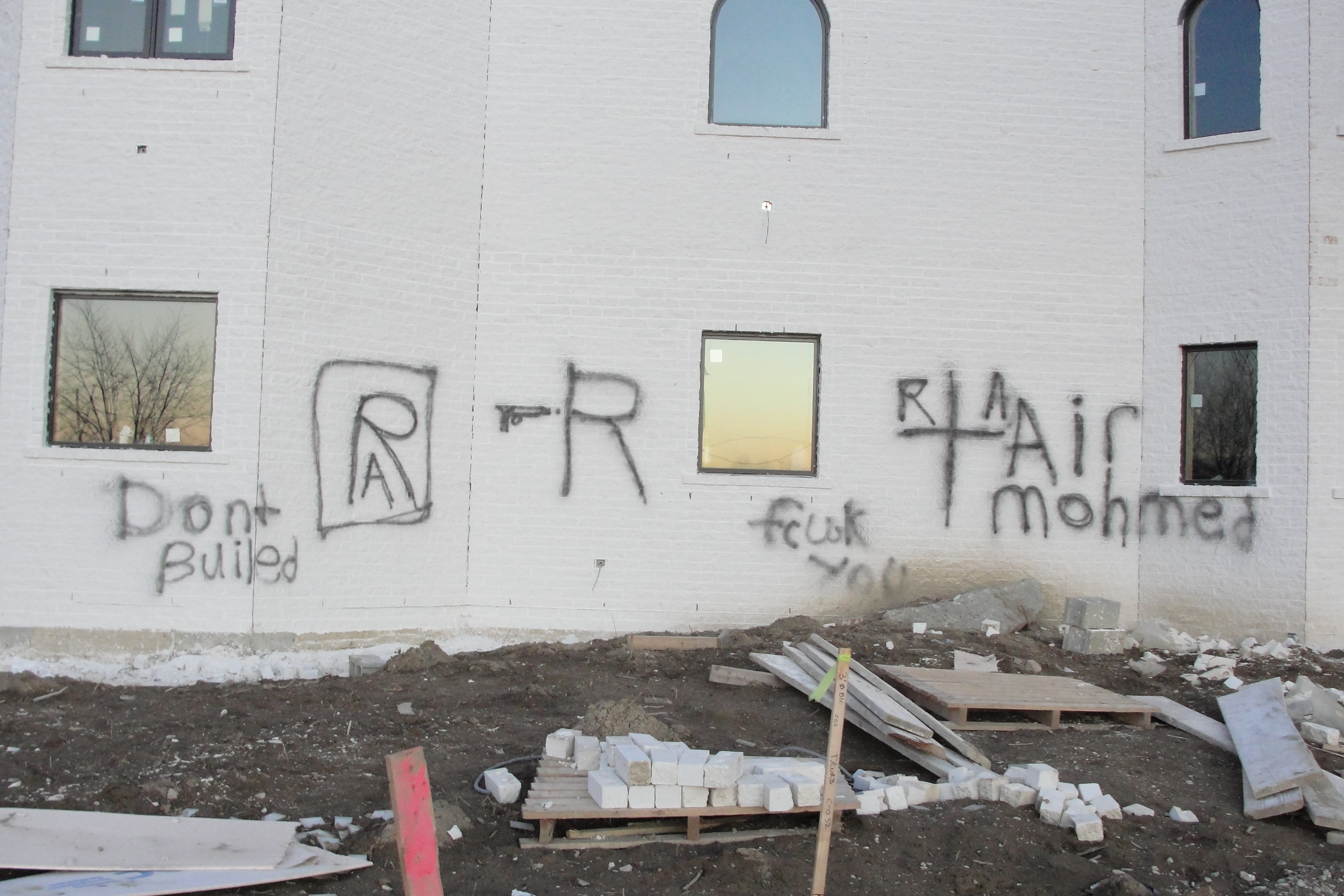 ad. While the spelling and grammar are poor, it seems safe to assume the perpetrator was fueled by Islamophobia of some sort.
We talk a lot about anti-Muslim bigotry here at The Langar Hall (as Jodha did on Monday), and it’s been at times disturbing to see comments on our posts reflecting the anti-Muslim sentiment in our community. Some who consistently make it a point to distance themselves from Muslims in every way and in every situation might struggle with this stark reality: the well-being, safety, and dignity of our community here in the US (and many other parts of the diaspora) is intimately connected to that of the Muslim community.
UPDATED ON 9/22/11 at 11:00am (after the fold)
On Wednesday, September 21st at 7pm, the state of Georgia plans to end the life of Troy Davis. Davis’s only hope at this  point may be if prison staff refuse to carry out the execution, if they courageously stand up for what is right, rather than blindly follow orders. He has stated many times, “They can take my body but not my spirit, because I have given my spirit to God.”
No, Troy Davis is not a Sikh nor does he or his case have any direct connection to the Sikh community. But I am writing this tonight, after his final attempt for clemency denied by the state, to ask you to keep Troy Davis in your thoughts and prayers and to take action in whatever way you see fit. You can immediately sign this petition, you can call or email Judge Penny Freesemann at 912-652-7252/pfreesemann@chathamcounty.org and urge the halt of the execution, you can attend a local rally, you can include Troy in your ardas.
Why?
Because since Davis’s conviction for the murder of a police officer in 1989, seven of the nine witnesses that testified against him have recanted their testimonies.
Because no murder weapon was ever found, and no DNA evidence exists connecting Davis to the crime.
Because some witnesses say another man committed the crime, a witness who testified against Davis.
Because many witnesses have stated in sworn affidavits that they were pressured or coerced by police into testifying against Troy Davis.
Because Troy Davis is a 42-year-old man who should have many more years to live on this planet.
Because as Sikhs, it is our duty to stand up for what is right. The planned execution of Davis is a tragic symptom of a broken and inhumane criminal justice system (which I’ve discussed before here and here). This is a Sikh issue. Indeed, Harinder Singh of the Sikh Research institute states,
As a Sikh, I must fight for criminal justice reforms, as the founders of my faith set the precedent when confronting the Mughal dynasty in South Asia. Guru Nanak confronted Emperor Babar over mass incarcerations, and Guru Hargobind championed prisoner’s rights by challenging Emperor Jahangir; both Gurus, founders of Sikhi, were imprisoned for doing so.
What are we willing to do for Troy Davis and the Troy Davises of the world?
It’s a matter of life and death.

NYC Sikhs speak out against the Transit Authority's religious discrimination in 2009
This morning, the New York City Council voted unanimously to pass the Workplace Religious Freedom Act (Int. 632-A), a bill that will strengthen the city’s human rights law that protects employees from religious discrimination at their jobs.
According to the City Council,
This law will provide greater protection to workers by strengthening the law that requires employers to provide employees with reasonable accommodations for religious observance.
Employers that are found to have engaged in unlawful discriminatory practices against its workers may be liable for a civil penalty of as much as $125,000 and/or be required to pay compensatory damages, award back pay, reinstate employees and extend full and equal accommodations to employees.
The law is of particular significance to turban-wearing Sikhs and hijab-wearing Muslims who have faced a great deal of discrimination in their workplaces in NYC, particularly since 9/11. Advocates including the Sikh Coalition (who played a lead role in pushing for the legislation) hope that the law will make it much harder for employers in both the public and private sectors to discriminate against potential or current Sikh employees. Notably, the New York Police Department still does not allow turban-wearing Sikhs to serve as officers. (There was a case years back involving a Sikh traffic cop, however, who ended up winning and serves with his turban).
We have many songs that remind us of Shaheeds; we acknowledge them in our Ardas; and they are an integral part of our Sikh history. It is a powerful experience to hear how an integral concept in Sikhi manifests in other communities. Specifically the Muslim community, which also adheres to a concept of Shaheedi.
Often times in the media, the concept of Shaheedi has been presented as a form of “brainwashing” done by religious and political leaders to condone terrorism and violence for their own self-interests. However, a recent NPR report highlights how two devote Muslim men from America became Shaheeds out of their own strong will to bring justice back to their home country of Libya.
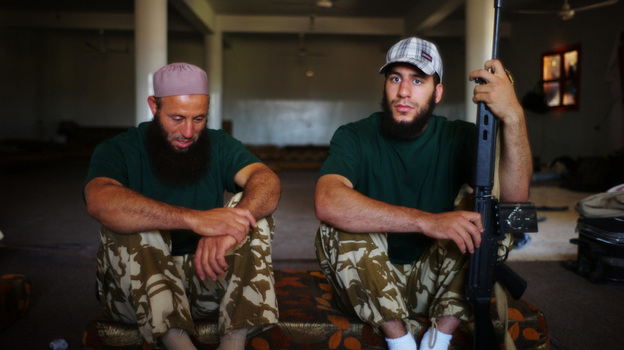
Mabruk Eshnuk (left) and his son Malik (right) left their home in Pittsburgh to volunteer and fight with rebels in western Libya's Nafusa Mountains.
A father and son left their home in Pittsburgh, Pennsylvania (USA) to participate in the Libyan revolution. Mabruk Eshnuk and his 21-year old middle son, Malik Eshnuk, died fighting the forces loyal to Moammar Gadhafi in western Libya.
Mabruk, a devoute Muslim had immigrated from Libya as a teenager. He taught Islam to convicts in the Pennsylvania state penitentiary system. In 2006, he housed the family of a young Iraqi boy who was getting lifesaving treatment in the United States. He said, “Everything that we do and work and help, it’s based on the Quran.” Outraged over what was happening in Libya, he took his middle son to fight in the Western mountains of Libya.
Guest blogged by Naujawani Sardar
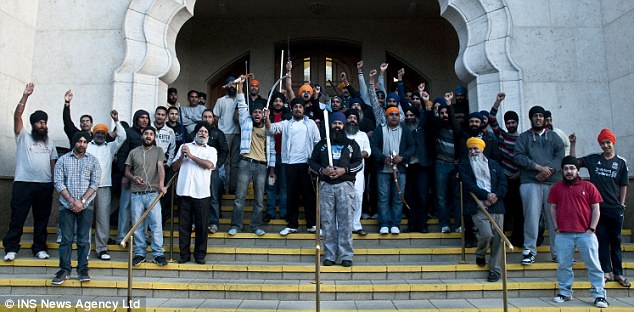 Riots have hit London and a few other cities in the UK over the last three nights causing mayhem, destroying property and leading to looting. Tonight, hundreds of Sikhs are gathering to defend the Gurdware in these cities should they fall under the eye of the looters. It is bringing together Sikhs of all backgrounds and affiliations; promising a glimmer of hope from an otherwise horrible situation.
To find out more about this mobilisation of Sikhs, go to the Sikh Riot Awareness UK page.

The trigger has been widely recognised as the shooting of a 29 year old black man Mark Duggan in the Tottenham area of North London. 48 hours after his shooting, members of his family, friends and the wider community congregated outside Tottenham Police Station to protest at what they saw as the heavy-handed action of the London Metropolitan Police and the unhelpful communication from them about the matter in the following days. At this gathering of about some 300 protestors, a relatively minor confrontation between a teenager and the Police is said to have ignited running battles that ensued well into the night. A double decker bus was set alight and 49 fires were being dealt with by morning. But more importantly, as a sign of things to come, shops selling household goods, sportswear, toiletries and glasses were looted with CCTV images capturing hooded individuals taking away trollies laden with items.
I just got an email from the Working Families Party (a progressive political party in NYC) about the latest developments in mega-corporation Walmart’s latest attempts to set up shop in NYC. One of the biggest real estate development companies in the city called Related is reportedly in discussions with Walmart about building its first NYC store in the Brooklyn neighborhood of East New York. The below video put together by ALIGN, the Alliance for a Greater New York, features a Sikh business owner, Iqbal Chhabra.

This video warmed my heart for several reasons. It goes without saying that I live in Brooklyn and am concerned with all things Brooklyn. Brooklyn is not exactly known for its large Sikh population. I see the occasional Sikh construction worker or shop owner, but I don’t know of too many other Brooklynwale Singhs or Kaurs. So I was pleasantly surprised to see Mr. Chhabra speaking out about an important Brooklyn-based issue in this video.

