BREAKING NEWS: The Sikh Art and Film Foundation has responded by including a female speaker in next week’s Leadership Summit!!! Great progress. Â Yet, the lack of representation of women and girls from 2004 – 2012 in the film festivals and galas still needs to be addressed, and this is a community wide issue. Â See below for actionable solutions.
Via Email:
November 15, 2013 7:43PM Nina Chanpreet Kaur,
Dear Sikh Art and Film Foundation,
I am very glad to see that Rashmy Chatterjee will be speaking at next Friday’s Leadership Summit.  This is a tremendous gain for our community as most of the speakers at the summit have been men since 2011.  This represents a trend in many Sikh organizations I hope we can change together. As a Sikh woman and resident of NYC for the last 11 years, I have followed your organization since it’s inception.  Over the years, I have attended many of your events and have been so inspired by the films, speakers and attendees.  I have also noticed the lack of representation of women and girls in your programs.  Though you took a step forward this week, I believe you could be doing more to address, highlight and celebrate the challenges and triumphs of Sikh women and girls whether in your Film Festival, Heritage Gala or Leadership Summit.
I understand that your goal is to transcend the dichotomies and binaries of gender and other categories to sustain the universality and equality that our Gurus envisioned in order to promote and preserve Sikh and Punjabi heritage. Â I share your vision and do not condone a gender binary or bias towards either men or women. Â I am also aware that you face limitations as all organizations do, in particular that you must base the selections of films on the submissions you receive. Â However, Sikh men and boys have been a central part of your programs in a way Sikh women and girls have not and this indicates a bias – whether intentional or not.
From 2007 to 2012, none of your Gala awards for Leadership and Vision have been presented to Sikh women. Â In fact, the only women who received awards were for Creativity/Art with the exception of Shonali Bose who received an award for Courage and Shelley Rubin who received an award for Leadership jointly with her husband. Â For 5 years in a row you have only presented Sikh women with awards for Creativity/Art and no other category. Â As a Sikh woman, this sends a message to me and the next generation of Kaurs that women can be honored for creativity and art but not for leadership and vision. Â It raises questions about your beliefs and assumptions related to gender roles and women’s capacities in relation to men. Â This is most certainly not the message young Kaurs should be receiving, nor do I think this is your intention based on the email I received from Ravi last week. Â Â Â Â (more…)
Guest blogged by Simran Jeet Singh
 Last week, people around the world watched a Sikh with a turban and beard – Gurpreet Singh Sarin – charm the judges on the iconic television show, American Idol. The show’s judges and producers played up his nickname, the Turbanator, and almost immediately, #Turbanator began trending nationwide on Twitter. As is often the case, however, the ugly face of bigotry reared its ugly head and reminded us all of the problems faced by Sikhs around the country. Countless Americans equated the contestant’s turban and beard with terrorism, and #Osama also began trending across the country.
Gurpreet has little control over how the producers of American Idol choose to project his image. Yet he has done an incredible job of working within the system to create positive change, and his breakthrough performance is something from which we will all benefit for years to come. More importantly, we as a community cannot learn how to build our image in greater America if we do not see Sikhs experiment within mainstream media and learn from those experiences. Certainly there were moments on the show that could have been improved, and while it is important to recognize and build upon these for the future, it is also important for us to take this moment to enjoy this unprecedented moment in our community’s history.
(Disclaimer: I’ve never watched American Idol before. It’s true.)
Most of you are probably already well aware that a young Sikh named Gurpreet Singh Sarin appeared on American Idol last night and made it through the first hurdle. In case you missed it, here is the clip from his audition in front of the judges.
Like most of you, I’ve been barraged with posts on Facebook and Twitter about Gurpreet’s success on the show last night, mostly expressing excitement and support for the self-proclaimed “Turbanator.” The vibe I’m getting from all the posts I’m seeing from Sikhs is that this big moment for Gurpreet is a big moment for the Sikh community in the US, perhaps an opportunity for some positive representation in popular culture. The Sikh Coalition and SALDEF have tweeted congratulations to Gurpreet as well, and the overall sentiment appears celebratory.
I share some of this excitement, or at least fascination, but the whole thing is also making me cringe a bit. I don’t want to unnecessarily rain on this parade because I do think it is an interesting moment and opportunity. I also think Gurpreet is a solid singer and did a great job at handling what must have been an uncomfortable situation on many levels.
 The use of social video sites by our community has seen an upward trend. Of course, many readers of this blog will instantly recognize individuals that have emerged in the last two to three years using YouTube and other social media sites – Mandeep Sethi, Humble the Poet, JusReign, and IISuperwomanII are but a few of the commonly recognized names from North America alone.
As it becomes more accessible, we are also seeing the emergence of more grassroots-level use of social video. This medium has allowed Sikhs, and particularly Sikh youth, to express themselves to an unprecedented audience size, and there are several organizations encouraging Sikhs to make use of this platform. For example, SikhNet has been running their Youth Online Film Festival since 2006, and the Sikh Coalition is also holding their third annual Diversity Video Competition for its third consecutive year.
Recently, Manbeena Kaur, the Sikh Coalition’s Education Director, was good enough to answer some questions about the use of social video for the purposes of Sikh education and awareness.
Needless to say, it’s been a tough week. I have been grateful for all the thoughtful writing my Sikh brothers and sisters have been putting out through the mainstream and independent media and all the important conversations that have been happening here at TLH and beyond.
That being said, sometimes it’s nice to take a few minutes away from the intense discussion and laugh a little. As Naunihal Singh noted in his recent (fantastic) column in the New Yorker, neither John Stewart nor Steven Colbert have made any mention of Oak Creek at all since the tragedy. Fortunately, there is a new, edgy late night talk show on FX called Totally Biased, hosted by comedian W. Kamau Bell and produced by Chris Rock, that did go there. And in a respectful way. No surprise, given that fellow desi Brooklynite Hari Kondabolu (who has a master’s degree in human rights from the London School of Economics) is a writer for the show. In this clip, Bell exposes the absurdity of some of the discussions in the mass media (and by politicians) about Oak Creek and the Sikh community. Hope you enjoy it. And I look forward to what Totally Biased has in store moving forward. (Also check out this clip from the same show about the NYPD’s stop & frisk policy).

Sikh comedians like Jus Reign have been gaining popularity through YouTube and social media sites for the last several years. I love being at gatherings of extended family when my little cousins show me the latest viral video, which often is hilarious. Even when it’s not, I find myself wondering what it would have been like to grow up as a Sikh in the diaspora in times like these. While we are still by and large not represented at all in the mainstream media, young Sikhs now create our own media, and many do so with much success. Sometimes the videos are brilliant, and perhaps sometimes they get hits simply because Sikhs in the diaspora, especially young Sikhs, are thirsty for the latest quirky, bizarre, or silly video put out by other Sikhs.
To end this hot and humid summer week in NYC, I thought I’d share this video that has been circulating lately, a trailer for what appears to be a series called “Sikhs in the City,” brought to us by Laughistan. There are some familiar faces in there including Sikh Coalition co-founder Amardeep Singh. I’m eager to see what their series will bring us in the future. Enjoy!
By now, you have surely been inundated with Facebook posts and discussions expressing excitement, amazement, or maybe skepticism about French designer Jean Paul Gaultier’s recent showcase of (non-Sikh) models wearing colorful “Sikh-style” turbans.
Gaultier has a thing for India, it seems. According to a recent news article, “The designer is known to visit the country quite often and owns a vast library of intensely coloured textile swatches here since his first visit to Kolkata in West Bengal and Puri in Orissa, in the 1970s.” In a recent interview, Gaultier said, “In every collection I have done, there is always an Indian inspiration.”

Over the last couple of weeks, I’ve been fascinated by the buzz about the turbaned models in Sikh circles and have been trying to figure out exactly how I feel about it and if I have anything useful to contribute to the conversation. I can’t promise this will be useful, but here are some thoughts and questions that have been swirling around in my head lately.
We Sikh men are not used to being seen as attractive or desirable through the lens of mass media. In Bollywood we are buffoons, in Hollywood we are nonexistent, save the English Patient and the occasional shoutout Waris Ahluwalia gets in the press. So yes, there is something amazing about seeing these models rocking turbans like they are the hottest accessories imaginable, when we, for so long, have received little to no positive reinforcement from the mainstream.
Chances are you’ve probably heard about Tonight Show host Jay Leno’s joke last week that has angered a lot of Sikhs in the US and around the world. In the segment, the voiceover stated, “Here’s a look at Mitt Romney’s summer home on Lake Winnipesaukee,” as a photo of Darbar Sahib was shown.

The New York group Sikhs for Justice has gone so far as to file a complaint with the Federal Communications Commission (FCC) and a California based Sikh doctor has filed a lawsuit for libel against Leno and NBC in the superior court of California. A petition to NBC is also circulating, which has over 4,000 signatures so far. The petition, in part, states:
…the sentiments of Sikhs worldwide are off limits to his monologues and cannot be used further his TV ratings. The Right to Speech under the First Amendment to the United States Constitution excludes defamation and spreading hate, incitement and false advertising.
It’s that time of year again!
For those Southern California natives, you (hopefully) know it rolls around once every year. This year, SikhLens is proud to announce its annual Sikh Arts and Film Festival to be held November 18th – 20th, 2011 at the prestigious Dodge College of Film and Media Arts at Chapman University in Orange, California. As avid supporters of Sikh Arts, and creativity in general, I am hoping our readers would be especially interested in this event coming up in the next couple of weeks.

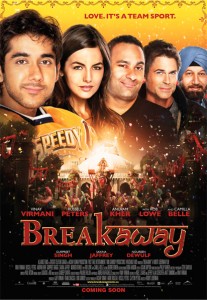 The Sikh Arts and Film Festival serves as a central venue for artists to showcase and share Sikh heritage and culturethrough the mediums of film, literature, art, music, social media and fashion. As an often-misidentified minority, this type of forum has proven to be essential for Sikhs to transcend cultural boundaries, generate awareness, and connect with the broader community.
For tickets, scheduling and more information, visit www.sikhlens.com.
Co-blogged by Sundari and Ajaib Kaur
How many young Sikh women do you know who are looking to meet their Sardar? And how many young Sikh men do you know who are looking to meet their Sardarni?
Lots? We hear you. But how can we make these two groups meet?
We decided to write a post on this topic for many different reasons. It’s clear that there is little space elsewhere to talk about how young Sikhs can meet each other, with the potential of pursuing something beyond a friendship.
Gasp! Are we actually admitting this? After a few dialogues with friends and families, we decided that we may as well start breaking the ice here on the West Coast. Over the last few years, SikhNet has been hosting “Gursikh Speed Meetings”, in cities such as New York, Boston, and Toronto. It is nice to see that the organizers has decided to bring this successful event to the West Coast, in our beloved City of Angels. These events give young, single Sikhs between the ages of 25-40 a chance to meet fellow single-and-ready-to-mingle like minded Sikhs in a communal safe space. This concept may feel familiar, because it is. The ‘speed meeting’ is a popular spin-off of an American cultured speed-dating event; having an even number of men and women participants, and rotating through getting a brief chance to connect with everyone in the room. It seems like a lot of work, but based on our feedback from some past participants, it is fairly enjoyable. The best part: if you do not click with someone mutually, you do not need to face them again. Contact information is only shared if both parties have expressed interest in each other. Fool proof for both ladies and gents!
Sit down with my cousins in Punjab for more than a few minutes and in-between their reckless driving and ear-pumping tracks of Jazzy B and Gippy Grewal, they will often give their commentary about how Punjabi music is now trash and doesn’t represent the “true” culture. Ask if they enjoy the folk music of Sharif Idu and they’ll ask, “Who?” Push them further and they’ll blame artists like Jasbir Jassi and other hucksters of cheap lyrics and videos. Here comes Amrit Bains of Canada (this video is also EPIC, check out the background dancers!) with a very different thesis, but one that may resonate with a previous conversation we’ve had here in The Langar Hall. It is the music industry’s fault.

Well, enjoy the video, especially the AMAZING background dancers. Sorry for the language, hope it brings a smile, and have a happy Friday!
UPDATE: Amrit Bains, a long-time bus driver, seems to be following his dreams. Here is a great interview that gives some background of this singer.

As mentioned last month, New York City-based Vishavjit Singh released his first “Sikhtoons” book this Spring. Entitled My Headcovering is Downright Sikh: An Illustrated Intro to Turbans, the book “uses a collection of cartoons from Sikhtoons.com to create a visual narrative to dispel the mysteries of the Sikh turban. Featuring Fauja Singh, Waris Ahluwalia and many other Sikhs from all walks of life this visual journey is a turbanful introduction to Sikhs.”
The book features 30 cartoons and can be ordered online in the US, Canada, and UK for $10.
Though I have not seen the book myself yet, it has the endorsement of Sikh scholar IJ Singh, who states:
Vishavjit Singh’s topic is serious, his touch light, but not comedic. The sense of the absurd is critically important to the cartoonist. That, too, will emerge, I am sure, for I see their seeds in his work. I believe that the lightest matters deserve a serious undertone and the most heavyweight issues need some levity, even comedic treatment sometimes, lest the burden becomes too heavy to carry.
Congratulations to Vishavjit on this accomplishment. As misconceptions and stereotypes about Sikhs continue to persist in the mainstream media and general public, I hope Vishavjit’s creative cartoon interventions reach a much wider audience through this book.

Happy 100th Birthday Fauja Singh!
New York City-based Vishavjit Singh, the creator of Sikhtoons, is releasing his very first Sikhtoons illustrated book next weekend at the Museum of Comic and Cartoon Art Festival in NYC. We’ve blogged about Vishavjit and Sikhtoons many times before, and are glad to see Sikhtoons going to the next level in book format.
According to Vishavjit, “The book focuses on dispelling the mysteries of the Sikh dastaar…target[ing] young and old, Sikh and Non-Sikh. The book features Fauja Singh, Hip Hop Singhs, Waris Ahluwalia and much more.”
Sikhtoons has long been a creative and light-hearted medium to tackle important issues for our community from 1984 to Hindutva, bullying in schools to contemporary Punjab politics. The details on the release event are below, and you can buy tickets in advance here and RSVP on Facebook here. Hopefully the book will be available to order online in the future. We’ll keep you posted.
Museum of Comic and Cartoon Art Festival
MoCCA Fest 2011!
Saturday April 9th and Sunday April 10th 11am-6pm
At the Lexington Avenue Armory
68 Lexington Ave (Between 25th &26th Streets)
New York, NY 10010
This post by our Mehmaan is none other than Harinder Singh. About Harinder Singh – he works with the Sikh Research Institute and the Panjab Digital Library to address all things Sikhi and Panjabi. http://twitter.com/1force
I have taken some time off to be Mr. Mom while my wife is on a work assignment in India. In preparing to make the move to Bangalore, I was excited about being in the land of MS Subbulakhsmi (renowned Carnatic vocalist) and Kalmane (locally grown 100% Arabica beans) coffee. Being here for about three weeks, this is what I have discovered: people are nicer than the North, infrastructure is horrible, and there is not much to see in the city. Even Frommers.com couldn’t come up a list of not-to-be-missed attractions in Bangalore, though people in India claim it to be a great city. I guess the new IT opulence has brought in pubs and gigs only (it is common for Indians to end almost every sentence with ‘only’).
Yesterday, I picked up my son Jodha Singh from the pre-school he is enrolled in here. His teacher said, he wouldn’t play Holi (“Festival of Colors”—though bastardized; some “celebrants” today throw sewerage on people as well!). Now, the legend of Holika is vanishing and so too the spirit of post harvesting thanksgiving prayer to the Almighty. Apparently, Jodha was upset when other children were throwing water and colors on him. I told Miss Priya that his aversion may have come because he has not partaken in this festival as the Sikhs of Panjab have a little reason to celebrate. She wasn’t sure how to respond; do most Panjabis and Sikhs know how to “play Holi?”
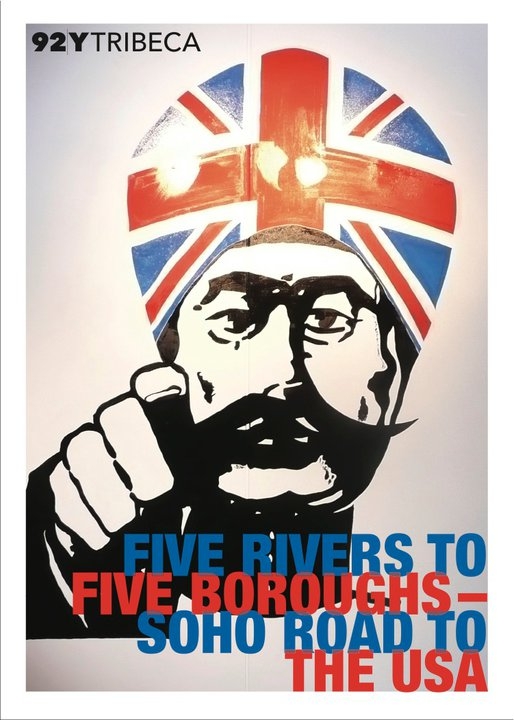 An exhibition showcasing British Bhangra music and Culture, titled ‘Soho Road to the Punjab’, will be crossing the pond from the UK to New York City on March 18th 2011 at 6pm. The USA version of the exhibition, Soho Road – Five Rivers to Five Boroughs, will be the world’s first visual arts exhibition inspired by Bhangra music and culture held outside of the UK. The event is being hosted by 92YTribeca and is free to the public.
Originally debuting in Birmingham, UK, Soho Road to the Punjab is an exhibition that includes photography, album sleeves, promotional art and rare prints from South Asian media. This contemporary archive uncovers the worldwide Bhangra phenomenon, showcasing individuals who have championed the UK and USA Bhangra scene.
“Soho Road – from the Five Rivers to the Five Boroughs” is a gift of a title. The Punjab is, of course, the Land of the Five Rivers, while New York iconically comprises Brooklyn, Queens, Manhattan, Staten Island and the Bronx. This is a symmetry just too much too leave alone – it’s a sign! Queens is the largest and the most diverse, and famous as the birthplace of bebop and jazz. Queens also has the largest Sikh population outside California and the highest concentration of Indians anywhere in America. Punjabi is in the top ten of the hundred-odd languages spoken locally, and almost half of all South Asians who live in New York live in Queens. The NY experience will shape the show for the USA. [link]
The event will be held at 92YTribeca, 200 Hudson Street, New York. For more information and to view the exhibition online, see the Facebook page.
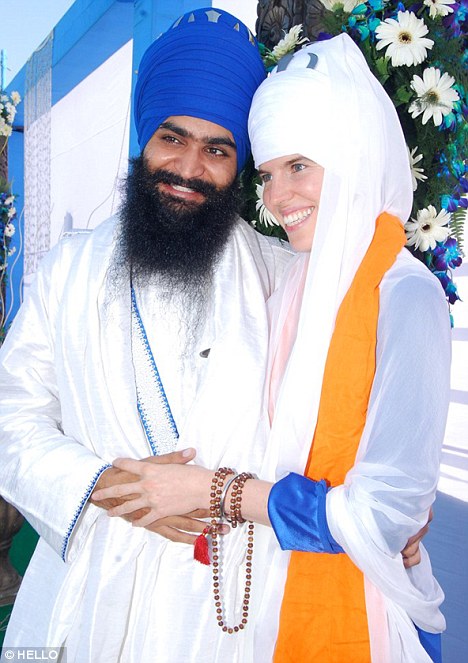 So it is my mother use to tell me. This particular marriage, however, seems to have been made at Darbar Sahib (as close to heaven, as I’ll ever get!). UK’s tabloid press has reported on the wedding of Harvinder Kaur Khalsa (formerly Alexandra Aitken, daughter of disgraced Torty politician Jonathon Aitken) and Inderjot Singh. The picture speaks a thousand words.
Just as interesting has been her interest in Sikhi. Below the fold, you’ll find some of her thoughts/observations about her transformation, well worth a read!
Frankly, if someone had told me ten years ago, when I was living the party girl lifestyle in London, that a decade later I’d be a teetotal vegan, I simply wouldn’t have believed them.
If they’d gone on to tell me that I’d also have converted to Sikhism, changed my name to Harvinder Kaur Khalsa and be married to an Indian warrior whom I fell in love with before we even exchanged a single word, I’d have laughed my head off.
After all, I was positively allergic to organised religion. It just seemed so grey to me. But then I don’t really think of Sikhism as a religion, more a path for anyone who is looking for something more spiritual.
Though Sikhs have settled all around the world, roughly 20 million Sikhs still reside in Punjab. There, and elsewhere, Sikhs are facing serious problems including, but not limited to: farmer suicide, female infanticide, drugs and alcohol abuse, domestic violence, economic disasters, disease, poverty, illiteracy, and much more. [Lahir Press Release]
Many of my most recent posts have been about upcoming events happening in the Sikh Community. I think this is a positive sign – that rather than idly discussing and debating issues that inflict our panth, we are actually doing something about it! I would like to highlight two upcoming events occurring in North America. These platforms will bring together talented youth to raise awareness and by doing so, will aim to address important issues within our community. Please support these endeavors so that we can continue to move our panth in the right direction.
Lahir: Save Punjab. Save Ourselves | New Jersey | November 20th | 6pm
Lahir: Move the Movement 2010 is a night of spoken word, poetry, music, and the arts. Artists will include G.N.E., Hoodini, Mandeep Sethi, Gunjiv “Baagi” Singh, MC G-Singh and Humble the Poet. The event will kickoff the movement to respect and protect Punjab by donating all profits to the Baba Nanak Education Society (BNES), an organization which provides humanitarian assistance in rural Punjab to next of kin of suicide victims. These are families with small children left completely destitute by the death of bread-winners and have been neglected by the government. A donation of approximately $350 can help support one family for a year. For more information, visit the facebook page.

We have previously written about SikhLens, an art and film festival which brings together Sikh filmmakers, authors, artists and actors. For those of you who support the development of Sikh arts, you will be pleased to know that the second annual Sikh Art and Film Festival (SAFF) will be held from November 19th-21st, 2010 at the Dodge College of Film and Media Arts at Chapman University in Orange, CA. SAFF provides a venue for artists to present their “Sikh-centric” films, art, and music to the broader community with the intent of showcasing their talents and generating increased Sikh awareness.
The Festival begins Friday, November 19th with a red-carpet Opening Night starting at 7:30 pm. A youth-focused cluster will start off the Saturday events. This cluster focuses on films and live book readings intended to incite interest and inspire youth, while teaching about Sikh history. The focus then turns to creative Sikhs in the Visual, Audio and Entertainment Industries. Hear their stories, watch and listen to their craft, and interact with and support Sikhs breaking ground in these unique areas. Also introducing for the first time an interactive segment on “Introduction to Film-making,”to demystify the film-making process. Rounding out the day’s events are a series of short films featuring a wide variety of genres, an eclectic mix of filmmakers, and a unique blend of topics, including special selections from the SikhNet Youth Online Film Festival. Sunday’s events start with an international flavor, with an emphasis on Sikh films and artists from all over the world. The concluding cluster of the festival will touch upon Social Issues within the Sikh Diaspora. This segment is aimed to bring upon a meaningful and insightful look into the surroundings of the Sikh Community today.
I am especially interested in this final cluster which brings together films addressing the social issues that inflict our community. We have spoken many times on this blog about how media and film are critical to dialoguing about important issues.
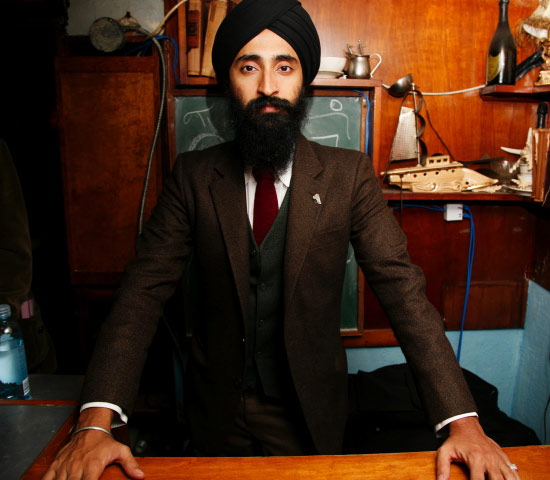 Having just been named as one of the international best-dressed honorees by Vanity Fair, Waris Ahluwalia is getting noticed not only for his dynamic sense of style but for his versatile portfolio. Best known for being a unique jewelry designer, Waris is also an actor (having starred in Wes Anderson and Spike Lee films) and recently co-wrote a book, To India with Love.
I never get tired of talking about Waris Ahluwalia by the way, but apparently i’m not alone. Blogs and articles are abuzz discussing his jewelry company, House of Waris, his sartorial taste and even his interest in Bollywood.
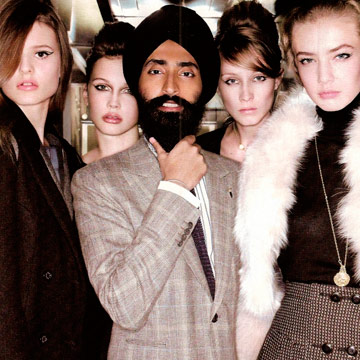 Wait, Bollywood… really?
…Despite his turban and beard look, Waris says that he has never been stereotyped in Hollywood. “Everyone likes to put people in categories, whether its Hollywood, Bollywood or the media in general. Whenever I meet agents their big concern is that I’ll be stereotyped. Well, I haven’t been stereotyped yet. “Some of the roles I’ve played; camera man, a bank hostage, a Republican, a hypo-chondriac, none of these roles called for an Indian.” [link]
The famed Grand Trunk Road, stretching from Bengal to Peshawar is made up of legends. Due to the “GT Road” passing through Punjab and the number of Punjabis involved in the transport business, references to the transport network can be found in music and popular iconography.
The road has a long history stretching from its early precursors during the brief rule of Afghan Sher Shah Suri, to greater development and expansion during the reign of the Mughals, finally to its naming as the Grand Trunk Road (GT Road) and paving under the colonial British Raj.
NPR is doing an extended story titled “Along the Grand Trunk Road: Coming of Age in India and Pakistan.” I’ll leave aside the colonial rhetoric of the title – coming of age? who decides? what does that really mean? Regardless there are a series of interesting vignettes as the NPR reporters travel the length of the modern road, through Amritsar and Darbar Sahib. Also enclosed on the story’s website are pictures documenting 150 years of history of GT Road. Do take a listen, or you can stick to Kuldip Manak if you prefer….