
PUZZL3PEACE is the alias of Los Angeles born Sikh artist Jusdeep Singh Sethi, who passed away last year in a tragic accident at the 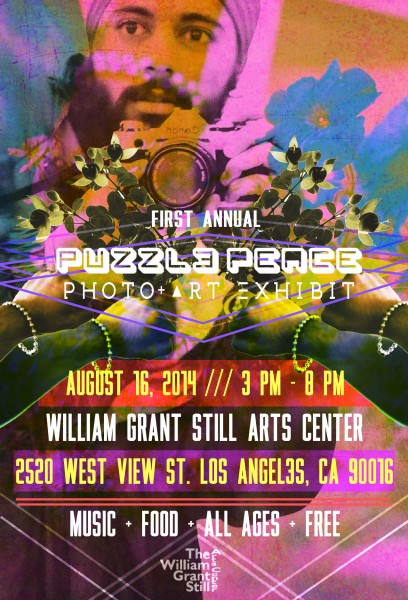 age of 21. Jusdeep, the younger brother of hip hop artist Mandeep Sethi, used 35mm film photography as his primary means of creative expression. He was known for his deep love of and connection to nature and planned to go to school to study naturopathy and holistic healing.Â
According to Jusdeep’s tribute website:
Jusdeep recognized Mother Earth as his foremost teacher, while continuously giving praise to the most high divine spirit. He was never too proud to ask questions, working daily to diminish his own ego in order to learn more from those that surrounded him.
Jusdeep was a shining free spirit who created music and art with his sitar and film camera, while living a passionate life. Driven by his yearning for social justice and positive change, Jusdeep was also a genuine soldier for the causes. He had the power to light up a room with a smile and embodied the kind of energy that was delightfully contagious.
If you met Jusdeep even once, you remembered him forever.
Whether you had the privilege of meeting Jusdeep or not (sadly, I never did), his family and community are putting together an event in a few weeks well worth checking out if you’re in southern California. On August 16, 2014, community members, friends and family, and lovers of photography and art will be gathering in Los Angeles for the 1st Annual Puzzl3Peace Photo and Art Exhibition. The event will be a celebration the life and artistic work of Jusdeep and will feature his photos never seen before publicly. There will also be space to express and share memories of Jusdeep’s life, work, and impact on attendees.
According to Jusdeep’s brother, Mandeep, “This event marks a 1 year rotation around the sun since the transition of our young warrior. Jusdeep enshrined a piece of himself with all those he had the chance to share space with. When we collectively align together, we begin to fit together as parts of a larger puzzle. A puzzle that will bring us all Peace.”
Below are all the details. You can RSVP and spread the word on Facebook as well.
 There are only a few days left in the annual SikhNet Youth Online Film Festival. Â This year’s theme, “onKaur: Focusing the Lens on Women”, brings together a collection of 18 films by and about Sikh women. Â The films look at the idea of “Kaur”, what that means and how it can be represented in film.
The films have been categorized as documentary (“think”) and drama (“cry”) with issues including: Anand Karaj, bullying, hair, health issues of Panjab, gender justice, family, and gatka among others.
The film festival is important for several reasons and this year’s theme brings to light the need to include Sikh women’s voices in conversations around identity and community. Â It’s a valuable way of showcasing issues affecting Sikh women.
Here’s how to view and vote:
The film festival also provides a platform for young filmmakers to showcase their films to a wider audience.
1. View the documentary films here and vote via Facebook.
2. View the drama films here and vote via Facebook.
Voting ends on October 9th.
 The Junior Sikh Coalition is an initiative of the Sikh Coalition to help develop leaders in local communities, providing young Sikhs with experience in organizing, advocacy, diversity education and civil rights.
In a new project, the Junior Sikh Coalition is harnessing the power of art in advocacy with an unprecedented art collection called the Nirbhau Nirvair Poetry & Art Book to bring attention to issues such as bullying and hate crimes. Young Sikhs across to country are invited to submit their art, poetry, and photographs, to showcase their perspective on the concept of Nirbhau Nirvair (“without fear and without hatred”), as first proclaimed by Guru Nanak in Jap Ji Sahib.
Find out more below about this unique opportunity for young Sikh artists.
Co-blogged by Sundari and The Sikh Love Stories Project
Each year, International Women’s Day is celebrated to honor women’s economic, political and social achievements. As individuals around the world celebrate this day – in both big ways and small – I am left to consider how we can work to honor the achievements of Sikh women not only today but on an ongoing basis.  Sikh women have contributed in such meaningful ways, and yet much of that dialogue is often missing from our history.
In this post, we will be sharing some images with you and discuss various ways Sikh women have been witness to and engaged in our history both locally and globally.  We know this post will not be comprehensive – there is much to unearth about Sikh women’s contributions – but we hope it’s a starting point that will encourage us to keep this valuable history in our minds. Many of the following images each depict a different element of Sikh women in history.
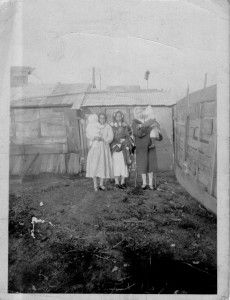
Stories often begin with immigration and this first image shows Sikh women pioneers in Canada who were part of an immigrant labor force recruited in the early years of the twentieth century.
Mill Town Pioneers. Most of Canada’s early Sikh immigrants found work in lumber mills throughout the Pacific Northwest.
Canada’s largest mill community, Fraser Mills in New Westminster, BC, had between 200 and 300 Sikhs living and working there in 1925.
In this photograph from that period, three Sikh women stand in front of company houses at the mill. [link]
One of them wears a traditional embroidered shawl called ‘phulkari’. The phulkari played an important role in the lifecycle rituals of women in Punjabi villages at times of birth, marriage and death.
 Mill Town Pioneers. Most of Canada’s early Sikh immigrants found work in lumber mills throughout the Pacific Northwest.
A goat
A sacrificial lamb
Halal meat
Her blood runs dry at the bottom of a river
Cleansing the land
Peshawar
Punjab
Pakistan
India
Afghanistan
Sri Lanka
The tip of my soul
New Delhi
Amritsar
Anandpur Sahib
Chandigarh
Jalandhar
Ludhiana
My constellation of stars
Drip drip dripping
Blood seeps into earth
One quick slice from the neck
Less painful that way
More fertile that way
Mothers, sisters, daughters
We bury red splashes
Virgin ground
Today’s Lens section of the NYTimes highlights the work of photographer Kenro Izu, whose images of sacred spaces in India will be on display at the Howard Greenberg Gallery in Manhattan.  The article opens with a black and white image of a woman sitting on the parkama facing the Darbar Sahib in Amritsar and is followed by other striking images showing how faith plays out in daily life.
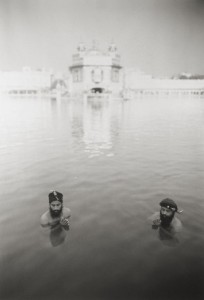
Copyright: Kenro Izu
The exhibition, titled “Where Prayer Echoes” focuses not on the structures of these sacred spaces, but rather on the individuals who go to pray at these sites.  This particular exhibition covers the photographer’s trip to India and includes portraits of people who follow various religions, from Hinduism and Islam to Sikhism and Jainism.
For more than 30 years Mr. Izu has been on a pilgrimage of sorts, taking exquisitely classic landscapes and portraits of sacred places and the faithful.
At first, he was interested only in pictures of grand temples, pyramids and holy sites.
But then he had a revelation.
“Before, I was just attracted to form,†Mr. Izu said. “In the last 10 years, I am more interested in the humans who go into these structures. That is where the spirit is. Without the people who pray or offer flowers, it’s just a structure.â€
The exhibition will be on display through February 23rd 2013.
Guest blogged by a Kaur
A note from the author: Thank you Gurlene Kaur for starting the conversation.
ਚà©à¨ªà©ˆ ਚà©à¨ª ਨ ਹੋਵਈ ਜੇ ਲਾਇ ਰਹਾ ਲਿਵ ਤਾਰ ॥
By remaining silent, inner silence is not obtained, even by remaining lovingly absorbed deep within.
1
19 years later
I still hear his cry tugging at my heart
In the middle of the night
Glistening red blood fills my consciousness
I sit up, breathless
My apartment
New York City
I see something familiar
Then drift back to sleep.
2
Sleep still in my eyes
I pull on a purple pajami and wrap myself in a chunni
One by one we pile into the car
Kirtan playing in the background
My 4 year old cousin sits next to me expectantly
Long black curls sneak out from underneath her pink hat
Betraying her age, revealing her true spirit
A kid-sized computer and backpack grace my lap
I follow the lilt of her voice as we pass by field after field.
 Following the assassination of Prime Minister Indira Gandhi in 1984, the Indian government employed orchestrated pogroms against Sikhs. Mobs, equipped with weapons, kerosene, and the addresses of Sikh homes, chanted “khoon ka badla khoon se lenge! (Blood for blood)” as they hunted innocent Sikhs, and those protecting Sikhs, throughout Delhi. Suddenly, Sikh Indian citizens were left stranded in their homeland with no protection and no exercise of control by the Indian government.
“Murderous gangs of 200 or 300 people led by leaders, with policemen looking on, began to swarm into Sikh houses, hacking the occupants to pieces, chopping off the heads of children, raping women, tying Sikh men to tires set aflame with kerosene, burning down the houses and shops after ransacking them. Mobs stopped buses and trains, in and out of Delhi, pulling out Sikh passengers to be lynched to death or doused with kerosene and burnt alive. In some areas, the Sikh families grouped together for self-defense. The police officials then arrived to disperse them, by force when the persuasion did not work. In other areas, the police searched the houses for weapons including ceremonial daggers, and confiscated them before the mobs came. Over the next five days, nearly 3,000 Sikhs were killed.” -Reduced to Ashes, pg. 42
We believe at the heart of each Sikh American woman, there are multiple love stories that inhabit the mind, body, and soul.
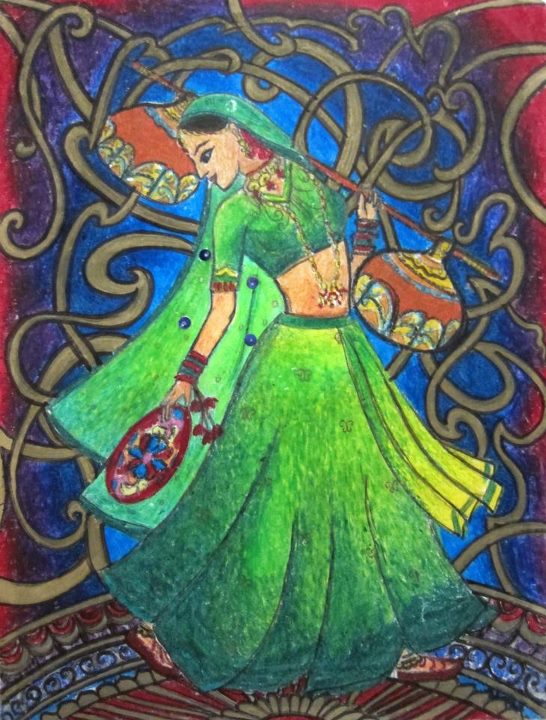
Artist: Rupy Cheema Tut
This one is for you dear Kaurs!
The first ever Sikh Women’s Love Anthology is being created and your voices are needed. This groundbreaking anthology will be a compilation of love stories written by and about Sikh women living in North America and will be published in the form of memoirs, creative non-fiction stories, and creative essays.
Sikh women have an incredible history of powerful and inspiring narratives – often heard through our oral tradition. This project is a way of documenting these narratives and providing a space for women in the Sikh community, connecting with one another to dialogue and document the complexities and nuanced experiences of love as we see it. Love can take many forms – “through lovers holding hands, singing a shabad, eating a good meal to nourish one’s body, hiking an unknown terrain, traveling a new country, holding a sick child close, fighting for civil and human rights or even embarking on the journey to falling in love with ourselves as women and human beings, spiritual beings” [from guidelines]. Love is at the core of our very existence as Sikhs.
This is a wonderful opportunity to pave the path for Kaur voices that we do not often hear. Sikh women who are dedicated to their families, their faith and their activism and manifest their love in dynamic ways. Yet their stories go unheard. Documenting one’s story provides for self-reflection and is “an act of resistance against social, cultural, media, and political forces that want to define women as less than humane“. This is an important way to chronicle narratives for future generations of Sikh American women and men.
Click below the break for submission details. For further information and full submission guidelines, please email sikh.lovestories[at]gmail.com.
 The use of social video sites by our community has seen an upward trend. Of course, many readers of this blog will instantly recognize individuals that have emerged in the last two to three years using YouTube and other social media sites – Mandeep Sethi, Humble the Poet, JusReign, and IISuperwomanII are but a few of the commonly recognized names from North America alone.
As it becomes more accessible, we are also seeing the emergence of more grassroots-level use of social video. This medium has allowed Sikhs, and particularly Sikh youth, to express themselves to an unprecedented audience size, and there are several organizations encouraging Sikhs to make use of this platform. For example, SikhNet has been running their Youth Online Film Festival since 2006, and the Sikh Coalition is also holding their third annual Diversity Video Competition for its third consecutive year.
Recently, Manbeena Kaur, the Sikh Coalition’s Education Director, was good enough to answer some questions about the use of social video for the purposes of Sikh education and awareness.
Guest blogged by Preeti Kaur
For Bhai Balwant Singh Rajoana
For everyone who flies the kesri jhaanda today
ZINDABAAD TO THE KESRI FLAG WAVING ACROSS MY HEART
ZINDABAAD TO MARCH 31, 2012
ZINDABAAD TO THE EYES
ZINDABAAD TO THE LUNGS
ZINDABAAD TO THE WRIST WHICH WEARS THE KARA TO REMAIN SHACKLED TO THE SKY
ZINDABAAD TO THE ROPE
ZINDABAAD TO THE TATI TAVI
ZINDABAAD TO THE BELLS RINGING
ZINDABAAD TO THE BRIDGE
ZINDABAAD TO THE LAMP
ZINDABAAD TO THE KIRPAN DIPPED IN INK
ZINDABAAD TO THE CHILDREN OF THE FIELDS RUNNING AWAY RUNNING TOWARD
ZINDABAAD TO THE DISAPPEARED WE REMEMBER
ZINDABAAD TO THE DISAPPEARED WE FORGOT
ZINDABAAD TO THE ASHES WHICH COULD NOT TRAVEL TO KIRATPUR SAHIB
I came across this poem today, and definitely wanted to share with all you Langarites. Preeti Kaur, the author from California, is able to speak to numerous aspects of self-identifying as a Punjabi. We’ve had some discussions around Punjabi and Sikh identity here before, thought it would be refreshing to have an artistic take to the topic. Here are a few of my favorite lines:
You Bring Out The Punjabi In Me
By: Preeti Kaur
with respect to Sandra Cisneros’ “You Bring Out the Mexican In Me“
…
sonu
you burn the inquilabi in me
ghadar is a language
i speak only to you
pacific mist we breathe
the subcontinent to freedom
from our san francisco dreams
hidden under guise of fog
tag taxis with saffron orange bumper stickers
ZINDABAAD!!! ZINDABAAD!!!
perhaps the morning pooni the start of our rebellion
radioactive jalebis the danger
we eat
Click here for the audio podcast and full poem published at the online literary magazine Qarrtsiluni.

Cover of "Guru Tegh Bahadur: The Ninth Guru of the Sikhs" (photo: sikhcomics.com)
Let me first take the opportunity to thank the bloggers of TLH for welcoming me to this blog. A few might recognize me from americanturban.com, and I’m excited about the opportunity to engage with the audience on this blog in discussing many of the issues we face as a community, and particularly in the United States.
Most of my early education in Sikh history came from comic books, namely those published by Amar Chitra Katha, based in India. My father purchased every title related to Sikhism that was released by this company — covering the stories of the Sikh Gurus to those of Sikh legends and heroes — and I loved reading and re-reading these comic books until I knew the stories by heart.
It was a great introduction to Sikhism that captured my imagination. As I got older, I moved on from these comics to literary works on Sikh history that filled my growing mind with more knowledge and detail.
I started reading those comic books almost 30 years ago (I’m astounded as I write that number), and I’ve recently come across a new effort to bring such Sikh stories to today’s young audiences.
Gyan Khand Media has recently begun producing a new set of Sikh-based comic books. While now based in India, author Daljeet Singh Sidhu saw the opportunity for such a comic book after living in the west:
When Daljeet Singh Sidhu wanted to introduce his three-year-old son to Sikh heroes and history, he was not at a loss of words. But what he did not have, was a story that his boy could see, feel and later read. That’s when it struck Sidhu; that Sikh history has many heroes, but no graphics. So after 12 years in the US, he packed his bags and moved back to India to chronicle Sikh history, its great gurus and warriors and present them in the comics format. That’s how www.sikhcomics.com, a Sikh comics project, was born.
Gyan Khand Media has currently published three titles covering the stories of Baba Deep Singh, Guru Tegh Bahadur, and the Battle of Saragarhi. Many more are planned, and I had the opportunity to download and read the first two titles using Amazon’s Kindle app on my mobile device.
As promised, here is my follow-up to Monday’s post about the Inquilab hip hop workshop in New York.
This past Saturday night brought together hundreds of Sikhs (and others) for the fourth annual Lahir: Move the Movement. I always seemed to have a conflict the last several years, but finally made it out to New Brunswick, New Jersey this year for my first Lahir. I am grateful for it.
Again, I’ll keep my words short as the video below speaks for itself. But a couple of things that were especially noteworthy to me about the experience.
The audience was really multi-generational. It was much more like a typical gurdwara sangat than I had expected, crying babies, hyper adolescents, and plenty of elders included. The energy was positive and empowering, and the high school and college-aged youth, in particular, were fired up.
The performances were extremely diverse and full of raw talent and passion. As you’ll see below, the performances (only a few of which I captured) went far beyond the spoken word and hip hop that I was expecting.
A friend of mine leaned towards me while a pre-pubescent high school student with a patka was rapping passionately about post-9/11 racism and said, “I am so excited about this new generation.” Indeed, I share her sentiment. These young people are indeed moving the movement, and in doing so, in the words of the event’s organizers, perhaps they are also “bringing Sikhi back.”

As Sundari blogged about a few days ago, we just had an exciting weekend of Sikh youth art and activism in the NY/NJ area. I was lucky enough to sit in on the Sikh Coalition’s “Inquilab: Raising Our Voices” hip hop workshop for a few hours on Saturday and then ride the bus to New Jersey with the youth to attend Lahir 2011: Move the Movement.
I managed to get some video footage of both events, so I will keep my own words to a minimum. Today I am posting a brief montage from the Inquilab workshop, and on Wednesday I’ll post some highlights from Lahir.
I walked into the workshop on Saturday in the basement of South Asian Youth Action in Elmhurst, Queens while the group was in the midst of a writing activity. Many of the young people of diverse backgrounds (mostly South Asian and many Sikh) ended up putting their newly honed writing skills to the stage — a pretty large stage — at Lahir that night. Their pieces were honest, real, accessible and courageous. I was truly inspired. And found myself wondering what my teenage years would have been like had something like this (both the workshop at Lahir) had existed.
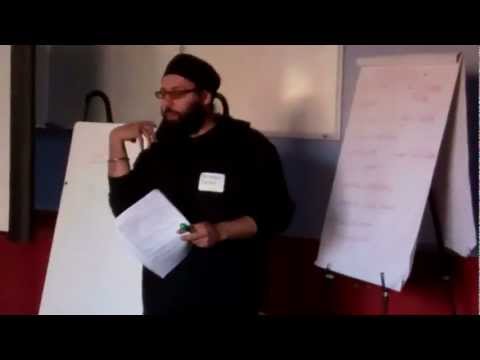
 On December 2nd and 3rd, Sikh youth will have the opportunity to participate in a special workshop that will allow them to learn the power of expression and how it can be used to create change in their life and communities. Inquilab: Raising our Voices, organized by The Sikh Coalition and Slumgods, will bring together hip-hop artists, Mandeep Sethi and Selena Dhillon, to work with South Asian youth as a way of encouraging their engagement with expression. Through this participation, youth can learn how to effectively use art to inspire positive change within their own communities.
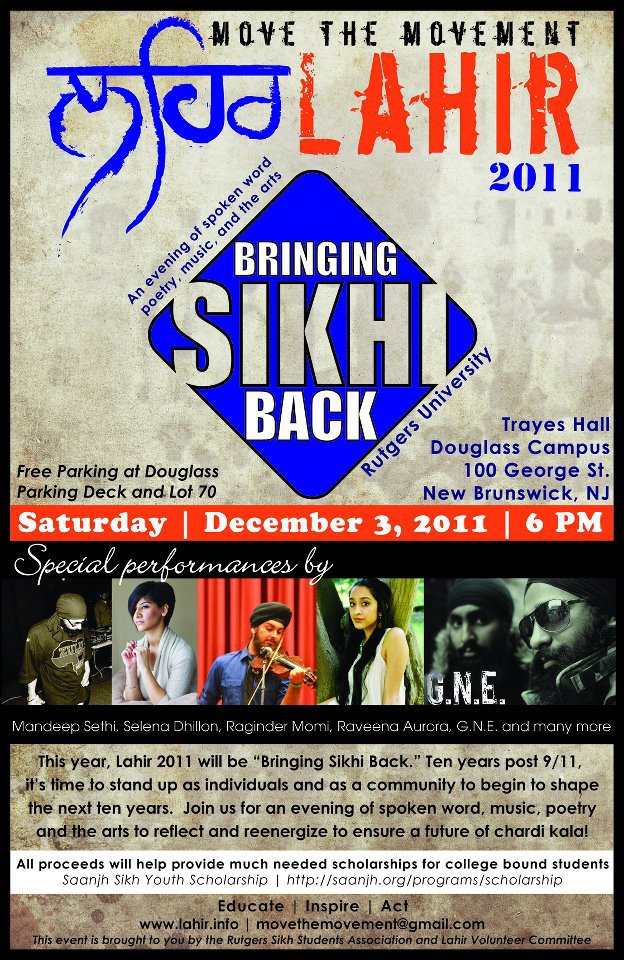 Following the workshop this weekend is Lahir – an event that aims to inspire, educate and awaken the community to rebuild the panth and encourage youth to become activists. The concert will provide a much-needed platform for powerful Sikh artists to express themselves through music, art, film, and poetry. Some more information from the organizers:
In past years, Lahir’s central theme focused on 1984 and Punjab. This year, Lahir 2011 will be “Bringing Sikhi Back”. Ten years post 9/11, it’s time to stand up as individuals and as a community to begin to shape the next ten years. Join us for an evening of spoken work, music, poetry and the arts to reflect and reenergize to ensure a future of chardi kala! This year, all proceeds will go to the Saanjh Sikh Youth Scholarship. We need strong voices in our community and we need diverse voices to help us educate others and ourselves about the historical, political, social, and economic issues that affect our community. Therefore, this event is not just for us, but for our future.
Inquilab will take place on December 2nd and 3rd 2011 at South Asian Youth Action Inc | 5405 Seabury St, Elmhurst, NY.
Lahir will take place on December 3rd 2011 at Rutgers University
We encourage you to learn more about these events, and if you are in the area – please attend and let us know how it goes!
It’s that time of year again!
For those Southern California natives, you (hopefully) know it rolls around once every year. This year, SikhLens is proud to announce its annual Sikh Arts and Film Festival to be held November 18th – 20th, 2011 at the prestigious Dodge College of Film and Media Arts at Chapman University in Orange, California. As avid supporters of Sikh Arts, and creativity in general, I am hoping our readers would be especially interested in this event coming up in the next couple of weeks.

 The Sikh Arts and Film Festival serves as a central venue for artists to showcase and share Sikh heritage and culturethrough the mediums of film, literature, art, music, social media and fashion. As an often-misidentified minority, this type of forum has proven to be essential for Sikhs to transcend cultural boundaries, generate awareness, and connect with the broader community.
For tickets, scheduling and more information, visit www.sikhlens.com.
Do you know how to tie a patka? The following video, an original creation by Keerat Kaur, was produced by Saffron Press in an effort to educate about the Sikh identity – allowing educators (and curious children) to learn how to tie a patka/dastaar and see what actually lies beneath the piece of cloth that covers a lion’s mane. As one blogger writes,
The video [reminds] me of a vague recollection I had of sitting in a room while two teachers were trying to figure out how to re-tie my patka on my head. I remember trying to explain how the patka was supposed to be tied, but the teachers couldn’t figure it out. I also recall how vulnerable I felt when, to attempt to re-tie it, they removed my patka and my hair was exposed.
Another blogger has similar memories of his childhood,
For most of my childhood, I was the only Sikh kid in school that had long hair. Never mind that the other kids didn’t know nor appreciate my Sikh identity, even my teachers were clueless about my faith.

Beginning on October 15th, a three-day exhibition was held in Ludhiana to profile a generation of rising young artists in Punjab. The mission according to gallery is ‘to further enrich and diversify cultural life in the Punjab region by facilitating the development of emerging artists.’ The newly constructed gallery in Ludhiana offers exhibition and installation space, leads and collaborates in the development of programs for the visual and performing arts, and will soon be providing an art residency.
 A recent exhibit called ‘Three/One: A Collaborative Art Exhibition in Ludhiana’ was held to showcase the work of Rachna Sidhu, Ankur Singh Patar, and Vivek Pandher, children of some of the most famous literary figures in Punjab. Rachna Sidhu, daughter of the famous thinker and literary critic Amarjit Grewal is a portrait maker at Guru Nanak International public school. Vivek Pandher is the son of the poetic genius Jaswant Zafar, a photographer by profession and a student of film production at UBC. Finally Ankur Singh Patar is son of poetic legend Surjit Patar and focuses on digital art, drawing much of his inspiration from his father’s literary treasures.
Sit down with my cousins in Punjab for more than a few minutes and in-between their reckless driving and ear-pumping tracks of Jazzy B and Gippy Grewal, they will often give their commentary about how Punjabi music is now trash and doesn’t represent the “true” culture. Ask if they enjoy the folk music of Sharif Idu and they’ll ask, “Who?” Push them further and they’ll blame artists like Jasbir Jassi and other hucksters of cheap lyrics and videos. Here comes Amrit Bains of Canada (this video is also EPIC, check out the background dancers!) with a very different thesis, but one that may resonate with a previous conversation we’ve had here in The Langar Hall. It is the music industry’s fault.

Well, enjoy the video, especially the AMAZING background dancers. Sorry for the language, hope it brings a smile, and have a happy Friday!
UPDATE: Amrit Bains, a long-time bus driver, seems to be following his dreams. Here is a great interview that gives some background of this singer.

