
Guest blogged by Bandana Kaur
“Pavan guru paanee pitaa
Maataa dharat mahat
Divas raat du-i daa-ee daayaa
Khaylai sagal jagat”
-Guru Nanak SahibÂ
In honor of the Sikh concern for preserving ‘Mata Dharat’ (Mother Earth), Sikhs from cities across the northeast are joining the People’s Climate March in New York City on September 21st, the largest mass movement for climate justice in history.
Next week, world leaders are coming to New York City for a UN summit on the climate crisis. The world is urging governments to support an ambitious global agreement to dramatically reduce global warming pollution.
With our future on the line and the whole world watching, we’ll take a stand to bend the course of history. We’ll take to the streets to demand the world we know is within our reach: a world with an economy that works for people and the planet; a world safe from the ravages of climate change; a world with good jobs, clean air and water, and healthy communities.
Why Are We Marching?
We march because Sikhi affirms the sanctity of the Earth.
We march because the ecological basis of Sikhi rests in the understanding that the Creator (‘Qadir’) and the Creation (‘Qudrat’) are One. The Divine permeates all life, and is inherent in the manifest creation around us, from the wind that blows across land and skies, to the water that flows through rivers and seas, to the forests and fields and all creatures of land and sea that depend on the earth for sustenance.
We march because Sikh Gurus teach that there is no duality between the force which makes a flower grow and the petals we are able to touch and sense with our fingers.
We march because the Sikh Gurus referred to the Earth as a ‘Dharamsaal,’ a place where union with the Divine is attained. Guru Nanak describes this in Jap Sahib, that amid the rhythms of Creation, the changing seasons, air, and water, the Creator established the earth as the home for humans to realize their Divinity in this world.
PUZZL3PEACE is the alias of Los Angeles born Sikh artist Jusdeep Singh Sethi, who passed away last year in a tragic accident at the  age of 21. Jusdeep, the younger brother of hip hop artist Mandeep Sethi, used 35mm film photography as his primary means of creative expression. He was known for his deep love of and connection to nature and planned to go to school to study naturopathy and holistic healing.Â
According to Jusdeep’s tribute website:
Jusdeep recognized Mother Earth as his foremost teacher, while continuously giving praise to the most high divine spirit. He was never too proud to ask questions, working daily to diminish his own ego in order to learn more from those that surrounded him.
Jusdeep was a shining free spirit who created music and art with his sitar and film camera, while living a passionate life. Driven by his yearning for social justice and positive change, Jusdeep was also a genuine soldier for the causes. He had the power to light up a room with a smile and embodied the kind of energy that was delightfully contagious.
If you met Jusdeep even once, you remembered him forever.
Whether you had the privilege of meeting Jusdeep or not (sadly, I never did), his family and community are putting together an event in a few weeks well worth checking out if you’re in southern California. On August 16, 2014, community members, friends and family, and lovers of photography and art will be gathering in Los Angeles for the 1st Annual Puzzl3Peace Photo and Art Exhibition. The event will be a celebration the life and artistic work of Jusdeep and will feature his photos never seen before publicly. There will also be space to express and share memories of Jusdeep’s life, work, and impact on attendees.
According to Jusdeep’s brother, Mandeep, “This event marks a 1 year rotation around the sun since the transition of our young warrior. Jusdeep enshrined a piece of himself with all those he had the chance to share space with. When we collectively align together, we begin to fit together as parts of a larger puzzle. A puzzle that will bring us all Peace.”
Below are all the details. You can RSVP and spread the word on Facebook as well.
A few weeks ago, I was invited to participate in a planning and brainstorming retreat for an innovative pilot project that Union Theological Seminary is launching this summer. UTS, which has a longstanding commitment to social justice, are aiming to bring together a group of 30 young(ish) (21-35 year old) leaders from different religious and spiritual backgrounds for five days in New York City this July to explore the intersection of faith and justice and build a stronger spiritual activist movement together.
The Millennial Leaders Pilot Conference will take place July 13th to 17th at UTS in Manhattan. All travel and room and board expenses will be covered for participants, who should have histories of doing social and economic justice work in their respective communities. According to the conference website, applicants “may be community organizers, staff of NGO/NPO, in ordained or lay service to a local church or religious community, as well as they may function is less official leadership roles. Formal affiliation with a specific religious tradition or community is not a prerequisite and people with no affiliation are encouraged to apply. In this regard, the only formal requirement is an interest in the intersection between spirituality and activism.”
This promises to be an exciting and unique gathering with the potential of building a more long-term, sustainable movement of activists and organizers from different faith traditions. At the planning retreat, many of us discussed how questions of spirituality and religion are so often left out (or are even taboo sometimes) in progressive social and economic justice spaces. And on the other hand, which we often discuss here at The Langar Hall, social and economic injustices are so often perpetuated in the name of religion, including Sikhi.
If these ideas resonate with you, I hope you’ll consider applying and spreading the word to your friends, family, and colleagues, Sikh and non-Sikh alike. All the details about the conference and the application can be found here. The deadline to apply is the end of the day this Friday, May 23rd.
When most of us imagine what the people inside immigration detention centers in the United States look like, we usually do not  think of Sikhs from Punjab. Our Sikh American community — and more broadly South Asian American community — has been reluctant to deeply engage with the harsh realities of immigration policy and detention here in the United States. Too often we have seen this as someone else’s issue or passed quick judgment on those migrants from various parts of the world who overstayed their tourist visas or crossed the border under the radar — in search of work, to feed their families, in hopes of a better life. Papers or not, this hope for freedom is what brings all migrants to the United States.
Right now at least 37 Punjabi migrants, who fled India in search of this illusive freedom, are detained in an Immigration and Customs Enforcement (ICE) detention center in El Paso, Texas. News of these men and others at the El Paso facility protesting their indefinite detentions (they have been detained for over nine months now) came to surface in December. Last week, we learned that 37 Singhs — now known as the El Paso 37 — began a hunger strike.Â
37 young Sikh men — many who are seeking political asylum in the US — have been detained for almost a year in Texas, yet we have heard almost nothing about it in our organizations or gurdwaras. There has been no major news coverage of these men’s plight. Their harsh journey to El Paso reportedly took them through Moscow, Havana, Ecuador, El Salvador, Guatemala, and Mexico. Instead of finding respite, comfort, and safety in the US, they have found prison walls.
BREAKING NEWS: The Sikh Art and Film Foundation has responded by including a female speaker in next week’s Leadership Summit!!! Great progress. Â Yet, the lack of representation of women and girls from 2004 – 2012 in the film festivals and galas still needs to be addressed, and this is a community wide issue. Â See below for actionable solutions.
Via Email:
November 15, 2013 7:43PM Nina Chanpreet Kaur,
Dear Sikh Art and Film Foundation,
I am very glad to see that Rashmy Chatterjee will be speaking at next Friday’s Leadership Summit.  This is a tremendous gain for our community as most of the speakers at the summit have been men since 2011.  This represents a trend in many Sikh organizations I hope we can change together. As a Sikh woman and resident of NYC for the last 11 years, I have followed your organization since it’s inception.  Over the years, I have attended many of your events and have been so inspired by the films, speakers and attendees.  I have also noticed the lack of representation of women and girls in your programs.  Though you took a step forward this week, I believe you could be doing more to address, highlight and celebrate the challenges and triumphs of Sikh women and girls whether in your Film Festival, Heritage Gala or Leadership Summit.
I understand that your goal is to transcend the dichotomies and binaries of gender and other categories to sustain the universality and equality that our Gurus envisioned in order to promote and preserve Sikh and Punjabi heritage. Â I share your vision and do not condone a gender binary or bias towards either men or women. Â I am also aware that you face limitations as all organizations do, in particular that you must base the selections of films on the submissions you receive. Â However, Sikh men and boys have been a central part of your programs in a way Sikh women and girls have not and this indicates a bias – whether intentional or not.
From 2007 to 2012, none of your Gala awards for Leadership and Vision have been presented to Sikh women. Â In fact, the only women who received awards were for Creativity/Art with the exception of Shonali Bose who received an award for Courage and Shelley Rubin who received an award for Leadership jointly with her husband. Â For 5 years in a row you have only presented Sikh women with awards for Creativity/Art and no other category. Â As a Sikh woman, this sends a message to me and the next generation of Kaurs that women can be honored for creativity and art but not for leadership and vision. Â It raises questions about your beliefs and assumptions related to gender roles and women’s capacities in relation to men. Â This is most certainly not the message young Kaurs should be receiving, nor do I think this is your intention based on the email I received from Ravi last week. Â Â Â Â (more…)
 Over the past two years, the Sikh American Legal Defense and Education Fund (SALDEF) has enabled vital training in advocacy, self-empowerment, and community change to over thirty Sikh American youth through SikhLEAD’s Leadership Development Program. Now, with two classes already pioneering their own projects, SALDEF is proud to be gearing up for the third class of rising Sikh leaders.
The Leadership Development Program brings together approximately 17 young Sikh American leaders from across the country to participate in six days of training spread over Columbus Day and Memorial Day weekends. Attendees will participate in a series of workshops aimed to challenge, inspire and support a group of intelligent and motivated Sikh leaders. The purpose of the program is to empower Sikh American youth to be confident, aware and resourceful individuals, equipped with all the tools they need to not only fulfill their personal potential, but also become change makers within the Sikh American community. For more details please visit www.sikhlead.org.
SALDEF’s SikhLEAD Leadership Development Program will ensure that our youth remain engaged with the issues that affect our community today and will provide them with the resources and skills they need to enact real change in the future.
The deadline to apply for the SikhLEAD LDP is Sunday, August 4, 2013 at 11:59 EST.
I’ve been invited to and participated in a number of interfaith gatherings, conferences, retreats, and discussions over the years. Time and time again I find myself being the only Sikh in these spaces. And often find that the well-meaning, progressive faith-based activists in these spaces don’t know other Sikhs besides me nor do they know much about Sikhi. So then it was refreshing to hear about the 2030 Faith in America Challenge, an interfaith gathering to strategize around creating a more just society, from a Sikh friend who is helping organize it. On October 6-7, the Nathan Cummings Foundation will host leaders in the 20s and 30s for a retreat in upstate New York to explore important and urgent questions around religious diversity. The application deadline is Monday, July 15th! Check it out and consider applying. Sikh voices are greatly needed in this discussion.
More information follows, and visit the website here.
In a rapidly changing world, where faith is as often a force for inspiration as well as polarization, how might we as people of faith, support individuals and communities connected to their religious and spiritual identities, to amplify their voice, vision and public leadership?
Is this a challenge that resonates with you or keeps you up at night? Would you invest four days of your life to wrestle with this challenge with a diverse group of leaders?
If yes, we invite you to complete an application to join us for the 2030 Faith in America Challenge gathering application due on by Monday, July 15, 2013. If selected, travel, food and lodging will be covered by the Nathan Cummings Foundation. Below you will find the articulation of the broader context in which we are locating this challenge, our belief in the importance of a strong religious and spiritual voice in the public arena, information about outcomes, methodology, profiles of potential participants, and a Frequently Asked Questions section.
Please review the required preparation and questions and please submit the completed application online by 11:59pm EST on Monday, July 15, 2013. Please send questions to 2030Challenge_FIA@nathancummings.org.
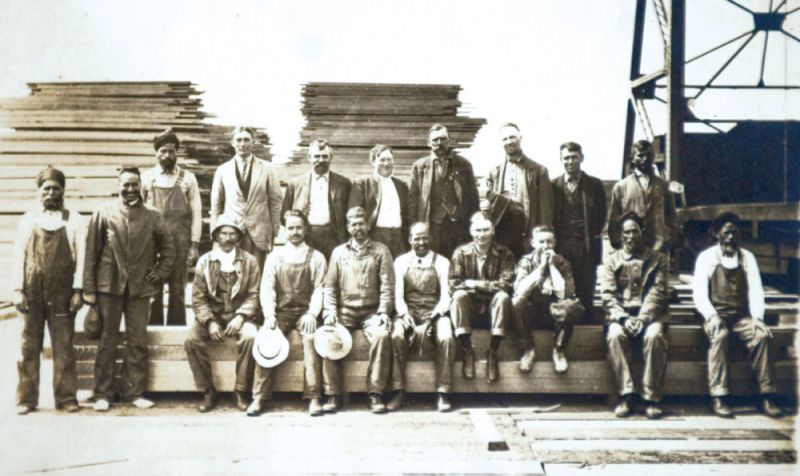
“Indians, many of whom were Sikh, worked at the Hammond Mill before its demise in 1922. During that time period, the Indians left their mark on Astoria, participating in wrestling matches, occupying Alderbrook also known as “Hindu Alley,” and forming the Ghadar political party. Courtesy of Clatsop County Historical Society.” (source: The Daily Astorian)
One of the legacies of the earliest Sikh and Indian immigrants to the United States at the turn of the twentieth century was the creation of the Ghadar Party, a political movement based in northern California that sought to promote India’s liberation from British rule.
Led by Indian expatriates in the United States, the Ghadar Party was formed in 1913. One of its main activities was the publishing of literature to promote resistance to British rule and for a free India. Obviously a threat to the ruling class, the literature was banned in India, and upon their capture, the Ghadarites were often imprisoned or executed as terrorists by the British.
This year, the San Francisco headquarters of the Ghadar Party has been opened to the public by the Indian Consulate as a museum. The printing press that the Ghadar Party used to print their literature is also now on display at the Gurdwara in Stockton, California. However, while it was previously believed that the Ghadar Party was founded in California, historians now place the genesis of the movement further north in the state of Oregon, where Johanna Ogden recently mapped a forgotten (and primarily) Sikh settlement of laborers in 1910 known as “Hindu Alley”.
A North American based Internationalist movement for the liberation of India
Guest blogged by York Ghadaris
On the centenary of the Ghadar Movement, a conference is being held at York University, Toronto, Canada on April 12 to April 13, 2013, to honour and remember its history, and its contemporary relevance to the revolutionary struggle of people of the Indian subcontinent.
It has been 100 years since the Ghadar Movement was formed by emigrant Punjabis and other Indian nationals in San Francisco in 1913. The Ghadar Movement ranks alongside other revolutionary movements of the early 20th century. In common with revolutionary movements in Latin America, Asia, Africa, and the Black Liberation movements of North America, the Ghadar Movement opposed imperialist powers, colonialism, and strived to develop working class internationalism.
This conference is called, with the participation of approximately 18 scholars and activist from North America and the UK, to remember the Ghadar Movement, its historical development, and to analyze its contemporary relevance to the revolutionary struggle of the people of the Indian subcontinent. The conference will examine the Ghadar struggle as a journey from the 20th century, “a century of revolutionsâ€, to its role in laying the foundation stones for the revolutions of the 21st century. These revolutions are crystallizing in response to the imperialist occupations of Afghanistan, Iraq, Libya, Haiti, the air attacks on Pakistan and the possibility of NATO attacks on Iran and Syria. The economic meltdown of the European Union (EU) and North America resulting in mass unrest are adding to the cause of revolution. They are taking shape in the form of the Arab Spring, the ongoing revolutions in Venezuela, Nepal, and the emerging people’s struggles in India.
“While Sikh American women do a lions-share of organizing and executing the business of the Sikh community, their experiences of faith, family, and community are under-represented in art, literature, and scholarship. In fact, the experience and image of a Sikh woman is obsolete and – in most cases – invisible in the North American milieu. The modern landscapes and political and social influences that shape Sikh women’s lives as well as the subsequent paths they take have yet to be understood, documented, shared and absorbed by our cultural psyche.”
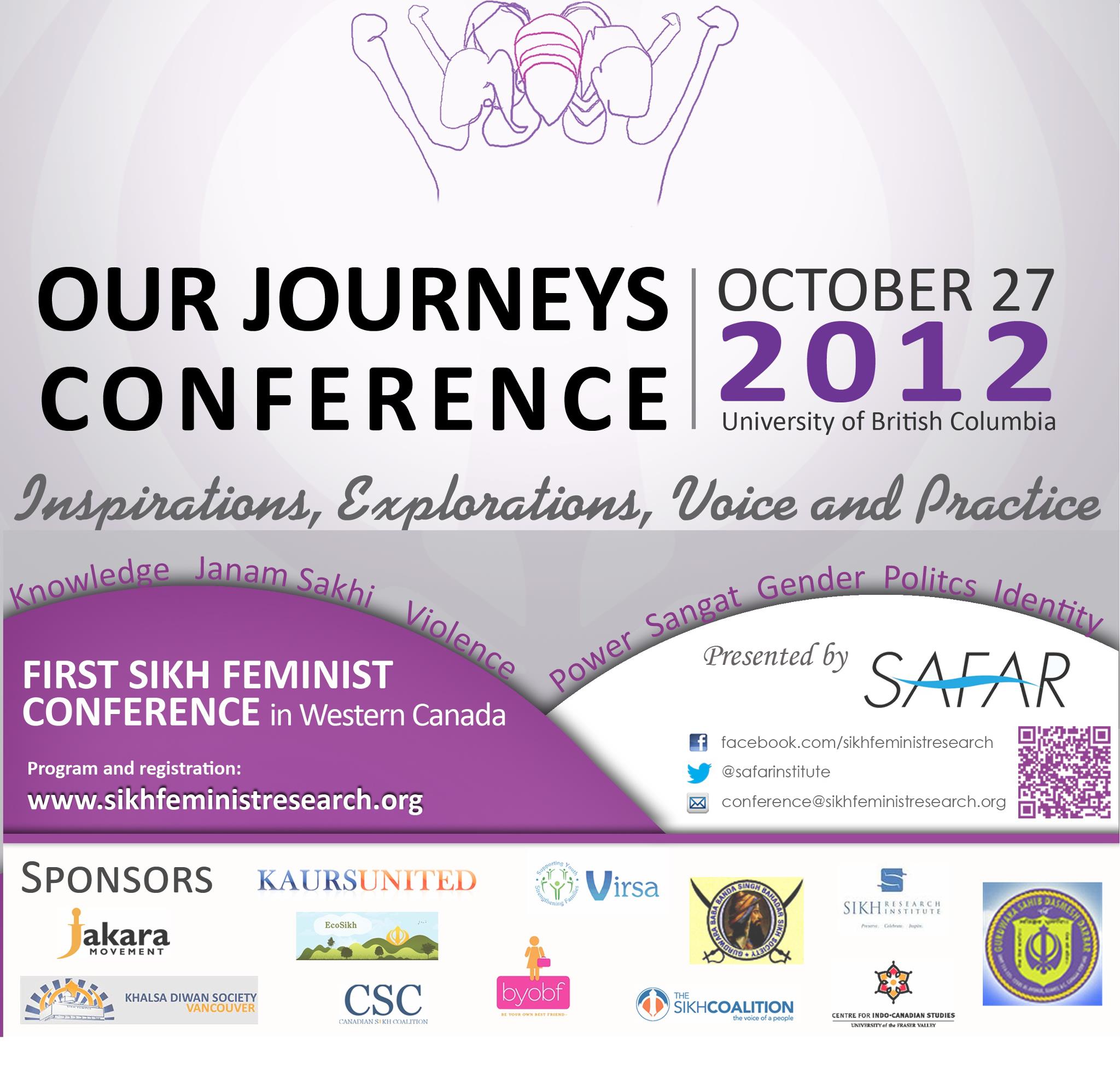 The above description is an excerpt from the “Sikh American Women and Their Love Stories Collection” presentation that will be taking place at this year’s Our Journeys conference, hosted by the Sikh Feminists Research Institute on October 27th. This conference series, the first of its kind, provides a platform to explore the intersections of Sikhi and gender. The goal is to promote research around Sikh feminist issues, heighten participation in critical discourse, promote alliance building and develop partnerships between academic and community organizations.
Often times, conversations about Sikhs, Sikh issues and the Sikh identity start and end with the Sikh male identity. While this conversation is acutely relevant in the climate of ignorance and discrimination that we live in, it’s also critical that we have conversations that include, are about, and are led by Sikh women.
Having attended last year’s inaugural conference, I look forward to engaging once again in a conversation around women’s issues within the Punjabi/Sikh framework. It’s exciting that we have a platform to celebrate the growth and development of the Sikh feminist voice.
 During this past week following the tragic events in Wisconsin, our community has changed substantially. We have grown as a people and identified even more with Sikhi, standing up in a time of crisis, and responding in a positive and effective way, battling apathy with activism and suffering with solidarity.
SALDEF’s SikhLEAD Leadership Development Program will ensure that our youth remain engaged with the issues that continue to affect our community today and will provide them with the tools they need to enact real change. Although it may be a dark time for many of us, it is now more than ever that we need leaders and young activists leading the struggle against oppression. It is now more than ever that we need the younger generation to step up to the podium and speak out and act against injustice. It’s not enough to feel for our Sikh brothers and sisters anymore. The time is now for the youth to rise up and become leaders, especially in the wake of the Wisconsin shooting tragedy.
The Leadership Development Program brings together approximately 15 young Sikh American leaders from across the country to participate in six days of training spread over Columbus Day and Memorial Day weekends. Attendees will participate in a series of workshops aimed to challenge, inspire and support a group of intelligent and motivated Sikh leaders. The purpose of the program is to empower the Sikh American youth to be confident, aware and resourceful individuals, equipped with all the tools they need to fulfill both their personal potential but also that of the Sikh American community. For more details please visit www.sikhlead.org.
Let us take on the Guru’s seva together and become the pioneers of our own future, a future that has no place for events such as the Wisconsin shootings. The deadline to apply for the SikhLEAD LDP has been extended until August 19, 2012 at 11:59 EST.
 Guestblogged by Harinder Singh
Harinder Singh is a co-founder of the Sikh Research Institute and the Panjab Digital Library. He is interested in anything Sikhi, esp. institutional development towards community building. His Twitter handle is @1Force.
I heard as recently as last Sunday at a Baltimore gurduara, that Sikhs don’t know how to make their own decisions. True, and false.
For more than a century (1699-1805), Sikhs made tough, controversial, politically incorrect, yet reached consensus-driven, time-sensitive, and decisive conclusions via the institutions of the Sarbat Khalsa and the Gurmata. And this was accomplished during a century that saw half of Sikh population killed in a single genocidal campaign.
It has taken more than 200 years to dismantle these systems of consensus building; it will take a concerted effort for at least 20 years to revive it. This process will require complete openness and inclusivity. It is a risk worth taking and a solemn opportunity to grasp what others deemed worth dying for!
Sikhs worldwide responded to the recent Rajoana phenomenon with stunning solidarity. Governments, politicians, and spiritualists weren’t sure what was going on. Musicians used the opportunity to wash-off their “sins” of sycophancy from the last Panjab election promos. People-at-large were excited, but they were not prepared. I felt personally that I failed to convince myself of what matters most, and I failed to convince the activists (both the Tweeting and sloganeering kinds) to do something meaningful in any concerted way. I concluded that we self-deluded panthak folks failed everyday-Sikhs at this historical moment with an engagement policy. There was no mechanism to decide what the Panth must do at the crucial tipping point of actionable potential.
 Last year the Jakara Movement held the first ever Bhujangi Youth Academy camp, aimed at young “at-risk” Sikh males, ages 13-17. It was a HUGE success. You can see the previous description and reflections write-up from last year.
This year the camp is happening again.
WHEN: July 15-24, 2012
WHERE: Camp Sierra (central California)
HOW TO REGISTER: Visit www.bhujangi.org
WHO TO CALL: For more information, call 1-408-905-7454 (English and Punjabi)
There will be fun activities such as paintballing, horseback riding, and sports. There will also be classes to instill a sense of pride in our collective Sikh past, but also an opportunity for reflection, emotional growth, and anger management.
The Jakara Movement is willing to work with all families of any means. As the deadline is soon approaching, we need your help and encouragement. Recommend a family member or talk to a friend if they have a young son, nephew, cousin, or brother that may be able to benefit from such an experience.
Caste is one of those dark secrets in our community. Some defend it as “culture”, others downplay its discriminatory effects, and some go even as far as to blame the victims of the violence itself.
Many have documented the ongoing apartheid that exists in our villages and in our minds.

Some scholars have recently looked at the issue in light of the commitment to equality bequeathed by our Gurus, but the continued existence of discriminatory practices by many Sikhs. Professor Natasha Behl sheds some light on this topic in her dissertation, titled “The Politics of Equality: Caste and Gender Paradoxes in the Sikh Community.” She began her research asking the simple questions: How do ordinary Sikhs maintain a belief in equality while also participating in caste- and gender-based discrimination? How do Scheduled Caste Sikhs and Sikh women take political action in a community that engages in discrimination, yet denies its very existence?
Tomorrow, May 1st, is International Workers Day and may very well be one of the largest days of mass action and protest we’ve seen in the North 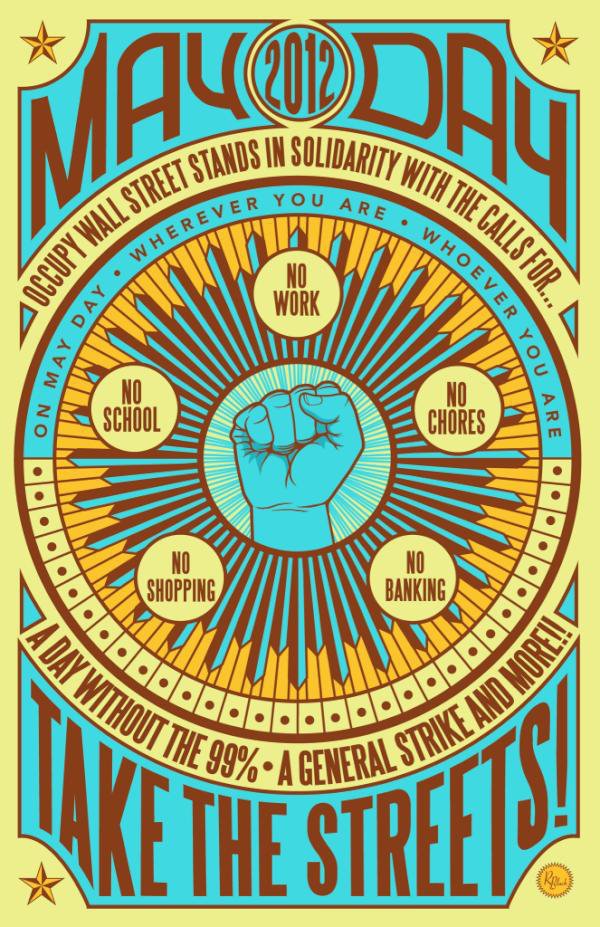 America in some time. Also known as May Day, the day has a long and rich history of working people courageously fighting for dignity and justice.
May 1st is the original “Labor Day” in the US. On May 1, 1886, 100,000 workers went on strike in Chicago demanding an eight-hour work day. They were met with violent repression from the police who killed four and injured many more. A massive rally against police brutality was organized in the coming days at Haymarket Square where violence escalated. Martial law was declared in Chicago, and police arrested hundreds of activists. The “Chicago Eight” were arrested and convicted solely because of their political beliefs. Seven were sentenced to death, and four were eventually hanged. Hanged for being freedom-fighters. Sound familiar?
In more recent years, May Day has become a mass day of action for immigrant workers rights here in the United States as well. In 2006, literally millions of immigrants and allies took to the streets in the midst of draconian anti-immigrant legislation working its way through the halls of Congress in the first “Day Without Immigrants.”
90 percent of truckers did not show up for work at the Port of Los Angeles, 27 percent of students did not show up for school. In the Central and Imperial Valleys, farm tools lay idle in the biggest agricultural work stoppage in California’s history. Corporations like Perdue, Cargill, and Swift preemptively gave workers the day off in an effort to save face and minimize production losses. In New York, whole neighborhoods closed as Korean and Latino business shuttered their windows. (see: http://maydaynyc.org/history)
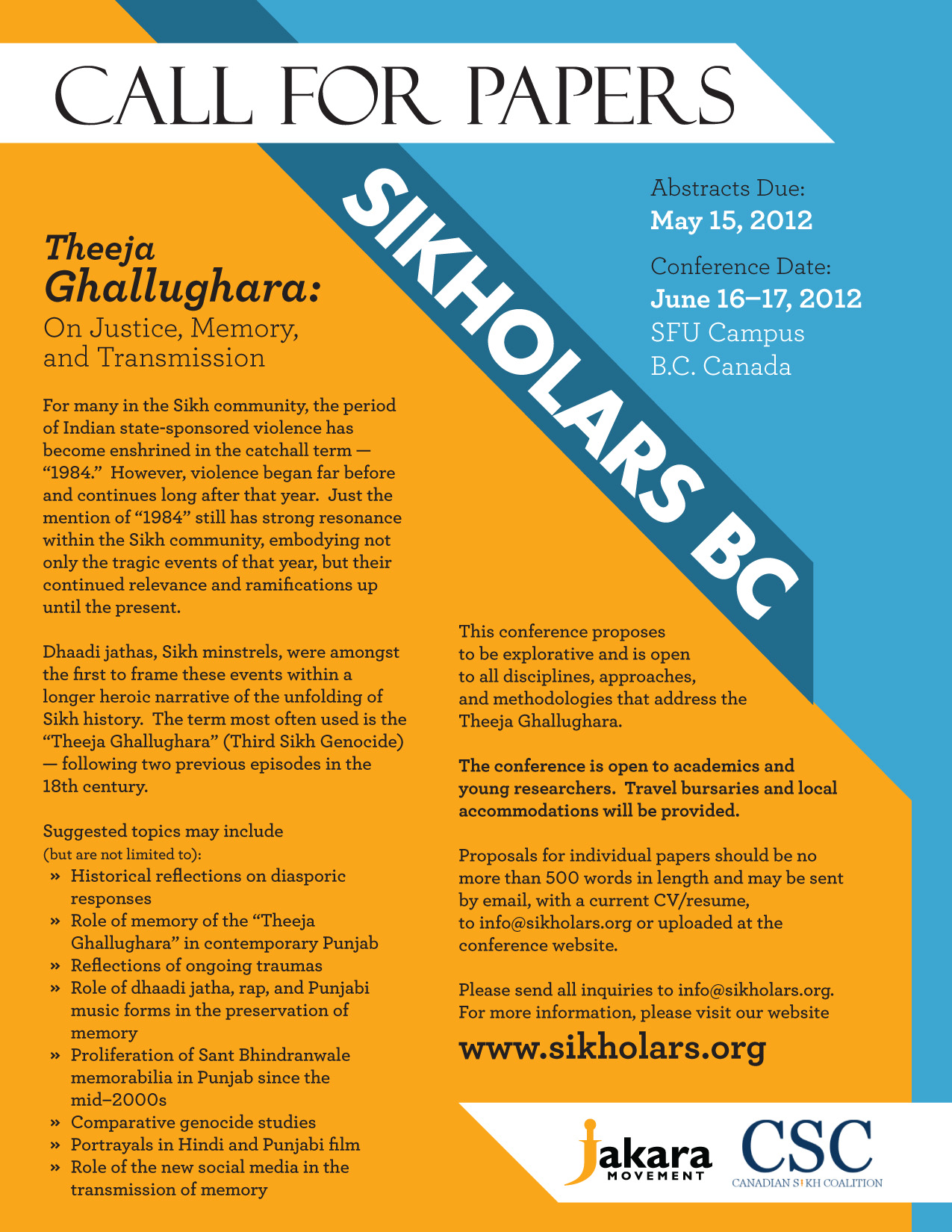 Following the success of the third Sikholars conference in February, the Jakara Movement is allying with the Canadian Sikh Coalition to bring the conference to British Columbia.
This unique forum brings together researchers, budding scholars, and community members in conversations about some of the most pressing issues. For this year’s inaugural conference, a theme has been selected: Theeja Ghallughara: On Justice, Memory, and Transmission. The conference will be held at Simon Frasier University from June 16-17, 2012. Please help circulate and encourage young scholars to send their abstracts before May 16, 2012 for consideration.
The scope of the conference is global; papers may concentrate on particular localities or regions, or they may present cross-regional comparisons and convergences. We encourage submissions from a broad range of disciplines, methodologies, and perspectives. All approaches will be considered – from medicine, to law, to history, sociology, media studies, etc. so long as they are related to the theme.
You can get more information about the conference at the Sikholars website.
In a previous post, I reflected on attending the Sikholars Sikh Graduate Student Conference at CSU East Bay in Hayward, California a few weeks ago. I commented on the first day’s presentations and panel discussions and now offer the same for the second day. As before, I will refer to Jodha’s post that provided a recap of the conference and also to the papers that were presented this year made available on the Sikholars website for a limited time.
Day 2 of the conference was very thought-provoking, and both reinforced and challenged some of my perspectives.
 The Sikh American Legal Defense and Education Fund (SALDEF) has announced the application for the 2012 SikhLEAD Internship Program. The objective of SikhLEAD is to inspire, train, and support motivated and enterprising young Sikh American leaders as they prepare for a lifetime of community engagement and community leadership.
The internship program is aims to put Sikh American college and graduate students, as well as recent grad, in competitive internship in the White House, on Capitol Hill and government agencies. Through this program, students will be afforded first-hand perspective into the functioning of the federal government, as a way of providing experience-based training to individuals interested in civic engagement and government affairs.
Through the experience of interning in a congressional office, interns will:
- explore a potential career track
- create a network of professional and personal contacts
- develop real-world skills
- build confidence and professional work habits
The application deadline for summer 2012 internships is THIS SUNDAY, Feb 26th, 2012!
Visit www.sikhlead.org for more details and to apply. Spread the word and tell your friends about this exciting opportunity.

(photo: Twitter user @ksalag)
I would like to follow up on Jodha’s recap of the third annual Sikholar’s conference that took place this past weekend at California State University, East Bay (in Hayward, California). I had attended the previous conferences in 2010 and 2011 and was happy to attend this year’s event. I’ve enjoyed all three of these meetings of the mind immensely, and I believe the 2012 iteration was a raising of the bar in the discourse it brought forth about our community and faith group.
What follows are some of my own reflections of the presentations and panels as a member of the audience.

Since the inception of Sikholars: Graduate Sikh Conference, we have featured it here on The Langar Hall. The past two years have been huge successes and the third year will prove no different. A terrific agenda of evidence and research-based topics, as well as current thinking and new ideas will be presented by graduate students and professionals in various fields to challenge you and get you thinking.
As always, this year, Sikholars will offer a balance of well-known experts along with new faces and a stronger international representation. Students and professionals will come together from all across the globe and have the opportunity to learn from each other, to interact and form personal and professional relationships and to focus on learning and spreading knowledge.
Everyone is invited to come to CSU East Bay on February 18th & 19th, 2012. For more information: www.sikholars.org
Below the fold, I’ll post the abstracts of this year’s presenters.

