
Interview with Shonali Bose, director of Amu and Margarita, with a Straw
Shonali Bose, writer and director of the acclaimed 2005 film Amu (which powerfully uncovered the brutal realities of 1984) has just 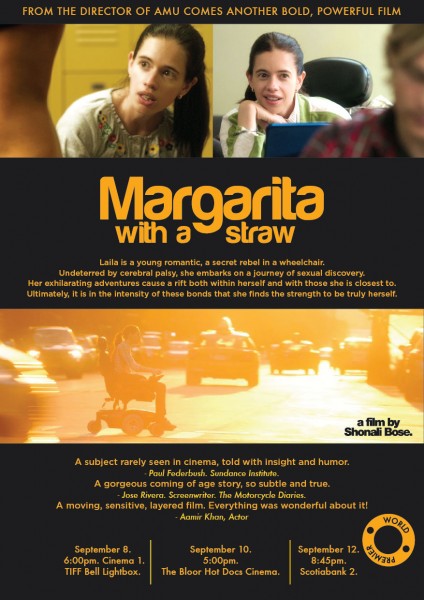 completed a new feature film called Margarita, with a Straw. Premiering next week at the Toronto International Film Festival, the film is a coming of age love story about a part-Sikh college student from Delhi named Laila who has cerebral palsy.
Given the popularity of Amu in the Sikh community, I wanted to interview Shonali about her new film, which explores equally important issues to those brought up in Amu—disability and sexuality among them. Read on for the full interview, and check out the trailer here.
What inspired you to make Margarita, with a Straw?
This my second film, which is inspired by my cousin sister Malini who has acute cerebral palsy. That’s a condition where the part of your brain that controls your motor skills is damaged at birth. But your emotional and intellectual abilities are intact. When I was 40 and Malini was 39, I asked her, what are we going to do for your 40th? It’s absolutely the best birthday. Her speech is usually garbled and difficult to understand. But sometimes when she is angry or excited – it comes out crystal clear. This was one of those times. She banged her fist on the table and spoke loud and clear: I just want to have sex by the time I’m 40! I grinned sheepishly and assured her it was not what it was made out to be, etc. But later when I was thinking about what she said, what she so passionately wanted – I realized that I had never thought about her sexuality much. Or maybe I just avoided it as I didn’t know what to do about it. This started me on my journey of Margarita.
As I started exploring my fictional character and her issues, the big question that came up was one of self worth. This is a core issue that everyone faces, whether one is disabled or not. From there it went to a place of finding deep self acceptance and self love.
I loved your first film, Amu, which powerfully highlighted the anti-Sikh pograms of 1984 through the eyes of a young Sikh woman. The main character in your new film is also a Sikh woman. Where does your interest in telling “Sikh stories” come from?
I don’t see them as Sikh stories at all. The 1984 genocide is a watershed in the entire subcontinent. Like Partition. I made a film about it because no one had and it was covered up. And this history had to get out. To me, this is not a Sikh issue. It’s an Indian issue. Thousands of innocent people being killed in the capital city in broad daylight, organized by those in power—30 years later justice still not delivered. Every justice loving Indian—every Indian who cares about right and wrong and about their country—should be as bothered by this issue as those who were made victims. That was the aim of Amu. In fact, the leads are all Bengalis. It’s only in the end that the lead protagonist, raised as a Hindu Bengali, finds out that she is Sikh and wears a kara.
When I was making Amu, the son of one of my investors—Bhajneet Singh Malik—told me that he was bothered by the fact that Sikhs are only shown as victims, terrorists, or buffoons in films. That remark stayed with me. It’s a fact. When I started creating characters for Margarita and was thinking of the father’s role, I thought it would be nice if I made him Sikh. As a tribute to Amu. To the community that has given me so much love and support on my first film. Balraj Kapoor is an ordinary middle class father. He also happens to be Sikh. He had a love marriage and married his college mate who is Maharashtrian. The actor playing this role was actually little Amu’s father who got killed in Amu.
Bhajneet also said that he hated when Sikhs were played by non-Sikhs who put a turban on. So it was very important to me once I made this decision to cast a real Sikh. My lead protagonist in Margarita is the daughter of this man, Laila Kapoor. She is half Punjabi, half Maharashtrian. Half Hindu. Half Sikh.



66 Responses to “Interview with Shonali Bose, director of Amu and Margarita, with a Straw”


Very Nice
Nice article, thanks for information, thanks for shearing
Good artcile, but it would be better if in future you can share more about this subject. Keep posting.
Super post. Thanks for sharing.