
[Joint post by Singh and Reema]
The plot is thick. Nearly 100 million Phillipine pesos are at stake (roughly $ 2.2 million USD). Multiple groups of god-father like figures control entourages of loyal henchmen. Money is being used for unauthorized purposes, and powerful figures have put competitors out of play – risking not just the money, but [dun dun dun]…their lives!
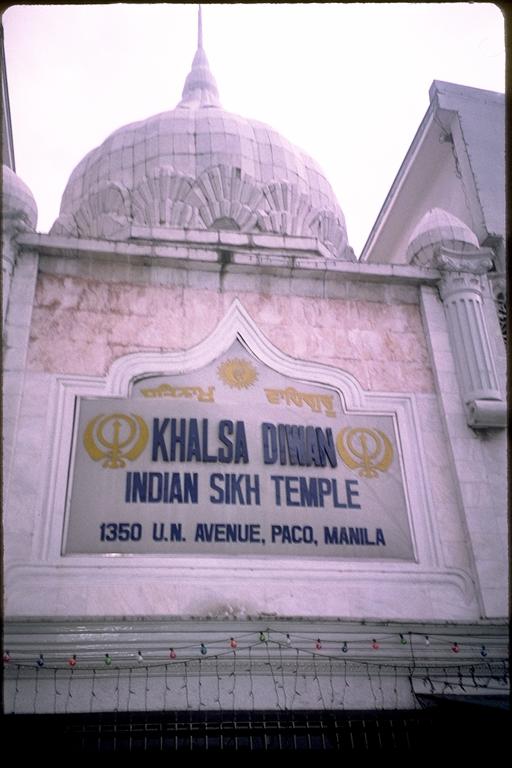
Is this:
(a) The set of Al Capone?
(b) A government paramilitary force under a dictatorship?
(c) The Punjab Police?
(d) Or is it just the story of a gurdwara?
You guessed it: the answer is (d)!
This is the set for the latest episode of “Who Wants to be a Pardhaan (President of the Gurdwara),” and it takes place in Manila, where a battle for control of the local guru ghar has been waged for years. We had heard of this type of thing being publicized in the West (Europe and the Americas), but why should the Phillipines be any different – and undoubtedly this story has just as much drama and un-Sikh-like behavior as any we have heard. It goes something like this:
2004: Bansal became Gurdwara president following a court-supervised elections. After coming into power, he looked into organization’s assets and found that Amardeep’s group (the old committee) had siphoned off P30.6 million from Gurdwara donations to a new corporation they had created—Khalsa Diwan (Sikh Religious Association) Inc.
For many of us Sikhs of Panjabi-background, those Sikhs that chose to embrace Sikhi (often termed as ‘goray Sikhs’, but by no means are all of them of such ‘gora’ background) are sometimes seen as an enigma. Too often stereotypes and easy labels such as ‘hippie’ or ‘weird’, knee-jerk opinions on ‘yoga’, or even a certain ‘guilt’ in terms of our own relationship with our Guru tend to be expressed in hushed tones. 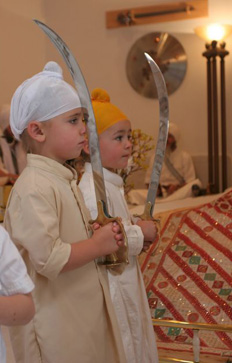 However, such labels only dehumanize those that we should be most embracing as brothers and sisters of a shared Guru.
A recent article in a local Surrey newspaper recently has me re-thinking how as a Sikh community we can continue to strengthen our Qaum. Reading about Hari Nam Singh Khalsa’s own evolution was not only inspiring, but also a point for reflection.
The Oakville, Ontario resident is the host of the only English-language program on Canadian television that provides knowledge about Sikhi. His “Insight into Sikhism” airs on Saturday mornings throughout Canada (you can click here for Canadian times and channels). On the show’s website, the program’s purpose is described as:
Each week, host HariNam Singh Khalsa explains aspects of the Sikh religion and its relevance to modern day issues. Insight into Sikhism introduces the core principles of Sikhism in a simple and basic format in English for everyone to understand. HariNam Singh’s mission is to spread the universal teachings of Sikhism to people of all faiths.[link]
Although I have never seen the show (if you have, please do comment and let us know your thoughts about it), it seems like a remarkable and much-needed project.
I got this cute video link via ASATA and wanted to share it with TLH. It talks about Italy’s desi-Sikh minority, relations between Italians and Sikhs, and the role of Sikhs in Italy’s cheesemaking industry

A delegation of representatives for the PSGPC traveled to the U.S. and UK to discuss congregational needs, socioeconomics, and Muslim-Sikh relations in Pakistan [ed note: forgive the confusing grammar from the news source; the translation is imperfect].
The delegation did quite a bit of fundraising, and they stopped to check in with several Sikh “community leaders” throughout California, and elsewhere. Largely these were founders or heads of private non-profits, not congregations. It’s hard to discern what actually happened from the news coverage, which focused on explaining “those wacky” Sikhs. However, the group attempted to bring special attention to the disparities in achievement, etc., between Pakistani Muslims and Sikhs.
I finished the article with many more questions than when I started reading it; Why did the committee chose to travel to those two regions? Why were so many of their questions fixated on the ritualistic veins of Sikhi that have begun to penetrate our communities? How did they pick who to visit on their trip? What is the status of Pakistani Muslim-Sikh relations and disparities, today?
Did you hear about this tour from anyone? If so, what did you think?
So recently I came across a blog about all the “Stuff Korean Moms Like”. A Korean girl, Chiyo, who loves her KM (Korean Mom) decided to create this blog “to share the joy and dread of KM”. As I went through the list … I kept thinking about our own PSM’s (Panjabi Sikh Moms) … now now don’t think it’s funny to call our mummies’ PMS that actually stands for Panjabi Male Syndrome!
From corningware to marrying people off and stank eye … I found many similarities between KMs and PSMs (although the differences were stark … I don’t even think many PSMs know what redbean is let alone love it. And when it comes to Jesus … let’s just stick with the Gurus and Waheguruji)!
Inspired by Chiyo’s blog on Korean Moms, let’ start our own list of “Stuff Panjabi Sikh Moms’ Like”! I will begin …
- Tupperware (i.e. I am not just talkin’ about Rubbermaid … I mean sour cream and whipped butter dabhaa). Over time this Tupperware becomes yellow from all the haldhee in sabjis … but soak it in the sun and most of the stains go away. Slowly over time old ones are replaced as new ones are collected.
- Corningware (do I really need say anything more … I think Chiyo’s explanation resonates perfectly with PSMs).
- Zee TV, Sony TV, and Alpha Etc. Punjabi nateekhs (what’s your mom’s favorite soap opera …).
- Noon Dhani (i.e. the steel container with small steel bowls and spoons for all their spices).
- Dhahee (i.e. homemade yogurt … sorry I personally can’t stand the boxed stuff after growing up on my mom’s delicious freshly made dhahee).
- Outrage at the rising cost of Ataa (i.e. flour that is commonly bought at the Indian store to make roti).
- House-walls that are painted hospital white … look how clean and simple they look. The rooms feel much more lighted with this color.
- Overstuffing Family And Friends With Food … lai if they leave your house without a food-coma, they did not have a good-time.
- Cooking your favorite Panjabi dish when you come home from college. It’s a sign of how much she missed you.
- The ten Gurus’ pictures, particularly those of Guru Nanak Dev Ji and Guru Gobind Singh Ji, are the number one home-decorating items.
Please add to the list ( it’s in no particular order)! What do you think Panjabi Sikh Mom’s really like? I know many of you must have your own favorites! 🙂
Disclaimer: Please keep it clean, respectful, and hate-free … I really should not have to say this, but unfortunately in the virtual world people often display a “holds-no-bar” attitude when commenting on issues like this one.
This day marks the 221th anniversary of the signing of the U.S. Constitution.
No matter how much we argue about the details of its meaning today, in the opinion of many, the Constitution signed in Philadelphia on September 17, 1787 represents the greatest expression of statesmanship and compromise ever written. In just four hand-written pages, the Constitution gives us no less than the owners’ manual to the greatest form of government the world has ever known. [Link]
To commemorate this historic day, the U.S. Congress designated September 17 as “Constitution Day” and required all schools that receive federal financial assistance to “provide some educational programming about the U.S. Constitution on or around Sept. 17[.]” Despite the brilliance of the American constitutional system and the congressional mandate for schools to study the Constitution on at least one day, ignorance of the American government remains high. For example:
- When asked to name two of Snow White’s Seven Dwarfs and two of the nine U.S. Supreme Court Justices, 77% of Americans polled were able to identify two dwarfs, while only 24% could name two Supreme Court Justices.
- 73% of those polled [were] able to name all three of The Three Stooges, while only 42% could name the three branches of government. [Link]
Further, more American teenagers
- know the Fresh Prince of Bel-Air than know the Chief Justice of the Supreme Court (94.7% to 2.2%)
- know which city has the zip code “90210” than the city in which the U.S. Constitution was written (75% to 25%) [Link]
These and similar statistics should alarm Americans and they reflect the need for greater civics education in American schools. But we should not think that this is a concern from which Sikhs are exempt.
In light of the Indian government’s response to this past weekend’s bombings in Delhi, this video seems especially poignant (not to mention sweeet!).

[hat tip: chapati mystery]
We have had a lot of discussion about the Sikh identity here on TLH, so it is no surprise that when I saw this movie poster I immediately wanted to bring it to your attention.
 Bollywood is doing it again – another movie with Sikhs. But instead of what we have seen in the past with Sikhs often portrayed as unflattering villains and goofballs, it seems that the trend now is to cast people in Sikhs roles where the Sikhs are the heroes. I suppose it is partly in that spirit that the movie is called “Heroes.”
Heroes is about two friends who journey through India meeting everyday heroes, at least one of whom is a Sikh. But that is not the part that interested me of course. The interesting part is not the story line, but all of the press that Salman Khan (the actor who plays a Sikh hero) has gotten for his attempt to play a real Sikh.
Salman Khan [is] seen in a Sikh makeover for the first time ever and he makes a good looking jatt Sikh with a beautifully tied turban. He grew his beard for three weeks before the filming for an authentic bearded Sikh look. Source.
I think this is probably the first time that I have heard this happening. Although, I think actor Sunny Deol may have grown his own beard for a couple of his roles as a Sikh – it has never been so explicitly commended or publicized. I’m not sure how I come down on this, but all the press does point to a deliberate effort by Bollywood to NOT-offend Sikhs, which I think is a positive move on the film industries part.
Update: wow, I did an AWFUL job of summarizing SRI’s first webinar. (Apologies to the good folks at SRI) Here’s a better summary:
Sikh Theology – A Gurmat Framework: The first session comprised of introducing an approach to Sikhi and recognizing how Guru Nanak Sahib revolutionarily delivered a message of Oneness through illustrating a direct connection between ideas and practice. We engaged in understanding what ‘Guru’ means in the Sikh context and how we can begin to comprehend the Guru’s wisdom, Gurmat. To develop this understanding, three facets of bani (scripture), tavarikh (history) and rahit (lifestyle) were introduced. The greatness of a religion is when harmonious balance between Ultimate reality and visible form is exemplified thru the aforesaid facets. We concluded with Puran Singh’s rendering on the Guru’s vision, “It sweetens you and your sweetness sweetens all life around. At your sight, the lamb and the tiger must drink at the same pool.”
And some info on session 2:
Bani – The Message: In session two, we continued to build on our understanding of the Guru’s message; We engaged in actively learning about the scriptural canon, the Guru Granth Sahib. In covering topics as the compilation, contributors, structure, language and content of Guru Granth Sahib, we tackled questions such as, “How do we know Guru Granth Sahib is the Guru?” and “What is the Sabad Guru?”; thus, facilitating and inspiring us to continue to build our personal relationship with Guru Granth Sahib.
And 3:
Tavarikh – The Revolution: Having concentrated on the written form of our Guru’s message (Bani) last week, this week in session three, “Tavarikh – The Revolution”, we will turn our focus on to how our Gurus exemplified The Message. We will walk through the lives of Guru Nanak Sahib through Guru Gobind Singh Sahib and try to understand them through a social, political, economic and spiritual framework. We will cover a range of issues, from touching on the ramifications of negating the need of a Divine intermediary, to the economic center created by the Guru Sahibs, to the activism of both social and political kind. In surveying the inspiring history of our Gurus, we hope to remind ourselves of how relevant, active and exemplary the revolution of Sikh? is.
Jagmohan Malhi has become New Zealand’s first officer to wear the custom police turban. Following in the footsteps of the British constabalry (who also have specially tailored turbans), and the MTA, New Zealand  adopted the new attire after Malhi’s campaign to include the turban in the uniform.
Interestingly, Malhi discusses the many challenges and accommodations he’s made since coming to the New Zealand, including cutting his kes and dari when he first arrived. I found this move towards practice really interesting; Malhi mentioned that he wanted to make this possible out of respect for his dying father’s wishes.
Is this the “right” rationale for this move? On one hand, I think it’s admirable and important for there to be the option and existence of visible Sikh officers in New Zealand’s police force. On the other hand, how do we make this possible, and how do people come to this place?
In the past, several posts have focused on the work of the Sikh Coalition around community mobilization to fight school bullying and the launch of an educational tool.  As part of the Sikh Coalition’s on-going work, it has opened a new office in Northern California to provide coast–to-coast civil/human rights advocacy for Sikhs. On September 10th, over 100 attendees, including local community members and politicians, celebrated the Sikh Coalition’s office opening in Fremont, California.
The Coalition’s, Western Regional Director, Neha Singh, said:
“Fremont is nationally the heart of the Sikh community … since we started, we’ve always taken cases from around the country, and a large amount of them were from the Bay Area. We thought it was now time to open an office in an area where a lot of the people requesting our services were.”
On September 19, a full bench of the Punjab and Haryana High Court will begin hearing arguments to decide the constitutional contours that define a Sikh under the Gurdwara Act of 1925. The decision will have important consequences, such as whether sahajdhari Sikhs ought to have voting rights in SGPC elections.
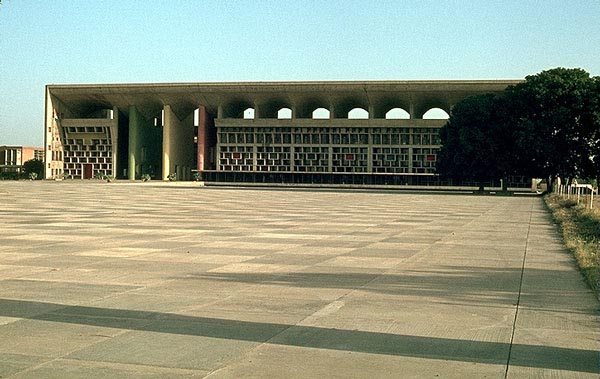 I’m not completely sure how the courts in India work, but the full bench seem to be joining two unrelated cases, that both turn on the definition of a Sikh, under the Gurdwara Act of 1925.
One:
. . . a plea filed by Gurleen Kaur whose candidature for an MBBS seat in the SGPC-run Guru Ram Dass Institute of Medical Education & Research, Amritsar had been rejected. . . Significantly, the college had a 50 per cent quota for Sikhs but Gurleen was denied the seat on the ground she did not fit the “definition of a Sikh in the purest sense of the term”. In fact, she was dubbed a ‘patit’ Sikh, a term referring those Sikhs one trim their hair or pluck their eyebrows. [link]
The Sri Guru Granth Sahib World University, a project that has the potential to be groundbreaking, was announced in September 2004. As it’s currently being presented, it’s quite an ambitious project. From announcements, it seems that at least in its planning phases, a truly comprehensive education will be offered.
Contrary to popular perception, the university will be in keeping with modern times and trends, and besides a school of religious and civilisation studies, the institution will also have a school of emerging technologies, school of basic sciences, school of management, school of social sciences, school of arts, school of languages, school of engineering, school of architecture and planning and school of law and social justice.
Talking to TNS, university vice-chancellor Jasbir Singh Ahluwalia said the varsity would neither be religion-based or religion-dominated. The university would take up the teaching of emerging technologies like information technology (IT), biotechnology (BT) and nano-technology, besides other emerging disciplines like ecology, human rights, feminism and empowerment of downtrodden, he said. [link]
The proposed university’s forward-looking goals make me hope that it actually materializes. It strives to address the role that Sikhi should and does play in the 21st century.
Once upon a time, a fellow langa(w)riter commented that you know you’ve made it as a ‘notable’ community, when you are featured on the game-show Jeopardy.
While she may or may not have been right, in today’s consumerist I think when a member of your own has a potato chip named after them that social recognition  grows near.
Cricket has never featured very prominently at The Langar Hall, possibly as many commenters have noted, the current American-bias of this young blog. Despite the blog’s current limitations (which we do hope to change in the future), sometimes cricket does make it to our attention, albeit in ways still tied to the diaspora.
A recent article in a Californian newspaper discusses cricket’s popularity. Cricket aficionados have been gathering for years on weekends to come together to play cricket. From software engineers to truck drivers from small store owners to behavioral technicians, sports is one of those rare fields that maintains the potential to bring scores of people together. Although still hardly a blip in the American sporting world, cricket’s popularity continues to blossom:
Public intellectual Patwant Singh observed that Sikh immigrants have “not only prospered in business, industry, and the professions; they are also beginning to participate in the political life” of their adopted homelands. Case in point — Harmeet Kaur Dhillon is currently seeking a seat in the California State Assembly (from the 13th district no less, which covers several prominent San Francisco neighborhoods).
Harmeet’s web site indicates that she has exceptional academic credentials, extensive experience as an attorney, and has been at the forefront of important social issues, especially and including domestic violence in the South Asian community.
Of course, I mention Harmeet’s candidacy here not because of her C.V. or platform, but, let’s face it, because she’s a Sikh. That said, while having more Sikhs in elected public office is important, it does not follow that a Sikh should be supported simply because he or she is Sikh.
[updates in italics]
The New York City school system has established a new process for reporting bias and bullying, prompted partially by Sikhs marching in Queens, led by the Sikh Coalition, two months ago. 1.1 million students will be affected by the new regulations. 
The new regulation — which is intended to prevent bullying based on a student’s ethnicity, national origin, religion, gender, sexual orientation or disability — comes two months after leaders of the Sikh population marched in Queens to protest attacks against Sikh students and what the leaders described as a lackluster response by the public school system. [link]
What is this new regulation? It includes several important provisions:
- Every principal must designate a staff member to whom students can report bullying and harassment episodes.
- A new e-mail address — RespectForAll@schools.nyc.gov — has been set up so that students who have been harassed, but do not feel comfortable reporting it to their school, can seek help.
- Each school must create an annual plan “to ensure that it has a safe and supportive learning environment,” and train students in the new rules so that they understand what behavior is prohibited and where to go for help if they have been bullied.
- Schools will have to report all complaints of harassment, intimidation or bullying within 24 hours, and conduct full investigations, including interviews and written statements.
- A full investigation of an incident within 5 days
- A written report for the alleged victim of the results of any incident within 10 days
- School staff members who witness or are told about bullying episodes must report them, and schools must contact the families of accused students. [link]
It seems that “Respect for All” will be a idea promoted by NY schools this coming year, and trends in bias-related bullying will also be tracked.
Newspapers in Panjab have been buzzing about the recent proposal by the Sikhs in Haryana to form their own Gurdwara political body. However, the Chief Minister of Punjab, Parkash Singh Badal, and head of the Akali Dal has been on a warpath trying to prevent such a move. Badal even went so far as to give a sort of veiled threat of the outcome by such a move:
“We are a peace-loving community and hope that attempts to open a fresh festering wound in the country in Punjab would be dropped. The whole of country is already up in flames and it can easily do without another trouble spot in Punjab along the lines of Jammu and Kashmir.” [link]
The problem with forming an opinion or even coming to terms with the situation is the layers of political intentions and motives. In a move to somewhat demystify and explain the situation, I write this post.
Here at TLH we’ve have lengthy discussions about the potential commodification of religious symbols and also about problematic media representation of groups of people. So, I thought that the recent hoopla over the questionable photo shoot in the August issue of Vogue India would be a colorful addition to those discussions. The New York Times reported that,
Vogue India’s August issue presented a 16-page vision of supple handbags, bejeweled clutches and status-symbol umbrellas, modeled not by runway stars or the wealthiest fraction of Indian society who can actually afford these accessories, but by average Indian people. [link]
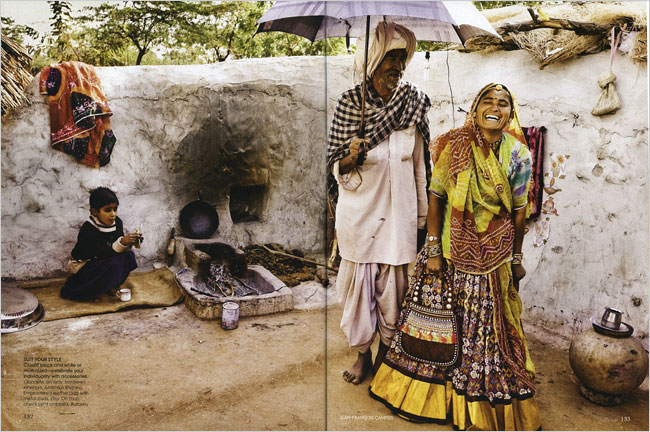 In one picture, a older poor woman holds a small child wearing a Fendi bib (cost = $100), in another pose a family preparing for their daily commute, sits on a motorbike with the mother riding the traditional sidesaddle way… oh and with her Hermès Birkin bag (cost = $10,000) on her wrist. Then of course, there is the turbaned man who models a Burberry umbrella (cost = $200). The photo spread itself is definitely striking. However, knowing that many Indians live on less than a dollar a day is even more striking when put in context with these exorbitant goods. The debate has raised questions from both sides of the table. Those that believe the photo shoot was distateful and that it exploits the poor by using them as props. Then there are others who believe this juxtaposition of wealth against poverty is a reality in India and exactly what people need to see.
An Australian private school has agreed to apologize to a Sikh boy who was denied admission for his refusal to cut his hair and shave (as required by the school dress code). Surprisingly, this is the first time Australia has faced an anti-discrimination case of this nature:
The Anti-Discrimination Tribunal case was the first of its kind involving a Sikh student in Australia, although a British court found in a favour of a Sikh student in a similar trial more than 25 years ago.
An out-of-court settlement was reached in recent weeks after the school agreed to issue a public apology and pay the family undisclosed compensation. Ormiston College yesterday confirmed the settlement, which thwarts a public trial in the tribunal next month.
Australia has a system of minority rights protection that falls broadly under the “multiculturalist” umbrella (albeit in a very different way from the U.K. model). What I find amazing is the broad steps private schools are taking at this juncture to avoid accommodating religious minorities. Like the Sarika Singh case (also involving a private school), both of these schools are, at this point, familiar with its own Sikh community. Cultural competency and latent racism aren’t really compelling or effective screens for bigoted policies. In both cases, families had to turn to a legal remedy (and legal fees) to ensure access to a high quality education for their children.
There’s been a backlash around religious diversity in Western Europe for a while now, with the idea of “secularism” taking on a distinctly anti-religious (or, in most cases, anti-non-Christian-religions) flavor that isn’t really echoed in American conceptualizations of secularism. Do these two school cases mark the beginning of a reaffirmation of the principles underlying anti-discrimination laws? Is this a distinct position from what we see in France, Germany, Turkey and Italy?
Many of you may have already heard about the shooting that occurred on Sunday afternoon at the Sacramento Sikh Society Sports Complex, next to the gurdwara. A cricket match, part of a sports festival, was being held when an ongoing argument took a fatal turn. So far, I’ve seen no news of the substance of the dispute. But the result left Paramjit Pamma Singh (name misreported?) dead, and an unnamed 38 year old man with a leg wound. [link]
Gurpreet Singh Gosal, 24, of Indianapolis, was arrested and booked into Sacramento Main Jail Monday morning for the murder of Parmjit Pamma Singh, said sheriff spokesman Sgt. Tim Curran… The shooting followed an ongoing argument between the victims, Singh Gosal and a second man, according to investigators. The suspect and the second man opened fire on Pamma Singh and a 38-year-old man as they watched a tournament at the Sacramento Sikh Society Sports Complex in the 7600 block of Bradshaw Road about 1:30 p.m. Sunday, Curran said. Pamma Singh died at the scene. [link]
We must find better ways to resolve our disputes. 
Often, I’m proud of how our community quickly takes action when action is necessary, though this weekend’s events illustrate a darker side of this willingness to take initiative. If anyone has more information about the substance of the dispute between the shooters and the victim, please share.
Gurpreet Singh was apprehended by other spectators and athletes who beat him into submission with cricket bats and hockey sticks until the police arrive.

