
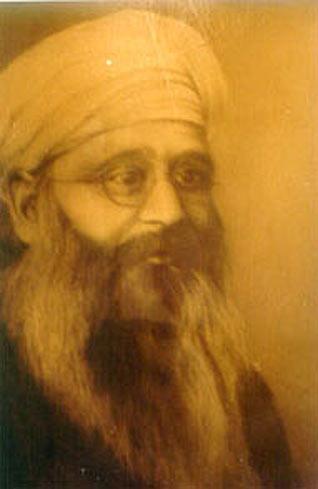
 The digitization of books has created a whole new way for Sikhs to access their history. I’ve stumbled onto a lot of historical Sikh literature that I had never heard of. For example, through Google’s Book Search function, I discovered a tourist guide to Punjab from the 1880’s (here’s an excerpt on visiting Amritsar).
Over the holidays, I found a scanned version of a first edition of The Life and Teachings of Sri Guru Tegh Bahadur. It was written by Puran Singh and published by The Khalsa Agency in Amritsar in 1908. Puran Singh has a way with words like no other Sikh author I’ve ever encountered. His books The Spirit Born People and The Ten Masters are essential readings for anyone interested in Sikhi. In his book on Guru Tegh Bahadur he writes:
He looks upon the world with that far-seeing vacant eye with which a mariner, having lost his boat, looks upon the broad sea, seated on a rock in the middle dashed by the waves of the angry sea. The world to him is lost in the constant vision of the higher Reality of its soul. There is an intense spirit beating within his heart, which weeps ard cries at the sight of a man who is lost in the tempest of passions and remembers not the glorious life of his beyond this little life and the glorious inheritence of his in ideals of God, Love, and Truth.
He is a high abstraction in the love of God, and whenever a single thought of the world lowers his consciousness from those ethereal heights, he at once sings of God-consciousness and soars again.”Remember thy God, remember thy Lord, this is thy one duty, thy only duty,” says he.
However, what I really want to share is his opening introduction. The words are 100 years old, but just as or probably more relevant today.
In a significant development, the Government of Iraq has decided to rebuild the 15th century Sikh Guru Guru Nanak Dev’s shrine which was destroyed in the 2003 war in Baghdad. [link]
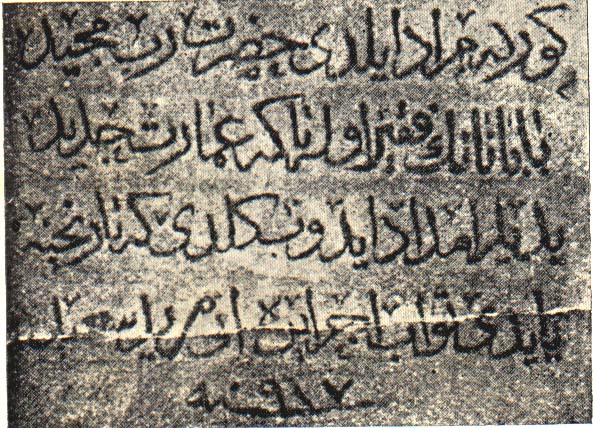 Guru Nanak Dev Ji is said to have visited the place on his way back from Mecca where he stopped to speak with religious leaders including the caretaker of the mausoleums of Abdul Qadir gilani and Bahlol the Wise, who were greatly impressed by his views on God and religion. A monument, in the form of a platform, was raised where Guru Nanak had sat and provided these discourses. It is documented that Sikh soldiers who went to Iraq during the First World War, 1914-18, raised a Gurdwara here, but now only a room exists which is visited by Sikh and non-Sikh Punjabis who work in Iraq. In addition, it is noted that since the gurdwara is located within a graveyard, visitors are banned from staying overnight, cooking meals or holding Langar and Kirtan. I was not able to locate any information regarding who is currently in charge of the gurdwara or what the dynamics of the gurdwara are (without Langar or Kirtan). I do wonder if a Guru Granth Sahib is kept there and, in that case, who does the seva.
 My Nana Ji (maternal grandfather) often says: “Ja savair da bhulia, shaam noo ghar muriavye, ta oh nu bhulia nehee keheeda”. That if one is lost in the morning, but finds his way home by evening, he’s no longer lost. Hopefully that’s the case with Sikhs and their preservation of history and architecture.
Over the years, well-intentioned but individuals kar sewa babas took on the responsibility for the renovation and expansion of Sikh religious institutions across South Asia. Unfortunately, in almost every case, they lacked any expertise in preservation and caused way more harm then good. The result has been, literally, a whitewashing of Gurdwaras. With an “out with the old and in with the new” attitude, old historical structures have been torn down, modified beyond recognition and historical paintings and frescos have been painted or tiled over.
For me the most shocking example of this came from the Baba Atal tower in Amritsar, where hideous green bathroom tiles (that no self-respecting homeowner would ever use) were installed over top of century-old paintings. Here is pic that were sent my way a few years back.
Thankfully, someone has woken up to the fact that bathroom décor isn’t the best way to preserve our history for future generations.
The heritage experts engaged by the SGPC and the district administration have found priceless frescoes from the first floor of Baba Atal, the tallest building of Amritsar, hidden under bathroom tiles put up by Sikh Babas during previous kar sewa.
The art work is exquisite. Most of the art work, hidden during the kar sewa can be retrieved though it requires extra care and expertise. The experts are careful that further damage is not caused while removing marble or bathroom tiles.
Earlier, the SGPC had entrusted kar sewa to the Sikh Babas who had “destroyed” the Sikh heritage, much to the chagrin of experts. Deputy commissioner Kahan Singh Pannu today held a meeting with experts in the Golden Temple complex after monitoring the restoration work of Baba Atal and Ramgarhia Bungas.
Earlier, the kar sewa, carried out to repair age-old murals at Gurdwara Baba Atal, had earned flak from heritage lovers. Interior walls of the first floor were adorned with murals depicting Sikh history. About 100 panels of murals had been left on the first floor of the gurdwara, while the rest of them had been destroyed beyond recognition. Link
This is an area where the Sikh diaspora can have a direct impact. Most kar sewa efforts are highly dependent on dollars and pounds coming in from abroad. Before giving from your dasvand to these causes, please make sure and find out what the project is actually doing. The last thing anyone wants to further devastate the little physical we have left.

