
Update: The Flying Sardar?
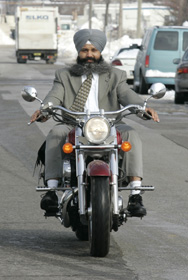 UPDATE: Canadian courts ruled against Baljinder Singh’s request for a religious exemption to its mandatory motorcycle helmet law. While the court found that the law DID violate his right to religious freedom, they felt that the net benefit to the country’s healthcare system justified such an infringement [Globe & Mail]. The court also argues that failure to wear a helmet raises the potential for emotional risk and trauma should Mr. Singh — and other Sikhs — suffer injury in a collision. I found the last point a little weird; was the court attempting to avoid civil suits against it for negligence or some other such duress (lawyer-readers, can you help me out here)? Mr. Singh will be appealing the Ontario decision.
</update>
We saw this story last week, but I wanted to comment on the recent coverage of a kesdari Sikh who challenged Ontario’s motorcycle helmet statute under grounds that it is unfairly applied to turban-wearing Sikhs [cite 1, cite 2]:
Ontario Court Judge James Blacklock was told yesterday that, in order to disprove a Crown theory that turbans unravel at high speed and cause accidents, Mr. Badesha drove around Cayuga Speedway at 110 kilometres an hour… Mr. Badesha and the human rights commission maintain the helmet law discriminates against Sikhs because their religion obliges them to cover their long hair with nothing more than a turban.
Apparently the twist in the story has shifted from whether a religious exemption is ok to whether the disproportionate likelihood of injury, and the assumed increased cost to Canada’s public health care system, warrant an exemption. From a panthic perspective, Mr. Badesha’s objection to the mandatory helmet law is reasonable and justified.
However, we know from experience that other countries have adopted differing approaches to the Sikh right to maintain his/her uniform. In the United States, courts and commissions have ruled in both police departments and city agencies that wearing the turban does NOT violate uniform policies, and that creating policies without accommodation violates individuals’ right to the free exercise of religion. Conversely, in France an uber-strict ban on “religious articles” (barring, of course, “minor” Christian pieces) has led to a series of disputes about the role of religion in public space.
Sikhs face various challenges when trying to explain accommodation and observance in regions where Sikhi is not the default or majority faith. So we have a few questions at play here:
- Would this issue be moot if Canada did not have public health care?
- Would attitudes towards “minority accommodation” differ if the default understanding of faith had a normalized view of religious uniforms?
- Given that, in the U.S. and Canada, Sikhi is still not understood as a mainstream faith, what are tools, analogies, and explanations Sikhs could use to help explain the context and motivation for our religious requirements and observances?
- What qualifies as accommodation, and what is seen as “normal”?



91 Responses to “Update: The Flying Sardar?”


As Jodha writes the fundamental purpose of a Kirpan is,
Then Ruby, doesn't:
undermine that very purpose of wearing a Kirpan symbolically and practically? I would argue it does! Hence, it's not an argument of: "give and take in a multicultural society", but fundamentally being able to practice the Sikh faith.
As Jodha writes the fundamental purpose of a Kirpan is,
Then Ruby, doesn’t:
undermine that very purpose of wearing a Kirpan symbolically and practically? I would argue it does! Hence, it’s not an argument of: “give and take in a multicultural society”, but fundamentally being able to practice the Sikh faith.
That is one way to look at it. However, I was always under the impression that the kirpan was more of a nishaan (symbol), rather than something to be practically used. I think that this is where Ruby is coming from.
The kirpan did have practical uses in earlier times in India, but times change and society changes. I don't think there is a practical use for the kirpan in everyday Western society. When you say that having a non-weaponized Kirpan is unpractical, you are implying that Sikhs should be using it in everyday situations where deemed necessary (e.g. preventing assaults, bank robberies, etc).
That being said, I believe I'm speaking with a Canadian bias, as we tend to frown more upon weapons in public. In U.S., there is much more of a "right to bear arms" culture, and in that case, I don't see why carrying a kirpan in public would be in contradiction to any norms since people are allowed to carry concealed firearms in many states.
That is one way to look at it. However, I was always under the impression that the kirpan was more of a nishaan (symbol), rather than something to be practically used. I think that this is where Ruby is coming from.
The kirpan did have practical uses in earlier times in India, but times change and society changes. I don’t think there is a practical use for the kirpan in everyday Western society. When you say that having a non-weaponized Kirpan is unpractical, you are implying that Sikhs should be using it in everyday situations where deemed necessary (e.g. preventing assaults, bank robberies, etc).
That being said, I believe I’m speaking with a Canadian bias, as we tend to frown more upon weapons in public. In U.S., there is much more of a “right to bear arms” culture, and in that case, I don’t see why carrying a kirpan in public would be in contradiction to any norms since people are allowed to carry concealed firearms in many states.
Aman,
You write:
For myself, the symbolism and practicality are not mutually exclusive. They share a very intimate relationship in terms of Sikh belief. How can we talk about a Kirpan representing self-defense and protecting those who are being oppressed (we know oppression is not always words, but physical force that requires physical force in-return to fight it) if we ask Sikhs to carry a blunt kirpan that must remained sheathed? This is not a question of Western-society’s “civilized” behavior and Eastern “barbarianism” (I knew of a Granthi who had to use his Kirpan when his newly arrived family from India was about to be violently attacked in the United States), but of the interrelationship between religious ideology and practice. Furthermore, the use of the Kirpan is a last resort-method of self-defense … maybe that's why, as P.Singh argues, there are not many documented cases to exemplify it as a common or semi-common occurrence that should cause so much fear.
If it is just about symbolism, then would you be content with asking those who carry the Kirpan as a religious symbol to put on a Kirpan sticker?
Aman,
You write:
For myself, the symbolism and practicality are not mutually exclusive. They share a very intimate relationship in terms of Sikh belief. How can we talk about a Kirpan representing self-defense and protecting those who are being oppressed (we know oppression is not always words, but physical force that requires physical force in-return to fight it) if we ask Sikhs to carry a blunt kirpan that must remained sheathed? This is not a question of Western-society’s “civilized” behavior and Eastern “barbarianism” (I knew of a Granthi who had to use his Kirpan when his newly arrived family from India was about to be violently attacked in the United States), but of the interrelationship between religious ideology and practice. Furthermore, the use of the Kirpan is a last resort-method of self-defense … maybe that’s why, as P.Singh argues, there are not many documented cases to exemplify it as a common or semi-common occurrence that should cause so much fear.
If it is just about symbolism, then would you be content with asking those who carry the Kirpan as a religious symbol to put on a Kirpan sticker?
Aman, I would argue that the kirpan should NOT be worn purely symbolically. It is meant for practical use (it is a weapon, but it is a weapon which can only be used in self defense as a last resort). By that same note, Sikh martial arts (e.g. gatka) also develop in the same context as the need for the kirpan — that you should be able to physically resist oppression and defend justice when required. In my view, the kirpan is fundamentally rooted in the concept of sant-sipahi, and so long as there is injustice and harm in the world, there will be a need for physical defense.
Aman, I would argue that the kirpan should NOT be worn purely symbolically. It is meant for practical use (it is a weapon, but it is a weapon which can only be used in self defense as a last resort). By that same note, Sikh martial arts (e.g. gatka) also develop in the same context as the need for the kirpan — that you should be able to physically resist oppression and defend justice when required. In my view, the kirpan is fundamentally rooted in the concept of sant-sipahi, and so long as there is injustice and harm in the world, there will be a need for physical defense.
Phulkari,
That's an interesting perspective, but that requires the weaponization of the kirpan. I believe most court victories by defendants who want to wear the kirpan have relied on the fact that the kirpan is strictly to be interpreted as a religious symbol. Specifically, from the following court case:
http://en.wikipedia.org/wiki/Multani_v._Commissio…
The Court replied it was untrue that the kirpan represented violence, and that it had religious meanings instead.
I do not believe that the defendants in this case had made the argument that the kirpan was also to be used for self-defense or for helping those in need. Of course, had they made this argument, they would have been much less likely to win the case. This means that they either
a) Believed that the kirpan was for religious symbolism only
b) Were being disingenuous in their argument in court
If they choose to wear a kirpan sticker as their symbol, then that's their choice. It doesn't matter to me if their symbol is a sticker, a kirpan carved out of wood, a plastic kirpan, a dull metal kirpan, etc. It only becomes a public issue if the kirpan can be used as an actual weapon in public venues.
Phulkari,
That’s an interesting perspective, but that requires the weaponization of the kirpan. I believe most court victories by defendants who want to wear the kirpan have relied on the fact that the kirpan is strictly to be interpreted as a religious symbol. Specifically, from the following court case:
http://en.wikipedia.org/wiki/Multani_v._Commission_scolaire_Marguerite%E2%80%91Bourgeoys
The Court replied it was untrue that the kirpan represented violence, and that it had religious meanings instead.
I do not believe that the defendants in this case had made the argument that the kirpan was also to be used for self-defense or for helping those in need. Of course, had they made this argument, they would have been much less likely to win the case. This means that they either
a) Believed that the kirpan was for religious symbolism only
b) Were being disingenuous in their argument in court
If they choose to wear a kirpan sticker as their symbol, then that’s their choice. It doesn’t matter to me if their symbol is a sticker, a kirpan carved out of wood, a plastic kirpan, a dull metal kirpan, etc. It only becomes a public issue if the kirpan can be used as an actual weapon in public venues.
Camille,
[quote comment="848"]
Aman, I would argue that the kirpan should NOT be worn purely symbolically. It is meant for practical use (it is a weapon, but it is a weapon which can only be used in self defense as a last resort). By that same note, Sikh martial arts (e.g. gatka) also develop in the same context as the need for the kirpan — that you should be able to physically resist oppression and defend justice when required. In my view, the kirpan is fundamentally rooted in the concept of sant-sipahi, and so long as there is injustice and harm in the world, there will be a need for physical defense.[/quote]
From my perspective, I think it is more important to adhere to the spirit behind a particular requirement, rather than strict adherence to the requirement itself. The kirpan was chosen as the symbol because it was the weapon of choice back in those days, not for spiritually ordained reason. For example, had Guru Gobind Singh Ji ordained the Khalsa today, rather than in 1699, he may have chosen a rifle, because swords/daggers are no longer common amongst militias/soldiers. So the spirit behind it would be the same, but the end symbol or tool would be different. In this scenario, would a real rifle be allowed in public places such as schools? Definitely not, because it would definitely be deemed a security risk.
So how to get around this issue? Perhaps if one truly believes in the spirit of self defense, and saving those from oppressors, one must also engage in alternative methods to complement the kirpan. What if one learns karate, or some other martial art? Possessing this skill would allow one to faithfully fulfill this requirement in situations where a weaponized kirpan would be otherwise unavailable (e.g. a school).
Camille,
[quote comment=”848″]
Aman, I would argue that the kirpan should NOT be worn purely symbolically. It is meant for practical use (it is a weapon, but it is a weapon which can only be used in self defense as a last resort). By that same note, Sikh martial arts (e.g. gatka) also develop in the same context as the need for the kirpan — that you should be able to physically resist oppression and defend justice when required. In my view, the kirpan is fundamentally rooted in the concept of sant-sipahi, and so long as there is injustice and harm in the world, there will be a need for physical defense.[/quote]
From my perspective, I think it is more important to adhere to the spirit behind a particular requirement, rather than strict adherence to the requirement itself. The kirpan was chosen as the symbol because it was the weapon of choice back in those days, not for spiritually ordained reason. For example, had Guru Gobind Singh Ji ordained the Khalsa today, rather than in 1699, he may have chosen a rifle, because swords/daggers are no longer common amongst militias/soldiers. So the spirit behind it would be the same, but the end symbol or tool would be different. In this scenario, would a real rifle be allowed in public places such as schools? Definitely not, because it would definitely be deemed a security risk.
So how to get around this issue? Perhaps if one truly believes in the spirit of self defense, and saving those from oppressors, one must also engage in alternative methods to complement the kirpan. What if one learns karate, or some other martial art? Possessing this skill would allow one to faithfully fulfill this requirement in situations where a weaponized kirpan would be otherwise unavailable (e.g. a school).
Other weapons like gunpowder appeared in India (by way of Moguls) around the 1300-1400's. I would add that Sri Guru Gobind Singh Ji could have chosen other weapons but specifically chose the kirpan as an article of faith for the Khalsa. Additionally, Guru Ji cannot be equated to you or I, that can't see the nature of weapons a year from today.
Other weapons like gunpowder appeared in India (by way of Moguls) around the 1300-1400’s. I would add that Sri Guru Gobind Singh Ji could have chosen other weapons but specifically chose the kirpan as an article of faith for the Khalsa. Additionally, Guru Ji cannot be equated to you or I, that can’t see the nature of weapons a year from today.
You are correct that gunpowder appeared in India at that time, but I believe that the sword was still the predominant personal weapon at the time (somebody can correct me if I'm wrong).
I'm not sure what you mean by the above statement. I believe he chose the kirpan because it was the cheapest, most widely available weapon at the time. He chose a weapon that most Sikhs could actually possess at the time. What other weapon could he have chosen? If Guru Ji had ordained the Khalsa today, I don't see how the kirpan could be chosen as the practical weapon of choice. Sikhs used to go into battle with the kirpan in that era; sending your soldiers into battle today with a kirpan would be suicide.
You are correct that gunpowder appeared in India at that time, but I believe that the sword was still the predominant personal weapon at the time (somebody can correct me if I’m wrong).
I’m not sure what you mean by the above statement. I believe he chose the kirpan because it was the cheapest, most widely available weapon at the time. He chose a weapon that most Sikhs could actually possess at the time. What other weapon could he have chosen? If Guru Ji had ordained the Khalsa today, I don’t see how the kirpan could be chosen as the practical weapon of choice. Sikhs used to go into battle with the kirpan in that era; sending your soldiers into battle today with a kirpan would be suicide.
Aman, I think you're being too restrictive in your definition. A kirpan is a required religious article, and it is a weapon. I understand that classifying in court (as a weapon) may not help someone's case, but I seriously doubt that Sikhs who wear the kirpan with a full understanding of why they wear it are doing so under the idea that it is "purely symbolic" and not meant for use.
I also think it's preferable for Sikhs to be in generally good physical shape and learn self defense via martial arts, also. However, such training should not be seen as an alternative to the kirpan, but rather a compliment. Even within the past 100 years, the concept of holistic physical training and readiness was prevalent among Sikhs. Regardless of the advent of technology, the Khalsa are required to carry the kirpan and to be able to use it. This requirement is upheld both through teachings in the SGGSJi and in the Reht Maryada. I think there are practical explanations for why a person would want to carry a kirpan as opposed to a gun/rifle, as well, but that's another conversation.
It is, in my opinion, a severe limitation of a Sikh's right to free exercise for countries (who can't even agree on what constitutes a proper "right to arms") to attempt to severely limit its wear/use based on mistaken norms or ideas of the kirpan's role and purpose.
Aman, I think you’re being too restrictive in your definition. A kirpan is a required religious article, and it is a weapon. I understand that classifying in court (as a weapon) may not help someone’s case, but I seriously doubt that Sikhs who wear the kirpan with a full understanding of why they wear it are doing so under the idea that it is “purely symbolic” and not meant for use.
I also think it’s preferable for Sikhs to be in generally good physical shape and learn self defense via martial arts, also. However, such training should not be seen as an alternative to the kirpan, but rather a compliment. Even within the past 100 years, the concept of holistic physical training and readiness was prevalent among Sikhs. Regardless of the advent of technology, the Khalsa are required to carry the kirpan and to be able to use it. This requirement is upheld both through teachings in the SGGSJi and in the Reht Maryada. I think there are practical explanations for why a person would want to carry a kirpan as opposed to a gun/rifle, as well, but that’s another conversation.
It is, in my opinion, a severe limitation of a Sikh’s right to free exercise for countries (who can’t even agree on what constitutes a proper “right to arms”) to attempt to severely limit its wear/use based on mistaken norms or ideas of the kirpan’s role and purpose.
I do agree that much of the opposition to the kirpan is the result of racism, xenophobia, and general ignorance.
I'm curious to know if you believe there is any situation/scenario/place where it is OK that the kirpan is disallowed (e.g. plane)?
I do agree that much of the opposition to the kirpan is the result of racism, xenophobia, and general ignorance.
I’m curious to know if you believe there is any situation/scenario/place where it is OK that the kirpan is disallowed (e.g. plane)?
aman,
one of the first things that comes to mind after reading your recent posts is the fact that the guru did not perscribe the symbolism of the kirpan as a kakkar. he perscribed the kirpan itself. for me this is one place where i have to stop and contemplate on if i am following the hukham of the guru. you have made clear that following that hukham, even when possible for you to, is something you are choosing not to do – and that is ultimately your choice.
secondly, your statement above assumes that you know the reason for the kirpan's institution into sikhi. although i respect your learn-ed perspective, i would also like to point to a line written by guru gobind singh ji which equate the kirpan with a spiritual teacher (a pir/peer)- when refering to the kirpan and other weapons guru gobind singh ji in his bani says:
so there is a spiritual link to the kirpan. additionally, the mere fact that it is connected to a religious doctrinal idea imputes a certainly spirituality into the kirpan. finally, let us not forget the swords of miri and piri adorned by guru hargobind sahib ji…one of those was specifically representative of spirituality.
another feeling i had while reading your posts is that – by extension of your practicality argument, all of the kakkars and the dastar can be proven obsolete. this is simply not something i can do. if you accept that the kirpan no longer has a practical significance then what of the kachh and the kanga? there are far "better" ways of staying hygenic than to carry a wooden comb around or to wear a specific type of undergarment. again, these too were specifically prescribed – not merely their symbolism. yes, this is a slippery slope argument, but this is the logical (and dangerous) conclusion of this avenue of thought.
1 – why does it not matter to you? why do you not have a stake in upholding a religious identity or at least respecting it? 2 -why is it the kirpan that you are specifically worried about? others have mentioned that many things can become public issues because they too are capable of being used as weapons. even a dull kirpan can cause a lot of damage. i dont quite get why you are so adamant in your support of limiting the kirpan (and by extension all outward articles that become public issues) and so dismissive about reality. this is honestly mind boggling to me – perhaps you could differentiate for me why you are so passionate about this. from my perspective, it is amazing that the kirpan is a religious article and still has not been the cause of much actual "scare" in the west.
ultimately this is what i am hearing (please correct me if i am wrong) your point – like ruby's – is that if people are ignorant (and get scared or threatened) we need to yield to their ignorance and change our practice of sikhi – the very practice that the guru put into place. i dont see this is as a reasonable option, nor do i see it is as one that fits into the symbolism of the kirpan, which we would all like to uphold.
aman,
one of the first things that comes to mind after reading your recent posts is the fact that the guru did not perscribe the symbolism of the kirpan as a kakkar. he perscribed the kirpan itself. for me this is one place where i have to stop and contemplate on if i am following the hukham of the guru. you have made clear that following that hukham, even when possible for you to, is something you are choosing not to do – and that is ultimately your choice.
secondly, your statement above assumes that you know the reason for the kirpan’s institution into sikhi. although i respect your learn-ed perspective, i would also like to point to a line written by guru gobind singh ji which equate the kirpan with a spiritual teacher (a pir/peer)- when refering to the kirpan and other weapons guru gobind singh ji in his bani says:
so there is a spiritual link to the kirpan. additionally, the mere fact that it is connected to a religious doctrinal idea imputes a certainly spirituality into the kirpan. finally, let us not forget the swords of miri and piri adorned by guru hargobind sahib ji…one of those was specifically representative of spirituality.
another feeling i had while reading your posts is that – by extension of your practicality argument, all of the kakkars and the dastar can be proven obsolete. this is simply not something i can do. if you accept that the kirpan no longer has a practical significance then what of the kachh and the kanga? there are far “better” ways of staying hygenic than to carry a wooden comb around or to wear a specific type of undergarment. again, these too were specifically prescribed – not merely their symbolism. yes, this is a slippery slope argument, but this is the logical (and dangerous) conclusion of this avenue of thought.
1 – why does it not matter to you? why do you not have a stake in upholding a religious identity or at least respecting it? 2 -why is it the kirpan that you are specifically worried about? others have mentioned that many things can become public issues because they too are capable of being used as weapons. even a dull kirpan can cause a lot of damage. i dont quite get why you are so adamant in your support of limiting the kirpan (and by extension all outward articles that become public issues) and so dismissive about reality. this is honestly mind boggling to me – perhaps you could differentiate for me why you are so passionate about this. from my perspective, it is amazing that the kirpan is a religious article and still has not been the cause of much actual “scare” in the west.
ultimately this is what i am hearing (please correct me if i am wrong) your point – like ruby’s – is that if people are ignorant (and get scared or threatened) we need to yield to their ignorance and change our practice of sikhi – the very practice that the guru put into place. i dont see this is as a reasonable option, nor do i see it is as one that fits into the symbolism of the kirpan, which we would all like to uphold.
If someone decided to wear a "sticker" Kirpan, and use that as the symbol, there is nothing anybody can do about it. It is that person's choice, and they have every right to do that in a free society. I'm not sure what you think could be done about this short of performing some sort of vigilante justice on such persons via intimidation and assault under the pretext of defending one's religion.
I don't think I've been writing that passionately about this issue. I'm just exploring all the issues and the ideas that are involved.
No, I haven't been arguing this at all. I'm not advocating yielding to any xenophobia and ignorance (which is the basis for popular opposition). I think we all try educate other people and lift them out of their ignorance as much as possible.
My main point is exploring how the kirpan can represent a security issue itself, despite its religious significance and the intentions behind using it. In certain situations, I am willing to acknowledge that security simply trumps anything else, including religious freedom.
Examples:
1) Boarding an aircraft
2) Secure areas that involve being the vicinity of high-profile politicians (e.g. prime ministers/presidents)
I don't see how the above position makes me passionately against the kirpan.
If someone decided to wear a “sticker” Kirpan, and use that as the symbol, there is nothing anybody can do about it. It is that person’s choice, and they have every right to do that in a free society. I’m not sure what you think could be done about this short of performing some sort of vigilante justice on such persons via intimidation and assault under the pretext of defending one’s religion.
I don’t think I’ve been writing that passionately about this issue. I’m just exploring all the issues and the ideas that are involved.
No, I haven’t been arguing this at all. I’m not advocating yielding to any xenophobia and ignorance (which is the basis for popular opposition). I think we all try educate other people and lift them out of their ignorance as much as possible.
My main point is exploring how the kirpan can represent a security issue itself, despite its religious significance and the intentions behind using it. In certain situations, I am willing to acknowledge that security simply trumps anything else, including religious freedom.
Examples:
1) Boarding an aircraft
2) Secure areas that involve being the vicinity of high-profile politicians (e.g. prime ministers/presidents)
I don’t see how the above position makes me passionately against the kirpan.
Hmmmm…point taken. I see now that you are very supportive of the right to wear a kirpan – so long as people aren't scared of it.
Hmmmm…point taken. I see now that you are very supportive of the right to wear a kirpan – so long as people aren’t scared of it.
[quote comment="860"]
Hmmmm…point taken. I see now that you are very supportive of the right to wear a kirpan – so long as people aren't scared of it.[/quote]
People being scared of it has nothing to do with what I said, as being scared is about emotions.
I am very supportive of the right to wear a kirpan – as long as it does not represent a justifiable security risk in a context where security is paramount.
[quote comment=”860″]
Hmmmm…point taken. I see now that you are very supportive of the right to wear a kirpan – so long as people aren’t scared of it.[/quote]
People being scared of it has nothing to do with what I said, as being scared is about emotions.
I am very supportive of the right to wear a kirpan – as long as it does not represent a justifiable security risk in a context where security is paramount.
So, back to this issue of the helmet –
Does no one else recognize this as a severe safety issue? Motorcycle accidents are among the most dangerous and fatal, and not wearing a helmet guarantees injury in the case of an accident. Personally, I don't think Sikhs are able to practice better when they are dead. And I think Waheguru understands if the turban is replaced with a helmet for 15 minutes if it means the guy can be safe.
OR
Sikhs are creative. Can't we design helmets that fit over pags, or some other kind of arrangement to satisfy the government's need for safe motorcycling?
To me, this seems more of an effort to ensure safety rather than oppress someone's religious rights. There has to be a way for both needs to be met.
So, back to this issue of the helmet –
Does no one else recognize this as a severe safety issue? Motorcycle accidents are among the most dangerous and fatal, and not wearing a helmet guarantees injury in the case of an accident. Personally, I don’t think Sikhs are able to practice better when they are dead. And I think Waheguru understands if the turban is replaced with a helmet for 15 minutes if it means the guy can be safe.
OR
Sikhs are creative. Can’t we design helmets that fit over pags, or some other kind of arrangement to satisfy the government’s need for safe motorcycling?
To me, this seems more of an effort to ensure safety rather than oppress someone’s religious rights. There has to be a way for both needs to be met.
[…] have posted in the past about the legal issues concerning Sikhs who ride motorcycles, as wearing a helmet on a […]