
Navigating Identity as a Sikh Child
A nice piece in the Columbia Journalist discusses the challenges incurred by young Sikh men and women as they navigate through their adolescent years. The article tells us of two friends, Sonu Singh and Manjinder Singh, who have bonded over their love of hip-hop, video games, and (of course) girls. However, as the article notes, what sets these friends apart is the fact that while Manjinder chooses to keep his kesh, Sonu plans to grow his hair and wear a pagh later on in life.
Sonu and Manjinder embody a larger tension within the Sikh community – the internal dilemma among children to remain true to their faith while still fitting in with their peers. After the terrorist attacks of September 11, 2001, some Sikhs simply do not want to stand out. Incidents of harassment and discrimination towards Sikhs students have increased dramatically since then…
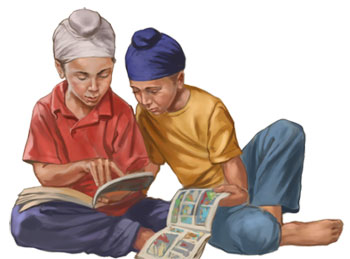 The article talks about the various cases of harassment and bullying which have taken place in New York City schools. The Sikh Coalition has stated that almost half of students who wear paghs have experienced physical violence in school. Yes, half! While bullying affects children of all ethnic groups, it is clear that Sikh children feel especially vulnerable. In addition, many young Sikh children don’t feel that they are adequately equipped to deal with harassment targeted at their physical appearance.
You’ve probably heard the saying, “Why blend in when you were born to stand out” and it rings true for many minority groups. Whether we want to admit this or not, many young Sikh children do not feel confident of their appearance and identity. I think that’s okay, however, as many young children of all backgrounds are struggling with these same questions. However, to address harassment and bullying in schools, it is critical that we teach our Sikh children how to articulate their faith through self confidence and self esteem. Much of this has to start before our children begin school. When we hear about stories of bullying and harassment, it is often too late to lift a broken spirit.
While navigating one’s identity is an issue for all Sikhs, it adversely impacts young Sikhs as they attempt to balance the many different expectations which are placed on them by their families, their friends and their peer groups. To address this, we should create and encourage young Sikhs to get involved in camps which help to develop self confidence and leadership skills. These camps are critical in formulating positive self identity and embracing our differences. We have a long way to go, but I really believe it is up to us to pave the way for the next generation. If it saves one child from being bullied, it is well worth the effort.



30 Responses to “Navigating Identity as a Sikh Child”


It’s really a nice and useful piece of info.!! I’m glad that you shared this useful info with us.
Please keep us informed like this. Thanks 🙂
It’s really a nice and useful piece of info.!! I’m glad that you shared this useful info with us.
Please keep us informed like this. Thanks 🙂
Sikhs had some strong spiritual and cultural practices going around their life and they're pretty good at following them. Some people might face a bit harassment after a few attacks by the terrorists, especially of the asian but they must stay strong and follow their cultural beliefs as they always do. This article had explained the same thing in a well descriptive manner. Thanks for the share.
I was extremely joyful as I found this site. I required to thank you for this astounding data! What's more I have bookmarked your website to peruse. Numerous much obliged.
Its really good to know about that some facts and other guided principles and techniques given here are up to the level of the technology.
I do agree with all of the ideas you have offered to your post. They are very convincing and will definitely work. Nonetheless, the posts are too quick for newbies. May you please extend them a little from subsequent time? Thank you for the post. Visit essay shop for best essays.
Excellent…. Superb,,,, That looks absolutely fantastic. Dramatic You can say its a passion of thinking. I found your post quite amazing. I like it very much. Your presenting feature are up to the level
“Our wounds are often the openings into the best and most beautiful part of us.”
It is so exciting to see others that truly care about students and their future (it affects us too!) May I pass this out in class as a handout. I copy articles I believe will inspire my students. I found a assignment that seems to help. I have the student make a 8X11 picture collage of either their support system or some goal to finish this program (LPN). Then on first class I have each student tell about their collage and hang it on back wall, this is a great ice breaker and I have not had one student refuse. It sometimes is very emotional sharing but so heartwarming. I then explain there will be time when they want give up and quit and this is when they need to look at their collage and remember why they are there. Then at the end of the semester I have them take it and keep in their notebook to keep them motivated. It has been a success (wish I could say it was my idea -but it wasn't). Thanks.
Outsourced IT Services
“Knowledge unlocks the door to the mysteries of our mistakes; wisdom guides us away from repeating them". HS/el”
trivia crack unlimited spins
“There is more to joy than looking only for affirmation; refusing to be challenged is the only bigotry.”
Get Unlimited Coins for My Talking Tom
“She herself is a haunted house. She does not possess herself; her ancestors sometimes come and peer out of the windows of her eyes and that is very frightening. She has the mysterious solitude of ambiguous states; she hovers in a no-man’s land between life and death, sleeping and waking.”
free diamonds hack my singing monsters
IT technology is necessary for complex competence also to take it with a further stage, as the particular technology will be developing every day, and almost everything is online, which helps it be technology any mandatory a single.inonetechnology.net
All tiny and huge organizations must practice purchase recovery system so that you can gain highest possible return from your office money investments. All useful resource recovery requires identification of most office resources and their particular redeployment before they may be finally disinvested.technologyassetrecovery.net
Cell phones- it really is hard to keep in mind a moment before we were holding so everywhere, but today the cellular phone has become an essential piece regarding technology for many people. Many put it to use for enterprise, others put it to use for entertaining, but regardless how they're deploying it, most people may possibly.cellphonescrazy.net
I think it's the best piece I have read about this subject thanks for sharing
This is info is really informative to all the sikh children for the good identity on navigation and other type of services. So, everyone must read the articles and essay services from your educational blog.
Some people might face a bit harassment after a few attacks by the terrorists, especially of the asian but they must stay strong and follow their cultural beliefs as they always do. This article had explained the same thing in a well descriptive manner. Thanks for the share.
That looks absolutely fantastic. Dramatic You can say its a passion of thinking. I found your post quite amazing. I like it very much. Your presenting feature are up to the level.
safety mats
Here i glad to discover this and after read this my mind is really disturbed.
Escorts in South Delhi
Its really good to know about that some facts and other guided principles
Awesome thanks for sharing information admin here at work now.
Looking amazing post…
Keep it up………
I was looking for this kind of article inspiring the sikh child’s. I found this article from Escorts Belfast and I would like to thank the author for writing on this sensitive matter. A sikh child faces a lot of harassment from childhood which is not expected at all. We all should encourage them that they are also a part of our society. We should help them to create their own identity so that they don’t have to face harassment and dont have to struggle in society.
Very interesting and informative post. Thanks for sharing this post.
Hey, great post, thanks for sharing such a great informative post.
Cleaning a house or business isn't any small job. Having to maintain your home clean while coping with your ongoing relocate can merely be an excessive amount of to manage. Take the actual cleaning away your dish with professional relocate cleaning providers.deep house cleaning
If you want to sell or buy your first house, may may visit https://Homeia.com/blog . Homeia is a website that organizes and publishes real estate content thoughtfully to make it much quicker for you to find the information you want, when you want it.
I gain so bounty encounter from this site. I other than bookmark it for over again understanding. I uniform this prompt. I appreciate the conspicuous blog you gain.
Creative post…very nice and interesting..
Nice.