
Dastarbandi/Turban Tying
A few days ago Sikhnet News posted a story about the Dastarbandi/Pagri di Rasam/Turban Tying Ceremony of Harmanas Singh, a 16 year old young man in California. 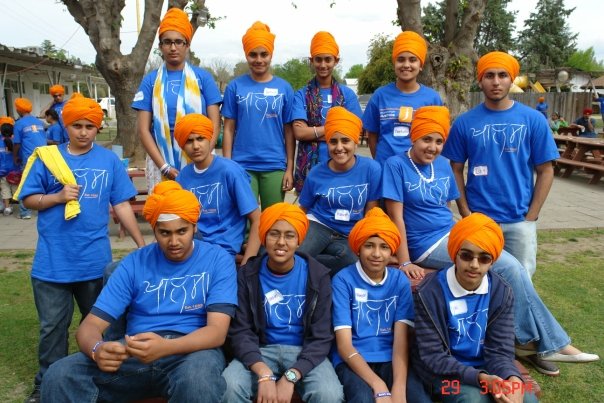 While the story gave only a brief explanation for the ceremony it got me thinking about the significance of the ceremony in the Sikh community in general: why we perform the ceremony, how wide spread it is, and how it pertains today to Sikh women.
A couple of websites describe the ceremony like this:
People who have lived in India would know the turban tying ceremony known as Rasam Pagri (Turban Tying Ceremony). This ceremony takes place once a man passes away and his oldest son takes over the family responsibilities by tying turban in front of a large gathering. It signifies that now he has shouldered the responsibility of his father and he is the head of the family. [Source]
The explanation is a bit off –because the ceremony seems more for the passing of personal rather than family responsibility. While there may have been a time when the ceremony signified the passage of family leadership – I think in the Sikh faith the ceremony has come to signify the shouldering of personal responsibility for young Sikhs. The dastarbandi ceremony represents something different for Sikhs – it is as Guru Gobind Singh intended it – a stamp of identity for Sikhs and the responsibilities that being a Sikh entail.
Along with the changed meaning from its traditional roots, the ceremony has also taken on greater significance in recent years. I grew up in a very Punjabi/Sikh area of California and as a regular at the local gurdwara I can count on one hand the number of dastarbandi events I saw. However, due to recent socio-religious realities in countries outside of India and our community becoming for comfortable abroad, the ceremony has become more widespread and a symbol of education for both Sikhs and non-Sikhs. The article above is one indication of external impacts…since the story originally appeared in the OC Register, I’m pretty sure the reporter was invited to cover it. Within the faith Fremont Gurdwara Sahib in California and others gurdwaras have started holding “Turban Day” events where Sikh children are educated about the significance fo the dastar and formal dastarbandi’s are performed on dozens of Sikhs. One Fremont official summed up the motivation for the event as follows:
The turban is part of our identity…there’s a lot of peer pressure for kids, and they don’t want to wear them. This tells them to be proud of who they are, their religion and their history.
In addition, Jakara (Juniors) held 9 synchronized day camps last year focused on the turban – with approximately a thousand Sikh boys and girls attending across California. The camps held their own mass turban tying.
Finally, although this is typically a ceremony for males, there are more and more Sikh girls and women donning turbans. I wonder if our social culture will change to include women in this “male” ceremony? As far as I know of there is no female equivalent to the dastarbandi in the Punjabi/Sikh community. However, with the positive trend of Sikh females also wearing dastars I think it is only a matter of time before we see more Sikh girls at the center of the ceremony.



14 Responses to “Dastarbandi/Turban Tying”


I agree Singh, it's just a matter of time. Of course, how much time … I don't know I think it will be a while. I do believe that females will be more likely perceive the ceremony from the religious retrospect that Guru Gobind Singh Ji intended. This is not sheerly the depiction of a feminist or sexist attitude but a logical inclination. For males, it may be easier, as compared to a female, for them to perceive the ceremony in the cultural patriarchal ‘becoming the head of the household’ context. Females, in the typical Punjabi Sikh household, would never be given such a status within a household unless done so by default. So in a way there isn’t room for females to perceive the ceremony in this cultural context of becoming the head of the household. Put simply, females do not get the option of viewing the ceremony from the perspective of becoming the head of a household.
Males, contrarily, would be more likely to perceive the ceremony in the description that Amardeep provided simply because it is easier to do so. I am not saying it is easy to be the head of a household, but I do believe taking on the responsibilities given towards your quam maybe more difficult to tackle than those of your household.
I agree Singh, it’s just a matter of time. Of course, how much time … I don’t know I think it will be a while. I do believe that females will be more likely perceive the ceremony from the religious retrospect that Guru Gobind Singh Ji intended. This is not sheerly the depiction of a feminist or sexist attitude but a logical inclination. For males, it may be easier, as compared to a female, for them to perceive the ceremony in the cultural patriarchal ‘becoming the head of the household’ context. Females, in the typical Punjabi Sikh household, would never be given such a status within a household unless done so by default. So in a way there isn’t room for females to perceive the ceremony in this cultural context of becoming the head of the household. Put simply, females do not get the option of viewing the ceremony from the perspective of becoming the head of a household.
Males, contrarily, would be more likely to perceive the ceremony in the description that Amardeep provided simply because it is easier to do so. I am not saying it is easy to be the head of a household, but I do believe taking on the responsibilities given towards your quam maybe more difficult to tackle than those of your household.
Dastarbandi usually just means that the "dastar" (responsibility, ownership, management) of something is being passed on to you and you are now the leader, jathedar, responsible person for that thing. It could be an institution, a seva, a jathebandi, a taksal, a gurdwara, or a family.
However in a simplest "coming of age" ceremony of dastarbandi, a dastarbandi is just like a bah mitzvah. It's like when a young person becomes a young adult and then you tie a dastaar on them to represent that they are an esteemed member of the family, a responsible Sikh in the family, etc.
However most Gursikh kids these days tie a dastaar from a young age. In fact some Gursikh kids have their "dastaarbandi" the day they come home from the hospital after they're born!
and everything I wrote above could apply to a Singh or a Kaur.
Dastarbandi usually just means that the “dastar” (responsibility, ownership, management) of something is being passed on to you and you are now the leader, jathedar, responsible person for that thing. It could be an institution, a seva, a jathebandi, a taksal, a gurdwara, or a family.
However in a simplest “coming of age” ceremony of dastarbandi, a dastarbandi is just like a bah mitzvah. It’s like when a young person becomes a young adult and then you tie a dastaar on them to represent that they are an esteemed member of the family, a responsible Sikh in the family, etc.
However most Gursikh kids these days tie a dastaar from a young age. In fact some Gursikh kids have their “dastaarbandi” the day they come home from the hospital after they’re born!
and everything I wrote above could apply to a Singh or a Kaur.
Education is the important factor and in modern age that is need of everyone however small or big. The peoples who are educated they are having the secure feature and anyone in the society respect his/her.
You'll find so many of areas to consider when making your reservation for an entertainer. Exactly like any unprejudiced business, there’s any variation inside quality in a entertainer to a new. Some are generally wonderful, some are generally good and many are possibly not as much as the typical you’d foresee. <a href="http://www.favientertainment.net” target=”_blank”>www.favientertainment.net
You'll find so many of areas to consider when making your reservation for an entertainer. Exactly like any unprejudiced business, there’s any variation inside quality in a entertainer to a new. Some are generally wonderful, some are generally good and many are possibly not as much as the typical you’d foresee. <a href="http://www.fivestarentertainment.net” target=”_blank”>www.fivestarentertainment.net
In case you own a residence entertainment midsection or looking at new leisure centers to get, you almost certainly have a couple of pre-determined inquiries. There are many different types, proportions, and colors from which to choose. If you might be purchasing the initial enjoyment middle, read with all the following questions and remedies, and have an overabundance familiar while using the options you’ve. <a href="http://www.skykingentertainment.net” target=”_blank”>www.skykingentertainment.net
I have a very nephew which includes had their particular business due to the fact he received married. 4 seasons he married was also 4 seasons he thought we would stop running and undertaking into a thing really huge. He thought we would stop running because just what he was earning inside of his business wasn’t enough to help his household. It was a risk for them but he thought we would take this kind of. http://www.psychotherapyfinances.org
Small along with micro organizations are 10 times susceptible to fail compared to a larger business and lots of don’t last in excess of five a long time (Info NZ). Business cannot put up with the jolts huge companies can easily. http://www.nhbusinesstips.org
You'll find two locations to adopt a helicopter check out, and one of these brilliant is inside of Vegas, because the other is Arizona. Helicopters which usually depart by means of Vegas fly on the West Rim plus the choppers which usually depart by means of Tusayan fly on the south Rim from your Canyon. Just therefore you know, you'll find no flights relating to the two added wheels. So if you need to take the particular helicopter tour from your South Side, but you’re outstanding in Sin city, then you must take the particular plane on the south Rim which you could then commence your check out. http://www.travelsw.org
Trend professions are usually basically regarding 2 sorts — people popular design and the ones in the specific sales along with marketing side from your industry (type merchandising). You may well further individualize your speciality by means of choosing to look closely at a certain style or form of garment. http://www.fashionia.org