
A taste of Lahir via music and poetry (part 2)
As promised, here is my follow-up to Monday’s post about the Inquilab hip hop workshop in New York.
This past Saturday night brought together hundreds of Sikhs (and others) for the fourth annual Lahir: Move the Movement. I always seemed to have a conflict the last several years, but finally made it out to New Brunswick, New Jersey this year for my first Lahir. I am grateful for it.
Again, I’ll keep my words short as the video below speaks for itself. But a couple of things that were especially noteworthy to me about the experience.
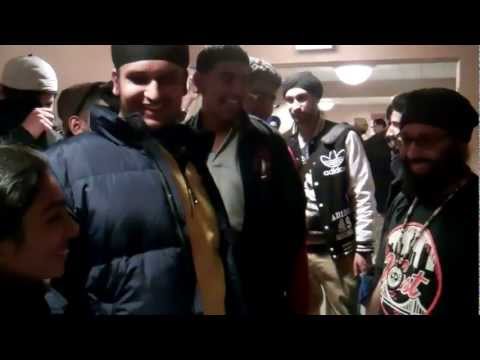
The audience was really multi-generational. It was much more like a typical gurdwara sangat than I had expected, crying babies, hyper adolescents, and plenty of elders included. The energy was positive and empowering, and the high school and college-aged youth, in particular, were fired up.
The performances were extremely diverse and full of raw talent and passion. As you’ll see below, the performances (only a few of which I captured) went far beyond the spoken word and hip hop that I was expecting.
A friend of mine leaned towards me while a pre-pubescent high school student with a patka was rapping passionately about post-9/11 racism and said, “I am so excited about this new generation.” Indeed, I share her sentiment. These young people are indeed moving the movement, and in doing so, in the words of the event’s organizers, perhaps they are also “bringing Sikhi back.”



31 Responses to “A taste of Lahir via music and poetry (part 2)”


While I appreciated everything that the event was about and do think that it brought a great energy and tremendous talent, I am a bit wary of whether or not Lahir's message was strongly received. I do agree that many of the artists themselves align with the progressive tones of Sikhi and the motive of "Bringing Sikhi Back" but I was a bit disappointed when I could not even hear the name of the scholar that the MCs brought up to the stage midway through the show to discuss the roots and implications of what "Bringing Sikhi Back" really means. That being said, I wonder what the follow-up to this type of event would look like to ensure that these pertinent central messages do get through to folks.
I hear you. With such a large crowd, you're always going to have a diversity of motives for being there and different levels of engagement (i.e. some people just wanting to rock out, some just wanting to eat chaat, others wanting to engage fully and deeply, etc.). The scholar you're referring to was Harinder Singh of the Sikh Research Institute. I regret not getting my camera out in time to record his remarks, as they were really powerful. "To bring Sikhi back, we have to pick up the rabab and the khanda…" (or something like that)
Lahir was great overall. My 7-yr old daughter was there and asked me a question, that was interesting. When Selena Dhillon sang, she asked me how's she's a Sikh when she cuts her hair. Then a Singh at the end, while singing removed his head scarf and threw it down. Then again she asked it doesn't look right.
What do you think about that? Do you think, we should be a little more careful in getting the performers?
As a member of the younger generation myself, I do understand your concerns and understand the need for stronger role models in our community. That being said however, I do think that there needs to be a stronger emphasis placed on learning the core ideologies of Sikhi and I appreciate what the mentioned artists are doing in trying to convey that message. Often times, I think our community gets caught up in needing to uphold a certain standard or portraying a certain image. Again, while I understand the importance of this especially given our oppressed past and post-911 racism that we face as Sikh American, I do feel as if at the core of it, someone should truly understand the reasoning for keeping hair, wearing a pug, what have you.
From personal experience, I can say that I have felt pressure to uphold these standards without fully understanding the reasons as to why Sikhism has these rules. After straying away from the pressure of just trying to fit in and live up to societal expectations, I am now, as a young adult, trying to deeply understand Sikhi and what it means to me in my life.
Instead of fixating on physical appearances, let's please try to increase understand and education of what the basis of Sikhism is and what the ideologies truly mean to us in this day and age.
Bhaji/Bhenji, unfortunately, you can't tell your 7-year olds that don't fixate on physical apperance. I mean yes, its important to tell them that one should have Sikhi inside as well, but as you can understand, for kids that age, it starts from there. For them, what they is, what it is.
With all do respect, isn't a big part of Sikhism accepting differences and realizing that we are all really equal. I think it would have been a really important conversation for you sir, to have with your daughter, that it is in-fact alright to be an individual and express yourself. Just because someone cuts their hair or has an unconventional way of keeping it does not make them any more or any less Sikh than someone that does. I understand that it may be hard for a child to understand this but again, there is a bigger lesson to be learned here.
@Anonymous, while we shouldn’t judge individuals on where they are on their journey as Sikhs, let’s be clear – the 5Ks are important elements of the panth – so yes, whether you decide to keep your external identity does matter. I don’t care if one keeps it or not – even I’m not 100% there – BUT I’m not going to pretend like those things don’t matter.
Parminder Singh – I appreciate your honesty and strongly support the fact that young girls (whether Sikh or not) need strong, confident Sikh role models who are comfortable in their own skin but also have a gratitude for Sikhi.
Love the glowing faces of the youth at the end of the video – they look inspired and empowered!
Its like when you go to Gurdwara (if you go) there are all kinds of people in all different stages of their lives and I am sure kids ask the same questions there as well and I hope parents have some sort of a default answer to that.
The question that comes to mind as I read the thoughtful dialogue above is if it's okay for us to consider not inviting exceptional performers like Selena Dhillon because they do not keep kes. What I mean is, by excluding Selena from performing at these events because she is NOT kes-dhari, we would be discriminating against our own community members.
Of course kes matters (and the 5ks matter). We all understand that. But we cannot judge Sikhs solely on keeping kes or not. There are many people who keep their 5Ks and are in full bana who do not follow the values of Sikhi. We see this at our Gurdwaras many times over. I think we need to celebrate all who are spreading the message of love, respect and unity.
Lastly, there are very few women who are participating in artistic expression in the way Selena or other Sikh artists have. It'd be great to see women in addition to Selena come through. Parminder Singh – perhaps your daughter will be up there one day, with full kes 🙂
I agree. It's a balance we must strike. It is so so important for young Sikhs in the diaspora to have role models in the arts who indeed keep their kes… I can't imagine what this would have meant to me as a kid growing up with literally no other Sikhs around. But at the same time I think it's important that we be inclusive within our community and embrace all those who embrace the Sikh identity, even if they make a choice to cut their hair. The majority of performers at Lahir indeed kept their kes, and I sensed that the young people in the audience left feeling very empowered, proud to be Sikhs.
Kes or Not, we must continue to Decolonize our own identity, a challenge in front of many indigenous communities.
We all are facing different challenges(consistent with Sikh history). The Sikh communities in Punjab continue to face challenges in finding ways to resist against an adversarial government and colonial/imperial forces. Diasporic communities are faced with world wide xenophobia, specifically the ill effects of islamophobia.
Proactive action will help us continue strengthening our connections with the core teachings of Sikhi within a global community context. Artistic expression that comes from within our communities are empowering, yet will always offer some analysis, critique, and criticism. Events like Lahir continue to amplify the Sikh voice, and offer discussions around our internal and external dynamics.
Which leads me into a small sharing around the "The Kes Discussion"
I had first cut my hair at 8 years old to escape severe bullying at a public school in Queens, where my braids and patka were targets. Ever since I turned 15 my kes has been such a source of internal struggle/strength while also a source of severe tension in my nuclear family. As a teen and young adult I cherished the Guru's teaching yet I didn't feel "Sikh" enough. My family post-1984 (we were in New Delhi and suffered major trauma as a result) & post-9/11 were and continue to be disagreeable to any move towards keeping my kes. It is a personal choice, and that's the only firm conclusion I have come to date. May my thoughts, feelings, and actions continue to face the Guru every day.
I wonder if someone can offer some history if the "Kes discussion" has been happening since 1699? I know there was a big push early 20th century with some movements around preservation of sovereign identity (and rightfully so in my mind).
I hope we can continue to inspire our sisters and brothers.
Appreciating the langar hall discussion forum, and glad you are sharing Sonny.
It seems to me that one of the attractions here is that Sikhs with kes are doing X.
Should it be considered an amazing event if simply the fact of a Sikh rapping, or playing an instrument?
What does that say about the expectations we have of ourselves? How far do you we have to come if its a challenge simply to play an instrument while being Sikh?
It
Self Expression is a beautiful thing, what's AMAZING is that there are forums for people to share their stories, thoughts and talents.
If you consider that Sikhi and Sikhs have faced extermination since creation, the fact we continue to strive and thrive through creative outlets without fear is a testament to one of the many strengths of the community. Song and Music are a big part of what our Guru's showed, taught and bestowed upon Sikhs.
Its amazing, but not anymore amazing than countless other forums that are going to happen in any large city in the US today or tomorrow.
Granted Sikhs as a community have faced difficulty, to put it mildly. But we should move to a different understanding of ourselves in my opinion. I believe defining our community as one that is imperiled and oppressed is not inevitable and possibly not all that helpful.
I disagree with the first point, I don't think there are countless other forums like this, my experience shows only a few. Regardless of how many, we can celebrate many if not all of them in one small way or another. To me forums aren't in a contest for ranking, but vehicles of sharing and discussion.
I do agree with your second sentiment, a victim and oppressed mentality is not the way to define our being, even if traumatic events have affected us individually and as a community. Critical resistance is a creative process. That is why I tend focus my energy highlighting strengths and creativity within the Sikh Community. I hope we will all continue to take ourselves away from the culture of guilt that has been placed internally and externally.
Positive reinforcement doesn't mean we can't strive for more (which is the part of your message I appreciate the most), they can go hand in hand. For example I we could discuss who was able to attend this (and other) forum as it relates to class boundaries? (not just the caste system of Hindustan but class dynamics here in the states). What about the gender discrepancies in who dominates the screen (in this video and in Sikh media in general)? Would this be a safe place for people who identify as queer (Sikh or not)?
We are moving toward a different and nuanced understanding of ourselves as we engage in discussion and share.
I meant there are countless artistic forums going on in any large city in the US is one takes into account not explicitly Sikh fora but those generally.
I'm not sure we agree on what striving for more means, though I appreciate your response. I am also concerned about fairness and the ability of those who wish to participate in any given endeavor to do so. But I am not so keen on identity politics as the mode to create the "more". A safe space for all modes of expression and being are needed, but I do not think this is the only end to work toward. I really feel this searching out of the Other and subsequent effort to bring them into the space can become an artifice that obscures more substantial purposes.
Basic fairness is essential, but essentializing and seeking out the various ways a given group is different to the point of ever-smaller sub-sections seems to me to be time not always well spent.
We could for example wonder if those with poor dress sense (a component of class perhaps) are being unduly negated in a space.
Your "more" and my "more" may not be the same. My "more" has to do with continuing to use practices based in a milieu and worldview that provides different benefits than what is otherwise on offer. In my opinion within the Sikh community are knowledge-ways that are valuable and I would like to see them brought forth, fostered and developed.
That is why I would say, as an American, or really a citizen of most nations maybe, understanding hip hop and having a means of expression through hip hop can be important, useful and rewarding. I wouldn't begrudge anyone learning how to rap. I love Mos Def. I would be interested in listening to someone who would be able to use his style to convey a part of my experience. But I think that the form of expression that is hip hop is not a like-for-like with dhadhi vaars or other forms of expression that are not current within North America in the same way. Its like going to the home of an ustaad of the dhol and asking him/her (acknowledging that for reasons of unfairness its likely to be a him) to teach you how to beatbox. Beatboxing is not likely to run its course as a form of artistic expression, and neither is dhol playing. The difference is, the dhol as an instrument requires some effort to establish itself in this culture.
And the aim of learning hip hop is not base solidarity that means I take up your practices as mine in order that we both are the same. I respect that hip hop has been nurtured by primarily the community out of which it came, and is now nurtured by a somewhat different community. I do think its exceptional for a Sikh to be into hip hop. Its not really a cause for celebration to me. Its not astounding, or amazing. Its pretty natural given I live in the US and its, indeed, all around me.
But for a specifically Sikh event to apparently feel that youth who identify as Sikh can be reached only through hip hop is to me to ignore other forms of artistic expression available to us that are not currently as robust. I think we have a cultural inheritance we are able to preserve and allow to flourish, and we should try to do so.
do not think its exceptional
if simply = if it's simply
Its also discouraging that simply saying that its wrong to harm someone is an applause line. Is that because Sikhs as a community are at such a level that its a challenge to be able to make this statement?
Striving for more (or something different) comes from your own statement “what does that say as the expectations we have for ourselves”. This statement suggest the expectation should be different or higher, does it not. Either way I would hope your more would be different than my more and this discussion between us highlights that.
writers
I too have serious issues with identity politics but I am confused as to what u said in the paragraph
I will discuss hip hop below but to my knowledge Lahir isn’t just hip hop/rapping…aren’t there performers who play music and share in other ways? Perhaps the moderator can elaborate.
As for hip hop it needs more dissection. Flow might be the same regardless of culture but the message will always be different. Rapping is story telling and includes Sikh world views and isn’t just about a “Sikh rapping”. So yes u will have Sikh rappers in it for the money, the notoriety, etc…. But there are those who love the poetry and expression. If u want others to learn more about this world view that Sikhi do not discount hip hop as a tool to do so. On that note what other specific ways do u suggest the community engage with a bigger group?
I am truly worried about the hypermasculinized tone that some if not most hip hop takes and the correlation it has with bhangra. Yet I don’t want to discount it is a powerful way to express a Sikh spirit.
I wrote this from a cell sorry for spelling or grammar errors.
In terms of engaging with the wider community I think one example is from hip hop itself, refine and learn the history and culture and then bring it forth. One of the most powerful aspects of the kind of hip hop I like (what might be called conscious rap) occurs when a rapper expresses facts or presents a thesis that is little known, ignored, or forgotten.
On hyper masculinity, I think the perception of this as a problem in hip hop, or Bhangra, is based in part on a misreading that the kinds of things that are excessive occur most in certain communities. The kinds of practices that are potentially hyper masculine occur fairly commonly among young men in most settings. Only certain communities seem to have to own this fact. When a non punjabi young man or a non Latino or African American engages with hip hop for the purposes of basically engaging in a hyper masculine show, they can just leave the practice as soon as the song finishes. Because punjabi men somehow have to own the song as theirs, they have to answer for it. Same might be the case regarding hip hop. Black men have to the music somehow even they are not the only ones using the song for basically hyper masculine purposes. If you don't think for example a fraternity party that is majority non black can not be a scarily hyper masculine place at times, it sure can be. But just as black men have to own the hyper masculinity there punjabi men somehow have to own the hyper masculinity of those who consume Bhangra and those who project their needs onto them (us)
So for me the arrow of causation does not flow from the fact that punjabi men or punjabi jatt culture are necessarily are problematically masculine as a group, but that those labels stick to us because other parts of society disavow their own problematic masculinity. There are many punjabi jatt males who do not hold truck with the stereotypes but the difficult thing is these cases are taken only as the exception that proves the rule. In the same way, actually in many settings black and Latino men are less hyper masculine, more able to express emotion or unproblematically regard their friends with affection, but they are then said the be the exception rather than the rule. In all these instances the definitions are projected on to the group and they end up stuck like a fly on the wall.
Disavow also there own problems with masculinity as well
What I found most appalling was that one of the performers TOOK OFF HIS PATKA and THREW it on the ground on stage. Regardless of what these artists do in their personal lives, whether they follow Sikhi or not keep their hair or not they should atleast respect the Turban/Patka. I lost respect for this event after that and immediately went for the exit.
Just to clarify on behalf of the Lahir Organizing Committee, that is something the artist decided to do completely and SOLELY on his own. That sort of behavior is not something Lahir encourages or tolerates. At the same time it is also important to know that the act was absolutely unpredictable and since it was the last act of the night, there was absolutely nothing we could do about it then.
We provide all artists with guidelines weeks in advance and expect them to adhere to those guidelines at the show. Needless to say, we will not be inviting the artist back for any future events organized by the Lahir Organizing Committee.
@Lahir what “sort of behavior” does the organizing committee not encourage or tolerate? Could you be more specific as it pertains to this act? What guideline did this person break? And if it was not the final act what would you have “done”? The answers would clear things up a little. Thanks in advance.
Visit mp3 palco apk to have more with more information