
This weekend, from Friday to Sunday October 19-21st, the Sikh Studies department at Hofstra University will host ‘Sikhi(sm), Literature and Film,’ a conference on literary and visual cultures in the Sikh tradition, both in Panjab and the Diaspora.
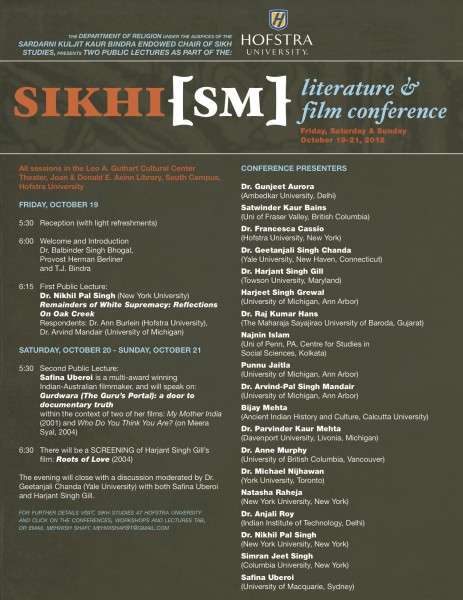 Paper presentations will be given during five sessions, with presentations ranging from de-categorizing the janamsakhis to the poetry of Puran Singh, discourses on secularism to literary representations of Sikhs, Sikh masculine identity vis-à-vis kesh and the dastaar to Panjabi theater, Museum exhibitions to Sikh identity in film and Bollywood, Hip Hop and rap as expressive forms among Panjabi youth to Gurbani sangeet and female kirtaniya. Presentation topics and bios can be accessed via the Sikh Studies website at Hofstra.
This year the conference will also host two supplementary film screenings and offer a forum to deepen the discourse around the recent Oak Creek Massacre. The films include Safina Uberoi’s ‘Gurdwara: the Guru’s Portal: a door to document Truth’ and Harjant Gill’s ‘Roots of Love,’ while the pieces related to Oak Creek include Dr. Nikhil Pal Singh’s ‘Remainders of White Supremacy,’ and Dr. Balbinder Singh Bhogal’s ‘Oak Creek Killings: The Denial of a culture of oppression’ (which can be read online).
We believe at the heart of each Sikh American woman, there are multiple love stories that inhabit the mind, body, and soul.
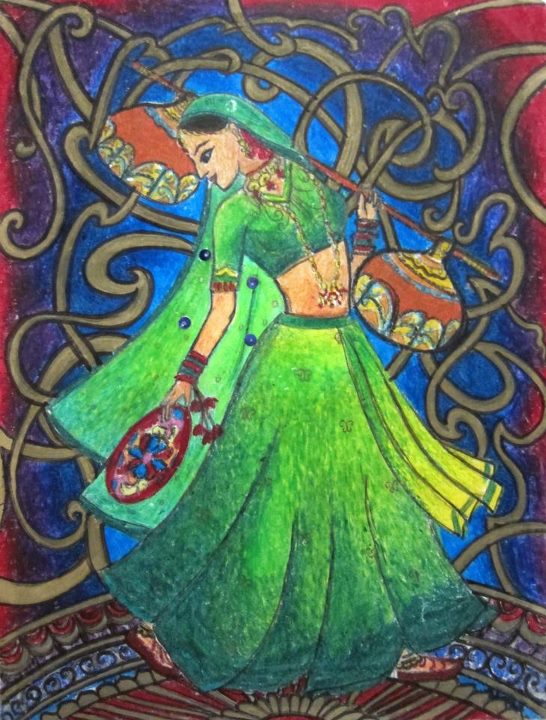
Artist: Rupy Cheema Tut
This one is for you dear Kaurs!
The first ever Sikh Women’s Love Anthology is being created and your voices are needed. This groundbreaking anthology will be a compilation of love stories written by and about Sikh women living in North America and will be published in the form of memoirs, creative non-fiction stories, and creative essays.
Sikh women have an incredible history of powerful and inspiring narratives – often heard through our oral tradition. This project is a way of documenting these narratives and providing a space for women in the Sikh community, connecting with one another to dialogue and document the complexities and nuanced experiences of love as we see it. Love can take many forms – “through lovers holding hands, singing a shabad, eating a good meal to nourish one’s body, hiking an unknown terrain, traveling a new country, holding a sick child close, fighting for civil and human rights or even embarking on the journey to falling in love with ourselves as women and human beings, spiritual beings” [from guidelines]. Love is at the core of our very existence as Sikhs.
This is a wonderful opportunity to pave the path for Kaur voices that we do not often hear. Sikh women who are dedicated to their families, their faith and their activism and manifest their love in dynamic ways. Yet their stories go unheard. Documenting one’s story provides for self-reflection and is “an act of resistance against social, cultural, media, and political forces that want to define women as less than humane“. This is an important way to chronicle narratives for future generations of Sikh American women and men.
Click below the break for submission details. For further information and full submission guidelines, please email sikh.lovestories[at]gmail.com.

Cover of "Guru Tegh Bahadur: The Ninth Guru of the Sikhs" (photo: sikhcomics.com)
Let me first take the opportunity to thank the bloggers of TLH for welcoming me to this blog. A few might recognize me from americanturban.com, and I’m excited about the opportunity to engage with the audience on this blog in discussing many of the issues we face as a community, and particularly in the United States.
Most of my early education in Sikh history came from comic books, namely those published by Amar Chitra Katha, based in India. My father purchased every title related to Sikhism that was released by this company — covering the stories of the Sikh Gurus to those of Sikh legends and heroes — and I loved reading and re-reading these comic books until I knew the stories by heart.
It was a great introduction to Sikhism that captured my imagination. As I got older, I moved on from these comics to literary works on Sikh history that filled my growing mind with more knowledge and detail.
I started reading those comic books almost 30 years ago (I’m astounded as I write that number), and I’ve recently come across a new effort to bring such Sikh stories to today’s young audiences.
Gyan Khand Media has recently begun producing a new set of Sikh-based comic books. While now based in India, author Daljeet Singh Sidhu saw the opportunity for such a comic book after living in the west:
When Daljeet Singh Sidhu wanted to introduce his three-year-old son to Sikh heroes and history, he was not at a loss of words. But what he did not have, was a story that his boy could see, feel and later read. That’s when it struck Sidhu; that Sikh history has many heroes, but no graphics. So after 12 years in the US, he packed his bags and moved back to India to chronicle Sikh history, its great gurus and warriors and present them in the comics format. That’s how www.sikhcomics.com, a Sikh comics project, was born.
Gyan Khand Media has currently published three titles covering the stories of Baba Deep Singh, Guru Tegh Bahadur, and the Battle of Saragarhi. Many more are planned, and I had the opportunity to download and read the first two titles using Amazon’s Kindle app on my mobile device.
Do you know how to tie a patka? The following video, an original creation by Keerat Kaur, was produced by Saffron Press in an effort to educate about the Sikh identity – allowing educators (and curious children) to learn how to tie a patka/dastaar and see what actually lies beneath the piece of cloth that covers a lion’s mane. As one blogger writes,
The video [reminds] me of a vague recollection I had of sitting in a room while two teachers were trying to figure out how to re-tie my patka on my head. I remember trying to explain how the patka was supposed to be tied, but the teachers couldn’t figure it out. I also recall how vulnerable I felt when, to attempt to re-tie it, they removed my patka and my hair was exposed.
Another blogger has similar memories of his childhood,
For most of my childhood, I was the only Sikh kid in school that had long hair. Never mind that the other kids didn’t know nor appreciate my Sikh identity, even my teachers were clueless about my faith.

Beginning on October 15th, a three-day exhibition was held in Ludhiana to profile a generation of rising young artists in Punjab. The mission according to gallery is ‘to further enrich and diversify cultural life in the Punjab region by facilitating the development of emerging artists.’ The newly constructed gallery in Ludhiana offers exhibition and installation space, leads and collaborates in the development of programs for the visual and performing arts, and will soon be providing an art residency.
 A recent exhibit called ‘Three/One: A Collaborative Art Exhibition in Ludhiana’ was held to showcase the work of Rachna Sidhu, Ankur Singh Patar, and Vivek Pandher, children of some of the most famous literary figures in Punjab. Rachna Sidhu, daughter of the famous thinker and literary critic Amarjit Grewal is a portrait maker at Guru Nanak International public school. Vivek Pandher is the son of the poetic genius Jaswant Zafar, a photographer by profession and a student of film production at UBC. Finally Ankur Singh Patar is son of poetic legend Surjit Patar and focuses on digital art, drawing much of his inspiration from his father’s literary treasures.
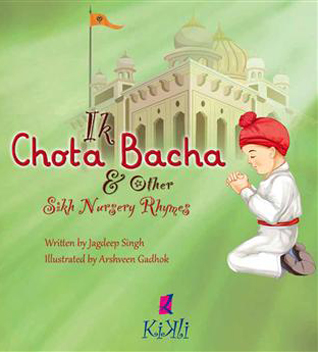
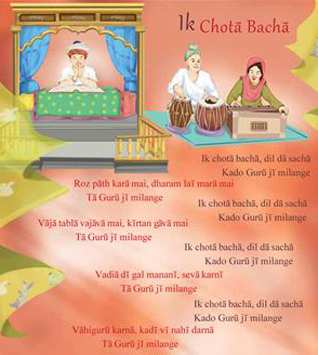
Embracing my new role as a proud Chacha, I recently bought some Sikhi-related children’s books for my niece for her first birthday. I was especially excited about this new book and CD of Sikh nursery rhymes called Ik Chota Bacha. The book/CD is a great way to teach basic Sikh values to kids and help develop their Punjabi skills (all the nursery rhymes are in Punjabi) in a fun way. I played the CD for my niece on the daily when I was visiting for her birthday, and by the end of the week, the whole family was singing along to some of the catchy (and rather cheesy) tunes. (See a full review of the book here.)
My excitement about the release Ik Chota Bacha quickly became muddied with disappointment and frustration once I saw the book’s illustrations. Every single Sikh child and adult depicted in the book looks WHITE. I don’t just mean they’re all fair-skinned on the spectrum of brownness. I mean peachy, rosey-cheeked, white.
I love books – but I have a special, and perhaps curious, interest in books by and about Sikhs. Perhaps it’s the fascination to discover how similar or different our experiences are. I’m convinced i’m not alone in this. There has been an established interest in South Asian literature for quite some time, but now – with the growing number of authors covering the British Sikh or North American Sikh experience – there is piqued enthusiasm in diasporic “Sikh Literature”. I think it’s important to support this type of work – not simply because the author is Sikh or writes about Sikhs – but because until we have enough of this representation in literature, we need to encourage it’s growth. This also means that authors will be faced with higher expectations from their readers who want authentic stories, sophisticated writing and dymanic story telling – just as we’d expect from any other piece of literature.
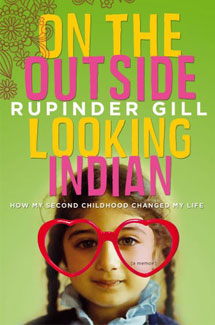 I recently read Rupinder Gill’s memoir, On the Outside Looking Indian. The premise and cover of the book attracted me, perhaps because it reminded me of Sathnam Sanghera’s, If You Don’t Know Me By Now – a book I highly recommend. Gill’s memoir, similar to Sanghera’s, deals with her personal experience growing up as the child of immigrants. Gill’s story is set in Canada and focuses on her year-long quest, at the age of about 30, to fulfill a list of her childhood dreams — learning to swim, going to Disney World, and living in New York etc – activities she didn’t participate in as a child. I found Gill’s descriptions of her childhood to be well-written, funny and often relatable.
Without a doubt, many of us can relate to childhoods of inactivity – unless activity consisted of housework – then no, we really didn’t participate in many activities, especially compared to how busy and structured the lives of children are today. There are obvious exceptions to this, however, this is most likely a common experience for many. While Gill’s story is framed around a Panjabi Sikh household, it’s clear that her experiences could be those of many first-generation children whose parents have emigrated to new lands.
“Grand harmony aims at elevating every unit of social and cultural life to the height of heroic majesty”
– Harinder Singh Mehboob (1937-2010)
Revered Punjabi poet, Harinder Singh Mehboob, passed away on Sunday night leaving behind a significant mark on the map of Punjabi literature. Mehboob, who had also worked as Principal of Khalsa College Gardhiwala, had written Sahji Rachio Khalsa and Jhanan Di Raat, a book on poetry which he received an award for in 1991. The Sahiyta Award was not without controversy. Regardless, Mehboob’s work will continue to be appreciated by the community:
Jhanan Di Raat which wins Sahitya Akademi Award for Punjabi is his second major publication. A collection of over two hundred poems, written over a period of three decades, in seven anthologies of poetry now published as one volume, Jhanan Di Raat is a formidable work both in conception and in content. The stylistic range and virtuosity reflected by this 828 page volume is enormous; and while the ideological orientation and the concerns of the age as reflected in the poems change gradually, the poet’s warm humanism is always extent.
The poet’s synthesis of the folk poetic traditions with contemporary trends is a distinctive feature; and a recurrent theme is his deep nostalgia for the past glory of Punjab. For its variety of styles, images and metaphors, its vastness of scope, its amalgamation of modern diction with folk-forms and its poetic intensity, this work is regarded as an outstanding contribution to Indian poetry in Punjabi. [link]
He will be remembered and appreciated for elevating Punjabi literature and for his important contributions to the Qaum.
Last weekend I attended the Sikh Lens Sikh Art and Film Festival in Hollywood. I have attended film festivals all over North America and strongly believe in their need and presence in our community. Many times, however, the events get overshadowed by the glitz and glamour – the red carpet, the photographers, the eccentric outfits… I was therefore grateful that my experience at the Sikh Arts and Film Festival was a fulfilling one – I left knowing that Sikh Arts and Films bring value to our community and need to be supported. In addition, I felt the organizers made a special effort to keep the event focused on the directors, artists, musicians, actors, authors and organizations who were present. They recognized the fact that we are all in this together. Sikh Arts and Films are only beginning to be acknowledged, there is so much potential and growth that will still occur. However, this isn’t going to magically happen overnight, and it most definitely won’t happen without the community’s support.
 I was recently told that Sikhs in the UK spend 7 times more on license plates than they do on books (yes, 7 times!). While I’m not sure of the statistic in the US, the point is clear – perhaps we’re not investing in the right places? I think as a community we have begun to establish the need to support non-profit organizations that are working to address human rights, legal, education and activism issues (although we still have a long way to go to enhance our support). However, what goes hand in hand with this is the support and advancement of Sikh Art and Media. Without a doubt, events such as Sikh Lens are helping to pave the path – however, we as a community need to ask ourselves why we are so hesitant to spend money on independent films, children’s books, on historical references and on paintings. When I think about other immigrant communities, I notice that their advancement as a community comes from their support of one another. Whether we like to admit it or not, our community is extremely frugal and competitive with each other, and unless we start to move away from those stereotypes – we will not be creating a better world for our children.
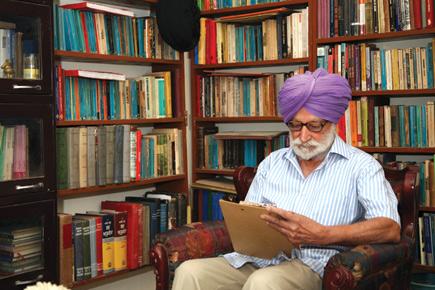 To be or not to be? Well, apparently for Surjit Singh Hans – it is to be. Hans, an academia based in Mohali, is undergoing the feat of translating Shakespeare’s work into Punjabi. Hans retired from Guru Nanak Dev University in Amritsar, where he had once been head of the department of history having done extensive work on Sikh literary sources and in particular the Janamsakhis. He has been working on this task for the past sixteen years.
The translation follows the original line by line—you want to locate line 20, Act II, scene (i), in the Arden edition of Hamlet, all you have to do is look at the corresponding line in the translation. The iambic pentameter of Shakespeare has given way to the chaupai in Punjabi, but what matters is that these lines are almost as resonant in Punjabi as they are in the original English. They work well when read aloud, as Shakespeare is meant to be, and there is little here that a Punjabi can’t take to heart. Indeed, the heavy-headed revelry ‘takes from our achievements, though performed at height’. [link]
As for how well Shakespeare’s work translates into Punjabi, Hans suggests that King John could parallel the story of Aurangzeb and Two Noble Kinsmen could be a scene out of a Punjabi village (two men, one girl – hardly promising).
It might partly be the scarcity of female voices and public female faces in the Sikh community that makes Nikky-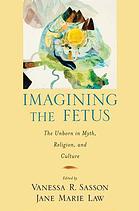 Guninder Kaur Singh’s so distinctive and refreshing. But in addition to her position as one of the few public female voices in the Sikh community, her original and creative work is really what makes Ms. Kaur-Singh so refreshing. As we have discussed in the past, in the context of “Relocating Gender in Sikh History,” the vast majority of Sikh history has been written by men. And thus, despite their best intentions, for the most part, women’s voice in Sikh history has been non-existent. It is silent.
In this realm of mostly male voices, Ms. Kaur-Singh has taken an original position on a much-needed project: to explore a feminist perspective in interpreting Gurbani. Many translations of Gurbani have been written, some of which are quite good, and others that are quite lacking (in terms of staying close to the feeling of the original shabad and being easily understandable for today’s audiences). One of the most popular translations today, if not the most popular, is Sikhi to the Max. It’s heavily used in gurdwaras, at weddings, and by individuals at home. And in this translation, the divine is interpreted as He/Him/Lord. Not only is this archaic, it creates a framework of masculinity that limits our understanding of Waheguru. The Sikh conception of gender embraces as well as goes beyond gender.
In a piece we discovered recently, Ms. Kaur-Singh contrasts current practices of sex-selective abortion with the place of the feminine within Gurbani. In a chapter of “Imagining the Fetus: The Unborn in Myth, Religion, and Culture,” Ms. Kaur Singh orients readers with the history of sex-selection in Punjab. She then goes on to show how Gurbani holds the power to turn today’s practices on their head. In a few short pages, we are treated to a celebration of the feminine, reminded that our spirituality can focus on our source (the physical allegory of which is the mother) rather than its current infatuation with the end, and given a gender-neutral interpretation of excerpts of Gurbani which resonate as closer to a truer meaning than some other more widely used interpretations today.
 African American publishing houses were born out of a need – the need to fill a void in the industry. Bookshelves needed to share stories of their struggles and to give children a stake in their evolving identities. In turn, they gave rise to a new generation of diverse voices, with Asian-Pacific and Latino publishers following suit. They all have the same goal – to represent stories of their respective communities and give readers some authenticity and a sense of belonging. Now, consider this, how often did the covers of the books you read as a child have children who looked like you? Did these children’s books offer you a sense of belonging or importance? As our children enter into such a global community, it is clear that having access to authentic literature representing their heritage can only help ease the numerous challenges of peer pressure and to elevate self-esteem. Literature is perhaps the strongest avenue to enable us to realize our commonalities while teaching us about the idiosyncratic nature of one another.
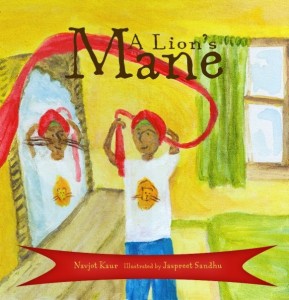
This is why we are so excited to bring you news about a new children’s book that promises to be “a staple on the shelves of young visionaries.” A Lion’s Mane, being released this month, is written by Navjot Kaur and illustrated by Jaspreet Sandhu. The book is published by Saffron Press, an independent publisher, aiming to encourage children to deepen their understanding of positive self-identity.
In this beautifully illustrated story, young readers journey to cultures around the world to explore the meaning of the dastaar, or turban of the Sikhs. Allusive words placed within a vibrant red dastaar help promote our connections as global citizens and encourage dialogue around issues of identity and kinship. [link]
This book certainly moves beyond the traditional in several ways. A Lion’s Mane brings a global perspective to the often misidentified image of the Sikh turban. It is printed on 100% recycled paper as well as displaying an Eco-Libris badge – 625 trees were planted for the first edition! In addition, a portion of proceeds from the sale of each book will support Seva Canada’s work to restore sight and prevent blindness in children. By shopping at Saffron Press, you really will be contributing to a green and ethical experience! We spoke with the author, Navjot Kaur, about the book and the challenges she underwent to have this story published. After the jump is the book trailer and the author’s first interview. As you view the information, consider this – how important is diverse and multicultural literature on the shelves of every library and school? Did you or do your children have access to this type of literature?
Mark your calendars- the Kaur Foundation and the Asian Division of the Library of Congress have 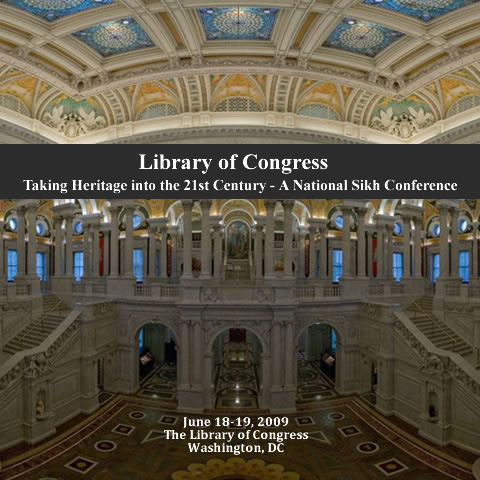 teamed up to undertake a unique initiative, to institutionalize knowledge by and about the Sikh community for future generations. The Library of Congress is the oldest federal cultural institution in the US, the largest library in the world, and the research wing of Congress. (LOC). The Sikh Collection Initiative is an effort to ensure that knowledge of and by Sikhs is collected and preserved for future generations. Given the tragic loss of valuable cultural and religious artifacts, manuscripts, and books from the Sikh Reference Library in the Darbar Sahib complex during Operation Bluestar, an initiative such as this begins to ensure that collective knowledge of our community will be preserved somewhere.
As our nation grows and becomes more diverse, it is critical that we appreciate and understand the different backgrounds of all that make this country great. Sikh Americans have significantly contributed to every field of human endeavor from technology, commerce, health, science, agriculture, to the arts – further enriching the cultural fabric of this land of immigrants.
This week, Peter Bance published “Sovereign, Squire and Rebel: Maharajah Duleep Singh and the Heirs of a Lost Kingdom.” It includes some little known and interesting information on Rani Jindan- the youngest of Maharaja 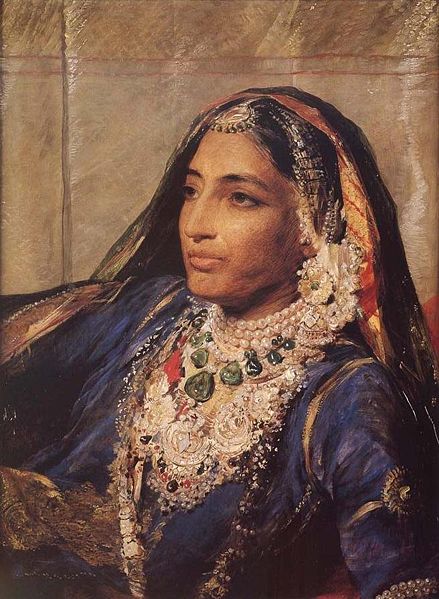 Ranjit Singh’s wives. While the tale of her son, Duleep Singh, has been well documented, less has been known about Rani Jindan.
While researching a tome on the Duleep Singh family, which lived in exile on a sprawling country estate near Thetford, Norfolk, Mr Bance stumbled upon the gravestone of Jind Kaur in the catacombs of the Kensal Green Dissenters’ Chapel. Historians had assumed that the Maharani’s cremation occurred in India but here was a simple white marble tombstone in London with her name on it. [link]
So who was Rani Jind Kaur? Some things were previously known- that after the death of her husband, she became the Regent (acting head of state because the ruler is a minor) for her son, Duleep Singh.
To say that Jind Kaur was a thorn in the side of the East India Company would be an understatement. She was born into humble origins, the daughter of the Royal Kennel Keeper at the Sikh court in Lahore, but she was ravishingly beautiful and soon caught the attention of the Punjab’s greatest ruler, the one-eyed Ranjit Singh.
Having kept the British at bay for decades, Ranjit’s empire began to crumble with his death in 1839. Following a series of bloody succession battles, Jind emerged as regent for Duleep who was less than a year old when his father died. [link]
Rani Jindan was instrumental in organizing Sikh resistance to the British in the First and Second Anglo-Sikh wars.
 Last year we discussed Satnam Sanghera’s memoir, If You Don’t Know Me By Now: A Memoir of Love, Secrets and Lies in Wolverhamptom, and dialogued around the issue of mental health in the Punjabi Sikh community. The memoir was recently awarded the Mind Book of the Year Award for its literary contributions to raising awareness around issues of mental distress. The Boy with the Topknot, as it is now known, was picked from 110 entries by Mind, a non-profit organization in the UK committed to creating a “better life for everyone with experience of mental distress”.
On winning the award last night, Sathnam Sanghera said:”It was such a strong shortlist, and this award is judged by some of the greatest authors in the UK, so this is a real privilege. There are hardly any books about Asian communities’ experiences of mental health problems, so I hope people read this book and it leads to more understanding.” [link]
I would highly recommend this book as I found the story to be sincere and enlightening. However, I would add that while it is important to provide this type of insight to the English-speaking literary community, it is just as (or perhaps even more so) important to ensure this type of literature is accessible to the Punjabi-speaking community. Perhaps we can strive to have these types of memoirs translated into Punjabi or made available via audiorecordings?
He locked the washroom door, unravelled the nine-metre turban, took a pair of scissors and started cutting. Ten minutes later, three feet of hair lay in a pile and Charanbir Singh sat down and cried.
Outside, his parents and grandmother were in tears. Two friends persuaded him to come out, but Charanbir, his head wrapped in a towel, rushed to his room.
That was a year ago. Charanbir, now 17, still shudders at the memory. “I had to cut my hair.” (Link)
One of ironies of life in the 21st century western world is that despite an unparalleled degree of freedom of religion, the majority of people seem to be opting for freedom from religion.
Last week, Raveena Aulakh, a reporter from the Toronto Star, put a Canadian twist on the worldwide issue of apostasy amongst Sikh Youth.
Sikhism dates back to 15th-century India. Adherents are required to not cut their hair, considered a visible testament to their connection with their creator. The turban was adopted to manage long hair and make Sikhs easily identifiable.
For many young men in Greater Toronto, that is the problem: They don’t want to stand out.
Like other new or second-generation immigrants, many Sikh youngsters are desperate to fit in with the school crowd, while others complain of racism because they wear the turban. Add to that cultural influences, peer pressure and the desire to assimilate.
The end result? Many youngsters cut their hair, leading to family friction and, in some cases, lasting estrangement.
As a counterpoint, in the article and video above, Pardeep Singh Nagra (of boxing fame) presents his thoughts on why he’s decided to keep his hair.
Fear & Guilt
I’ve often wondered why so many Sikh youth keep their hair through high school but cut it as soon as they feel free from their parent’s control? From my perspective I see this as symptomatic of a great challenge facing Sikhs around the world today. Somehow, someway, we have fallen into the trap of pushing Sikhi to the next generation with fear and guilt, rather than sharing Sikhi through love.
Take your typical Sikh family; actually take mine. My now 25 year old cousin in Punjab had wanted to cut his hair since he was a teenager but two things stopped him. He was afraid that if he cut his hair his dad would beat him and then disown him. Secondly, he knew that if he did get a haircut and shave he wouldn’t be able to look his crying mom in the eye.
Unfortunately, there was little positive reinforcement around Sikhi in his life. Sure there was Sikhi by osmosis: visiting Gurdwaras, gurbani playing in the background, the odd sakhi told by our visiting grandfather. However, my cousin had little exposure to the aspects of Sikhi (nitnem, kirtan, seva, simran) that would have connected him with his faith on a deeper level. Most of the discussions with his parents were a flavour of the famous Goodness Gracious Me clip. So not surprisingly, upon entering college, he too cut his hair. And sure enough, he became our family’s black sheep, making a kid with already low self-esteem, feel even worse.
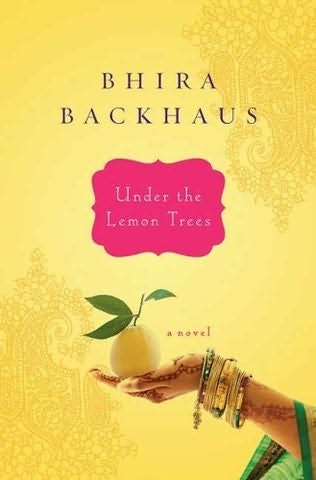
“A young woman scarcely had time to weave the fragile fabric of her dreams in our town.”
This is one of the opening lines of Bhira Backhaus’ debut novel, Under the Lemon Trees. The novel – published this month – is set in a small town in Northern California, and tells the story of two generations of a Sikh family facing difficult decisions about love, cultural traditions, and familial ties. The story focuses upon the life of 15-year-old Jeeto who stuggles between embracing her heritage and fitting in as an American and journeys through her reconciliation of the possibilities of freedom and love (I’m sure many of us can relate to one or all of these!). The publisher describes the novel as part Bend it Like Beckham, part Monsoon Wedding.
The book is based on the author’s own experiences growing up in a small-town Sikh community in California’s Sacramento Valley.
“It’s a story that I’ve [always] known I wanted to tell,” she said.
Dealing with cultural disconnect is one of the story’s driving forces, Backhaus said, but many of the novel’s themes, such as the search for love, identity and dignity, are cultural universals she hopes appeal to people of all backgrounds. Although she said she hopes “Under the Lemon Trees” will have similar success to the string of popular tales of the Indian experience, such as “Slumdog Millionaire” and the novels of Jhumpa Lahiri, Backhaus said her work is different. “Under the Lemon Trees” tells the story of Sikh Indians immigrating to California from lower-class villages in India, she said – a story that has not been told by other successful media depictions of Indian life. [link]
I’d be interested in doing a full review of this novel once I’ve finished reading it. In the meantime, here’s an excerpt from the first chapter.
I was excited to come across information about the Jaipur Literature Festival which will be held January 21st through the 25th in Rajasthan (mainly excited because it will coincide with a trip I’m planning to take to the area!). The festival is directed by author and historian, William Dalrymple.
Entering its fourth year, the festival will be hosting some of the best-known national and international writers including Vikram Seth, Michael Ondaatje, Pico Iyer, Simon Schama, Colin Thubron, Patrick French, Tariq Ali, Tina Brown, Mohammed Hanif, Rajiv Chandrasekaran, Coleman Barks, Pankaj Mishra, Chetan Bhagat, Ahmed Rashid, Charles Nicholl, Hari Kunzru, Michael Wood, Nandan Nilkeni, Paul Zacharia, Prasoon Joshi, Shashi Tharoor, Sunil Gangopadhyay, Tarun Tejpal, Wendy Doniger, U R Ananthamurthy, among many others.
While perusing through their list of authors, I was surprised by the small number of Sikh writers who will be in attendance leading me to ask which (if any) other Sikh authors were invited and whether Sikh authors were, in general, being recognized for their work. While we attempt to address these questions, I wanted to use this space to highlight a couple of Sikh authors who did show up on the list.
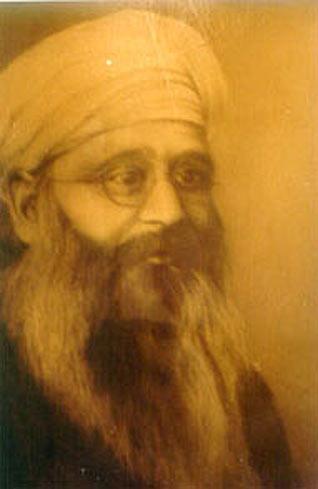 The digitization of books has created a whole new way for Sikhs to access their history. I’ve stumbled onto a lot of historical Sikh literature that I had never heard of. For example, through Google’s Book Search function, I discovered a tourist guide to Punjab from the 1880’s (here’s an excerpt on visiting Amritsar).
Over the holidays, I found a scanned version of a first edition of The Life and Teachings of Sri Guru Tegh Bahadur. It was written by Puran Singh and published by The Khalsa Agency in Amritsar in 1908. Puran Singh has a way with words like no other Sikh author I’ve ever encountered. His books The Spirit Born People and The Ten Masters are essential readings for anyone interested in Sikhi. In his book on Guru Tegh Bahadur he writes:
He looks upon the world with that far-seeing vacant eye with which a mariner, having lost his boat, looks upon the broad sea, seated on a rock in the middle dashed by the waves of the angry sea. The world to him is lost in the constant vision of the higher Reality of its soul. There is an intense spirit beating within his heart, which weeps ard cries at the sight of a man who is lost in the tempest of passions and remembers not the glorious life of his beyond this little life and the glorious inheritence of his in ideals of God, Love, and Truth.
He is a high abstraction in the love of God, and whenever a single thought of the world lowers his consciousness from those ethereal heights, he at once sings of God-consciousness and soars again.”Remember thy God, remember thy Lord, this is thy one duty, thy only duty,” says he.
However, what I really want to share is his opening introduction. The words are 100 years old, but just as or probably more relevant today.
A fellow blogger (thanks Jodha) sent me a link to an incredible new animated movie to be released across North America in May 2008. Sundri the movie, based on Bhai Vir Singh Ji’s masterpiece (and yes, my namesake), is the third animated Sikh movie released by Vismaad. Many of you may have seen the notable work they did with Sahibzadey and Rise of Khalsa. This movie looks similarly impressive:
The film salutes Sikh women and presents a piece of history which celebrates equality and respect. From the site,
Singhs ought to respect Kaurs.
Kaurs ought to live as true daughters of Guru Gobind Singh ji.“Gender equality” may become a genuine practice than a mere rhetoric.

