
Working for Langar Justice
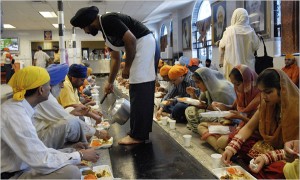
I love food. I love to cook. I love to gather with friends, community, and sangat and share a meal together.
Because food it our most primal need and our common bond to the earth and one another, it can ground us as we stretch ourselves to draw in all the interlaced threads—so we can weave a whole, meaningful picture for ourselves. I still believe food has this unique power. With food as our starting point, we can choose to meet people and to encounter events so powerful that they jar us out of our ordinary way of seeing the world, and open us to new, uplifting, and empowering possibilities. – Frances Moore Lappe and Anna Lappe, from Hopes Edge: The Next Diet for a Small Planet
The Sikh institution of langar has always been something near and dear to me, partially because of my borderline obsession with food, but also because it really gets to the heart of Sikhi. The practice of langar, our free community kitchen, was started some 500 years ago by Guru Nanak to meet a basic human need – eating – and to create a space for community-building that reflected the Guru’s radical vision of equality. Rules about food preparation and eating were (and still are) one of the central ways that caste oppression was enforced. Langar turned this all on its head. With everyone sitting together on the same level (on the floor) and eating the same simple food, which was prepared by people from all caste backgrounds, langar was nothing short of a revolutionary accomplishment.
It is with this lens that I want to discuss the food of langar itself.
When I sit down in the langar hall to eat in that very sacred space, I rarely consider where the food is actually coming from. Yes, we very well know the labor of the sevadars who prepare and distribute the food with love and with the spirit of the Guru. But what about the ingredients? What do we know about the farmers who grew and harvested the aloo, gobi, and mattar, and if they were being paid a decent wage and treated with respect? What do we know about the living conditions of the cows from whom the milk and butter originated? And what about the handful of multinational corporations that control the majority of the world’s food supply and bring home billions in profits?
There is nothing sacred nor revolutionary about harmful pesticides (that affect farm workers, the earth, and those of us who ingest them), the exploitation of migrant farm workers, the horrendous and unnatural confinement of animals on factory farms, and the carbon footprint of having our vegetables shipped from thousands of miles away.
I am well aware of the barriers to accessible, affordable organic, locally-sourced food in many of our communities, especially working class communities. But creative solutions do exist, from CSAs (community supported agriculture) to community gardens (imagine if large Sikh neighborhoods had their own community-run gardens!), farmers markets to food co-ops.
Isn’t it time we ask ourselves, as Sikhs who are so proud of our institution of langar and who love our Punjabi food: What are we doing to promote food justice, or more specifically, langar justice?
If langar is an institution that is, at its core, about equality and justice, is it unreasonable to expect ethical and just food sources for this sacred meal we share together as a sangat?
Has anyone ever come across a gurdwara that makes conscious choices about where its food comes from? Any organic langar halls out there? Locavore langars?
I know we’re a long way away from this in most of our gurdwaras and communities (where styrofoam use is the unquestioned status quo!). But if Guru Nanak and his followers succeeded in creating the institution of langar in the face of one of the most ancient forms of oppression (caste) hundreds of years ago, it must be possible for us to transform the way we do langar in gurdwaras today to better reflect the values of Sikhi.
And what better place to start the discussion than here at The Langar Hall!



10 Responses to “Working for Langar Justice”


Excellent post, Brooklynvala. Being an avid foodie myself, I do find it strange that we have reached a point where we question the sugar and oil levels of langar food, inspiring some Gurdwaras to go as far as to have a no-ghee policy, and yet haven't thought about the enviornmental impact of Guru Ka Langar. I would also take what you've said and give another example of the environmental concern: the use of non-biodegradable cups, plates, and silverware. Is it really that much more expensive?
Thank you for bringing Guru Nanak's vision of langar to our current context. You provide a beautiful vision for food justice in langar, one that I think is quite tangible. I especially love the idea of developing community gardens/farms to supply food for Langar!
@Navdeep Singh, I was pleased to discover that gurdwaras are implementing no-ghee policies. Would you kindly share which Gurdwaras are doing this? Love the concept.
[…] post is an edited version of a piece I wrote entitled “Working for Langar Justice” for a progressive Sikh blog called The Langar Hall. I’m excited to share it here at […]
Have you any idea how the particular hobby damage rules apply to your residence business? There are numerous aspects with the income duty law which can be important to get a home enterprise, but an section of the law which is often overlooked will be the hobby damage rules.financeroom.net
Your organization name will assist you to segment you from the competitors and also reinforce what your business image will be. Think concerning your brand name positioning and also what your profession is and work towards picking a business identify.finance-services.biz
Are you currently thinking about learning to be a home company owner? Creating your own personal business is a wonderful way to make a living while getting independent and also spending more hours with your household.deltafinance.biz
While there are numerous fitness suggestions, exercises, and programs it could be confusing about what works best to suit your needs. It can be so confusing you obtain frustrated and present up. The thought of fitness combination eliminates virtually any frustrations you could have before an individual start any exercise routine.visualfusion.biz
In accordance with a advertising and marketing survey, the necessity and business of taxi cab services presents risen for some gargantuan smt, currently ‘at ever sold high’. The complete revenue from your industry presents reached so that you can $644m, alone in america.houmatravel.biz
With all the growth regarding big package stores and also online purchasing, it can easily seem in which smaller, local businesses are fighting a great uphill struggle. However, in reality there are numerous things neighborhood retailers offer the larger businesses cannot.
Just about the most important market sectors in Of india, which is making several headlines, could be the Indian handicraft market. For decades it's got remained one of many instrumental market sectors in India if you are one of many largest makers of job.